

You are a CEO who is spending more on tech and getting less back.
Margins are tight, IT and cybersecurity bills keep rising, and every board packet adds a new set of questions you cannot answer in one clear slide. Projects start with big energy, stall in the middle, then quietly roll into “phase two” that never ends.
Your IT spending likely accounts for between 5 and 7.5% of revenue already. That spend can be a drag on profit, or it can be the IT budget as growth engine that funds your next stage. The difference is how you manage it, not how much you spend.
CTO Input exists to sit on your side of the table as a neutral senior technology guide. No tools to sell, no hidden agenda, just a clear technology strategy to turn what feels like a cost sink into a strategic investment, a portfolio of technology investments you can explain to your board and your team. This article gives you that path and concrete moves you can start this quarter.
Why Your IT Budget Feels Like A Cost Sink Instead Of A Growth Engine
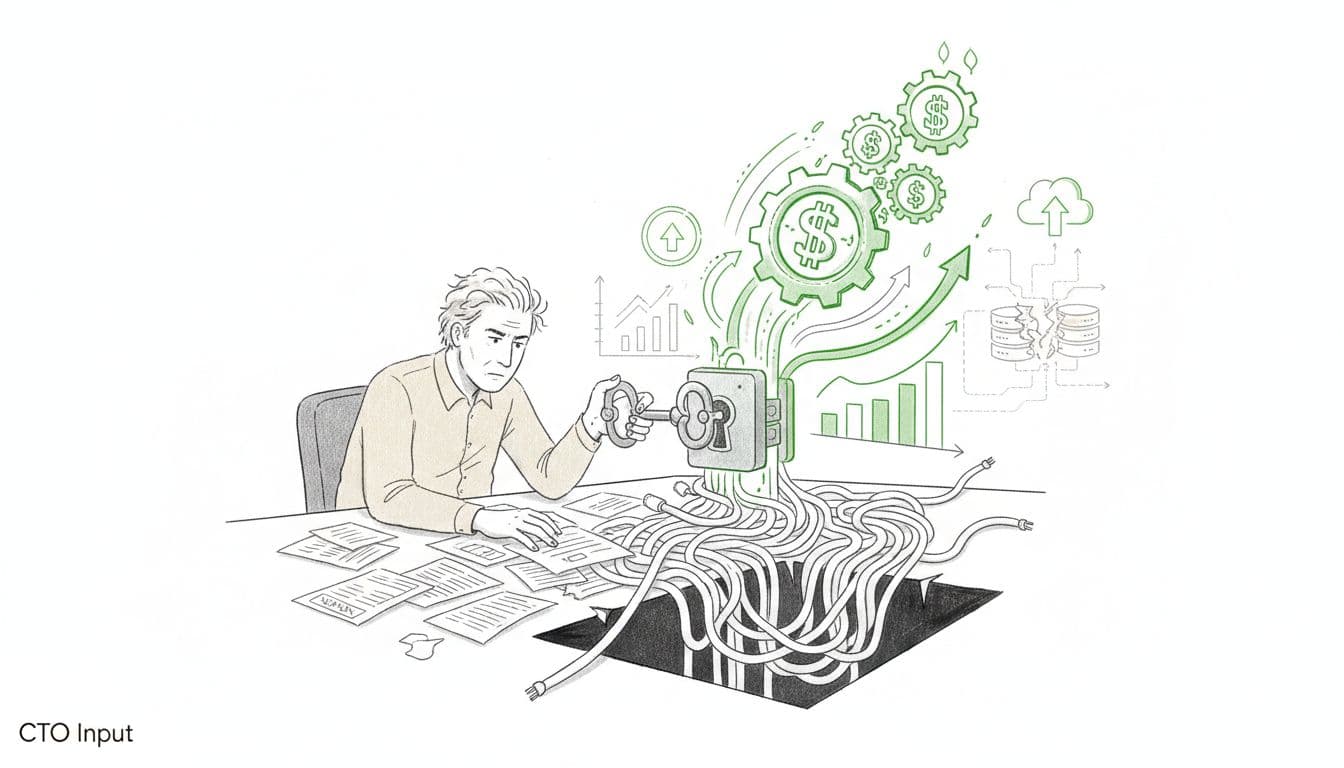 You are not imagining it. IT does feel expensive and hard to control right now.
Most mid market firms treat technology as a cost center. The budget shows up as a long list of licenses, vendors, support contracts, and project lines that only a few people understand. It all sits in one big “IT” bucket that you approve each year with a mix of trust and unease.
The real pain is not the spreadsheet. It is the friction that budget hides:
- Sales waiting days for reports.
- Finance keying the same data into three systems.
- Operations juggling outages, manual workarounds, and customer experience (CX) issues.
You feel the drag in slow decisions, repeated errors, and teams that are busy but not moving the company forward.
IT looks like “overhead” because the work is not linked, in plain language, to growth, risk, and cash. That is a leadership problem, not a moral failing. The good news is you can change it without becoming a technologist.
The Mid Market Reality: Rising IT Spend, Flat Business Impact
Across 2025, IT spend is climbing. Research shows mid market IT budgets rising about 4.6% year over year, with global IT spending up close to 9%. More than half of that spend is tied to public cloud infrastructure, and a growing share goes into Artificial Intelligence (AI) and security as part of digital transformation efforts.
On paper, that looks like progress. Cloud, AI, security. These words sound like the future.
In practice, many firms are paying more and getting about the same business impact. The issue is not the tools. It is the lack of a clear line between each dollar and a result the business can feel.
A large share of your current spend is locked into “keep the lights on” maintenance work:
- Legacy infrastructure that cannot be turned off without risk.
- Vendor contracts that renew by default.
- Patchwork integrations that sort of work, as long as your best people babysit them.
By the time you fund all that, little is left for real growth bets. The result is rising IT spend, flat margins, and a board that starts to ask sharper questions.
If you want a sense of where mid market IT planning is heading, resources like this mid-market IT strategic planning playbook show how many peers are trying to link roadmaps to business outcomes. The gap is not ideas. It is execution at the leadership level.
Three Common Patterns That Turn IT Into A Drag On Growth
Most mid market companies fall into the same three traps.
1. Reactive projects driven by crises or vendor pitches
Something breaks, a regulator asks a hard question, or a vendor shows you a glossy deck on Artificial Intelligence (AI). A project spins up fast, with weak ties to strategy. Twelve months later, you have a finished project that solved last year’s issue but did not move revenue or margin this year.
2. Systems that do not talk to each other
Your CRM software, ERP, billing, and support tools all store similar data, but they do not share it cleanly. People export, merge, and re-enter the same information across systems. This burns hours, slows decisions, and hides what is really happening with customers.
3. Cyber and compliance spend driven by fear
You invest in cybersecurity tools and audits because “we cannot afford a breach,” but nobody has put a clear risk tolerance and business case on the table. The board hears scary headlines, the IT team asks for tools, and you approve line items that you cannot tie to avoided loss or trust gained.
Each pattern hurts revenue, margins, and trust. Not just IT efficiency.
The way out is to stop treating the IT budget as a single bill and start treating it as a portfolio of growth bets, each with a job to do.
How To Turn Your IT Budget Into A Portfolio Of Growth Bets
This shift does not require deep technical skills. It does require different questions.
You are going to sort your spend into a few simple buckets, rebalance the mix, run smaller and faster experiments, and make the return from IT as visible as sales and operations. That is how you turn the IT budget as growth engine from slogan into practice.
Step 1: Tie Every IT Dollar To A Clear Business Outcome
Start with a whiteboard, not a tool.
Take your current and planned spend and sort it into three plain buckets:
- Protect (security, AI governance, compliance, resilience)
- Run (operations, support, core systems)
- Grow (projects that increase revenue, speed, or customer experience)
For each item, ask two questions:
- What business goal does it support?
- How will we measure it in dollars or time?
Keep the answers simple and tied to business outcomes.
- A CRM upgrade should tie to higher close rates or larger deal size, not “better reporting.”
- Process automation should tie to fewer full time hours for a task, or faster cycle time on orders, boosting operational efficiency.
- A security upgrade should tie to reduced breach likelihood, lower incident response cost, or better board and insurer confidence.
If an item cannot be tied to a clear outcome, pause it, resize it, or demand a better case. This single discipline changes the conversation from “IT wants” to “the business gets.”
For budget planning ideas that mirror this kind of structure, you can compare your approach with this IT budget planning guide for businesses, while keeping your focus on outcomes, not only categories.
Step 2: Rebalance The Portfolio Toward Growth Without Ignoring Risk
Once you have your protect, run, and grow buckets, look at the mix.
A simple target range that works for many mid market firms:
- Protect: 30 to 40%
- Run: 35 to 45%
- Grow: 20 to 30%
Your exact numbers will depend on your industry and risk tolerance, but the pattern is common. The run bucket is often bloated. Legacy systems, maintenance, overlapping tools, and “we have always had this” contracts crowd out growth.
The goal is not to starve protect or run. It is to trim waste through cost optimization and redirect that money into growth bets as part of your technology strategy and modernization efforts.
Practical moves you can push in the next 90 days:
- Consolidate licenses across business units that use similar tools.
- Retire unused features or entire apps that no one can justify.
- Move low value or seasonal workloads to cloud services and reliable cloud infrastructure where you pay for what you use, achieving scalability.
- Clean up vendor sprawl so you have fewer, better partners.
Then, create a small growth reserve inside your budget. Even 5% earmarked for AI, automation, and customer facing experiments changes the tone of every planning call. IT stops being a pure cost center and becomes a funder of controlled bets.
Step 3: Fund Small, Fast Experiments Instead Of Big Bang Projects
Big bang projects consume budget and leadership attention. They often ship late and underwhelm.
Instead, treat new technology work like a series of capped experiments.
A simple pattern:
- 90 day cycles
- A small, cross functional team
- One or two metrics that define success in business terms
You are not betting the company. You are buying options.
Concrete experiment ideas that fit most mid market firms:
- Invoice automation: Use a small tool or workflow to cut manual invoice processing time in half. Measure hours saved and days faster to cash.
- Artificial Intelligence (AI) assisted support: Add AI suggestions to your customer service team so they respond faster and with more consistency. Measure handle time and customer satisfaction.
- Basic customer portal: Give key accounts a simple portal to track orders, upload documents, or view invoices. Measure call volume, NPS, and improvements in customer experience (CX).
If the experiment works, you scale it in the next 90 day cycle. If it fails, you stop without blowing the budget. Over a year, this turns a static budget into a living portfolio of growth bets.
Resources on optimizing tech budgets with Artificial Intelligence (AI) can give your team extra ideas for where to run these pilots.
Step 4: Make ROI From IT Visible In The Same Way As Sales And Operations
An IT budget becomes a growth engine when its results are visible and trusted.
Ask your IT lead or a fractional CTO to build a simple scorecard powered by data analytics that you and the board can read in five minutes. No jargon. Three to five measures, tracked over time:
- Dollars saved
- Hours saved
- Revenue influenced
- Risk reduced
For each protect, run, and grow item, add a small note: what we expected, what we got, what we learned.
Then, talk about IT at the leadership table in the same way you talk about sales and operations. Not “tickets closed” and “uptime,” but customer impact, cost, and risk.
This visibility does three things:
- Builds trust between IT and the rest of the business.
- Makes it easier to fund the next round of growth bets.
- Reduces the defensive, fear based posture around cyber and compliance, delivering competitive advantage.
A neutral advisor, such as CTO Input, can often turn your current tangle of metrics into a simple story your board will actually read.
What Success Looks Like When IT Becomes A True Growth Engine
Success does not look like a shiny new system. It looks like calm.
Effective IT services make your financials cleaner. You can point to a short list of technology investments and say, in dollars and days, what each one has delivered. Audit and board questions still come, but you answer them with clear facts, not vague comfort.
Projects finish closer to plan. Your team spends less time fighting fires, with positive impacts on workforce development, and more time improving customer experience, refining the product, and supporting business growth.
Cleaner Numbers, Fewer Surprises, And Faster Execution
Picture a mid market company at 80 million in revenue.
Two years ago, IT spend sat near 6% of revenue, most of it in “run” with constant complaints about outages and slow reporting. The CEO could not explain the value of that spend, only that it seemed to rise every year.
They sorted the budget into protect, run, and grow. A handful of licenses and duplicate tools came off the books. A growth reserve funded a series of 90 day experiments in automation and client experience.
Within a year:
- Finance improved operational efficiency by closing the books three days faster.
- Manual order entry volume dropped by 40%.
- A simple customer portal enhanced customer experience (CX) and shaved support call volume by 15%.
Spend stayed around 6%, but the mix shifted and the story changed. The board no longer saw IT as a drag, but as a pool of controlled bets that paid off. That shift often happens faster when a seasoned, neutral advisor helps you design the portfolio and keep it honest.
Conclusion: Your Next Move To Turn IT Into A Growth Engine
Your IT budget is already large enough to matter. The question is whether it stays a cost sink or becomes a growth engine you can explain in a single page.
The path is clear. Use zero-based budgeting to tie every dollar to a business outcome. Rebalance spend toward growth while strengthening cybersecurity. Fund small, fast experiments instead of giant projects. Make ROI from IT as visible and simple as your sales and operations metrics.
You do not need to be a technologist to lead this digital transformation. You do need someone senior and neutral at your side who can turn complexity into a technology strategy and options into a roadmap.
If you want that kind of partner, visit https://www.ctoinput.com to see how fractional CTO, CIO, or CISO support can help you drive business growth. Then explore more practical articles and guidance on the CTO Input blog at https://blog.ctoinput.com, including on Artificial Intelligence (AI), so you can keep turning technology from a source of anxiety into a steady driver of growth.