
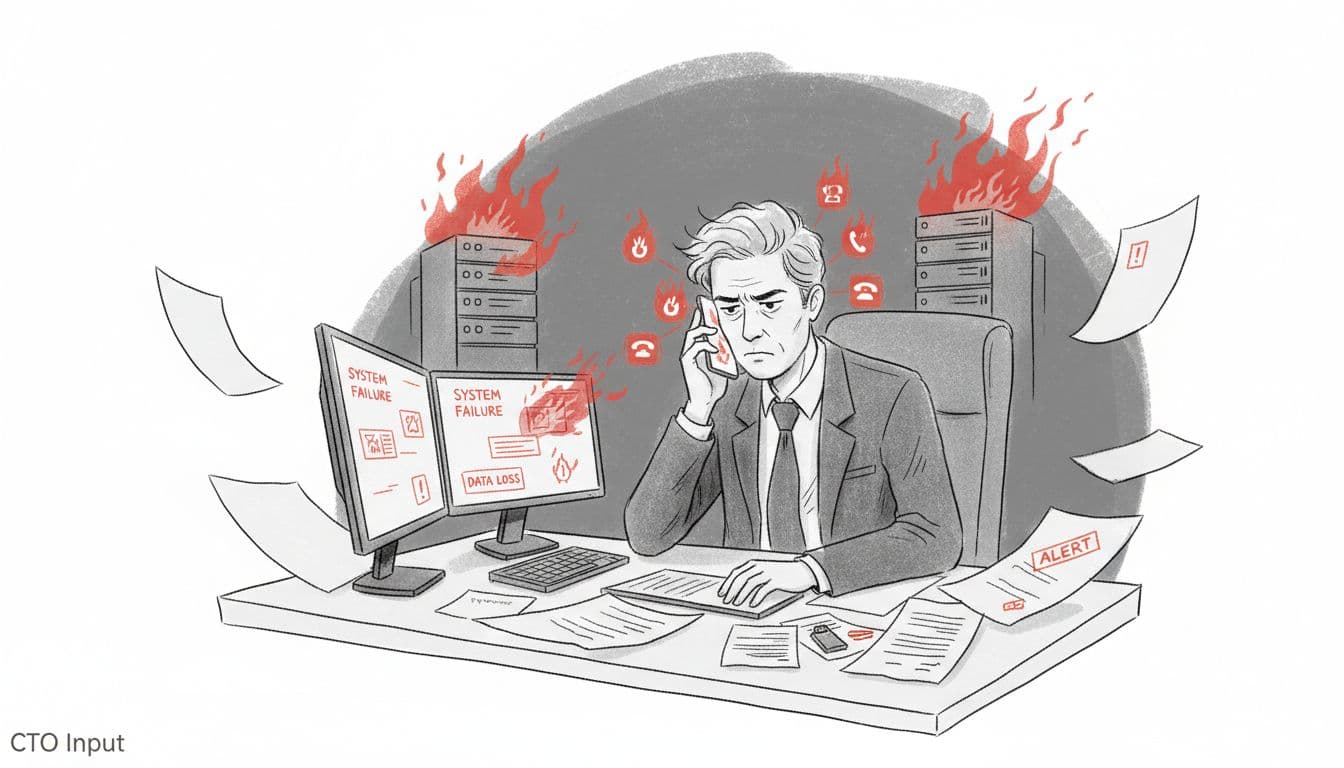
You are a CEO, COO, or founder who is tired of late-night outage calls. Tired of projects slipping, vendors steering the agenda, and board questions about risk that you cannot answer cleanly.
You spend more on technology every year, but your world feels more fragile, not less. Revenue is exposed. Customer trust feels brittle. Your own leaders are pulled into Slack threads and incident bridges instead of growing the business.
This is a simple, practical stop IT firefighting guide written for business leaders, not technologists. You will see why you are stuck in constant IT emergencies, how to map the real problems, how to fix the root causes, and how to build a calm, predictable operating rhythm.
CTO Input acts as a seasoned, neutral guide for mid-market companies, turning unstable IT into a stable platform for growth. The path is clear: map incidents, fix roots, then build a steady drumbeat that keeps systems, cost, and risk under control.
From Constant IT Firefighting to Calm: What Is Really Going Wrong
If you feel like every week brings a new “critical” incident, you are not alone. Many mid-market companies live in a cycle where IT is always fixing the latest problem, but nothing really changes.
On the surface, it looks like a technical issue, but the symptoms are easy to see in the business, including constant emergency response draining resources:
- Revenue hits from outages at the wrong moment
- Leaders pulled into status calls instead of customer meetings, hurting decision making
- Board and lenders asking about cyber risk and resilience, and getting vague answers due to a lack of clear communication
This is what firefighting mode looks like in real life. There is constant motion, but very little progress. A useful comparison is the way operations teams describe chronic firefighting in plants or warehouses. Resources like From chaos to control: Six steps to get out of firefighting mode show the same pattern in maintenance and operations: too much reaction, not enough planning.
When IT runs this way, every incident carries hidden costs. You feel it in missed launches, late integrations, and customers who quietly churn because the experience is shaky. You also feel it in your own attention span. The company spends more time working around systems than using them to win.
If you searched “how to get out of constant IT emergencies” or “stop IT firefighting guide,” you are really asking a different question:
“How do I turn technology from a source of anxiety into a calm, stable engine for growth?”
That starts by seeing the full cost of crisis mode, then understanding why problems keep coming back even when your people care and work hard.
The Hidden Cost of Living in IT Crisis Management
Crisis management is expensive, even when the incident looks small.
A payment outage during your busiest hour might only last 20 minutes. On paper, that is a short incident. In practice, it hits revenue, spikes call volume, and throws your finance and customer teams off for days. Your team often dives into search and rescue efforts for these complex incidents.
The same pattern shows up everywhere:
- Leadership time is spent on incident updates, not strategy
- IT and vendor costs rise, but actual reliability does not
- Your best technical people burn out and leave
- “Transformation” projects stall because the team is always on alert
One common story: a major deployment fails the night before a key board meeting. Numbers are wrong in reports, customer data looks off, and your team scrambles to fix it by sunrise. The board does not see the heroics. They only see risk.
Articles on operational focus like Stop Firefighting: A 3-Step Guide for SMB Strategic Focus point to the same truth. If you stay in constant reaction mode, you pay for it in missed growth, staff churn, and weaker results every quarter.
Without a change, every new project you approve sits on a shaky base. You carry more avoidable risk into each quarter than you realize.
Why Problems Keep Coming Back Even When Your Team Works Hard
In most mid-market firms, the IT team is not the problem. They are usually high-performance teams that are smart, committed, and tired.
The real issue is the system around them, stuck in defensive fire attack and offensive fire attack rather than proactive strategies.
Common patterns:
- No clear way to rank work, so urgent always beats important
- Weak or missing change control, so risky changes sneak into production
- Little time set aside for training and preparation to fix root causes, only symptoms; scenario-based training is often missing
- Key systems without clear owners
- Vendors pushing tools and features that do not match your real priorities
When there is no simple, agreed way to handle incidents and changes, the same outage repeats every quarter. One leader calls it “whack-a-mole as a service.” To break this, foster a future fit learning culture.
Operational experts writing on topics like how to shift from firefighting mode to proactive management describe the same trap in other functions. Too much urgent work, no space to fix the system, so the fires never stop.
Your job as CEO or COO is not to run the ticket queue. Your job is to change the conditions so that the queue itself gets smarter, calmer, and more predictable, building adaptive enterprises.
Signs Your Company Is Stuck in an IT Firefighting Loop
Here are clear signs that your company is caught in a firefighting loop:
- You hear about outages from customers, social media, or your own status page
- There is no single, simple view of major incidents and open risks
- The same integration, report, or batch job fails every quarter
- IT spends most of its week reacting, not improving systems
- Board questions on cyber risk or resilience get fuzzy or conflicting answers
If you read this list and see your own company in it, this guide is written for you.
You do not need to become a technologist. You need a clear plan that you can lead, in plain business terms.
A Simple Stop IT Firefighting Guide: Three Moves to Build Stable Operations
You can move from chaos to calm with three leadership moves:
- Map your incidents and make the work visible
- Fix root causes with a light, clear change and problem process
- Build a calm IT operating rhythm tied to your business plan
Each step is about decisions and habits, not tools.
Step 1: Map Your Incidents So You Can See the Real Problem
Set aside 60 to 90 minutes with your IT lead. No vendors, no distractions. The goal here is not to turn your IT lead into an incident commander, but rather to collaboratively map incidents.
Ask for a list of the last 3 to 6 months of major incidents and near misses. Keep it simple. A spreadsheet is fine.
For each incident, capture:
- What happened, in plain language
- Type (outage, security issue, bad deployment, vendor failure, data problem)
- Business impact (lost revenue, delayed orders, reputational risk, manual work)
- Duration and who got pulled in
Then, group them. You might see that:
- 70% of customer-facing pain comes from 2 core systems
- A single vendor or integration is behind many late-night calls
- A handful of recurring issues drive most of the noise
Think of this like a heat map. This lays the groundwork for root cause analysis. You are not trying to find someone to blame. You are trying to see where the fires actually start.
An external advisor like CTO Input can run this review as a neutral chair and help your team speak in simple, shared language. That often lowers the temperature and gets you to a clear picture faster.
Step 2: Fix Root Causes With a Lightweight Change and Problem Process
Once you see patterns, the next move is fire suppression against repeat offenders.
Root cause thinking sounds fancy, but it is simple. For each of your top recurring issues, ask:
- Why did this happen?
- What is the simplest change that would prevent it or provide exposure protection next time?
Then put a light change process around those fixes. For most mid-market firms, this can be as simple as:
- Log the change in one shared place
- Apply prioritization criteria by rating the risk (low, medium, high)
- Test on a small group or non-critical operational equipment
- Schedule the change for a safe time
- Have a clear backout plan
The goal is not bureaucracy. It is fewer surprises.
If you focus on your top 5 recurring issues, you often remove a large slice of pain and risk, bolstering the structural integrity of core systems. You also send a clear signal to your team. You care about fixing the system, not just firefighting faster.
Step 3: Build a Calm IT Operating Rhythm Linked to Your Business Plan
Now you need a steady rhythm for fire control that keeps things from drifting back into chaos.
You can keep it very simple:
- Weekly 20-minute check-in
- Review incidents from the week
- Confirm upcoming changes through clear delegation channels and who is impacted
- Call out any new risks in plain language
- Monthly 60-minute review
- Look at patterns in incidents
- Review top risks and key “technical debt” items in business terms
- Agree on 2 or 3 improvements through workload prioritization to tackle next month
- Quarterly leadership discussion
- Connect IT work to revenue, margin, and risk
- Review how platforms support the growth plan
- Align on where to invest and where to cut
Think of this like moving from ambulance runs to regular health checkups.
This rhythm lets you sleep better. It gives the board clearer answers. It frees your IT team to improve systems instead of living in permanent alert mode.
How CTO Input Helps You Move From Firefighting to Stable IT Operations
You do not need to build this alone, or hire a full-time CTO, CIO, or CISO to get there.
CTO Input provides fractional leadership that sits on your side of the table. The model gives you an experienced guide who understands incidents, risk, architecture, and vendors, and can turn that noise into a clear plan that matches your growth targets.
The three steps in this stop IT firefighting guide map cleanly to how CTO Input works: a short assessment to map incidents and risks, a focused roadmap to tackle root causes, and steady executive guidance that keeps technology in sync with cost, risk, and strategy.
The outcome is what you care about most: cleaner numbers, fewer surprises, smoother board sessions, and technology that feels like a lever, not a liability.
A Neutral Technology Leader on Your Side of the Table
CTO Input is not tied to one tool, vendor, or platform. The only agenda is your business.
Fractional technology executives leadership gives you:
- A single senior point of contact who can decode incidents and reports
- Clear priorities across vendors and internal teams
- Straight answers to board and lender questions about risk, stability, and AI use
You get the judgment of a seasoned technology leader, integrating seamlessly into your organizational structure without adding a full-time executive to payroll.
A Simple Path: Assessment, Roadmap, and Steady Guidance
The path mirrors the steps in this guide:
- Assessment
A short, focused risk assessment to map your recent incidents, current risks, and vendor landscape. - Roadmap
A tailored plan that targets root causes, tightens change control, and builds stable operations that match your growth and risk appetite. - Steady Guidance
Ongoing executive-level support so IT work stays tied to the business context of revenue, margin, and risk targets, not just the loudest request.
From there, you can start with a low-friction step, such as a 30-minute diagnostic call or reviewing related guides, and decide how far you want to take it.
Conclusion: You Do Not Have To Live In IT Firefighting Mode
You do not have to accept constant IT firefighting as the cost of growth.
With a clear map of incidents, a focus on root causes, and a simple operating rhythm, you can build a calm, predictable environment where systems stay up, projects move on time, and board conversations about risk feel steady. The next 30 days can include a few small moves that change your next 3 years.
Picture this: fewer late-night calls, cleaner dashboards at month-end, smoother board meetings focused on strategic decision making, technical staff advancing their career progression by improving systems, and technology that quietly supports growth instead of stealing focus. That is what a stable IT foundation delivers.
If you want an experienced partner to help you get there, visit the CTO Input site to learn how fractional CTO, CIO, and CISO leadership works at https://www.ctoinput.com, and explore more practical guides on the CTO Input blog at https://blog.ctoinput.com. You can start small, learn fast, and build the kind of stable operations your business deserves.