
Your pro bono program is a source of pride, a core part of your firm’s identity. But behind the scenes, you have a nagging feeling it’s not working as well as it should. It feels slow, clunky, and frankly, a bit chaotic. Cases get stuck in email chains, lawyers are frustrated by the manual scramble to find a match, and the people who need help the most are left waiting.
This isn’t a failure of passion. It’s a process problem. And it’s costing you more than you think.
The good news? This is a solvable problem. Using technology to match pro bono lawyers with clients faster isn’t about some massive, budget-breaking IT project. It’s about making a strategic shift from manual firefighting to an intelligent, automated system that gets the right help to the right people in hours, not weeks.
Why Your Pro Bono Program Feels Stuck in Second Gear
Imagine this scenario. A potential pro bono client reaches out with an urgent housing issue. The case details arrive as a PDF attachment in a partner’s inbox. That partner forwards it to the pro bono committee coordinator, who opens up a master Excel spreadsheet—the fragile, single source of truth for your entire program.
Now the scramble begins. The coordinator spends the next three days playing email tag, trying to find a real estate associate with availability. All the while, the client waits in a state of crisis, and a highly-paid associate is burning billable hours on administrative coordination.
If that feels uncomfortably familiar, you’re not alone. This manual, reactive process is the default for many firms. The intention is good, but the execution is broken. The result is a dangerous gap between your firm’s commitment to service and its ability to actually deliver it.
The Real Problem: Operational Drag is Killing Your Impact
The bottleneck in your pro bono program isn’t a lack of willing attorneys or deserving clients. It’s the administrative friction stuck in the middle. This operational drag creates predictable problems that directly impact your bottom line and your firm’s reputation.
- Delayed Justice: Clients with urgent needs are left in limbo while you sort out the paperwork.
- Misallocated Talent: Your best legal minds get bogged down in low-value coordination tasks instead of practicing law.
- Volunteer Burnout: Good lawyers get frustrated with the clunky process and stop raising their hands for new cases.
The hard truth is that your manual system is undermining your mission. Until you fix the process, your pro bono program will always be less impactful and more expensive than it needs to be.
This isn’t just about doing good more efficiently. It’s about risk. Relying on a patchwork of spreadsheets and email chains is a classic case of uncontrolled technology growth. It’s insecure, impossible to track accurately, and creates a system that’s completely dependent on one or two key people.
What if you could eliminate that risk and turn your pro bono program into a well-oiled machine? By using technology to match pro bono lawyers with clients faster, you can close the gap between good intentions and real-world impact, transforming the program from a source of frustration into a powerful asset for your firm.
The Hidden Costs of Manual Pro Bono Matching
As a leader, you know that the most dangerous costs are the ones that don’t show up on a P&L statement. Your manual pro bono process is likely a significant source of this hidden operational drag, quietly draining your firm’s most valuable resources: time and talent.
Think about it in stark business terms. When a senior associate spends three hours chasing down case details and coordinating schedules, that’s not pro bono work. That’s high-priced administrative overhead. You are paying a top-tier salary for an expert to perform work that simple automation could handle in seconds.
The True Cost is Wasted Hours and Reputational Risk
The friction from a manual system is more than an inconvenience; it’s a tangible cost that hurts your firm.
- Misallocated Payroll: Your best people are stuck in coordination, not consultation. It’s a staggering misuse of their specialized talent and your firm’s money.
- Glacial Response Times: A person facing a crisis can’t wait weeks for your firm to get organized. These delays directly harm the people you aim to serve and can tarnish your reputation for being effective.
- Fuzzy Reporting: Spreadsheets and email threads make it nearly impossible to accurately report your firm’s social impact to the board, clients, or regulators. This waters down your corporate social responsibility narrative and makes it hard to prove the program’s value.
This isn’t a hunch; it’s a clear trend. A recent Law Firm Pro Bono Challenge report, which tracked nearly 4.93 million hours of service, found that 67% of firms are now adopting technology to improve their pro bono work. The industry is moving on from spreadsheets.
Doing nothing is the most expensive option. Sticking with the status quo means you are actively choosing to let inefficiency, risk, and burnout remain a core part of your pro bono program.
The choice isn’t between your current manual process and some expensive new platform. It’s between accepting a slow, risky system versus investing in one that scales your impact, engages your talent, and solidifies your firm’s reputation.
By using technology to match pro bono lawyers with clients faster, you stop the bleeding of hidden costs. You cut operational waste, reduce compliance headaches, and build a program that top talent is genuinely proud to be a part of. You turn a “nice-to-have” initiative into a strategic asset.
A 3-Step Plan for Faster, Smarter Pro Bono Matching
Moving away from a manual process doesn’t require a massive, multi-year technology overhaul. It requires a simple, repeatable plan that connects the right case with the right lawyer in minutes, not weeks.
Think of it as building a simple engine with three core components. If one part is missing, the engine sputters. But when they work together, you create a smooth, efficient flow that moves clients from need to resolution with speed and precision.
The old way—the manual scramble—isn’t just slow; it’s costly. The administrative overhead, delayed responses, and reputational risk compound without a clear structure.
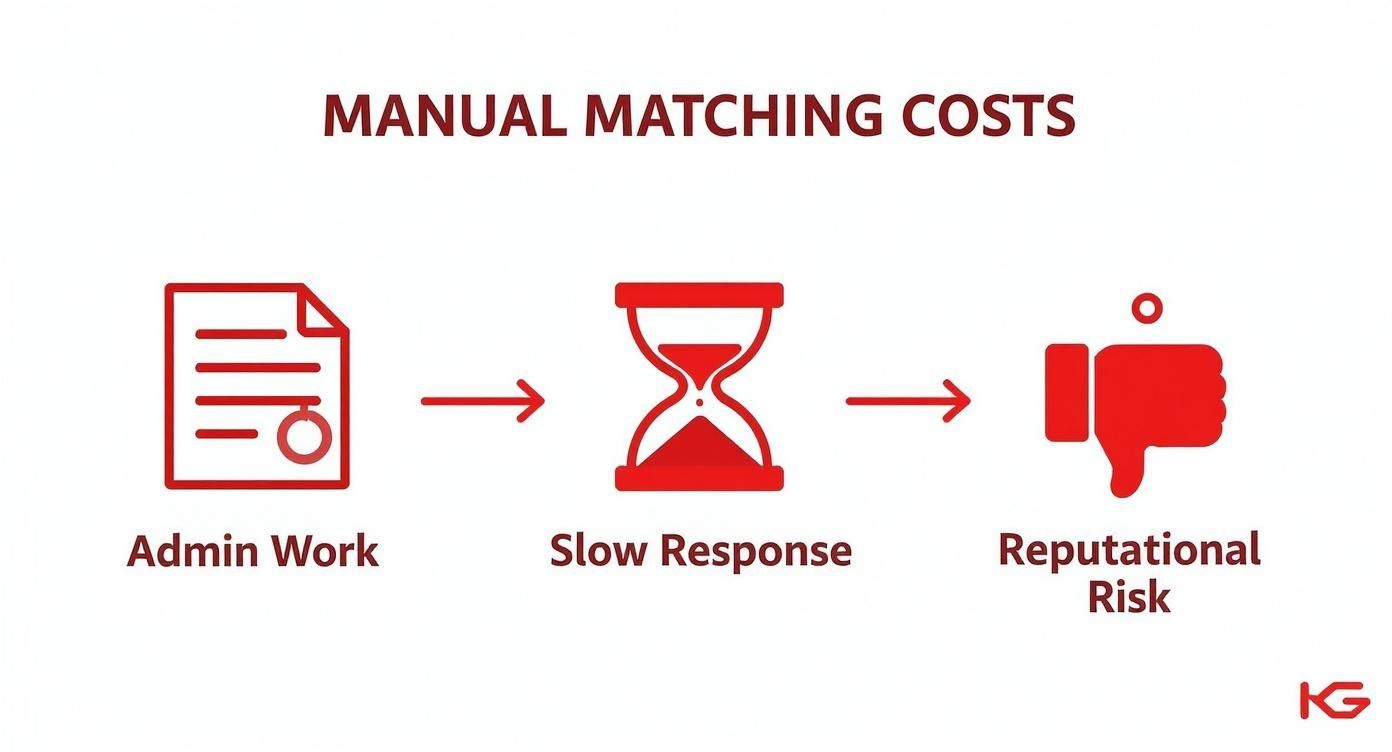
This inefficiency is a direct threat to your program’s success. Here’s a simple framework to fix it.
Step 1: Create an Intelligent Intake Funnel
Everything starts with how you capture information. A messy intake process guarantees a messy matching process. Intelligent intake isn’t about a 50-field form; it’s about asking the right questions upfront to eliminate the endless back-and-forth later.
A good intake process does the initial filtering for you:
- A Simple Online Form: A public-facing, mobile-friendly form that captures the core details: client info, a brief summary of the legal issue, and any key deadlines.
- Automated Triage: Based on keywords like “eviction” or “asylum,” the system can automatically categorize the case and notify the right internal coordinator.
- Eligibility Screening: Clear, simple questions confirm the client meets your program’s criteria, preventing your team from wasting time on out-of-scope requests.
This first step alone can cut administrative review time by more than half. By the time a human sees the case, the basic vetting is already done.
Step 2: Define Your Matching Logic
This is the core of the engine. Once a case is properly categorized, the system needs a set of rules to find the best-fit lawyer. This isn’t complex AI; it’s logic you define based on your firm’s priorities. It replaces guesswork with data-driven suggestions.
Your matching rules might include:
- Practice Area: The obvious one. A landlord-tenant dispute goes to a real estate attorney.
- Availability: The system knows which lawyers have capacity, either through a simple status they update or an integration with your case management system.
- Experience Level: A complex appeal needs a senior partner; a document review is perfect for a junior associate.
- Stated Interests: Letting lawyers flag areas they’re passionate about dramatically increases engagement and the quality of their work.
By defining these rules, you give your pro bono coordinator a highly qualified shortlist in an instant, dramatically increasing the speed and likelihood of acceptance.
Step 3: Integrate with Your Core Systems
The final, critical step is ensuring this new system doesn’t become another isolated data silo. To be effective, your matching engine must communicate with the tools your team already uses.
When a lawyer accepts a case, that assignment should automatically appear in your firm’s primary case management or time-tracking software. This eliminates duplicate data entry and provides a single, accurate view of all pro bono activities.
The impact of this approach is well-documented. In California, for example, the legal community saw a massive increase in pro bono service after implementing integrated digital platforms. Over 70% of new pro bono connections were made through these efficient channels, getting help to clients faster than ever. You can read the full report on California’s pro bono expansion to see the data for yourself.
By implementing this three-step plan, you create a powerful, scalable system for using technology to match pro bono lawyers with clients faster. It’s a clear framework you can hand to your team and say, “This is how we’re going to build it.”
The Build vs. Buy Decision: A Pragmatic Guide
You know you need a better system. The next question is a classic fork in the road for any leader: Do we build a custom solution or buy an existing platform?
This isn’t just a technical decision; it’s a strategic one about where to focus your firm’s resources. Getting it right is crucial. Building gives you total control but comes with the heavy burden of maintenance. Buying gets you to the finish line faster, but you’ll adapt to the vendor’s roadmap.
Here’s a simple framework to weigh the trade-offs in business terms.
| Decision Factor | Build (Custom Solution) | Buy (SaaS Platform) |
|---|---|---|
| Initial Cost & Timeline | High upfront investment in development. Months to years to launch. | Lower upfront cost (subscription-based). Can be live in weeks. |
| Customization & Control | Total control over features and workflow. Can be tailored precisely to your needs. | Limited to vendor’s feature set. Customization is often restricted. |
| Ongoing Maintenance | Requires an in-house or contracted team for updates, bug fixes, and security. | Vendor handles all maintenance, security, and platform updates. |
| Scalability | You are responsible for architecting and paying for a scalable infrastructure. | Scalability is managed by the vendor as part of the service. |
| Team Expertise Required | Needs dedicated product managers, engineers, and designers. | Requires a program manager to configure the system and train users. |
| Best For | Large firms with unique, complex needs and a dedicated IT budget/team. | Most firms looking for a proven, efficient solution without the technical overhead. |
For most firms, the math is clear. The Total Cost of Ownership (TCO) for a custom build—when you factor in maintenance, security, and hosting—is almost always multiples higher than a subscription to a specialized platform.
The best path is the one that gets a better tool into your team’s hands the fastest while aligning with your operational reality. For most, buying a specialized platform like Paladin offers the quickest and most reliable path to modernizing their pro bono program. It lets your team focus on driving impact, not managing software. A core principle of human-centered technology leadership is choosing tools that empower your people, not burden them.
Proving the Value: The 4 Metrics That Matter
A new technology investment has to earn its keep. You need a simple way to prove to your partners, your board, and yourself that this system is delivering a real return. Forget vanity metrics like sign-ups. You need a straightforward dashboard that answers one question: Is this working?

These four key performance indicators (KPIs) cut through the noise and tell the whole story.
- Time-to-Match: This is your north star for efficiency. It’s the average time from when a case is ready to the moment a lawyer is assigned. Before, this was likely measured in weeks. Your goal should be to get this down to days or even hours. A sharp drop here is the clearest sign your technology is working.
- Lawyer Utilization Rate: This tracks real engagement. What percentage of your lawyers have taken a pro bono case in the last quarter? A low rate points to friction. A climbing rate shows the new system makes it easier for lawyers to find and accept meaningful work.
- Case Throughput: This is your impact metric. How many pro bono cases did your firm close this quarter? If that number is rising without adding administrative staff, you have a powerful story about scalable impact. You’re helping more people with the same team.
- Client Satisfaction Score: This measures quality. A simple, one-question survey at the close of a case—”On a scale of 1-5, how would you rate your experience?”—gives you a vital feedback loop. High scores confirm your matches are effective.
These four numbers provide a 360-degree view of your program’s health. They shift the conversation from anecdotes to hard data, proving the strategic value of using technology to match pro bono lawyers with clients faster.
When you measure what matters, you can manage what matters. This simple dashboard gives you the clarity to make better decisions, celebrate real wins, and justify continued investment in a program that truly works.
Imagine walking into a board meeting and showing that you’ve cut client wait times by 80% while increasing cases handled by 30%—all with the same team. Suddenly, the pro bono program isn’t a cost center. It’s a highly efficient engine for community impact and brand building.
The Stakes: Inaction vs. Impact
You’re at a decision point.
You can continue with the status quo. That means accepting the hidden costs of a manual system: frustrated lawyers, delayed help for people in crisis, and a program that runs on heroic effort rather than smart process. It’s a path of quiet failure, where good intentions are slowly eroded by operational drag.
Or, you can choose a better way. You can implement a system that shoulders the administrative burden, freeing your legal talent to do what only they can do: practice law and help people.
Imagine a pro bono program where clients are matched in days, not weeks. Where your team is energized by their clear, measurable impact. Where your firm’s reputation for service is backed by a highly efficient, modern operation. This isn’t a fantasy; it’s an achievable outcome.
Your next step isn’t a massive, risky project. It’s a pragmatic conversation to identify the right first move for your firm.
Ready to see what that looks like? Schedule a call with a fractional CTO from CTO Input to map out your 90-day quick wins and get clarity on the right technology path for your firm.
Frequently Asked Questions
When it comes to using technology to match pro bono lawyers with clients faster, a few key questions always come up. Here are direct answers.
What’s the real first step we should take?
Before you look at a single piece of software, map your current process from start to finish. Get your team in a room with a whiteboard and trace the journey of a pro bono request from the initial phone call to the final “I’ll take the case.” Identify the single biggest bottleneck. Is it intake? Vetting? Finding an available lawyer? Only once you know where the friction is can you find a tool that solves the right problem.
How do we ensure client data remains private and secure?
This is non-negotiable. Any platform you consider must have robust security features like end-to-end encryption and role-based access controls, ensuring only authorized individuals can see sensitive client information. Your intake process must also be explicit about how data will be stored and used, and you must obtain clear client consent. A mistake here exposes both the client and your firm to significant risk.
How can we get our busy lawyers to actually use a new system?
Adoption lives or dies on one question: “Does this make my life easier?” If the new tool feels like more work, it will fail. Position it as a way to eliminate administrative tasks and find meaningful cases faster. The best strategy is to involve a few respected, tech-friendly lawyers in the selection process. Their endorsement will be your most powerful tool for driving adoption. Start with a simple win, like a weekly email digest of available cases that can be claimed with one click.
Can a mid-sized firm really afford this technology?
Yes. The era of bloated, six-figure enterprise software is over for this kind of work. Modern SaaS platforms offer flexible, subscription-based pricing that fits mid-market budgets. The smart approach is to start with a small pilot project. Automate just one piece of the process, like intake, and measure the time saved. Once you can prove a clear return on that small investment, getting buy-in to scale up becomes a much simpler business case.
Your pro bono program can be a powerful asset, but only if it runs efficiently. At CTO Input, we help leaders like you implement practical technology solutions that deliver clear results. If you’re ready to turn your program from a source of frustration into a model of impact, your next step is a simple conversation.
Schedule your no-pressure discovery call today at https://www.ctoinput.com to get a clear, actionable plan.