
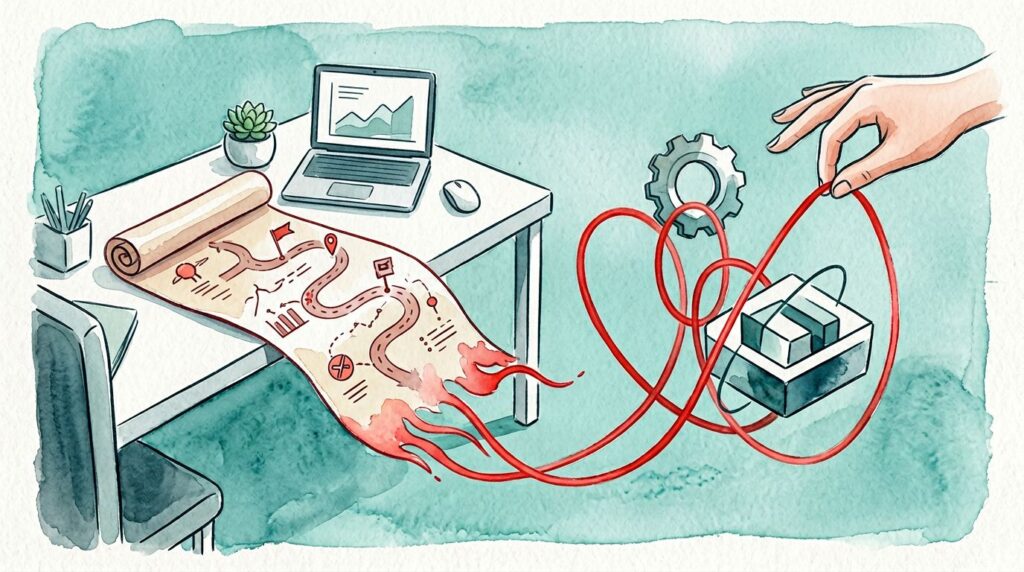
You can tell a vendor is driving too much of your technology strategy, often due to a lack of effective IT vendor management, when your roadmap starts sounding like their sales deck. The tools may be fine. The problem is that your business choices begin to follow their release cycle, their language, and their priorities.
That is hard to spot when you are in it. You still have meetings, dashboards, and project plans. But if you keep asking who owns the decision, why the work matters, and what happens if you say no, the answer should not come from the vendor.
This is a vendor technology strategy problem, and it usually shows up before the board or the budget does.
Key takeaways to keep in mind
- If the roadmap tracks vendor timing more than business goals, you have lost some control, risking long-term misalignment that hampers business growth.
- If vendor language replaces board-ready reporting, you are getting the wrong story, which misleads stakeholders and erodes strategic decision-making over time.
- The fix is not to dump every supplier. It is to restore ownership, decision rights, and a business-aligned roadmap, transforming the vendor from a driver to a strategic partnership.
- A business-led approach creates a sustainable competitive advantage by prioritizing your goals for lasting success.
The signs are usually plain once you stop squinting
The first clue is timing. Your business roadmap keeps lining up with the vendor management roadmap’s product cycles, not with the moments your business actually needs help. A new module, upgrade, or license tier suddenly becomes “urgent,” as SaaS platforms often push urgency over utility, even though the business case is thin.
The next clue is language. Your team starts explaining priorities in vendor terms instead of business terms. That is a bad sign. A healthy technology strategy should sound like growth, risk, service, margin, and execution. Not like a product brochure.
The pattern usually looks like this:
- New tools show up before the business problem is clearly named.
- Upgrades are treated as mandatory, even when the timing is wrong.
- Your board gets activity updates, not board-ready reporting.
- Shadow IT and tool sprawl keep growing.
- Nobody can explain which vendor owns what, or why.
When that happens, the problem is no longer just IT vendor management. It is technology governance. You need clearer ownership, a stronger decision rights map, and better stakeholder alignment around the few choices that matter most.

What vendor-driven strategy costs you
The cost is rarely one giant failure. It is a steady drip. You pay for overlap, custom workarounds, stalled projects, sprawl across cloud infrastructure and managed service providers, and a stack that keeps getting harder to run. That shows up in technology spend optimization, IT cost optimization, and plain old waste.
It also shows up in the story your leadership team tells itself. As one CIO-focused article puts it, vendor influence can slide into bias when future promises start outranking current results. See vendor influence can turn into CIO bias for a useful warning sign.
If the vendor is naming the future, you are not steering.
A real business-aligned technology strategy starts with your goals, your constraints, and your risk appetite. A vendor’s roadmap can inform that work. It should not define it. That is the difference between an IT strategy and roadmap that supports growth and one that keeps adding weight.
If your stack is bloated, the bill can also show up in technical debt, application portfolio rationalization, technology debt, and weak return on investment. If security posture is part of the picture, poor technology risk oversight and thin board cybersecurity reporting make the risk harder to see than it should be.
If you want a broader view of how a business-led plan should work, what a business-driven roadmap looks like is a good reference point.

How to take back control without blowing up the relationship
Start by naming the business outcome in plain English and defining technical requirements. Not the feature. Not the license. The outcome. If you cannot connect a project to revenue, margin, service, resilience, or risk, it probably belongs on hold.
Then build a simple one-page technology strategy and a 12-month technology roadmap using a RACI matrix to clarify ownership. You do not need a sprawling planning exercise. You need enough clarity to say what matters now, who owns it, and what can wait. That is the heart of strategic technology planning.
From there, tighten the operating basics through a structured vendor selection process:
- Do a real technology assessment or technology audit, then build a clean systems inventory.
- Review the vendor management lifecycle, vendor risk management, third-party risk management, and vendor due diligence including SOC 2 reports, Service Level Agreements, contract lifecycle management, onboarding and offboarding, and Regular Business Reviews with business eyes, not just procurement eyes.
- Put vendor offboarding and a vendor incident response plan on paper before you need them.
- Build technology dashboards for VenOps that support cost-per-outcome reporting with Key Performance Indicators, not just activity counts.
- Set a technology risk management framework that includes business continuity planning, disaster recovery planning, and incident response readiness.
- If the stack is getting crowded, revisit the vendor selection process with Request for Proposal tools, do software platform evaluation, application portfolio rationalization, vendor prioritization, vendor rationalization, and hard choices about shadow IT.
The same rule applies to data, AI, autonomous technologies, and Exponential IT. If your data strategy, data governance framework, governance structure, data quality, or data privacy story is fuzzy, the board will feel it. If you are rolling out AI, you need AI governance, AI adoption strategy, an AI acceptable use policy, and AI vendor due diligence with thorough due diligence before enthusiasm outruns control.
If you do not have a senior leader holding this together, that is the gap. It may call for a fractional CTO, interim CTO, outsourced CTO, or virtual CTO. In some companies, the right move is a fractional CIO or a fractional CISO. In others, it is a virtual CISO or interim CISO to clean up cyber reporting and strengthen cybersecurity oversight. If you are still deciding when to hire a fractional CTO, the answer is usually when the business has outgrown informal ownership.
If you need a steadier hand, fractional CTO services can reset the room without forcing a rushed full-time hire. For a broader view of the role, executive technology leadership is what restores control.

If technology decisions feel scattered, risky, or too dependent on the wrong people, start with Get an Executive Technology Clarity Check. You will leave with sharper priorities, clearer ownership, and a practical next step.
FAQ
How do you know if it is a vendor problem or a leadership problem?
Usually, it is both. If your team cannot explain the roadmap without the vendor’s language, you have a leadership gap. A vendor management roadmap should never supersede the business vision. If the vendor is also pushing hard on timing or scope, the influence has gone too far.
Is every vendor-driven decision bad?
No. Good vendors can be useful. In a strategic partnership, they inform your decisions without making them for you. That is a very different thing.
When should you bring in a fractional CTO?
Bring in a fractional CTO when the business needs executive technology leadership to support the maturation of IT vendor management and the vendor selection process, but not a full-time hire yet. That usually happens when ownership is fuzzy, reporting is weak, or the roadmap no longer matches what the business needs.
Conclusion
If your roadmap keeps drifting toward what the vendor wants next, pay attention. That is usually the point where your technology strategy stops being fully yours.
You do not need drama to fix it. You need clearer ownership, tighter governance, and a plan that connects technology to business results. Shifting from a vendor-led plan to a business-aligned one is the key to long-term return on investment and a proactive competitive advantage. Once you get that back in place, the stack gets easier to defend, and your next decision gets a lot cleaner.