

A fractional CIO is a part-time or contract Chief Information Officer who gives you executive-level technology leadership without the cost or commitment of a full-time hire. These engagements commonly range from about 10 hours per month up to 20 hours per week, which makes the role useful when you need senior control over growth, risk, or execution, but not a permanent C-suite seat.
If technology feels expensive, slow, and strangely hard to explain, you probably don't have a tooling problem. You have an ownership problem.
That's the reason CEOs start asking what a fractional CIO is. Not because they want a definition. Because they want the chaos to stop. They want fewer vague updates, fewer vendor surprises, cleaner decisions, and a way to trust that technology is helping the business move instead of taxing it.
A good fractional CIO does exactly that. They restore calm by turning scattered technology work into a managed business function with clear priorities, real accountability, and reporting leadership can use.
When Technology Feels More Like a Tax Than an Asset
You've seen the pattern.
The business is growing. Revenue pressure is real. Teams need systems that work together, leaders want better reporting, and customers expect speed. But your technology environment starts behaving like wet cement. Every change takes too long. Every project has a reason it slipped. Every vendor says their platform will solve the problem, yet the stack keeps getting messier.
Meanwhile, the bill keeps coming.
A CEO asks a simple question: Why are we spending this much, and what are we getting for it? The answer is usually a pile of activity. Server upgrades. License renewals. Security tools. A migration in progress. A dashboard coming soon. Lots of motion. Not much clarity.
Technology becomes expensive the moment leadership can't explain what it owns, what it's fixing, and what business result it should produce.
Companies often misdiagnose the issue. They assume they need better IT support, a new platform, or a stronger project manager. Sometimes they do. But more often, the missing piece is executive technology leadership.
The leadership gap behind the noise
An IT manager can keep things running. A systems administrator can solve incidents. A vendor can implement software. None of those roles are responsible for aligning technology decisions with business goals across budget, governance, priorities, and risk.
That's why the same symptoms keep showing up:
- Projects drift: Work starts with enthusiasm, then gets stuck in approvals, dependencies, and changing requirements.
- Spend lacks a story: You can see invoices, but not a clear line from spending to business value.
- Ownership is fuzzy: Everyone is involved, but no one is clearly accountable for the result.
- Leadership gets vague answers: The board asks about resilience, roadmap, or risk, and the room gets soft around the edges.
Why this gets worse as you grow
Small companies can survive on informal technology leadership for a while. A founder makes calls. A trusted IT lead handles the rest. A few vendors fill the gaps.
Then complexity increases. More systems. More departments. More compliance pressure. More customers depending on digital workflows. Informal leadership stops scaling.
What looked manageable at one stage turns into a coordination tax at the next. You don't feel it as one dramatic failure. You feel it in delays, rework, single points of failure, and the constant sense that nobody has the full picture.
That's the business problem a fractional CIO solves. Not just “IT oversight.” Control.
What a Fractional CIO Actually Delivers
A fractional CIO provides the same core functions as a full-time CIO, including enterprise IT strategy, budget supervision, technology investment prioritization, governance, and digital transformation oversight, but only for the hours or projects the organization needs, acting as an accountable extension of the executive team, as described by Meriplex's explanation of fractional CIO and fractional CISO roles.

That definition matters because most companies hear “fractional” and think “less.” Less time. Less cost. Less commitment.
That's the wrong frame.
A fractional CIO is not watered-down IT leadership. It's focused executive ownership. You bring in someone to make technology legible, governable, and useful to the business.
What they own
The core deliverable is decision quality.
A strong fractional CIO usually takes ownership of several business-critical areas:
- Strategy and roadmap: They translate business priorities into a technology plan with sequencing, tradeoffs, and deadlines.
- Budget discipline: They help leadership understand where money is going, what should be cut, what should be protected, and what should be deferred.
- Governance: They define who can approve tools, who owns platforms, and how priorities get decided.
- Vendor control: They stop vendors from effectively setting your roadmap through persuasion, urgency, or contract sprawl.
- Leadership reporting: They give CEOs, COOs, CFOs, and boards a plain-English view of progress, risk, and next decisions.
You're not hiring a fractional CIO to be the smartest technologist in the room. You're hiring them to make technology easier to run as a business function.
What they don't replace
They are not your help desk.
They are not the person resetting passwords, fixing printers, or closing every ticket. They also don't replace the need for capable internal operators. In many companies, the internal IT manager or director becomes more effective once a fractional CIO is in place, because the work finally has priorities, executive backing, and a roadmap.
That distinction matters. If your issue is day-to-day capacity, you may need operational support, engineering help, or a stronger internal manager. If your issue is that the business can't make clear technology decisions, you need leadership.
In some cases, that leadership also needs to shape the delivery bench around it. If you're trying to close execution gaps in software, data, or automation work, a model like AI staff augmentation can complement fractional leadership by adding specialized capacity without forcing a rushed full-time hire.
The real output is a management system
The best fractional CIOs leave you with more than advice.
They establish decision rights. They create intake rules. They force prioritization. They bring discipline to vendor selection. They make reporting less theatrical and more useful. They turn technology from a collection of moving parts into a system leadership can inspect.
That's the difference between having IT and having technology leadership.
Signs You Have a Technology Leadership Gap
Most companies don't say, “We have a technology leadership gap.”
They say other things.
They say, “We spend a lot, but I'm not sure what's moving.” Or, “The team is working hard, but everything still feels fragile.” Or, “The board keeps asking questions that no one answers cleanly.”
Those are leadership symptoms.
What the pattern looks like
A recent survey of 600 senior business and IT leaders found that only 32% had a clearly defined technology governance model, while 41% said shadow IT or decentralized technology purchasing creates material risk, according to InterimExecs on the fractional CIO governance gap.
If that sounds familiar, the issue usually shows up in plain business terms:
- Too many tools, too little control: Departments buy software independently, contracts stack up, and integration becomes an afterthought.
- Reporting that creates more questions than answers: Leadership gets updates on activity, but not on ownership, risk, or business impact.
- One person knows everything: A single employee or vendor becomes the keeper of critical systems, passwords, workflows, or history.
- Priorities change every week: Teams keep reordering work because no one has installed a credible decision process.
- Growth exposes weak seams: New hires, locations, products, or customer demands push systems past what informal coordination can handle.
Why leaders miss it
Many executives assume the problem sits lower in the org chart. They think the team needs to work harder, vendors need better oversight, or projects just need firmer deadlines.
Sometimes that's true. Often it isn't.
If ownership is unclear at the top, pressure gets pushed downward. The team looks disorganized because leadership never settled decision rights. Vendors seem hard to manage because nobody defined who owns architecture, procurement, or renewal authority. Reporting stays muddy because there's no agreed model for what leadership should see.
Weak technology leadership often looks like an execution problem until you inspect who actually has the authority to decide.
If you want a sharper lens, this breakdown of the technology leadership gap is worth reviewing. It gets to the root issue quickly.
The practical test
Ask these questions in your next leadership meeting:
- Who owns the technology roadmap across departments
- Who decides what gets prioritized when everything feels urgent
- Who can explain current technology spend in business terms
- Who is accountable for vendor rationalization
- Who reports technology risk to the board in plain English
If those answers are slow, disputed, or person-dependent, your company has outgrown informal leadership.
How a Fractional CIO Restores Calm and Predictability
The first job is to make reality visible.
Most technology chaos survives because nobody has mapped the full picture. Systems, vendors, renewal dates, unwritten dependencies, custom workarounds, sensitive data paths, tribal knowledge, side deals with software sellers. Until someone lays that out clearly, leadership is managing shadows.

A good fractional CIO starts there. Not with a giant transformation speech. With legibility.
First, make the environment legible
They map the core operating reality:
- Systems: What you have, what matters, what is redundant, and what is brittle
- Vendors: Who owns each relationship, what's renewing, and where influence sits
- Decisions: Which choices are centralized, decentralized, or currently made by habit
- Risks: Where the business is vulnerable because nobody has explicit ownership
A firm like CTO Input can be useful as one option among others. Its model focuses on mapping work, systems, vendors, and decision rights, then identifying the few issues that create most of the operational chaos.
Then, install an operating rhythm
Once the current mess is visible, the next move is simple and often missing: cadence.
Not more meetings. Better ones.
A fractional CIO creates a rhythm leadership can trust. Weekly review. Clear owners. Known deadlines. Escalation rules. A short list of priorities that doesn't get rewritten every two days.
Calm is not a personality trait. It's what the business feels when ownership, sequencing, and reporting finally become reliable.
That operating rhythm changes the texture of the company. Decisions stick. Teams stop chasing rumors. Leaders stop running status hunts. Vendors stop freelancing your future.
Finally, ship a few wins that matter
The role works when it reduces pressure quickly.
That might mean killing duplicate tools, fixing a broken approval path, cleaning up vendor ownership, tightening board reporting, or stabilizing a high-risk system. None of those moves are glamorous. All of them create relief.
Better doesn't feel abstract. It feels like this:
- leaders know who owns what
- the roadmap fits business priorities
- risk discussions are grounded in facts
- key work finishes
- reporting stops being a fire drill
That's what a fractional CIO is for. Predictable execution.
Fractional CIO vs Other Technology Roles
Executives often know they need help, but choose the wrong role.
That happens because several titles sound similar while solving very different problems. If you hire tactical support when you really need governance, the chaos stays. If you bring in a full-time interim executive when you only need focused strategic control, you create unnecessary cost and complexity.
Here's the clean comparison.
Choosing the Right Technology Leadership
| Role | Primary Focus | Typical Engagement | Best For |
|---|---|---|---|
| Fractional CIO | Strategic technology leadership, governance, budget alignment, vendor control, executive reporting | Part-time or contract-based, embedded with leadership for defined outcomes | Organizations that need senior IT strategy and decision clarity without a full-time CIO |
| Interim CIO | Temporary full-time executive coverage during a gap or transition | Full-time for a limited period | Companies between permanent CIOs or dealing with an urgent executive vacancy |
| vCIO | Often advisory technology planning, commonly tied to managed service relationships | Ongoing external advisory, sometimes narrower in scope | Smaller organizations that want guidance tied closely to infrastructure or MSP support |
| IT Manager or IT Director | Internal operations, team management, systems reliability, day-to-day support | Full-time employee role | Businesses that need stronger internal execution and operational ownership |
Where buyers get confused
The phrase “virtual CIO” often sounds interchangeable with “fractional CIO.” It isn't always. In practice, many vCIO offerings are attached to managed service providers and lean toward tactical planning inside the provider's delivery model.
That may be perfectly fine if your main issue is infrastructure planning or outsourced support coordination.
It is not enough if your problem is broader. If technology decisions are affecting board confidence, capital allocation, vendor sprawl, or cross-functional execution, you need a role with stronger executive authority and business accountability.
The simplest way to choose
Use this decision lens:
- Choose a fractional CIO when the business needs part-time executive leadership to create order, governance, and a credible roadmap.
- Choose an interim CIO when you need someone full-time right now because a critical executive seat is empty.
- Choose a vCIO when you want advisory support linked to managed services and your environment is relatively contained.
- Choose an IT manager or director when strategy is clear but daily operations need stronger internal leadership.
If your organization is also sorting out where CIO and CTO responsibilities should split, this comparison of fractional CTO vs CIO roles will help you avoid a costly category error.
The wrong technology role doesn't just waste money. It preserves the exact ambiguity you were trying to fix.
What to Expect in the First 90 Days
A serious fractional CIO engagement should not feel like endless assessment.
Yes, there's discovery. But the point is to produce control fast. This model is often used as a temporary or transitional solution, sometimes lasting around six months, to help define and execute IT strategy, evaluate infrastructure, improve processes, manage technology budgets, and ensure IT investments deliver business value during change, according to PI Partners on driving business value with a fractional CIO.
Days 1 to 30
The first month is about getting honest quickly.
You should expect the fractional CIO to review systems, vendors, major initiatives, budget lines, security concerns, and key dependencies. They should identify the few issues creating the most friction and flag immediate risks that leadership cannot afford to ignore.
Useful early outputs often include:
- A current-state map: What exists, who owns it, and where the business is exposed
- A short risk list: Not a bloated register. The top issues that matter
- A quick-win plan: Small moves that reduce noise and create room to operate
Days 31 to 60
The second month is where governance becomes real.
This is when ownership gets sharper, meetings get cleaner, and the roadmap starts taking shape. By now, the company should know how priorities will be set, who has authority to approve changes, and how progress will be reported upward.
A competent fractional CIO will also start translating technical concerns into business language. That matters more than most leaders realize. Boards and executive teams don't need more technical detail. They need stronger judgment, cleaner framing, and fewer surprises.
Early value should show up as reduced confusion, not just more documentation.
Days 61 to 90
By the third month, you should feel momentum.
The first meaningful initiatives should be underway. Reporting should be more stable. Vendor conversations should be less reactive. Internal leaders should spend less time decoding what is happening.
A practical ninety-day result looks like this:
- Reality is visible. Leadership can finally see the environment clearly.
- The operating rhythm is in place. People know how decisions get made.
- The roadmap has credibility. It reflects business priorities, not random urgencies.
- Execution is moving. Work is shipping with less friction and less drama.
If you want a more detailed look at how this kind of onboarding should work, review this guide to the first 90 days with a fractional CTO. The mechanics are highly relevant.
A Checklist for Hiring a Fractional CIO
A good buyer asks harder questions than “What's your rate?”
You are not buying insight alone. You are buying executive judgment, operating discipline, and the ability to restore control. That means the wrong hire can sound impressive and still leave you with the same confusion you started with.
What to look for
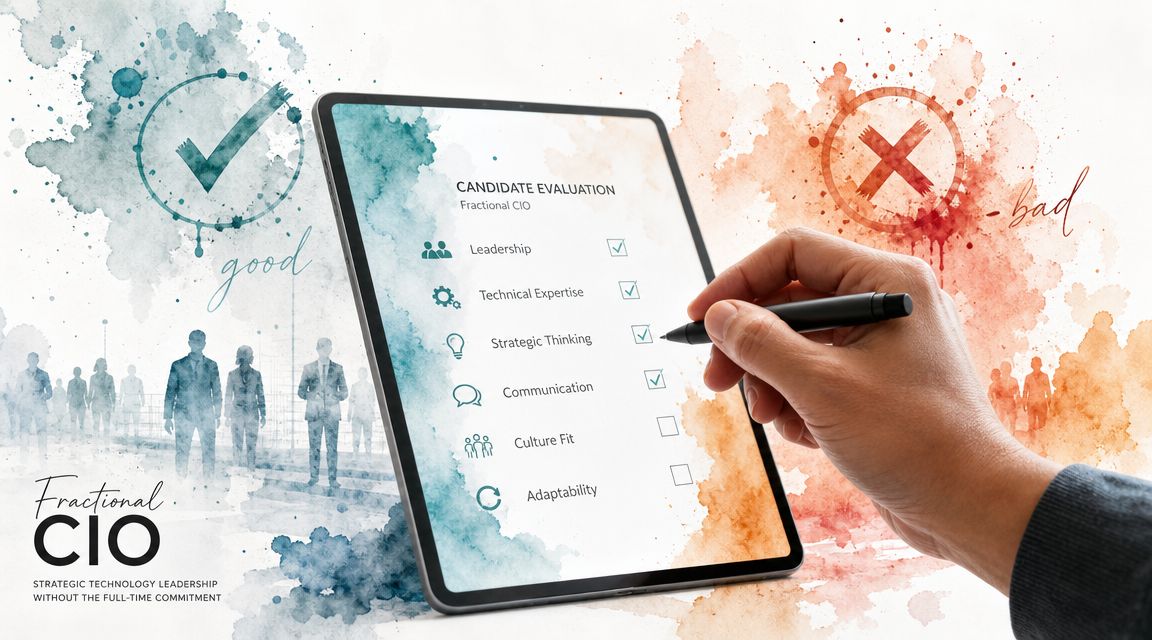
Use this checklist when evaluating candidates:
- Business-first thinking: They should talk about growth, risk, cost, resilience, and execution before they talk about tools.
- Clear ownership models: Ask how they define decision rights, escalation paths, and reporting lines.
- Experience in your stage of complexity: A leader who understands your size and operating model will get to clarity faster.
- A visible method: They should be able to explain how they assess the environment, set priorities, and create momentum.
- Comfort with tough calls: Good fractional CIOs can say no to vendors, challenge internal assumptions, and surface uncomfortable truths.
Red flags to avoid
Be wary if you hear any of these patterns:
- Tool obsession: They jump straight to platforms without understanding business priorities.
- Jargon as camouflage: They use complexity to avoid clear accountability.
- Vendor-led thinking: Their roadmap sounds suspiciously similar to what sellers want you to buy.
- No reporting discipline: They can't explain what a CEO or board will receive from them.
Pricing and scope should be concrete
Fractional CIO engagements can range from about 10 hours per month up to 20 hours per week, with typical pricing models that include $200 to $300 per hour, $1,000 to $6,000 per week, or $4,500 to $20,000 per month, depending on scope, as outlined by Go Fractional's breakdown of fractional CIO working models and pricing.
That range is useful, but don't anchor on price first. Anchor on scope.
Ask:
- What decisions will you own
- What operating cadence will you install
- How will you measure progress
- What will leadership see each month
- How will you reduce dependency on any one person, including you
The right answer to “what is a fractional CIO” is simple. It's a part-time executive who gives the business strategic technology leadership without forcing a full-time hire.
The more important answer is this: if technology chaos is slowing growth, weakening reporting, or increasing risk, a fractional CIO gives you a way to restore control before the damage gets more expensive.
If you need clearer ownership, better reporting, and a calmer operating rhythm around technology, CTO Input can help you see what's breaking and what the first steps to restore control should look like.