

If you're asking what governance, risk, and compliance is, you're probably not looking for a textbook definition. You're trying to solve a more immediate problem.
The board is asking sharper questions. Customers want stronger assurances. A regulator, insurer, acquirer, or enterprise buyer may be pressing for proof that the business is controlled. Meanwhile, your leaders are giving partial answers from separate systems, separate teams, and separate priorities.
That's what governance, risk, and compliance really touches. Not paperwork. Not policy theater. It determines whether leadership can make decisions with confidence and prove that those decisions were responsible.
A weak GRC model creates slow decisions, duplicated work, surprise exposures, and vague board reporting. A strong one gives the business something far more valuable than another checklist. It creates defensible oversight.
When Hard Questions Get Vague Answers
It usually shows up in a meeting.
A director asks who approved an exception for a critical vendor. The CIO says procurement owns the vendor file. Legal says the contract has the relevant language. Security says there are open issues but no agreed timeline. Operations says the system is too important to slow down. The CFO asks whether the risk is accepted. Nobody can answer cleanly.
That is a GRC failure.
The visible problem is weak reporting. The deeper problem is that the organization doesn't have a shared system for decision rights, risk ownership, and evidence. People may be working hard. They may even be doing good work. But if the answer changes depending on who is in the room, leadership doesn't have control. It has fragments.
What directors are actually hearing
Most boards don't expect zero risk. They expect clarity.
They want to know:
- Who owns the decision
- What the known risk is
- What controls are in place
- What exceptions exist
- What happens next if the control fails
When the answers come back as status updates instead of decisions, confidence drops quickly.
Boards lose trust when management can describe activity but can't show accountability.
This is why so many executive teams feel stuck between overconfidence and panic. On ordinary days, the business assumes the basics are covered because audit, legal, IT, security, and operations all exist. Under pressure, everyone discovers those functions were adjacent, not integrated.
Why this isn't a people problem
Leaders often blame communication. That's too shallow.
The problem is that the company hasn't decided how governance, risk, and compliance work together. So teams build their own versions. Legal tracks obligations. Security tracks controls. Audit tracks findings. Operations tracks workarounds. Finance tracks exposure. Each group is rational within its lane. The enterprise result is confusion.
A board doesn't need more dashboards. It needs a system that turns scattered control activity into decisions that hold up under scrutiny.
That is the practical answer to what is governance risk and compliance. It's the operating model that lets leadership answer hard questions without improvising.
What Governance Risk and Compliance Really Means
The cleanest definition comes from OCEG's explanation of GRC. In that model, GRC is an integrated capability set that enables an organization to reliably achieve objectives, address uncertainty, and act with integrity.
That definition is better than most because it starts where leaders operate. Objectives. Uncertainty. Integrity.
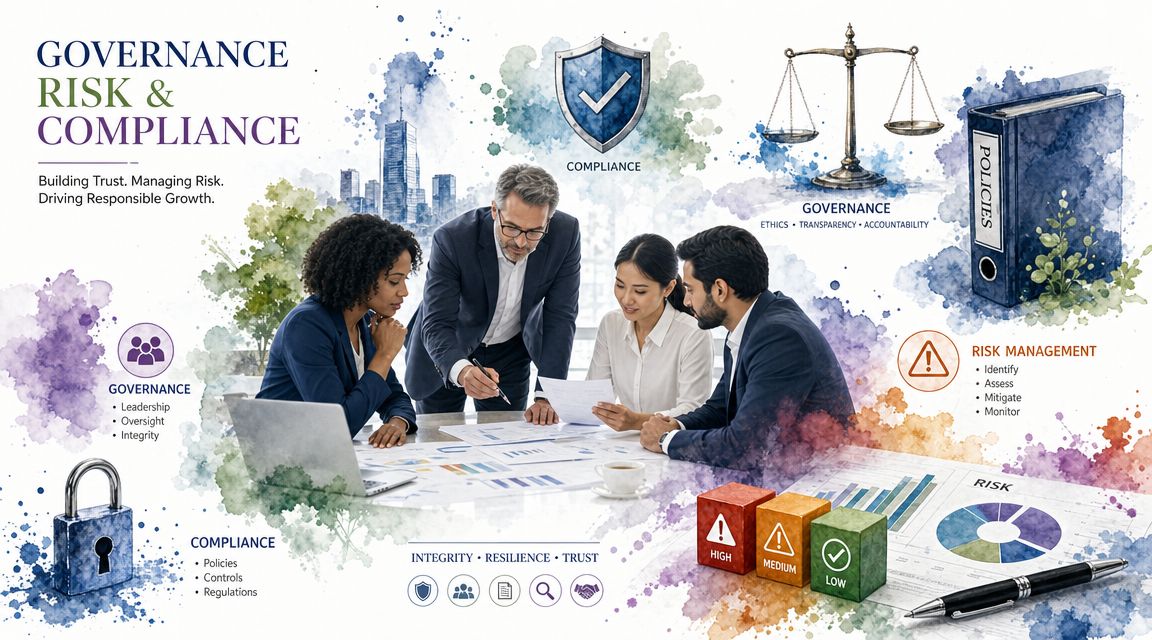
Governance means decision rights
Governance is the part most companies underbuild.
It answers questions like these:
- Who has authority to approve risk?
- Which issues must come to the executive team or board?
- What standards are mandatory versus optional?
- How are exceptions reviewed, time-boxed, and closed?
Without governance, the business confuses influence with authority. People participate in decisions, but nobody is clearly accountable for the outcome.
If your board materials still rely on personality and persuasion more than documented ownership, governance is weak.
For a related leadership view, CTO Input's article on IT governance best practices is useful because it connects decision structure to execution rather than treating governance as a static policy binder.
Risk means disciplined uncertainty
Risk management is not fear management.
It is the process of identifying uncertainty, judging business impact, prioritizing response, and deciding what the organization will mitigate, transfer, accept, or avoid. Done well, it speeds decisions because leaders know which issues warrant escalation and which don't.
Done poorly, risk becomes a vocabulary exercise. Teams label everything “high” and still can't decide what to fix first.
A practical example is application risk. If your software estate changes constantly, control evidence has to keep pace with releases, dependencies, and access changes. That's why resources on automated security for apps matter. They help connect technical signals to a broader risk assessment framework instead of leaving software risk isolated inside engineering.
Compliance means provable boundaries
Compliance is the proof layer.
It confirms that the business is operating inside legal, regulatory, contractual, and internal policy boundaries. It matters because organizations don't get credit for good intentions. They need evidence.
Compliance without governance becomes checkbox behavior. Compliance without risk management becomes wasteful because teams test controls that don't matter while missing the decisions that do.
Practical rule: If governance sets the rules, risk sets the priorities, and compliance proves performance, then GRC is the system that ties those three together.
When those parts stay separate, organizations create duplicate controls and fragmented reporting. When they work as one, leaders get a coherent view across security, legal, audit, and operations. That is what governance, risk, and compliance should do. It should make the organization legible to itself.
Why Leaders Overlook GRC Failures
Most GRC failures aren't caused by open neglect. They grow inside successful organizations that are moving quickly.
A business adds tools, vendors, data flows, and customer commitments faster than it adds decision discipline. Leaders assume the presence of capable departments means control exists across the whole system. It doesn't. It often means each department is controlling its own slice while nobody owns the seams.
The three blind spots
The first blind spot is delegation without oversight.
Executives push GRC downward because it sounds administrative. They treat it as a compliance office matter, or an audit matter, or a security matter. That decision deprives GRC of the only thing that makes it work. Authority.
The second blind spot is the illusion of coverage.
Separate teams produce separate reports. That looks mature from a distance. In practice, it often hides contradictions. One team says a control exists. Another says the exception is accepted. A third says remediation is in progress. None of that answers whether leadership knowingly approved the residual risk.
The third blind spot is tool substitution.
Buying a GRC platform can help. But software doesn't fix weak ownership. It digitizes whatever governance quality you already have. If decisions are fuzzy before the tool, they'll be fuzzy inside the tool.
A GRC platform can collect evidence. It can't decide who is accountable when tradeoffs get uncomfortable.
External pressure exposes internal weakness
This is why regulatory shifts tend to trigger executive panic. They expose what the company never had to prove before.
A clear marker was the rollout of GDPR in 2018. By December 2020, EU data protection agencies had issued 300 GDPR fines, up from an average of 5 fines per month between July 2018 and June 2019, a 260% increase in enforcement activity. In the same survey cited by Hyperproof, 51% of U.S. security and GRC professionals said they were spending 40% or more of their IT security budgets on compliance, and 86% said they were preparing for the possibility of a federal U.S. privacy and security law, as summarized in Hyperproof's compliance statistics review.
Those figures matter for one reason. They show how quickly ad hoc compliance becomes inadequate when scrutiny rises.
What leaders usually miss
Leaders often think the problem begins when a regulator asks questions, an insurer tightens terms, or a customer sends a security questionnaire. The problem started earlier.
It started when the company allowed policy, risk, and operational reality to drift apart.
By the time the pressure becomes visible, the organization is already paying for the disconnect through slow approvals, defensive reporting, duplicate testing, and last-minute remediation. GRC doesn't fail in the audit room first. It fails in ordinary decisions long before anyone labels it a governance issue.
The Hidden Costs of a Disconnected GRC Strategy
A disconnected GRC strategy taxes the business every day.
Not dramatically at first. Subtly. A delayed product launch because legal reviews a data use issue late. A stalled vendor renewal because nobody can prove control ownership. A board packet rewritten the night before the meeting because the underlying reports don't reconcile. Leaders feel the friction long before they call it GRC.

Where the cost shows up
You see it in several places at once:
| Business area | What weak GRC causes |
|---|---|
| Decision speed | Escalations bounce between teams because approval authority isn't clear |
| Operating cost | Teams repeat control work in separate systems and prepare evidence manually |
| Commercial momentum | Deals slow down when customers or partners ask for assurance the company can't package quickly |
| Board confidence | Directors get updates on activity, not a clean view of exposure, ownership, and exceptions |
| Resilience | When incidents happen, response gets muddled because policy, controls, and accountability don't line up |
This is why I don't treat GRC as a support function. It's part of enterprise execution.
A company with weak GRC doesn't just carry more compliance risk. It moves slower, spends less intelligently, and creates avoidable management drag.
Why this has become a major enterprise category
The market has already made the point. Grand View Research's enterprise GRC market analysis estimated the global eGRC market at USD 72.42 billion in 2025, with a projection to USD 203.65 billion by 2033 at a 13.7% CAGR from 2026 to 2033.
You can debate category boundaries. You can't miss the signal. GRC is no longer a niche control function. It's a foundational enterprise technology category because organizations need centralized policy management, regulatory mapping, audit trails, and automated control monitoring across jurisdictions and business units.
That scale reflects a simple truth. Boards, operators, and investors now expect proof that the business can govern itself.
One of the most common fracture points
Third parties are where many companies discover their governance isn't real.
The business depends on a vendor. Security has concerns. Procurement owns the contract. Operations needs continuity. Legal negotiates language. Finance watches cost. If nobody has clear authority to accept risk and no one operating view exists, the vendor relationship becomes a permanent exception.
CTO Input's piece on third-party vendor risk management is worth reading if vendor sprawl is where your control model is starting to break.
Strong GRC lowers the coordination tax. Weak GRC raises it until ordinary work needs executive intervention.
A Practical GRC Checklist for Your Leadership Team
If you want to know whether your GRC model is working, don't start by asking whether policies exist. Ask whether decisions are inspectable.
McKinsey's 2025 Global GRC Benchmarking Survey noted that many GRC programs remain a work in progress and recommended embedding risk and compliance targets into compensation to strengthen accountability, as discussed in McKinsey's GRC best practices perspective. That recommendation matters because it points to the core issue. Governance design. Not policy volume.
Questions about ownership
Bring these into your next executive or committee meeting:
- Who can accept a serious operational, security, or compliance risk on behalf of the company? If the answer is unclear, your governance is ceremonial.
- Which risks require board visibility, and who decides that threshold? If thresholds are informal, escalation will be inconsistent.
- Who owns exceptions? Not who logs them. Who owns the business decision, due date, and closure.
- When two leaders disagree on a risk tradeoff, what is the tie-break mechanism? If there isn't one, urgency will outrun discipline.
Questions about visibility
These questions test whether reporting is decision-grade:
- Can leadership see which controls are working between audits?
- Do reports connect risks to named owners, remediation dates, and current status?
- Can management explain residual exposure, not just gross exposure?
- Do we know where our highest-risk vendors, systems, and data obligations intersect?
If your reports are rich in status and poor in ownership, visibility is weaker than it looks.
For teams that need to translate evidence requirements into day-to-day engineering and documentation habits, this developer's guide to audit compliance is a practical reference. It helps technical teams think in terms executives can inspect.
Questions about operating discipline
At this stage, many programs break.
- How do we know policies map to actual controls?
- How do we test those controls in a repeatable way?
- What happens when a control fails?
- Who follows remediation until closure?
- How are overdue exceptions surfaced to leadership?
A company can have strong policy language and still fail every one of these questions.
Questions about incentives
This is the part boards often avoid and shouldn't.
- Are leaders rewarded only for speed and growth, or also for sound risk decisions?
- Do business owners carry consequences for unmanaged exceptions?
- Are teams pushed to bypass controls to hit deadlines?
- Does compensation reinforce responsible behavior or only visible output?
Incentives tell you whether the company means what it says.
What to do with the answers
Don't turn this into another scoring exercise. Use the answers to identify the first control points that need executive redesign.
A practical starting set is:
- One risk acceptance model with named authority levels
- One exception process with due dates and escalation rules
- One cross-functional reporting view for board and executive review
- One operating owner responsible for keeping policy, controls, and evidence connected
If you need outside help to make the current state legible and assign decision rights, firms like CTO Input's IT compliance services can support that work alongside internal legal, audit, and security teams.
What Better Looks Like A Governed Organization
A governed organization feels calmer.
The board asks a difficult question and management answers directly. Not because the issue is simple, but because the ownership is already defined, the evidence is already organized, and the exception path already exists. People don't scramble to reconstruct the story.

What maturity looks like in practice
The CMS view of GRC operations gets this right. A mature GRC program is operational, not theoretical. Policies map to specific controls, controls map to measurable test procedures, and exceptions have an owner and due date. When those links are missing, compliance becomes a manual fire drill instead of risk reduction.
That operating discipline changes the tone of leadership conversations.
Instead of:
- We think this is covered
- Someone is working on it
- Audit didn't flag it last time
You hear:
- The control owner is named
- The test result is current
- The exception is accepted until a stated date
- The remediation path is funded and tracked
What the board gains
Directors don't need perfection. They need proof of oversight.
A strong GRC system gives them:
- Clean escalation paths so management knows what must be surfaced
- Defensible records showing who approved what and why
- Forward-looking reporting that highlights emerging exposure, not just closed findings
- Better strategic freedom because the company can move faster without guessing where the landmines are
The goal isn't a risk-free organization. It's an organization that can take risk on purpose.
That is the payoff. Better GRC does not make a company bureaucratic. It makes the company more trustworthy, more investable, and easier to lead under pressure.
If your current reporting still depends on heroics, memory, and late-night reconciliation, the issue isn't documentation. It's governance. Fix that, and the rest of the control environment starts to become usable.
If your board is asking harder questions and the answers still feel vague, CTO Input can help make the current state legible, clarify decision rights, and turn risk and compliance work into an operating system leadership can use.