
Who owns third-party risk in your company? If your first instinct is “IT” or “legal,” you already have a gap.
Third-party risk is simple to describe and painful to ignore. Any third-party vendors that touch your data, your money, your customers, or your operations can hurt you: cloud platforms, SaaS tools, outsourced teams, payment processors, AI services, and more. The more you rely on them, the more you “rent” their problems.
Regulators and boards in 2025 now expect clear ownership, real oversight, and fast answers when a vendor fails. Yet in many mid-market firms, the pattern is familiar: a breach or outage hits, fingers point in every direction, and the CEO discovers that nobody really owned the risk.
This article gives a direct answer to “Who owns third-party risk?”, shows how to share responsibility across your senior management, and offers a 90-day playbook to regain control without drowning in unnecessary policy and processes.
What Is Third Party Risk and Why It Now Hits the CEO’s Desk
Plain-language definition: what third-party risk really means today
Third-party risk is any risk that comes from your third-party relationships (vendors, partners, platforms, or outsourced teams) that plug into your business.
If a company outside your walls can see your customer data, process your payments, run your operations, or connect to your systems, they carry risk back into your organization. This risk can also stem from fourth parties as they connect to your systems.
A few simple examples of third-party vendors:
- Your cloud CRM that stores every sales record
- An outsourced development team with admin access to production
- A payment processor that handles card data and refunds
- A marketing automation or AI tool that profiles your customers
None of these look scary on a slide. In practice, each one is a door into your business. A small misstep on their side can lead to a big mess on yours.
Why third-party failures cost more than in-house mistakes
When a vendor goes down, gets hacked, or breaks a rule, your customers do not care whose logo is on the invoice. They look at you.
Regulators and investors feel the same way. The SEC now expects public companies to disclose material cyber incidents and cybersecurity risks, including those caused by vendors, within a few days. Boards are under pressure to prove real oversight of cyber and vendor risk and ensure regulatory compliance, not just policies on paper. Resources like KPMG’s guidance on board oversight of third-party risk management reflect how high this sits on the agenda.
The business impact shows up in very real ways:
- Revenue lost during outages or slowdowns
- Failed audits or regulatory fines from vendor weakness
- Lost deals because customers doubt your controls
- Data breaches from vendor incidents
- Lower valuation when risk disclosures spook investors
This is why “Who owns third-party risk?” is no longer a technical question. It is a survival-level question for CEOs and boards.
Who Owns Third-Party Risk? The Shocking Truth About Accountability
The short answer: ultimate ownership sits with the CEO and the board, but control must be shared across clear roles in third-party risk management (TPRM).
The dangerous myth is that IT, security, or legal “own” third-party risk. They own pieces of it. Without leadership ownership and a shared model, those pieces never add up to real control.
A simple way to think about it:
- Accountability at the top
- Ownership by function
- Shared execution across the business
The CEO and board: why ultimate ownership lives here
Regulators, customers, and investors do not care which vendor failed. They look at the people who chose that vendor and set the guardrails.
The CEO and board of directors own:
- Risk appetite: how much risk the company is willing to take for speed or cost
- Tradeoffs: when to accept a weaker vendor control in exchange for growth or margin
- Visibility: which third-party vendors must appear in leadership and board packs
Third-party vendors, such as those handling sensitive customer data or core operations, should never be buried in a low-level procurement list. They belong in a simple, recurring report at executive and board meetings.
Boards are being reminded of this in many sectors. The Harvard Law School Forum’s piece on risk management and the board of directors reflects how regulators now expect clear board-level oversight of risk, which includes third parties.
Who owns what: mapping ownership across your leadership team
Once accountability is clear at the top, you can map real ownership across your team.
A simple view:
Role / FunctionPrimary responsibility for third-party riskRisk / TPRM / fractional CISO or CTODesign the risk management program, set standards, coordinate reviews and monitoringCybersecurity and ITTechnical due diligence on cybersecurity risks, secure access, monitoring, incident response plansCompliance and legalRegulatory requirements, contract language, audit-ready evidence for internal auditorsProcurement and financeVendor selection, renewals, pricing and controls that lead to risk mitigationBusiness unit leadersDay-to-day vendor performance, managing associated operational risk, and safe delivery of business outcomes
The key idea: every high-risk vendor needs both a business owner and a risk owner. When that mapping is missing, nobody quite knows who should say “no” or “not yet” during selection, or who should act first when a vendor stumbles.
Resources like Forvis Mazars’ perspective on who is responsible for vendor risk management (VRM) echo the same pattern. Responsibility is shared, but accountability is not.
Why “IT owns third-party risk” is a dangerous myth
In many mid-market firms, every vendor problem lands in one bucket: IT departments.
“Can you review this vendor?”
“Can you sign off on this contract?”
“Can you fix what they broke?”
IT becomes the default owner of risk they cannot see or control.
This fails for three reasons:
- IT cannot judge legal or regulatory exposure alone. A tool may be easy to plug in but risky under privacy or sector rules.
- IT is often absent when contracts are signed. They inherit the vendor after the price and terms are locked.
- IT does not own the business outcome. They can secure a tool, but they do not decide if that tool is worth the risk.
The result is predictable: blind spots, burnout in the tech team, and a false sense of safety at the top.
In a healthier model, IT and security are vital owners of technical risk, but they operate inside a structure led by the CEO and board. Shared Assessments’ guidance on what boards and CEOs should know about third-party risk management (TPRM) underlines that this is a leadership problem, not an IT problem.
How to Take Control of Third-Party Risk in the Next 90 Days
Once you accept that you own third-party risk management (TPRM), the next step is to gain control without building a massive bureaucracy.
Think of it as a 90-day sprint: inventory, assign ownership, fix the worst gaps, then set a light rhythm. Many companies use a fractional CTO or CISO to design and run this, instead of hiring another full-time executive.
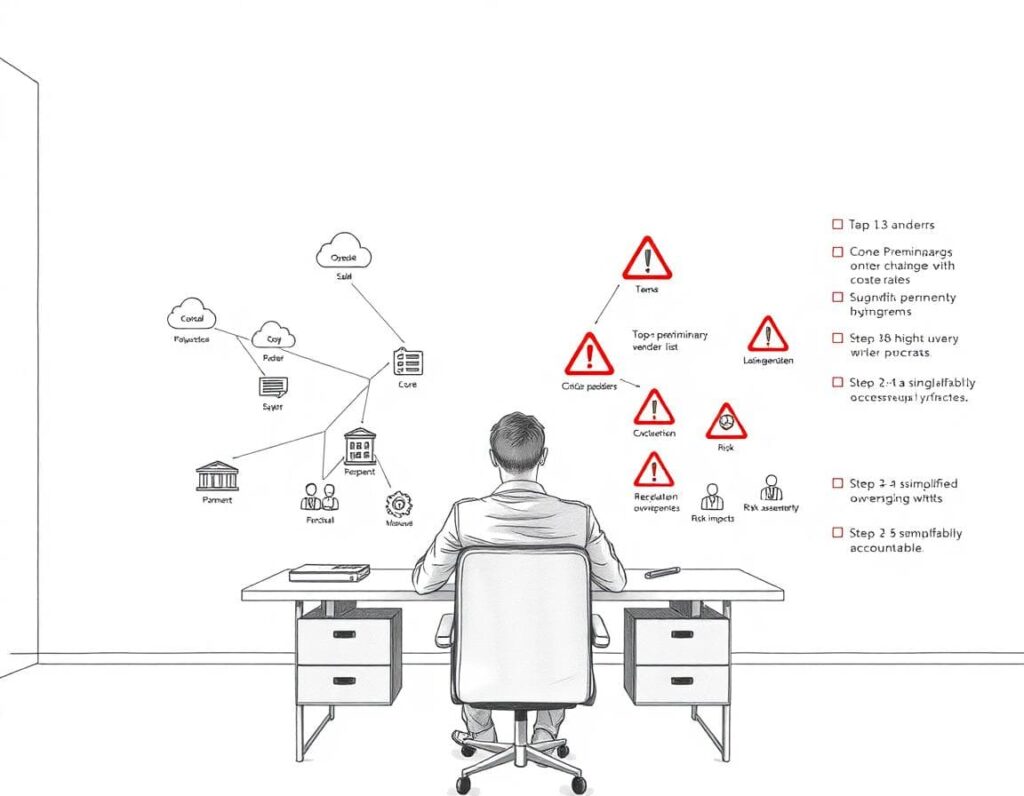
Step 1: Build a simple vendor map and find the real risks
Start with one fast preliminary risk assessment exercise.
List the vendors that:
- Touch customer or employee data
- Process payments or financial data
- Run core operations or production systems, managing supply chain risk
- Support regulated activities, like healthcare or finance
Identify critical third-party vendors through this preliminary risk assessment. For each vendor, mark:
- Which executive or business leader uses them
- What would happen in the next 48 hours if that vendor failed
Keep this on a single page. You are not building a system yet; you are building clarity. Tools and frameworks, such as this overview of a TPRM risk framework, can help later, but the first pass should be simple and human.
Step 2: Assign clear owners and decision rights for each risk area
Turn your vendor map into clear roles for third-party risk management (TPRM).
For high-risk vendors, answer four questions:
- Who is accountable? Usually you, or a named executive who reports to you.
- Who leads the work? Often a risk, security, or IT leader.
- Who must be consulted? Legal, finance, and the business owner.
- Who is informed? Stakeholders.
You do not need a formal RACI chart. A one-page ownership slide is enough, as long as it is used in leadership and board meetings.
The important part is discipline: no new high-risk vendor should go live without a named business owner and a risk owner.
Step 3: Fix the top 5 risks and set a light, repeatable process
Now, move from paper to action.
Pick the top 5 high-risk vendors from your map. For each one, focus on a short, repeatable checklist:
- Tighten account and access controls
- Update contracts with clear security and compliance terms
- Confirm who you call, and who they call, during an incident
- Set a review date and a small set of metrics
To keep it going, create a quarterly rhythm for third-party risk management (TPRM):
- Review new vendors that entered the environment
- Perform vendor assessment and ongoing monitoring of your high-risk vendors
- Track a few metrics, such as number of high-risk vendors and percentage with recent security reviews
Playbooks like the vendor lifecycle can give your team more detail, but the key is rhythm, not perfection.
This is where a seasoned fractional CTO or CISO can be a force multiplier. They design and run the playbook, coach your team, and give the board confidence, while you stay focused on growth and major risk decisions.
Conclusion: Ownership First, Playbook Second
So, who owns third-party risk? In practice, you do. The CEO and board carry ultimate ownership, even when the root cause sits inside a vendor’s stack.
The risk only becomes manageable through vendor risk management (VRM) when you share it in a structured way across risk, IT and security, Compliance teams, legal, procurement, and business leaders. Ignoring ownership does not push risk away, it just hides it until the next outage, data security breach, or awkward board question.
Your next move can be simple: build a one-page vendor map, assign real owners, and tackle the top five risks within 90 days. That alone will put you ahead of most peers.
If you want seasoned, neutral leadership across technology, information security, and vendor risk, visit CTO Input and explore more executive-level insights on the CTO Input blog.