
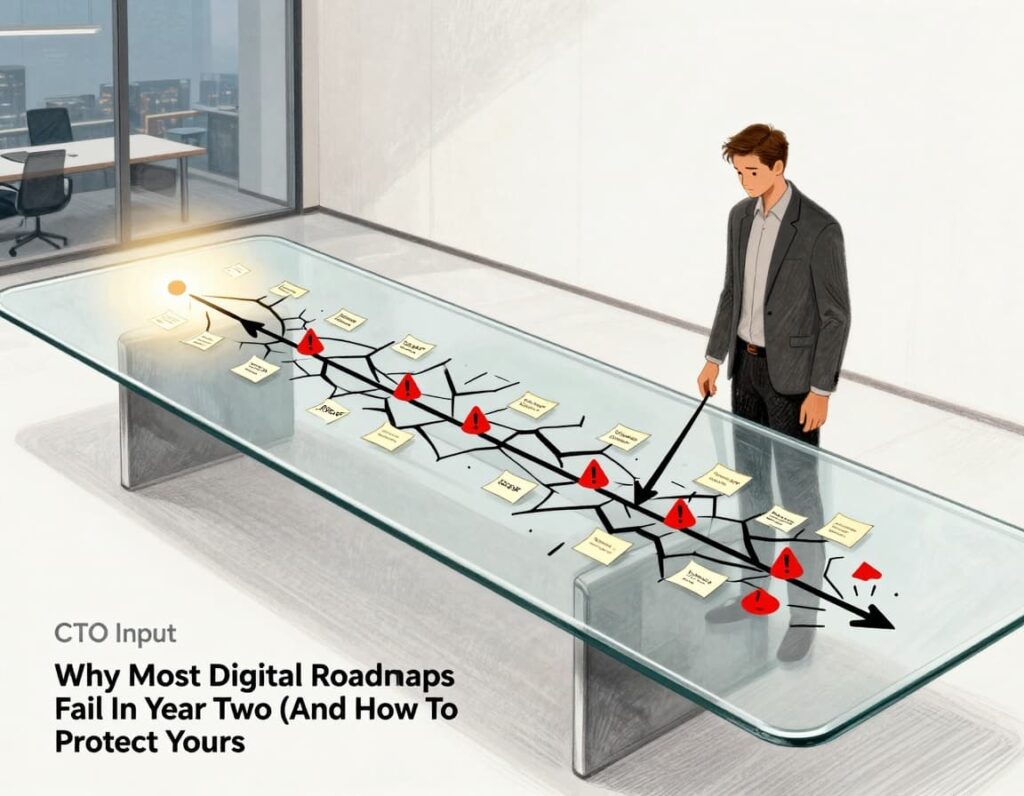
You are a CEO or founder who is spending more on tech and getting less back. Year one of your digital roadmap looked good. New tools went live, dashboards appeared, vendors were upbeat, your team felt like things were finally moving. Now you are in year two, costs are up, projects are stuck, and the board is asking why the numbers have not changed.
Stalled projects. No clear ROI. Tech team losing energy. Customers still feel the same friction.
You are not alone. Research shows that 70% to 80% of digital initiatives fall short of their goals, and many of the real digital transformation failure reasons only become visible in year two, after the easy wins are gone and deeper change is required.
CTO Input has watched this pattern across many mid-market companies navigating disruptive technological changes. The good news is that you can still reset the story. Below is a short, practical set of moves to protect year two and set up years three and four for actual business results, not just more tools.
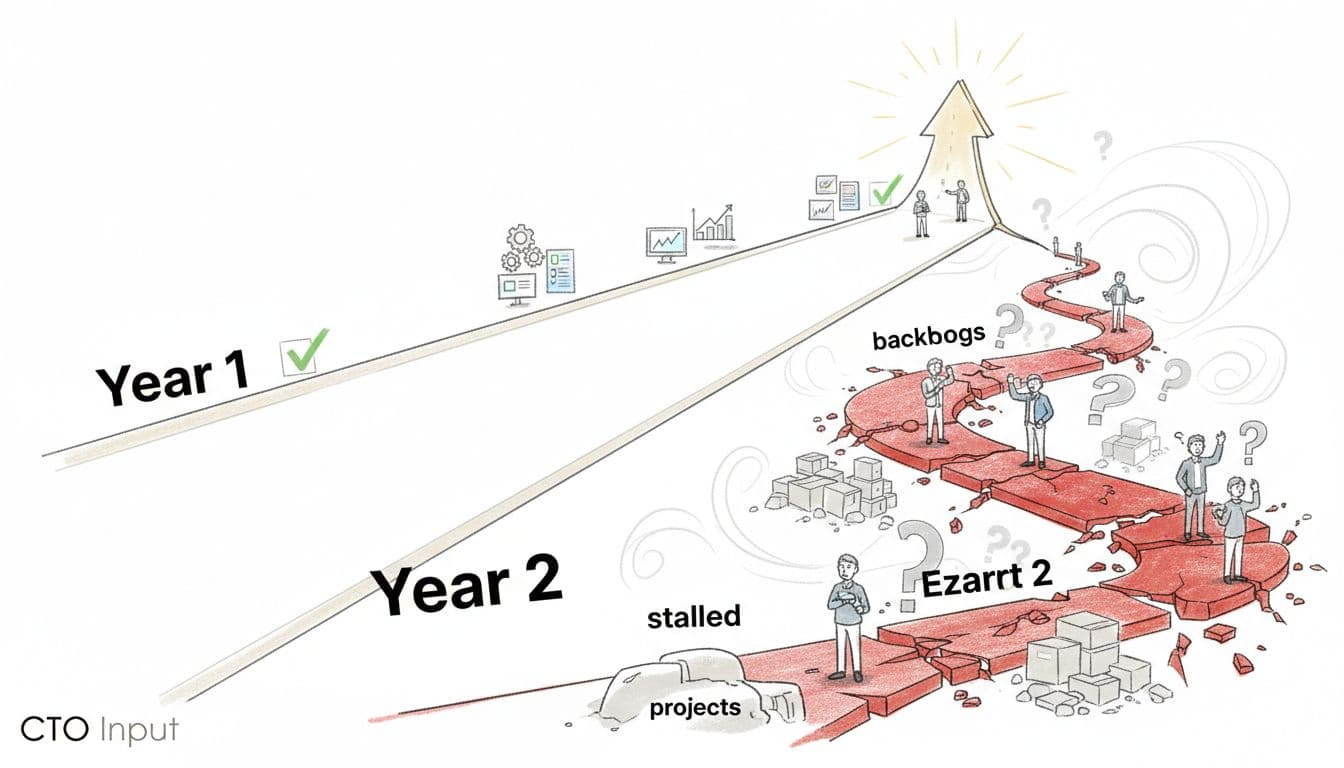
Year One Feels Like Progress, Year Two Feels Like Drag
Year one is the honeymoon.
You approve the budget. A new CRM, ERP software, a customer portal, maybe a data dashboard. Vendors move fast. Your team can point to screens and say, “Look, something changed.” The first board update is positive. People feel momentum.
Then year two shows up.
The backlog grows with technical debt. Integrations take longer. That dashboard does not match finance numbers. The CRM is not the “source of truth.” Customers still email PDFs. The same issues are back, just with more logins and higher subscription fees.
This is the moment when many leaders quietly start to wonder if they are wasting money.
Independent research points to a hard truth: around 70% to 84% of transformation efforts end in digital transformation failure, often because the hard parts, like organizational culture and process, come later in the journey. Studies on why digital transformation fails point again and again to culture, ownership, and change management, not the tools themselves. For example, Prosci highlights stakeholder engagement and change management as top reasons in their analysis of why digital transformation fails.
For mid-market companies, the problem is sharper:
- Budget is finite with lack of resources and budget, yet vendors pitch “enterprise” solutions that ignore your digital maturity level.
- The leadership bench is thin, and the CIO or IT lead wears too many hats.
- Investors and lenders expect digital progress, but have low tolerance for misses.
- Your people still need to run the day-to-day business while change happens.
Year one can run on adrenaline. Year two exposes structure, or the lack of it.
Why Digital Roadmaps Look Great On Slides But Break In Real Life
The roadmap usually starts in a deck.
It has impressive logos, colorful phases, and a smooth arrow from “current state” to “future state.” On paper, it makes sense. In real life, it skips the messy parts that actually determine success, as the traditional roadmap often lacks the flexibility of an agile approach.
Common gaps:
- Lack of a clear vision for how operational processes will change across sales, operations, and finance.
- No staffing model for who will run and support new systems after go-live.
- No serious work on data quality, integration, and ownership.
- No shared accountability across business units.
Think about a CRM rollout. On the slide, it is “single view of the customer.” In practice, sales keeps using spreadsheets due to poor communication, customer service logs tickets in a separate tool, and finance has its own records. The CRM is half used, the data is messy, and no one trusts the reports.
The gap between the glossy roadmap and operational reality is where most digital transformation failure reasons live. Articles like Businessmap’s breakdown of why digital transformation fails show the same pattern across industries: overpromising on tech, under-investing in process and people, especially when business models require deeper change.
The Hidden Shift From Excitement To Exhaustion After Month 12
Around month 12 to 18, the energy changes.
At first, there was excitement. Now every new request feels harder to justify. You hear:
- “We are 70% done” on multiple projects stuck in project execution, for multiple months.
- “We cannot finish that until the integration is ready.”
- “People are tired of more change right now.”
Signals you may be in this zone:
- Change fatigue, or organizational resistance to change, where people quietly go back to old ways of working.
- More board questions about ROI, risk, and vendor contracts.
- IT feels blamed for slow progress, business teams feel unheard.
- Finance starts to push back on spend that does not have clear payback.
This is a normal turning point. It does not mean you chose the wrong vision. It means you are hitting the hard part: turning pilots and prototypes into daily habits across the company and your digital initiatives.
The leaders who get through this phase do not push more tools. They change how decisions are made, how ownership works, and how progress is tracked.
Five Root Causes Of Year-Two Digital Transformation Failure
Most failure in year two comes from leadership choices, not software bugs. Here are the core digital transformation failure reasons that show up in mid-market companies.
Cause 1: The Digital Roadmap Was Built Around Tools, Not Business Outcomes
A tech-first roadmap, stemming from a lack of a clear vision and missing modernization priorities, sounds like this:
- “Implement X platform.”
- “Move to the cloud.”
- “Adopt AI in customer service.”
None of those are outcomes. They are activities.
In year one, activity can feel like progress. In year two, when the board asks, “What did we get for this spend,” the answer is fuzzy. A company can easily spend seven figures on new systems without tying a single feature to business outcomes, like “cut quote cycle time by 30%,” “improve customer experience by 20%,” or “reduce manual rework by 40%.”
When the first launch excitement fades, funding stalls. Support drops. The roadmap loses political cover.
Digital work only survives year two when every line item has a business reason: revenue lift, margin improvement, risk reduction, or better customer experience. Successful roadmaps align with core business strategy.
Cause 2: No Clear Owner For Cross-Functional Change
Digital work cuts across departments.
Sales, operations, finance, compliance, HR, all feel the impact. Yet in many companies, no single leader owns the full outcome. IT is expected to run what is fundamentally not just an IT department task, but does not control incentives, process changes, or staffing.
The result:
- Decisions get stuck between teams.
- Small alignment issues turn into major delays.
- Everyone is frustrated, but no one is fully accountable.
“No one owns the whole thing” always leads to slow progress and unclear results. Leadership alignment across business units is essential for shared accountability. For mid-sized firms, this is one of the most common digital transformation failure reasons.
Cause 3: Change Management Was An Afterthought, Not A Workstream
Most roadmaps give change management strategy two bullet points: “training” and “communications.” That is not a plan. That is a wish.
In year two, you see the cost of this shortcut:
- People were not coached on why the change matters to them.
- Middle managers were not equipped to reinforce new habits.
- Incentives did not change, so behavior did not change.
Usage drops. Workarounds grow. Organizational resistance to change builds, and leaders start to blame the tool.
Successful companies treat change management as its own project, with a budget, a leader, and clear metrics. Prosci’s work on digital transformation failure reasons shows that strong change management dramatically improves the odds of success because it turns “launch” into real adoption.
Cause 4: Data Quality, Integration, And Cyber Risk Slow Everything Down
In year one, vendors tend to say, “We can integrate that.” In year two, you discover what that really means.
Messy data, legacy systems, and rising cyber risk can stall your roadmap:
- Reports do not match across systems, so no one trusts them.
- Integrations take longer and cost more than planned.
- Customers, auditors, or the board raise new security and compliance questions.
Frontline teams lose faith in the numbers. Compliance raises red flags. Your IT or engineering team has to juggle urgent fixes with long-term projects, without a clear risk framework from a trusted CISO or CTO. This leads to governance lapses.
Many mid-market companies have a sprawl of vendors and old platforms. Legacy systems contribute to technical debt. Without strong data management guidance on which systems matter, what data is “source of truth,” and what level of cyber risk is acceptable, everything slows down.
Resources like this breakdown of digital transformation failure causes often highlight data and integration as silent killers when they are not addressed early.
Cause 5: The Funding Model Rewards Starts, Not Finishes
Year one often has a big, one-time budget. “We are going digital.”
Then reality hits:
- Results are uneven.
- New, urgent needs appear.
- Other parts of the business need cash.
In year two, funding gets choppy due to a lack of resources and budget. Projects get paused. Vendors feel the uncertainty. Your team stops trusting that the roadmap will hold.
Stop-start funding clashes with the needs of an agile approach and is one of the most common digital transformation failure reasons in mid-sized companies. Digital work needs a steady, multi-year investment model, tied to business outcomes and reviewed on a simple scorecard, not a one-off capital splash.
How To Keep Your Digital Roadmap Alive In Year Two And Beyond
Year two does not have to be the graveyard of your roadmap. Here is a simple, decision-level playbook you can use now.
Move 1: Rewrite The Roadmap In Plain Business Language
Take your existing roadmap and strip it down.
For every item, ask: “What measurable business outcome does this support?”
Tie each item to one of four buckets supporting business outcomes:
- Revenue
- Margin
- Risk
- Customer experience
If it does not tie cleanly to one of those, cut it or push it out. Use a simple, one-page view with a phased approach over a 12 to 24 month horizon. No dense decks. No vendor buzzwords.
This alone will clarify where to focus budget and attention in year two.
Move 2: Name A Single Executive Owner With Real Authority
Pick one executive to own the roadmap end to end.
They do not have to write code. They do need to:
- Bridge tech, operations, finance, and risk while improving stakeholder engagement.
- Make trade-offs and say “not now” with credibility.
- Report to the CEO and board in clear business terms.
If you do not have a full-time leader you trust for this, a fractional CTO, CIO, or CISO can fill that role and sit on your side of the table. This is exactly how CTO Input works with mid-market teams that need senior guidance without adding another full-time executive, helping manage critical decisions related to risk management.
Titles matter less than decision rights. The key is that everyone knows who owns the whole outcome.
Move 3: Protect The Boring Work That Makes Year-Two Transformation Stick
The unglamorous work is where the returns live.
Protect budget and time for:
- Process mapping and simplification of operational processes.
- Data cleanup and defining “source of truth.”
- Integration, testing, and training, essential to the change management strategy.
Think of this as the plumbing under your digital house. You do not show it in board slides, but it prevents floods.
Set a few leading indicators to see if change is sticking, maintaining an agile approach through frequent measurement:
- Usage of key features by target teams.
- Cycle time for a core process, like order to cash.
- Error rate or rework rate.
If these do not move, the tech has not really landed, no matter how nice the UI looks.
Move 4: Build A Simple Scorecard For The Board And Lenders
You can turn “Are we wasting money on tech?” into a clear conversation.
Create a one-page scorecard that you update every quarter. Include 4 to 6 metrics that tie directly to your roadmap, such as:
- Time to onboard a new customer.
- Uptime on core systems.
- Number of critical incidents or security events.
- Share of revenue that flows through digital channels.
- Key process cycle times.
Use the same metrics every time. Connect them to the roadmap items you kept after Move 1. This gives your board, investors, and lenders a line of sight from spend to outcomes, which protects year-two funding.
CTO Input often helps clients design these scorecards so they align with lender and board expectations without burying leaders in detail.
Conclusion: Year Two Can Be The Turning Point, Not The Cliff of Your Digital Roadmap
Most digital roadmaps fail in year two because they try to run on excitement, not on clear ownership, boring discipline, and steady guidance. This often signals a stalled digital maturity level, stuck between early hype and disciplined long-term success. The good news is that if your roadmap is wobbling right now, you still have time to reset.
A healthier future is not about more tools. It is about cleaner numbers, fewer surprises in board meetings, faster project execution, and a tech spend that finally matches strategy. You can get there by rewriting your roadmap in business language, naming a real owner, protecting the plumbing work to overcome challenges from legacy systems, and giving your board a simple, honest scorecard. This approach drives continuous improvements for the long term.
If you want a neutral partner at your side, visit https://www.ctoinput.com to see how a fractional CTO, CIO, or CISO can help you stabilize year two and set up years three and four for real returns. You can also explore more practical insights and case-style stories on the CTO Input blog at https://blog.ctoinput.com.