

You are not imagining it. Every quarter, the tech budget inches up. AI pilots. New platforms. Cyber tools. Yet revenue, margin, and customer experience (CX) do not move in the same way. The board asks for proof of financial returns. Lenders ask about risk. Investors ask what you are doing about AI. You stare at a stack of slide decks and still cannot answer a simple question: Is our technology ROI (Return on Investment) for CEOs actually improving, or are we just spending more?
Mid-market companies are not alone in this. Industry research shows IT spending keeps rising, especially for AI and cybersecurity, but many leaders struggle to convert those technology investments into clear ROI (Return on Investment). Reports such as Deloitte’s view on turning tech investment into impact highlight the same pattern. Big checks, fuzzy returns.
This article is for you if you run a growth-minded company pursuing business growth and feel that gap every time you open the budget. You will see why this happens, how to spot the real root causes (not just “IT is bad”), and a simple way to regain control of tech spend, risk, and ROI (Return on Investment).
Why Your Tech Budget Keeps Climbing While Results Stay Flat

From the outside, it looks simple. Costs are up, results look flat, so something must be broken.
Inside the company, it is more complicated. You are dealing with:
- Rising expectations from boards and lenders about cyber and resilience
- Real wage and vendor inflation
- A pile of old systems that keep needing “one more” fix
Analysts expect global IT spending to keep growing, with firms pouring more into AI and generative AI and cybersecurity every year. Gartner’s forecast of nearly 10% IT spending growth by 2026 reflects what you already feel in your own P&L.
The problem is not only that tools are more expensive. The real issue sits in how your technology is structured, decided, and measured.
You Are Paying For Complexity, Not Just Software And Hardware

Most mid-market companies carry more tech complexity than many large enterprises. They just have less leadership capacity to control it.
Common pattern:
- A legacy ERP systems that “we cannot touch”
- A CRM added later
- A few cloud platforms owned by marketing
- Custom spreadsheets and Access databases still doing critical work
Nothing quite talks to anything else, hindering scalability.
On paper, you pay one vendor for CRM, one for ERP systems, one for a customer portal. In reality, you also pay for:
- Integration work every time something changes
- Manual rekeying because systems do not sync
- Custom band-aids to keep old platforms alive
- Multiple vendors holding the same data in different formats
Imagine three vendors all storing customer data, each slightly out of sync. Sales updates the CRM, finance trusts the ERP systems, operations runs reports from a separate tool. Every “simple” change triggers more hours, more risk, and more support contracts.
You are paying for complexity, not just software investments and hardware. The total cost of investment is spread across line items, which makes technology ROI (Return on Investment) for CEOs almost invisible. The business value is fragmented, the waste is hidden, and the headache is yours.
Projects Start Big And Exciting, Then Drag On And Lose Impact
You have seen this movie.
A big digital transformation starts with sharp promises:
- “Six months to full rollout”
- “20% productivity lift”
- “Unified view of the customer”
Then reality shows up. Requirements keep changing. A vendor upsells “must have” modules. Internal sponsors get busy. IT is blamed for delays.
Suddenly, that “six month” CRM rollout is in month 18. The team is tired. Adoption is patchy. The original benefits slide feels like fiction.
This is not rare. Studies on tech projects show stubbornly high failure and delay rates. Recent research on AI initiatives suggests 70% to 95% of AI projects fail to meet goals, often because they never fully connect into real workflows. The same patterns hit ERP systems and other large platforms.
When benefits slip by six, twelve, or eighteen months, you still pay the bill every month. Only now, the board sees cost without payoff. That is why everything can feel over budget and underperforming, hurting ROI (Return on Investment), even when your team is working very hard.
Vendors Sell Features, But Your Team Needs Business Outcomes
Most vendors are very good at selling roadmaps and features. Your board, however, cares about growth, margin, and risk.
That gap is where ROI (Return on Investment) disappears.
Without a strong technology leader on your side of the table, your company ends up:
- Buying overlapping tools that solve the same problem three ways
- Paying for advanced features that nobody uses
- Accepting vendor “best practice” instead of designing to your strategy
Surveys of mid-market priorities, like Techaisle-style research on top SMB and mid-market IT issues, show data analytics and cyber near the top of every list. Vendors read the same reports and tune their pitches accordingly.
If nobody in your leadership team can confidently say, “This tool supports these two business goals, and we will hold it to these numbers,” then you are reacting to the market instead of leading it. Your team needs business outcomes.
Nobody Is Owning A Clear, Simple Picture Of Technology ROI
Here is the quiet truth in most mid-market firms.
No single person, or even a small group, owns a simple, board-ready picture of:
- Where tech dollars go
- What risks they reduce
- What revenue or cost outcomes they support
Spend is scattered across IT, operations, product, marketing, and security. Results are described in technical language, not business outcomes.
So in a board meeting, you see:
- “Infrastructure upgrade” instead of “cut outages by 60%”
- “AI pilot” instead of “reduce claim handling time by 30%”
- “New SOC tools” instead of “lower probability of a seven-figure cyber loss”
Without a basic, focused dashboard, technology ROI for CEOs will feel fuzzy at best and made up at worst.
A practical view that works for many boards groups impact into four buckets:
- Revenue impact
- Cost savings or cost avoidance
- Risk reduction
- Resilience or uptime
If you cannot link major tech investments to at least one of those, you have a visibility problem, not just a cost problem.
Five Root Causes Of Low Technology ROI For CEOs
If the symptoms feel familiar, it helps to see the root causes. They are patterns, not personal failures.
Across healthcare, logistics, financial services, e-commerce, and similar fields, the same five issues show up.
Technology Decisions Lack Strategic Alignment With Business Strategy
Many tech decisions happen one request at a time. A strong vendor pitch here, a critical pain point there, a board member asking about AI and generative AI.
What is missing is a short, sharp 12 to 24 month technology strategy roadmap that says:
- Here is how we will grow revenue
- Here is how we will protect the business
- Here is where technology investments help, in what order
So you end up:
- Buying new sales tools without fixing dirty data
- Piloting AI chatbots while service workflows are still broken
- Investing in analytics while frontline teams still enter data by hand
If you, as CEO, cannot ask about a project and hear a clear answer to, “How does this support our top three business goals?” then future ROI (Return on Investment) is already at risk.
There Is No Single Owner For Outcomes, Only For Systems
Your IT leader likely owns systems, uptime, and security. That is important.
But who owns operational efficiency results like “faster onboarding,” “fewer claim errors,” or “higher NPS”?
When nobody owns outcomes, you get:
- IT blamed for delays
- Business units blamed for weak requirements
- Vendors blamed for “overpromising”
Every major tech investment should have two clear owners for C-suite alignment:
- A business owner for the result
- A technical owner for delivery
Together, they agree on simple success metrics before any real money is spent. Without that, there is no one to say, “This is not working, we need to adjust.”
Metrics Focus On Activity, Not Real Business Outcomes
Most executive dashboards are full of activity metrics:
- Tickets closed
- System uptime
- Number of AI models built
- Number of users trained
These are useful for managers, not for you.
Metrics that matter to CEOs and boards look different:
- Margin improvement on a product line
- Reduction in manual hours in a key process
- Fewer outages or incidents per quarter
- Better audit findings and fewer exceptions
- Higher customer satisfaction or NPS
For example:
- “Reduced manual claims processing by 40%, saving 6 FTEs worth of time”
- “Cut invoice cycle time from 12 days to 4 days”
- “Reduced security incidents that reached customers by 70%”
Through KPI measurement and measurement frameworks with a basic, focused dashboard, technology ROI measurement stops being theoretical. It becomes a line of sight from project to result, delivering real ROI (Return on Investment).
Risk, Cybersecurity, And Compliance Are Treated As Extra Cost, Not Protection
Your board and lenders now ask hard questions about cyber, data, and compliance. At the same time, security tools and services keep getting more expensive.
If you see security as a pure cost center, two bad things happen:
- You underinvest in the right controls
- You overspend in the wrong places, because fear drives decisions
Research on AI threats and cyber trends, such as Gartner’s view of security budgets shifting to prevention, shows that spend is moving toward preemptive protection. That makes sense, but only if you can explain the business logic.
Security and compliance should be framed as risk mitigation:
- Avoided loss (ransomware, data breach, downtime, fines)
- Faster revenue (clean audits, smoother vendor approvals, better contracts)
When you link security dollars to risk reduction and deal speed, they stop looking like an endless tax and start looking like part of the growth engine for competitive advantage, boosting overall ROI (Return on Investment).
You Are Missing A Neutral, Senior Technology Voice At The Table
Most mid-market firms have capable IT managers or engineering leaders. What they often lack is a seasoned CTO, CIO, or CISO who:
- Understands your sector and risk profile
- Speaks board language
- Is not trying to sell you a product
Without that voice, investment decisions tend to be:
- Reactive to outages, audits, or vendor pitches
- Short term, with no portfolio view
- Full of jargon that shuts down good questions, including on data analytics
This is one reason so many technology investments in AI pilots and big system projects disappoint. Leaders approve spend without a trusted guide who can translate tech into clear tradeoffs and say, “No, not now,” when hype does not match your goals, jeopardizing ROI (Return on Investment).
A Simple Way To Measure Technology ROI For CEOs

You do not need a complex framework to get control. You need a simple, repeatable way for technology ROI measurement to ask better questions and see clearer numbers.
Here is a practical measurement framework a mid-market leadership team can start using in 30 days.
Start With Three Questions About Every Major Tech Spend
For any project or renewal above a certain threshold, ask for a one-page answer to three questions about technology investments to link them to business impact:
- What business problem or growth goal does this solve?
- How will we measure success in the first 6 to 12 months?
- What happens if we do nothing?
These questions:
- Cut through buzzwords and vendor hype
- Force clarity on outcomes and timing
- Reveal when you are buying comfort, not value
If the memo cannot answer those three questions in plain language, the project is not ready.
Pick A Short List Of Metrics That Your Board Actually Cares About
You do not need 40 KPIs. You need 5 to 7 for effective KPI measurement that tie tech to your strategy.
Group them into three buckets:
Grow revenue
- Revenue influenced by tech-enabled channels or products
- Conversion lift or faster time to close
Run lean
- Cost reduction through savings or cost avoidance
- Productivity gains (hours saved in key processes)
Protect the business
- Incident or outage reduction
- Compliance or audit findings
- Cyber risk posture (for example, high, medium, low, with clear criteria)
Concrete examples:
- “Reduced manual data entry in loan origination by 55%, delivering productivity improvements that save 3,000 hours per quarter”
- “Cut onboarding time from 10 days to 5 days for new customers”
- “Lowered critical security incidents from 12 per year to 3 per year”
Those are numbers a board can debate and support.
Compare Before And After, Not Just Budget Planned Versus Actual
Most reviews stop at, “We were on budget” or “We were 20% over.” That tells you about total cost of investment accuracy, not about ROI (Return on Investment).
For each project, ask the team to set a simple baseline before starting, then measure again after go-live and at 6 or 12 months.
Examples:
- Invoice automation
- Before: 15 minutes of manual work per invoice
- After: 4 minutes, with far fewer errors
- Self-service customer portal
- Before: 65% of support tickets created by phone or email
- After: 40%, with higher first-contact resolution
- Cyber hardening program
- Before: 8 critical vulnerabilities open for more than 30 days
- After: 1, with a defined response process
When you see these before/after numbers, you can decide to double down, adjust, or stop. That is real ROI (Return on Investment) in action.
Turn Your Technology Portfolio Into A Scorecard You Can Review Quarterly
Right now, your tech efforts might feel like a pile of separate projects. That makes it hard to see what to stop and where to invest more.
Instead, create a simple, one-page portfolio that:
- Groups projects by business goal
- Uses a color code for health (on track, at risk, off track)
- Shows which ones are delivering measurable outcomes and value realization
Every quarter, ask:
- Which investments are paying off and deserve more support?
- Which are stuck and need help?
- Which should we stop and reallocate to inform better investment decisions?
The goal is not to grow spend forever. It is to move dollars from low-value to high-value work over time, maximizing ROI (Return on Investment).
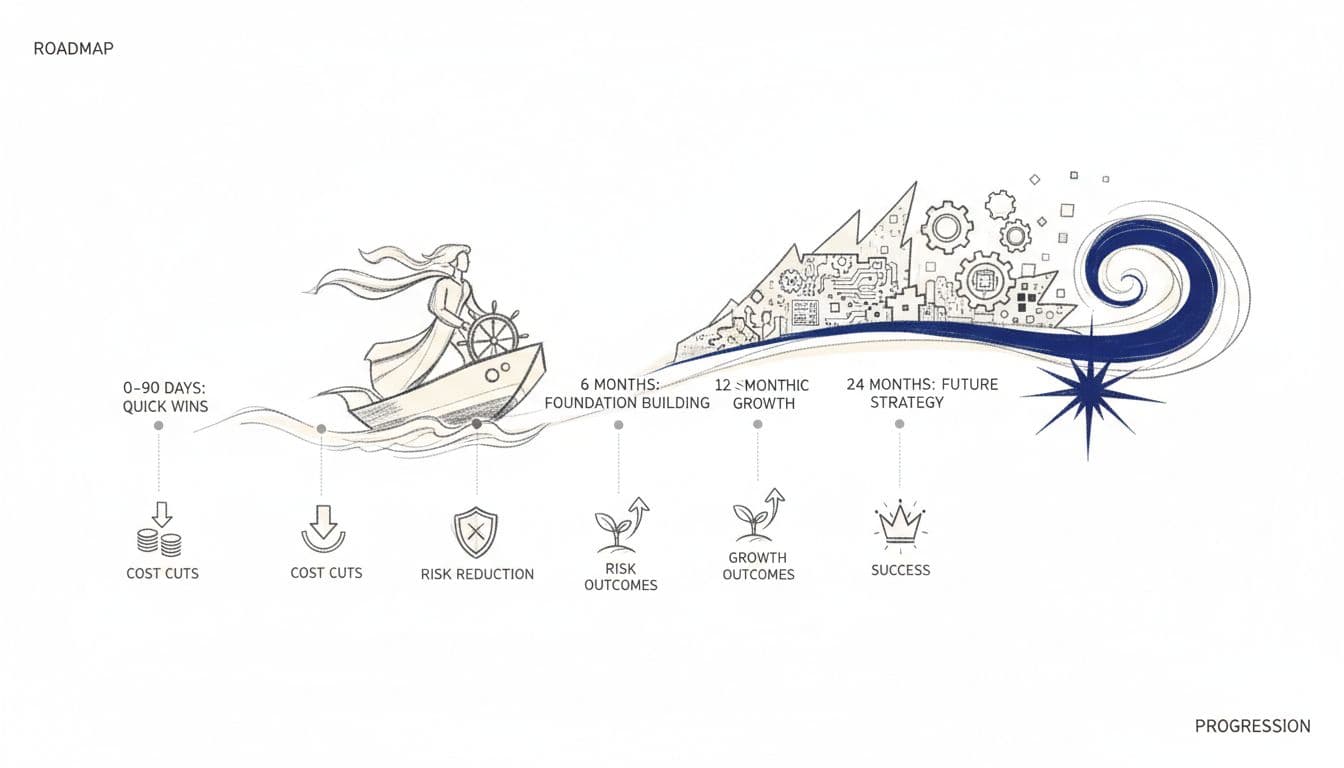
Practical Steps To Lower Tech Spend And Lift Results In The Next 90 Days
Industry data shows almost all mid-market firms are increasing budgets for digital initiatives like AI and security, yet many still struggle to see clear gains. A recent survey reported that nearly 70% of middle market companies are investing in AI, but the financial impact often lags the promise.
You can break that pattern faster than you might think.
Here is a 90-day playbook that does not assume spare capacity or a blank slate.
Find Quick Wins: Cancel, Consolidate, Or Right-Size Existing Tools
Start with a light audit of the total cost of investment in your current software investments and contracts. Aim for clarity, not perfection.
Look for:
- Licenses paid for but not used in the last 90 days
- Tools that do the same thing as another tool you already own
- Features you pay for but have never turned on
Examples of quick wins:
- Consolidating two chat or collaboration tools into one
- Reducing license counts to match real usage
- Canceling niche tools where only a few power users remain, then offering them options inside core systems
Many CEOs are surprised by how much spend can be freed in 60 to 90 days with this exercise alone, enabling significant cost reduction.
Fix The Worst Friction Points Your Customers And Staff Feel Every Day
Next, pick one or two high-friction journeys that everyone complains about and impact customer experience (CX):
- Order to cash in a logistics or manufacturing business
- Claim handling in insurance or healthcare
- Patient intake in a clinic
- Loan approval in financial services
You are not trying to replace the whole system in 90 days. You are trying to make visible, meaningful improvements in digital transformation with focused effort.
For instance:
- Add a simple status tracker so customers know where their order or claim stands
- Remove duplicate data entry steps that slow down front-line staff
- Automate a single repetitive task, like pulling data from one system into another
These focused fixes, aimed at boosting operational efficiency, build confidence that technology can help the business, not just drain the budget. They also give you concrete stories to share with your board when they ask about ROI (Return on Investment).
Put Guardrails Around AI And New Tech Experiments
AI and generative AI spend is rising fast, but as research on mid-market AI adoption shows, many pilots never reach production or profit. Articles like McKinsey’s technology trends outlook echo the point that execution quality matters far more than enthusiasm.
Set some simple guardrails:
- Limit pilots to a few, well-defined use cases
- Require clear measures such as time saved for productivity improvements, errors reduced, or cycle time cut
- Cap pilot budgets and run time until value is proven
- Require a security and compliance check before data is shared with any AI and generative AI tool
Appoint a small cross-functional group, including legal or compliance, to review AI and generative AI use. Their job is to keep experiments aligned with business goals and regulatory rules, not to slow you down for sport.
Create A 12 To 24 Month Roadmap That The Board Can Actually Read
Once you have some quick wins and cleaner spend, you are ready for a simple technology strategy roadmap that links technology, cost, and risk to your growth plan.
Keep it under control:
- Focus on 3 to 5 big themes, such as “modernize core systems,” “risk mitigation to reduce cyber risk,” “improve data quality,” or “unlock self service”
- Show when each theme starts, when key benefits should appear, and how you will measure them, including ROI (Return on Investment)
- Avoid deep technical detail; stay at the level of business impact
This roadmap becomes your filter. When a new tool, vendor, or request shows up, you ask, “Where does this fit on the roadmap, and what will we stop or delay to fund it?”
Bring In A Neutral Technology Leader On Your Side Of The Table
You may read all of this and think, “We do not have anyone who can own this end to end.” That is normal.
Hiring a full-time CTO, CIO, or CISO at big-company compensation may not fit your budget or current stage. At the same time, you cannot keep making seven-figure decisions with no senior technology voice you truly trust.
This is where fractional leadership or an external advisor focused on your interests can help you:
- Clean up existing spend and contracts
- Build the first version of your ROI (Return on Investment) dashboard and roadmap
- Prepare clear, confident messages for your board and lenders
- Translate technical tradeoffs into business options you can decide on
The point is not to “fix IT” in isolation. It is to give you, as CEO or COO, a partner who helps you turn technology from a drag on your energy into a controlled, strategic asset that drives competitive advantage.
Conclusion: You Can Turn Tech From A Cost Problem Into A Clear Growth Engine
If your tech spend feels high and your results feel low, you are not alone. Many mid-market leaders are increasing budgets for AI and generative AI, cybersecurity, and platforms, yet still struggle to see real returns on their technology investments. The gap comes from weak alignment with business outcomes, fuzzy ownership, activity-based metrics, and a missing senior technology voice at the table.
The good news is that technology ROI (Return on Investment) for CEOs does not have to be a mystery. With three sharp questions for every major spend, a small set of board-ready metrics focused on value realization, before-and-after comparisons, and a simple portfolio view, you can track ROI (Return on Investment) to see which investments deserve more fuel and which ones should be downsized or stopped. In the next 90 days, you can free up cash by shifting dollars from low-value to high-value work for stronger financial returns, reduce risk, and create visible wins for customers and staff to fuel business growth, even before you touch the big systems.
If you want a seasoned, neutral partner on your side of the table, visit the CTO Input website at https://ctoinput.com/schedule-a-call to schedule a discovery call about fractional CTO, CIO, or CISO support. For more practical guidance on aligning technology, cost, and risk with your growth plan, explore the articles on the CTO Input blog.