
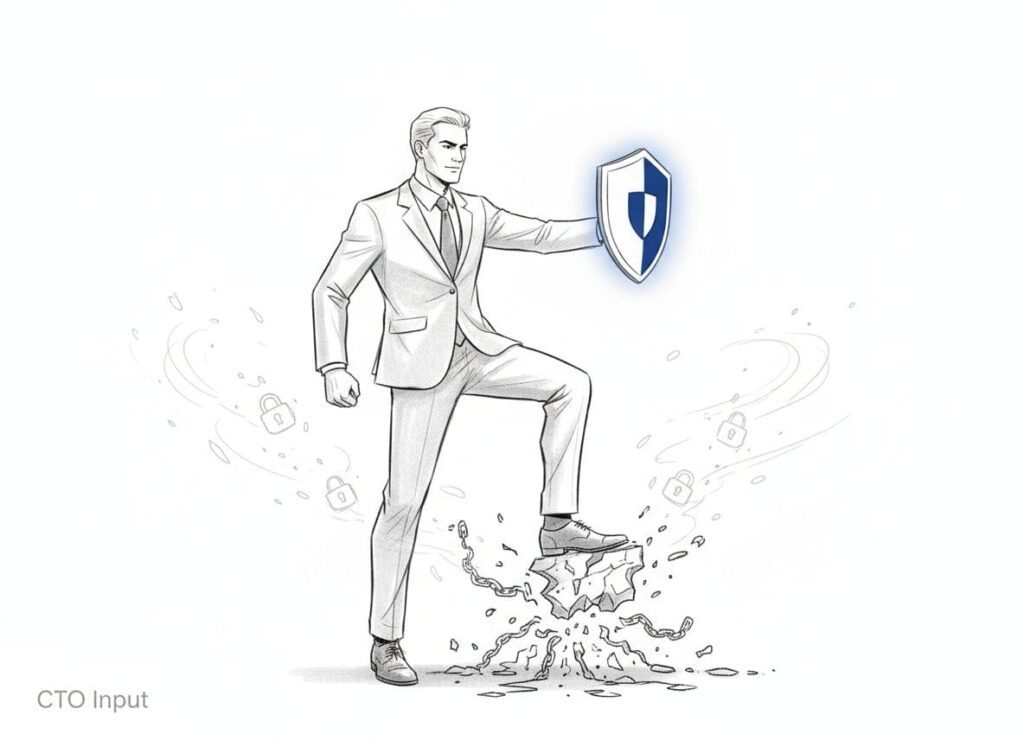
You are a CEO, COO, or founder who spends more on tech and vendors every year, yet you still wake up to headlines about vendor breaches and wonder, “How exposed are we, really?” Your own systems might be “good enough,” but that is not the full story anymore. In 2026, third-party cyber risk for executives is not an IT topic. It hits revenue, margins, and your reputation in the market. Recent data shows that about 30% of breaches now involve supply chain exposures through third-party vendors, with an average cost near $4.9 million per incident. In the evolving threat landscape, these are not edge cases; they are board-level events that can reshuffle your entire plan. Public examples of large third-party breaches keep growing, as tracked in reports like FortifyData’s overview of top third-party data breaches in 2025.
CTO Input exists to be the calm, experienced guide on your side of the table. The goal is simple: turn your messy vendor stack into a manageable risk portfolio through effective risk management. This article gives you a small set of contract-level and decision-level moves you can take now, so the next vendor headline is a challenge, not a crisis.
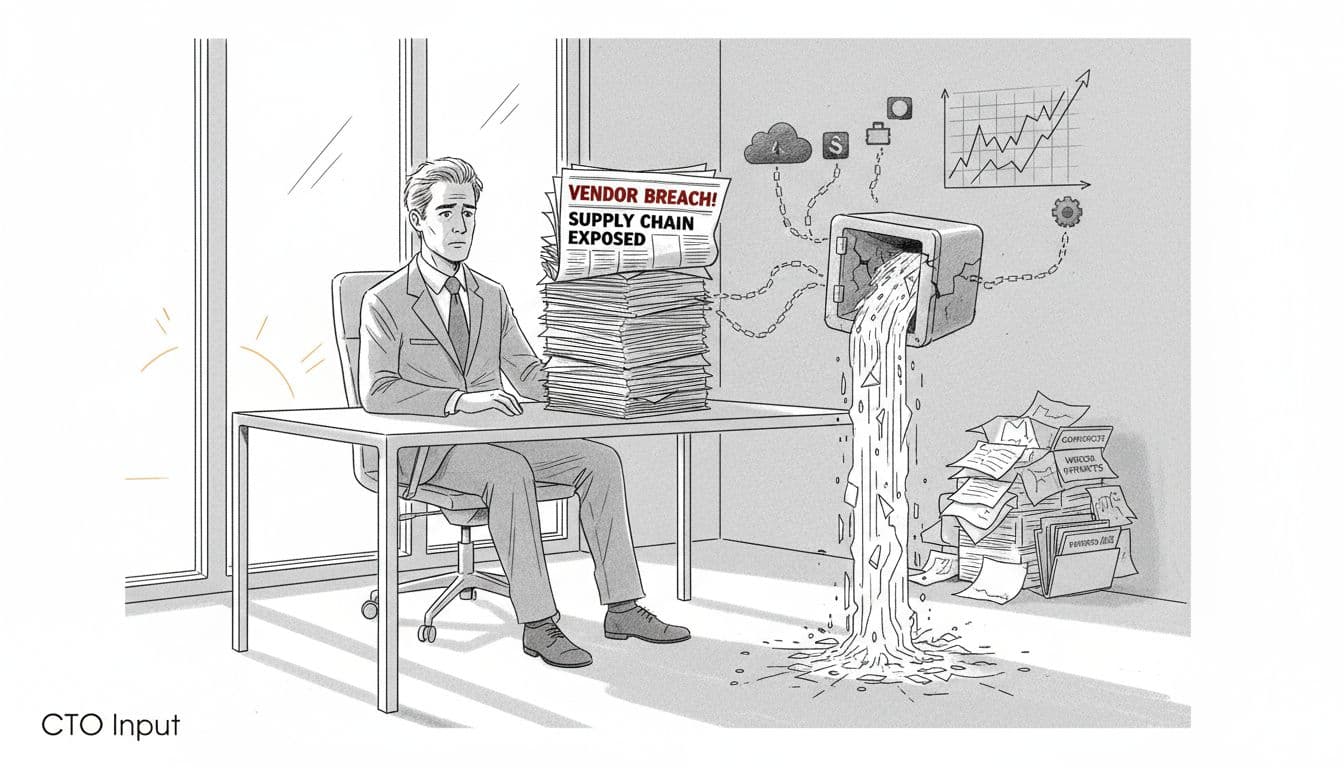 When a vendor gets breached, your customers do not care whose firewall failed. They care that their data, money, or operations are at risk. To them, the buck stops with you.
You share three things in cybersecurity with vendors: data, access, and brand. Your payroll provider has employee data. Your marketing tools hold customer profiles. Your service providers often have broad access to your core systems. When any of them go down or leak data, regulators and customers still see your logo at the top of the contract.
Think about a file transfer service used for sending financial reports, or a shared cloud tool used for patient or client data. If that service suffers ransomware, your operational risk can stall everything, your customers lose trust through reputational damage, and you are left explaining what happened.
Studies on third-party risk statistics show that roughly a third of breaches now involve third-party risk, and these events cost more on average than “direct” breaches. Around $4.8 to $4.9 million per incident in financial losses is material for any mid-market firm.
Third-party risk and fourth-party risk usually surfaces at the worst possible moments: a major customer renewal, a compliance audit, a new funding round, or M&A due diligence. That is when vague answers hurt you most.
How third-party cyber risk for executives shows up in the boardroom
Board members, lenders, and major customers now ask sharper questions, such as:
- Which vendors hold the data our largest customers care about?
- How do we monitor their security posture over time with continuous monitoring, not just at signup?
- If a key vendor is breached or goes offline, what is our playbook?
If your answers sound like, “IT has that covered,” or, “We send them a questionnaire, which falls short of proper Third-Party Risk Management (TPRM),” confidence drops. You get more conditions, more follow-up, and more delay.
Weak answers trigger:
- Extra controls or covenants from lenders
- Slower closings for deals and renewals
- Requests to bring in outside security audits or advisors
Strong answers, in plain business language, tell the board you treat third-party risk as part of core operations, not a side project for IT.
The hidden vendor and fourth party blind spots in your stack
Your risk does not stop with your direct vendors. It extends to their vendors too. That is fourth-party risk.
Simple example:
Your payroll provider might rely on a separate file transfer platform. Your marketing SaaS might sit on a cloud provider that later has its own security incident. Your data is riding along that chain, even if you never signed a contract with those firms.
Most mid-market companies do not have a clear map of their external attack surface or who touches their data beyond first tier vendors. That is why breaches can feel like they come out of nowhere. You cannot manage what you do not see.
Three Moves Executives Can Make Now To Shrink Vendor Breach Risk
You cannot control every vendor’s firewall, but you can control how you work with them, and how much damage a breach can do.
These three moves are executive decisions in Third-Party Risk Management (TPRM), not technical tasks. Your team can execute the details, but the direction has to come from you.
Move 1: Map your critical vendors and data in one simple view
Start with clarity. Build a simple map through risk assessment that you can review in a single meeting.
Ask your team to list them by business process, not by department:
- Payroll and HR
- Payments and billing
- Customer support and CRM
- File sharing and collaboration
- IT services, managed service providers, custom software shops
For each, mark:
- Do they hold sensitive data such as financials, health data, or personal details?
- Do they have deep access to internal systems or networks?
- Are they in a higher-risk category, like IT services, cloud infrastructure, or file transfer?
Turn this into a basic risk tiering model:
- Tier 1 (Critical): A breach here hits revenue or regulatory compliance fast.
- Tier 2 (Important): Painful, but not instantly existential.
- Tier 3 (Low): Limited data, limited access, low business impact.
The goal is risk identification, not a perfect inventory. The goal is a clear picture of where a vendor breach would hurt your revenue, compliance, or customer trust first, setting the stage for continuous monitoring. That picture becomes the anchor for contracts, monitoring, and board updates.
Move 2: Use your contracts to shift and contain third-party cyber risk
Your contracts are one of the strongest tools you have to manage third-party risk. They set expectations before trouble starts.
For your Tier 1 and key Tier 2 vendors, push for:
- Clear security and compliance duties. Spell out the standards they must follow, such as security controls, encryption, access controls, and regular testing. This sets a floor you can hold them to.
- Tight breach notification timelines. Think hours or a small number of days, not weeks. This helps you learn about issues before your customers or the press do.
- Rights to independent security reports. Ask for SOC 2, ISO 27001, or similar reports, plus summaries of meaningful findings on vulnerabilities. You are not outsourcing blind.
- Subcontractor transparency. Require them to manage and disclose their own critical subcontractors, especially those that touch your data. This gives you sight into that fourth party chain.
- Data handling and deletion rules. Set clear rules for data protection, including how long data is kept, how it is destroyed, and what happens when the contract ends. You do not want customer data sitting in an old backup three years after you leave.
- Limits on data use for AI. State whether they can use your data to train AI models. Many executives are surprised to learn how default terms treat “service data.”
- Indemnity and cyber insurance expectations. Align on who covers what if a vendor breach hits your customers.
You do not need to write the clauses yourself. You do need to insist your legal, procurement, and IT teams use contracts as a third-party risk tool in TPRM, not just a price and feature checklist.
Move 3: Plan your response now so a vendor breach does not freeze the business
A vendor breach is not the time to figure out who is in charge. That needs to be clear now.
Ask for a simple vendor breach playbook as part of your incident response plan that answers:
- Who decides what to do if a major vendor is taken offline?
- How do we quickly know which customers, regions, or products are affected?
- When do we involve legal, PR, and the board?
- What do we owe customers and regulators at a minimum, and in what time frame?
Run at least one tabletop exercise focused on a vendor breach, not just your own systems. Use a real Tier 1 vendor as the scenario. Have leaders walk through the decisions, the timing, and the communications.
Groups like Bitsight have shown, through third-party breach telemetry, how fast vendor-related incidents can spread. Planning on paper enables continuous monitoring, reduces chaos, speeds decisions, and signals to your board that you treat TPRM as an ongoing part of operations.
When To Bring In Outside Help To Tame Third Party Cyber Risk
There is a point where asking IT or legal to “handle Third-Party Risk Management (TPRM)” stops working. You feel it when your vendor TPRM maturity lags and:
- You cannot answer basic third-party risk questions in a board or lender meeting.
- No one owns vendor risk management across IT, legal, finance, and the business.
- Service provider contracts and renewals happen in silos, with no shared standards.
- Security reviews are long questionnaires that everyone fills out instead of proper risk assessment, and no one trusts.
In that situation, you do not need another platform right away. You need a seasoned, neutral cybersecurity advisor who can sit on your side of the table and translate third-party risk into clear priorities.
A fractional CTO, CIO, or CISO can help you:
- Prioritize which vendors matter most and why
- Update contract templates and negotiation playbooks
- Design a right-sized monitoring and response approach with continuous monitoring and security ratings that fits your stage and budget
At CTO Input, that often starts with a short assessment or roadmap, not a giant multi-year program. A focused review of your vendor stack, contracts, and incident planning can give you a practical path to risk remediation in a few weeks. If you want to explore that option, you can request a brief conversation at https://ctoinput.com/schedule-a-call.
Conclusion: You Cannot Control Every Vendor, But You Can Control Your Exposure
You cannot stop every vendor breach. You can decide how exposed your company is to cyber risk and third-party risk, and how ready you will be when it happens.
The core moves of Third-Party Risk Management (TPRM) are simple: know your critical vendors, data flow, and data, harden your contracts so third-party risk is shared and clear, and rehearse your response so a vendor incident does not freeze the business. That is what your board, lenders, and major customers now expect from serious leaders, including regulatory compliance.
Picture the upside. Fewer ugly surprises from third-party risk. Cleaner, faster answers in board meetings. Less finger pointing when something breaks. More confidence that your technology partners, from SaaS tools to IT services, support your cybersecurity and security posture instead of threatening your growth plan.
Strong Third-Party Risk Management (TPRM) like this minimizes vulnerabilities. If you want help turning that picture into a plan, visit https://www.ctoinput.com, and explore more practical, executive-focused articles on the CTO Input blog at https://blog.ctoinput.com.