
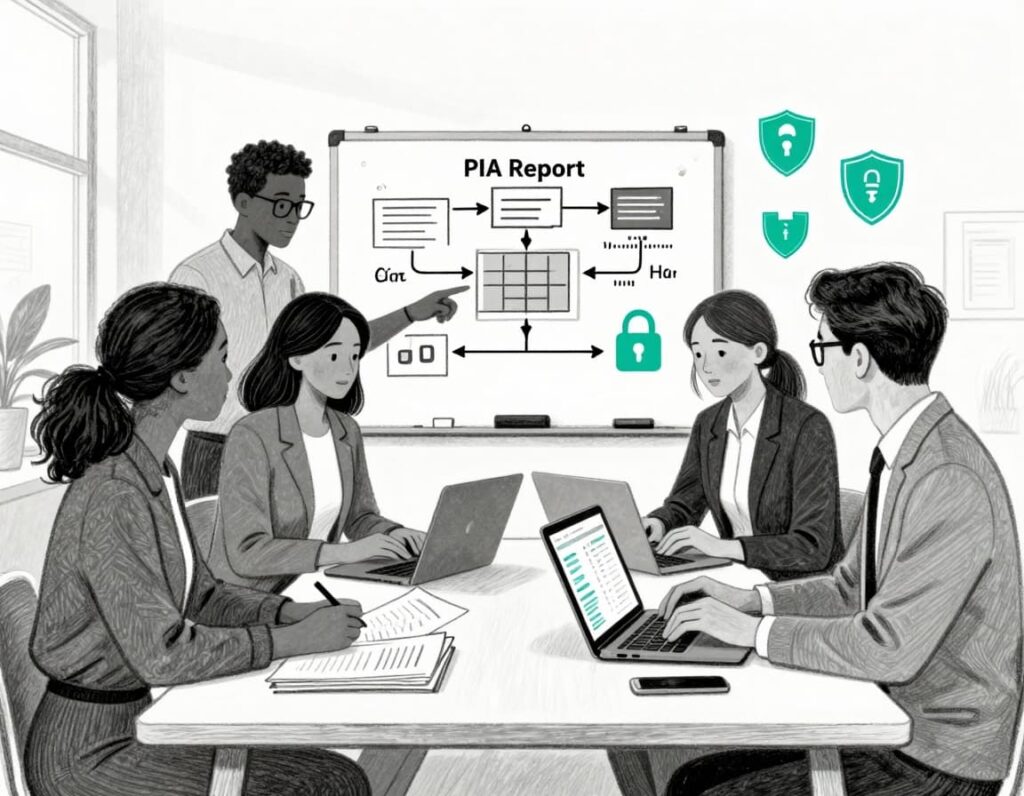
If you run a justice-focused nonprofit organization, you live with a quiet fear: one spreadsheet, one inbox, one vendor mistake away from exposing a client story that can never be taken back.
A privacy impact assessment for legal nonprofits is a simple, structured way to look that risk in the eye before you ship a new tool, share a new dataset, or sign a new vendor contract. It helps you slow down just enough to ask, “What personal information (PI) are we collecting, why, and how could this hurt the people we serve?”
For legal nonprofits in 2026, privacy impact assessments (PIAs) are no longer a nice extra. They are how you protect clients in immigration, incarceration, and youth work, comply with legal obligations under new state privacy laws, and answer the hard questions your funders and board are now asking. This post walks through a lean, repeatable PIA approach that fits small teams and tight budgets.
Key takeaways: Privacy impact assessment for legal nonprofits in 2026
- Run a PIA whenever a project changes processing activities involving how you collect, store, or share sensitive client data.
- A basic PIA should answer what data you collect, who can see it, what could go wrong, and how you reduce harm.
- PIAs lower risk for immigrants, incarcerated people, and youth by forcing clear choices about access, retention, and sharing.
- Several state privacy laws now cover nonprofits and require data protection impact assessments (DPIA) as required documentation for high risk processing activity.
- A short, standard PIA helps you respond with confidence to questions from boards, auditors, and funders about data protection.
What is a privacy impact assessment and why legal nonprofits need one
A Privacy Impact Assessment (PIA) for legal nonprofits is a structured review you run before or during a project that touches client data. It is part policy, part risk review, and part ethics check.
U.S. federal agencies have used PIAs for years under the E-Government Act of 2002 to review new systems and programs. You can see detailed examples from federal bodies like the Consumer Financial Protection Bureau’s privacy impact assessments. Legal nonprofits do not need that level of volume, but the idea is the same: slow, clear thinking before you flip the switch.
For organizations already wrestling with scattered systems, case data in many tools, and constant grant reporting, a PIA becomes a pressure valve. It links privacy questions to the broader technology and data risk picture you may already be exploring, similar to the larger technology challenges described for legal nonprofits at CTO Input’s legal nonprofit technology challenges overview.
Plain-language definition: A stress test for client data and trust
Think of a Privacy Impact Assessment (PIA) as a safety check or stress test for identifying privacy risks in how you handle client stories and records.
At its core, a PIA asks five things:
what personally identifiable information (PII) you collect, why you collect it, who can see it, what could go wrong, and what you will do to reduce harm.
Picture a new online intake form for immigration clients. A PIA would ask: do we really need full addresses, social security numbers, and detailed travel history at the first contact, or can some of that wait until after screening? That is not a form to file away. It is a decision tool for leadership.
Why PIAs matter more for justice-focused organizations
The stakes in your work are not abstract.
A data leak about immigration status can raise deportation risk. Exposure of incarceration history can trigger retaliation inside prisons or jails. Poorly protected youth records, which may fall under HIPAA, or survivor sensitive data can follow a young person for years.
By default, treat these categories as high risk. New state privacy laws within this legal framework, such as the Colorado Privacy Act, the California Consumer Privacy Act (CCPA), and others in Maryland, Minnesota, New Jersey, and Delaware now reach many nonprofits if they meet activity thresholds (consult legal counsel to confirm), and several require documented impact assessments for sensitive or high-risk processing activities. Putting PIAs in writing shows regulators, funders, and boards that your organization treats privacy as part of its duty of care, not an afterthought, while upholding consumer rights; it connects directly to broader modernization efforts like those outlined in CTO Input’s technology challenges for legal nonprofits.
When should a legal nonprofit run a privacy impact assessment?
You do not need a PIA for every tweak, but you do need clear triggers. Good moments to run one include:
- Launching or replacing a case management system.
- Adding online intake, text, or chat tools.
- Sharing client data with a partner, evaluator, or funder.
- Moving files into a new cloud tool or document platform.
- Starting any project that touches immigration, incarceration, youth, or survivor data.
- Building dashboards or reports from case data, even if you plan to de-identify it.
State laws may require PIAs or similar assessments for sensitive or high-risk processing. The safest practice is simple: if a mistake could cause serious harm to a client, run at least a short PIA. Many can be one to three pages.
A simple step-by-step privacy impact assessment process for legal nonprofits
You do not need a full-time privacy officer. You do need a clear, repeatable path for conducting a PIA.
Start with a one-page snapshot of the project and data
Begin with a single page that anyone on your leadership team can read.
Include: project name, project owner, what the project does (for example, “new online intake for detained youth” or “data sharing with reentry partner”), what types of personal information (PI) and sensitive data it will handle, and why that data is needed to serve your mission.
End with a simple decision line, such as: “We will proceed with this project only with the protections listed in this PIA in place.” That page becomes something you can share with boards or funders to show thoughtful review.
Map what data you collect, how it flows, and who can see it
Next, build a basic data flow analysis in words, not a fancy diagram.
List what you collect: name, contact details, immigration status, charges, juvenile records, disability info, family details. Note where it lives: case management system, spreadsheets, email, cloud storage. Then write down who has access inside the organization and which external partners, evaluators, or funders receive copies.
Highlight sensitive fields so they stand out. This same inventory also supports broader modernization and planning work like the kind described in CTO Input’s technology roadmap for legal nonprofits.
List the biggest privacy risks and how serious they are
Now ask, in plain language: what could go wrong?
Common risks include unauthorized access, staff error, vendor misuse, law enforcement interest, subpoenas, or cross-border transfer of data stored on foreign servers. For each one, rate how likely it is (unlikely, possible, likely) and how bad it would be (low, medium, high).
Treat immigration, incarceration, and youth data as high impact by default. Aim for a short list of the top five to ten risks instead of a long catalog that no one will use.
Choose practical protections that fit your staff and budget
For each major risk, pick at least one risk mitigation strategy.
Technical steps can be simple: apply data minimization by collecting fewer fields, restrict who can see sensitive data, turn on multi-factor authentication, encrypt laptops and cloud storage, require stronger passwords, use role-based access in your case system.
Administrative steps matter just as much: implement data security policies such as short privacy trainings, written data-sharing agreements, shorter retention periods for especially sensitive records, clear rules about using personal devices. Many of these steps also cut broader cybersecurity and technology risk and can fit into a larger plan like the ones described in CTO Input’s legal nonprofit technology products and services.
Pay extra attention to youth, immigration, and incarceration data
For your highest risk groups, add an extra filter.
Practical habits might include:
collecting fewer identifiers, shortening retention when law and ethics allow, using field-level encryption or strict access rules for sensitive data like immigration status and juvenile records, and stripping identifiers from data used for research or funding reports.
Pull program directors and frontline staff into these choices so the safeguards are real and do not block urgent legal work. In CTO Input’s legal nonprofit technology case studies, you can see how strong privacy design still supported powerful reporting and stories of impact.
Turning PIAs into an ongoing privacy practice your board and funders will trust
A Privacy Impact Assessment (PIA) matters most when it becomes a habit, an integral part of data governance, not a one-off fire drill.
Build a lightweight PIA routine that fits your capacity
Pick one person as the informal PIA coordinator, often an operations or technology lead.
Agree on three to five triggers when a PIA is required; embrace Privacy by Design to anticipate privacy needs proactively, such as with new systems, new data sharing, or any project that touches the highest risk client groups. Use a short standard template and review your highest risk systems at least once a year.
“Good enough and repeatable” will protect your clients more than a perfect template used once every five years, and it aligns well with broader governance work that outside advisors like CTO Input support.
Show your work to boards, funders, and community partners
Turn your PIAs into small artifacts that build trust.
Short memos or one-page overviews can show what you considered, which controls you added, and what residual risks remain. Include brief privacy updates in board packets and major funder reports when grants touch sensitive data.
This kind of transparency helps community partners see that you hold their stories with care, and documented PIAs give you a stronger defense if something still goes wrong.
FAQs: What Is A Privacy impact assessment for legal nonprofits
Are Privacy Impact Assessments (PIAs) legally required for my nonprofit?
Privacy Impact Assessment legal requirements vary. There is no single national rule. Some state privacy laws exempt many nonprofits, others do not, and several require impact assessments for high-risk processing if you meet activity thresholds to comply with privacy laws. Strong privacy practices also help mitigate risks such as a government data demand. Your counsel or privacy advisor should review states where you collect data.
How long should a PIA take?
For small projects, expect a few hours spread over a week to gather details, name risks, and agree on protections. Larger systems or data-sharing efforts may take longer, but the goal is still a focused, usable document, not a 50-page report.
Who should lead PIAs in a small legal nonprofit?
Often it is an operations, technology, or data lead who understands both programs and systems. They should pull in program staff, IT vendors, and, when needed, external privacy or security advisors.
What if our systems are old and messy, should we wait?
Do not wait for perfect systems. Start with your next new project or major change and use each PIA to learn a bit more about your data and risks.
Conclusion: Making A privacy impact assessment part of leadership work
For legal nonprofits that handle sensitive stories every day, Privacy Impact Assessment (PIA) are now a core leadership tool, not a side task for IT. A simple PIA process helps you see your real data flows, name the potential privacy risks to your communities, and choose protections that staff can actually follow. It also gives you clear, honest answers when boards, auditors, and funders ask how you are handling privacy, the risk of government data demand, and state law expectations.
CTO Input helps justice-focused organizations map their information systems, set up practical Privacy Impact Assessment (PIA) templates and routines, align privacy work with a broader technology roadmap, and make smarter choices about vendors and data-sharing. If you want support building a privacy practice you can defend, you can schedule a call with CTO Input. You can also explore more technology and governance insights on the CTO Input blog and deeper articles at the CTO Input blog archive.
PIAs are not theory. They are a concrete, doable step toward safer, more trusted systems that protect both your clients and your staff.