

You’re running on assumptions about your donor and client data. That nagging sense of dread is real. It’s the cost of invisible risk and fuzzy ownership. A single mistake with a spreadsheet or a vendor problem can erode decades of trust you’ve worked to build.
A nonprofit data privacy risk map is how you move from hoping you’re secure to knowing you have control. This isn’t about creating a massive, complex document. It’s about making ownership and risk visible so you can make clean decisions and protect your reputation.
The High Cost of Flying Blind With Donor Data

If you're like most nonprofit leaders, you see the headlines about security breaches and hope it doesn’t happen to you. It feels like a distant problem, until a near-miss at your own organization makes it painfully real. This isn't just bad luck. It's the predictable outcome of an operating system that relies on hope.
The costly mess is familiar: donor lists scattered across countless spreadsheets, sensitive client case files in unsecured shared drives, and vendor access that was never turned off. You keep paying for tools, but the mess stays. This chaos creates a constant "coordination tax"—time your team wastes in fire drills, hunting for answers that should be at their fingertips. This distraction slows down execution and pulls focus from your mission.
The risk is not theoretical. Nonprofits are prime targets, with incidents taking an average of 57 extra days to notify victims compared to other sectors. With each incident affecting thousands of individuals, the potential to alienate your donor base is very real. You can discover more insights about these nonprofit breach impacts and their financial fallout. This is the price of flying blind.
The Real Problem: Your Operating System, Not Your People

This persistent vulnerability isn't happening because your team isn't smart or dedicated. Smart people fail in ambiguous systems. The real problem is the organization's underlying "operating system" for data is broken. When no single person has explicit ownership of a dataset, accountability diffuses until it disappears.
This is especially common in the nonprofit world. Unlike a bank, your organization probably doesn't have strict external mandates for reporting every security incident. This creates a dangerous information vacuum. You simply can't manage or protect what you can't see, which is why there is chronic nonprofit incident reporting in this analysis.
When an incident, or even a near-miss, occurs, the first question is always, "Who owns this?" Too often, the answer is a collective shrug. Is it the program manager who uses the tool? The IT volunteer who set it up two years ago? The vendor who hosts the data? This ambiguity creates decision paralysis when speed is critical. Policies gather dust without clear decision rights and an enforcement cadence.
A Scenario: The High Price of a Forgotten Vendor
I worked with a human services organization that provided counseling to at-risk youth. They ended a partnership with a local agency that handled their case management intake. The contract was terminated, but no one was explicitly assigned the task of ensuring client data was securely returned or destroyed. The handoff was never defined.
Eighteen months later, a journalist called the Executive Director. Their former partner had a data breach. Sensitive case notes, including names and confidential details of the organization's former clients, were exposed online.
All work stopped. The leadership team spent days just answering basic questions:
- Who was the owner of the data transfer process? Nobody.
- What was the decision to be made? They debated if they were even legally obligated to notify clients.
- What was the price they paid? They burned weeks in crisis mode with legal counsel, paid a premium for a PR firm, and saw a measurable drop in new client intake for two quarters. Trust was shattered.
This wasn't a technology failure; it was an ownership failure. A simple nonprofit data privacy risk map would have assigned a named owner to the vendor offboarding process, with a clear checklist defining "done." It transforms governance from a binder on a shelf into a real, operational control. A data governance framework provides this structure in our guide.
The Decision: Make Ownership Explicit
As a leader, the most important decision you can make isn't about buying another security tool. It’s a fundamental choice: to swap ambiguity for clarity. You must decide to run your organization with explicit ownership and inspectable proof.
This starts by asking simple but powerful questions and demanding one name for each answer:
- Who is the single owner responsible for our donor database?
- Who is accountable for the security of our client intake system?
- What is the exact escalation path when a vendor reports a breach?
Getting these answers is an act of leadership. You are directly confronting the fuzzy ownership that leads to paralysis and multiplies your risk. This decision has an immediate payoff with your board and insurers. When you show them a chart with named owners, you demonstrate you are exercising due care. You are also translating the issue into the language of governance: clarifying delegated authority and defining your organization's risk appetite.
The most common objection is "we don't have time for this." You are already paying the price for ambiguity in daily fire drills and stalled projects. The time is already being spent. The decision for clarity is about redirecting that energy from reactive chaos to a predictable, low-stress operating rhythm.
The Plan: Your 30-Day Move to Restore Control

You don’t need a massive, multi-year project to get a handle on your data privacy risks. You need a focused, 30-day sprint to gain visibility and reduce your risk exposure. This plan is about trading ambiguity for action by installing a simple process with clear owners, a steady cadence, and tangible results.
Week 1: Name the Owner and Define the Outcome
Your first move is to assign a single owner for this initiative. One person, not a committee. Their outcome for the 30-day sprint is to deliver a "version 1" nonprofit data privacy risk map. To keep it manageable, the owner will focus on one critical data type, like your major donor data. By the end of this week, the owner should state their objective simply: "I will deliver an initial risk map for our major donor data, identifying where it lives, who has access, and its top three risks."
Week 2: Map the Handoffs and Define Done
The owner’s job is to map the current reality. They will create a simple inventory of where donor data lives (CRMs, spreadsheets, etc.) and who has access (staff, volunteers, vendors). Next, you must define what "done" looks like for this V1 map. A great definition: "A one-page diagram showing the systems and access points for our donor data, with a list of the top five potential failure points." A simple, actively used map is infinitely more valuable than a perfect one that collects dust. Understanding broader Governance, Risk, and Compliance (GRC) systems can provide a helpful framework here.
Week 3: Remove One Blocker and Ship One Visible Fix
Action builds momentum. In Week 3, the owner shifts from mapping to fixing. They will identify one high-priority, low-effort risk from the list and solve it. A classic example is cleaning up access permissions for former employees. This is your first tangible win. It proves this is not just another planning exercise; it's an initiative that delivers measurable improvements and helps you learn how to prevent data breaches.
Week 4: Start the Weekly Cadence and Publish a Proof Snapshot
The final week is about making the process stick. The owner will establish a 30-minute weekly meeting to review the risk map and track progress. This consistent cadence turns a one-off project into a reliable operational process. The final deliverable is a one-page proof snapshot for leadership, showing the mapped data asset, the named owner, key risks, the fix completed in Week 3, and the next risk to be addressed. This proves you can move from chaos to clarity.
Proof: What Your Board and Insurers Will Accept
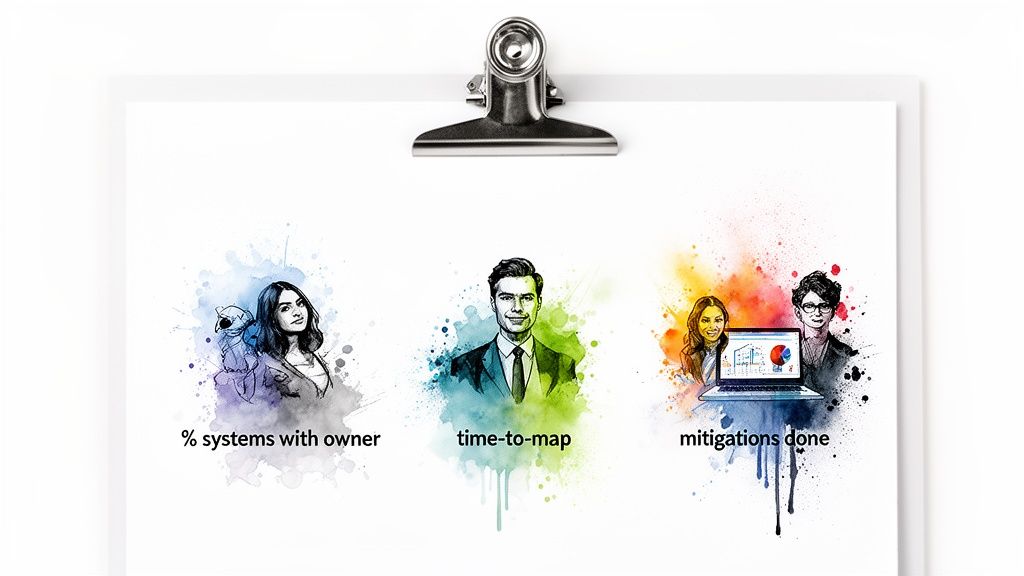
To satisfy your board, auditors, and underwriters for your cyber risk insurance, you need inspectable evidence that your governance is active. Your nonprofit data privacy risk map is the source of that proof. It's the living document that turns good intentions into a defensible reality.
Your board doesn't need technical details. They need to know that risk is being managed. You must translate your risk map into a concise, board-ready "proof pack" that shows you are in control. Focus on signals that prove you are genuinely reducing risk. For more on how this ties into broader legal frameworks, our guide on privacy impact assessments for legal nonprofits is a great resource.
Three Metrics That Demonstrate Real Control
Tracking just three metrics can tell a clear story of progress without requiring new tools.
- Percentage of Sensitive Data Systems with a Named Owner: Your goal is 100% coverage. A low number is a red flag for fuzzy ownership and high operational risk. Tracking the weekly increase shows you're systematically closing these gaps.
- Time-to-Produce a Data Map for a Specific System: If an auditor asks, "Show me who has access to your major donor data," how long does it take to answer? Aim to get this down to under one hour. This metric reflects your operational readiness.
- Number of High-Risk Mitigations Completed Per Quarter: A risk map that doesn't drive action is just a picture. By completing a set number of fixes, you prove your governance process is more than talk. A steady pace of two to three completed high-risk mitigations per quarter is a strong signal of progress.
This proof pack should be a simple, one-page document updated quarterly. It combines these metrics with a quick summary to give any non-technical leader the full picture. It’s not about overwhelming leadership with data. It’s about providing crisp, defensible answers that demonstrate control and build confidence. This can often lead to better terms on policies like cyber risk insurance.
Let's Find Your Starting Point
The cycle of fire drills and last-minute hunts for information doesn't have to be your reality. Building a nonprofit data privacy risk map is your first step toward a calmer, more effective way of operating. This is about building the confidence to focus on your mission, knowing your data practices are sound.
The goal isn’t more paperwork. It’s creating a clear system of ownership that lowers your risk and frees up your team to focus on the work that truly matters. The 30-day plan we've outlined gives you a roadmap, but leading this change while juggling daily operations is a massive challenge.
As fractional and interim CTO, CIO, and CISO leaders, we don't just hand you a list of recommendations. We roll up our sleeves and work with your team to implement the fixes, make ownership clear, and give you the inspectable proof your board needs.
Your next move is to book a clarity call. In one focused conversation, we will help you pinpoint your top data trust risks and sketch out a practical 30-day plan to restore control.
Ready to trade chaos for clarity?