

SEO Title: What Is a Virtual CTO and When Do You Need One for Growth Control
Meta Description: A practical guide to the virtual CTO role, when to hire one, and how it helps fix ownership gaps, vendor chaos, risk, and stalled execution.
Slug: virtual-cto-when-do-you-need-one
Growth can feel like progress on paper and chaos in practice.
Revenue is moving. Headcount is growing. Customers are asking for more. But inside the business, technology starts acting less like a support system and more like a source of drag. Projects begin with energy and end in ambiguity. Vendors keep talking. The team keeps reacting. You keep getting pulled into decisions you shouldn't still own.
That usually isn't a talent problem. It's a leadership gap.
A virtual CTO is often the right answer when technology decisions are affecting growth, risk, reporting, or execution, but the business isn't ready for a full-time CTO. Its primary benefit isn't just lower cost. It's restoring ownership, direction, and a working operating rhythm so the business can move without constant status hunts and fire drills.
When Growth Creates More Chaos Than Progress
A familiar pattern shows up in scaling companies.
The founder still approves major technology decisions because nobody else feels safe to own them. The operations lead is chasing updates across Slack, email, Jira, and vendor calls. The IT or engineering lead is capable, but buried in interruptions. Everyone is busy. Few things feel fully under control.
The symptoms look operational, but the root issue is structural.
The coordination tax gets expensive fast
You feel it when:
- Projects stay open too long: Work starts, stalls, gets re-scoped, and drifts because ownership isn't explicit.
- Vendors fill the vacuum: The roadmap starts reflecting what outside providers sell well, not what the business needs most.
- Leaders become human routers: The CEO or COO keeps translating between teams because nobody owns the whole picture.
- Risk stays vague: Security, compliance, resilience, and data handling get discussed only when a renewal, audit, or incident forces the issue.
If you're asking, "Who owns this, what's the plan, and why is this still messy?", you're already dealing with a technology leadership problem.
This isn't rare. One guide focused on small businesses notes a 40% failure rate in tech initiatives due to poor alignment, and cites a 2025 Gartner projection of a 27% rise in demand for vCTOs to address governance and execution issues, not just strategy alone (Synlabs).
What leaders usually miss
Most companies don't notice the break when it happens.
At first, informal leadership works. A strong vendor, a reliable senior engineer, or a hands-on founder can keep things moving. Then complexity rises. A second system gets added. Another vendor comes in. Security questions get harder. Customers expect cleaner delivery. The board wants clearer answers.
The old model doesn't collapse all at once. It leaks.
That leak shows up as rework, unclear priorities, burned-out operators, and reporting that depends on chasing people down instead of reading from a stable system.
What a Virtual CTO Does
A virtual CTO gives you executive-level technology leadership without turning every problem into a full-time executive hire.
That means they work on the business's technology system. They don't run helpdesk tickets. They don't replace your engineer, your MSP, or your product team. They create clarity about what matters, what comes next, who owns what, and where the risk sits.

It's leadership, not extra hands
A virtual CTO should answer questions like these:
- What are we trying to build toward
- Which systems matter most to growth and control
- Where are we taking unnecessary risk
- Which vendor decisions are helping us, and which are steering us
- What should leadership review every week or month to stay ahead
If you want a plain-language explanation of what strong technical leadership looks like across strategy, people, and execution, that resource is useful because it separates decision-making from day-to-day task handling.
Why this model keeps gaining ground
The market is moving this way for good reason. The virtual CTO market is expanding 3-4 times faster than traditional executive hiring, and companies can usually engage a virtual CTO in 2-4 weeks, compared with 3-6 months for a full-time hire. Cost matters too. A full-time CTO can cost over $250,000 in the first year, while a virtual CTO engagement typically ranges from $72,000-$144,000 annually (TST Technology).
That speed matters when growth is already being taxed by indecision.
What a virtual CTO is not
A lot of confusion comes from putting the same label on very different roles.
| Role | What they mainly do | Where they usually fall short |
|---|---|---|
| IT manager or MSP | Keeps systems running and handles operational support | Usually doesn't own business-level technology direction |
| Consultant | Gives advice or a report | Often leaves after the deck is done |
| Senior engineer | Solves implementation problems | Usually isn't there to govern spend, risk, vendors, and executive decisions |
| Virtual CTO | Aligns strategy, ownership, risk, and execution | Needs a clear mandate and real access to leadership |
A good virtual CTO is there to make decisions clearer and execution more reliable. If they only produce recommendations and disappear, that's not leadership. That's paperwork.
Key Responsibilities of a Virtual CTO
You shouldn't hire a virtual CTO for vague reassurance. You should expect concrete business outputs.
The role becomes valuable when it turns confusion into decisions, and decisions into repeatable follow-through.
Strategy and roadmap that guides action
A primary job of a virtual CTO is strategic roadmapping. Done well, it can support 25-35% faster project delivery, and the same work can improve operational productivity by 30% when it introduces the right automation or cloud decisions at the right time (Essendis).
That doesn't mean a bigger roadmap. It usually means a shorter one.
A useful roadmap should show:
- What matters now: The handful of initiatives tied directly to growth, resilience, customer delivery, or margin.
- What can wait: Work that is technically interesting but commercially premature.
- What must stop: Duplicate tools, low-value projects, and vendor-led detours.
Governance and risk that leadership can inspect
This is the part most articles underplay.
A virtual CTO should create a system where leadership can see risk without drowning in detail. In practical terms, that often includes:
- A current-state map: Core systems, owners, vendors, and dependencies.
- A risk register: A short list of known risks, their business impact, and who owns the next move.
- Decision rights: Clear answers to who recommends, who decides, and who executes.
- Simple board-ready reporting: Not technical noise. A clean view of status, exposure, and blocked decisions.
If your security tooling is growing faster than your clarity, even a basic read on categories such as Security Incident and Event Management Systems can help leadership ask better questions about visibility and response.
Practical rule: If nobody can explain ownership in one sentence, the problem isn't communication. It's governance.
Team leadership without taking over the room
A strong virtual CTO doesn't create dependence. They reduce it.
That often means coaching an internal lead, setting expectations for vendors, and making sure the team knows what "done" looks like. The deliverables here are less glamorous but very important:
- Role clarity across internal staff and outside partners
- Escalation paths when decisions stall
- Meeting rhythms that produce decisions, not just updates
- Hiring input where the team has a real gap
For a broader view of what the role can include at the executive level, this overview of https://blog.ctoinput.com/cto-responsibilities-and-duties/ is a useful benchmark.
Budget discipline and vendor control
A virtual CTO should also be able to look at your spend and say, plainly, what's earning its keep.
That means reviewing overlapping software, contract renewals, cloud usage, development partners, and support arrangements. The point isn't to squeeze every line item. It's to make sure money follows priority.
When this is working, vendor conversations get shorter, roadmap decisions get sharper, and the business stops buying around the absence of leadership.
Virtual vs Fractional vs Interim vs In-House CTOs
These terms get mixed together all the time. That's part of why companies make the wrong hire.
In practice, virtual CTO and fractional CTO are often used the same way. The important distinction isn't the label. It's the problem you're trying to solve.
CTO Model Comparison
| CTO Model | Typical Engagement | Core Focus | Best For |
|---|---|---|---|
| Virtual CTO | Part-time, often remote, ongoing advisory and governance | Strategy, risk, roadmap, vendor control, leadership clarity | Companies that need executive technology leadership without a full-time hire |
| Fractional CTO | Part-time share of senior leadership capacity | Similar to virtual CTO, often with a defined hours commitment | Founders who need regular access to senior judgment but not daily management |
| Interim CTO | Temporary leadership during transition or vacancy | Stabilization, continuity, immediate executive cover | Companies between leaders, in turnaround, or during a major change |
| In-house CTO | Full-time executive role | Long-term ownership of technology, team, delivery, and strategy | Businesses with enough scale and complexity to justify daily senior presence |
How to choose the right model
If your issue is ongoing chaos, weak ownership, and unclear technology direction, a virtual CTO is usually the cleanest fit.
If your issue is a sudden leadership hole, an interim CTO may be better.
If your issue is daily engineering management at larger scale, you may need an in-house CTO.
The mistake is hiring for prestige instead of fit. A full-time executive title doesn't fix a fuzzy operating model. Sometimes it just makes it more expensive.
For a more focused comparison of outsourced leadership options, this piece on https://blog.ctoinput.com/outsourced-cto/ helps clarify where external CTO support fits and where it doesn't.
The simpler decision lens
Use these questions:
- Do we need executive judgment, or daily delivery management
- Is the core problem leadership clarity, or team capacity
- Do we need continuity for a transition, or a better long-term operating rhythm
- Are we ready to carry a full-time executive role well
If you can't answer those cleanly, you're not ready to hire a full-time CTO yet. You're ready to diagnose the gap.
7 Signs You Need a Virtual CTO Now
Some businesses need a virtual CTO eventually. Others need one now.
The difference is whether technology has started to slow growth, weaken control, or raise risk in ways leadership can already feel.
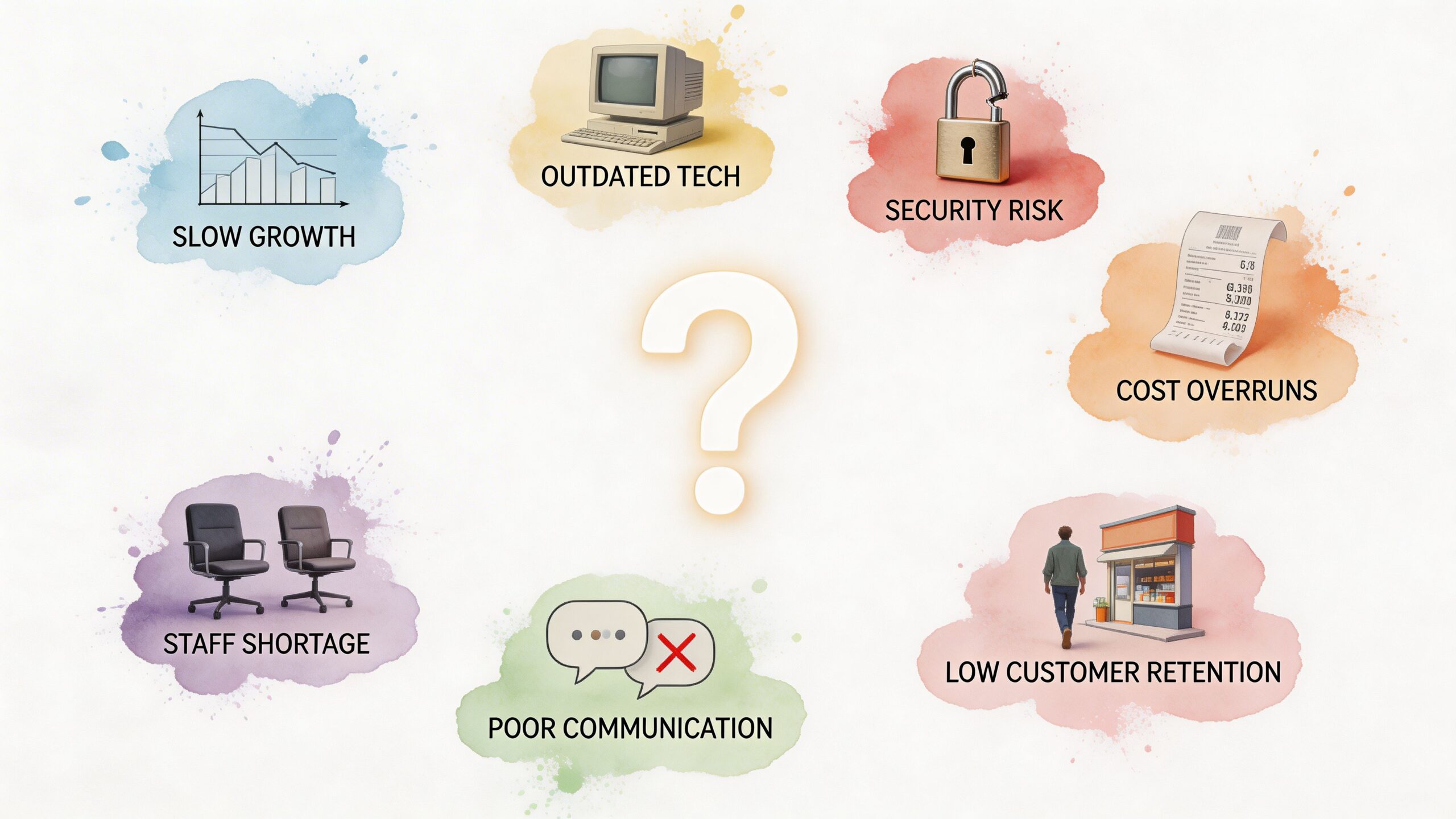
The signals are usually visible before they're named
Your technology spend keeps rising, but the value stays fuzzy
You approve tools, vendors, and projects, but can't tie them back to cleaner execution or stronger margins. That's not a finance issue. It's missing technology leadership.The board, investors, or insurers are asking harder questions
If answers depend on pulling fragments from multiple people, you don't have a reporting problem. You have an ownership problem.One or two people have become single points of failure
When key knowledge lives in one engineer, one MSP contact, or one long-term vendor, the business is exposed. A virtual CTO reduces that fragility by forcing clearer structure.Important projects keep slipping
This usually isn't because nobody is working. It's because priorities compete, decisions stall, and handoffs leak.
Risk is now part of the operating picture
- You're facing more scrutiny on security and resilience
The need for expert oversight is real. 493.33 million ransomware attacks were detected globally in 2022, which is why businesses need stronger technology and security leadership, not just more tools (Adrytech).
Most leaders don't need to know every technical control. They do need to know who owns the risk, what the exposure is, and what gets reviewed next.
You're preparing for diligence, a major contract, or compliance pressure
At that point, vague ownership becomes expensive. You need inspectable decisions, documented priorities, and fewer surprises.You're still the default technology decision-maker
If you're the CEO or COO and technology questions still keep landing on your desk by default, the company has outgrown informal leadership. That alone is enough reason to act.
A blunt recommendation
If three or more of these feel familiar, stop treating it as a temporary phase.
You're not dealing with random friction. You're dealing with a system that no longer scales under current leadership.
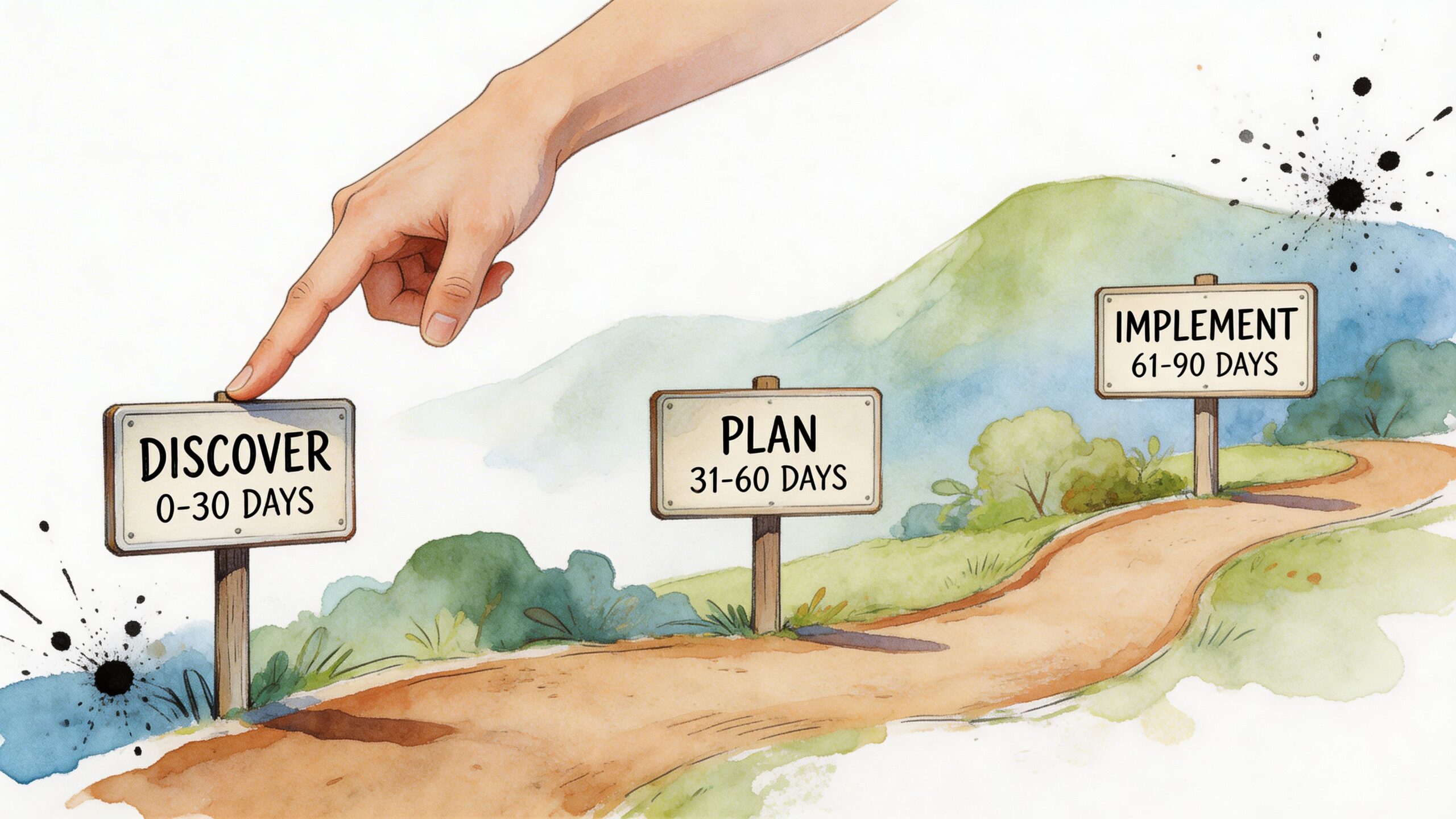
How to Engage a Virtual CTO A 90-Day Plan
A good virtual CTO engagement shouldn't feel mysterious. You should know what happens first, what changes early, and how you'll tell whether it's working.
The strongest engagements begin by making reality visible. Then they install a rhythm that keeps decisions from leaking.
Start with the right engagement model
Most companies use one of two structures:
- Monthly retainer: Best when the business needs ongoing leadership, recurring review, and executive access.
- Project-based engagement: Best when there's a specific need like diligence prep, vendor reset, roadmap triage, or a leadership gap.
The right choice depends on whether your issue is episodic or structural. If the same patterns keep repeating, a one-off project won't hold for long.
Days 1 to 30 make reality legible
The first month should be a discovery sprint.
That means mapping systems, vendors, responsibilities, current priorities, and decision rights. It also means finding the places where ownership is implied but not explicit.
A practical first-month output often includes:
- A clear map of core systems and vendors
- Named owners for critical decisions
- A short list of top bottlenecks
- A short list of top trust risks
- A first-pass roadmap with what to fix, defer, or stop
One case study on virtual CTO work showed that starting with a discovery sprint to map architecture and ownership helped a company launch its MVP 50% faster than projected through in-house efforts alone (TCI Techs).
That kind of result doesn't come from clever theory. It comes from getting clear before scaling confusion.
Days 31 to 90 install operating rhythm and early wins
Once the picture is visible, the next step is discipline.
A useful ninety-day plan usually includes:
Weekly decision cadence
A standing rhythm for open decisions, blockers, and ownership review.Visible priority tracking
Not a bloated project plan. A short executive view of what matters, what's blocked, and who's accountable.Early risk reduction
A few immediate moves that lower exposure or remove fragility.Simplification wins
Vendor cleanup, duplicate tools removed, clearer handoffs, or a cleaner reporting path.
Good virtual CTO work should make the business feel calmer within the first quarter, not just more documented.
If you want a stronger view of what executive-level involvement should look like during this phase, this article on https://blog.ctoinput.com/executive-technology-leadership/ is a solid companion read.
How to Avoid the Virtual CTO Trap
Not every virtual CTO engagement works.
Some fail without much fanfare. The meetings happen. The advice sounds smart. But the business doesn't get calmer, and execution doesn't get more predictable.
Three failure patterns show up again and again.
Ownership stays fuzzy
The virtual CTO recommends. The team nods. Nothing really lands.
This happens when there's no explicit owner for follow-through. Advice without accountability creates the illusion of progress. It doesn't change the operating system.
You need one person accountable for each major priority, each key risk, and each critical vendor relationship. Shared awareness is not ownership.
Handoffs leak between strategy and execution
The virtual CTO sees the issue. The internal team hears part of it. The vendor interprets it differently. Two weeks later, you're back in the same meeting.
Many advisory models break down here. They stop at insight.
A useful engagement translates decisions into actions, names who will do what, and creates a review rhythm that catches drift before it turns into delay.
Vendors drive the roadmap
This is the most common trap, and leaders miss it because it sounds reasonable in the moment.
A platform partner recommends more platform work. A security provider recommends more security tooling. A development shop recommends a bigger rebuild. Each recommendation may be defensible on its own. Together, they can pull the company away from business priorities and toward supplier convenience.
The virtual CTO should represent your business interests in vendor conversations, not amplify vendor incentives.
What to insist on before you engage
Ask for these things up front:
- A defined scope: What the virtual CTO owns, advises on, and explicitly doesn't do
- A cadence: How often leadership decisions, risk, and progress get reviewed
- Named counterparts: Who inside your business will partner with them
- Expected outputs: Roadmap, ownership map, risk view, vendor view, and executive reporting
- A handoff model: How strategic decisions become operational work
If those points stay vague, the engagement will too.
From Chaos to Calm Predictable Execution
The goal isn't more process. It's fewer surprises.
When a virtual CTO is doing the job properly, technology stops behaving like a side channel of confusion. Ownership becomes visible. Vendor conversations get shorter and sharper. Reporting gets easier because the system is clearer, not because people worked harder to prepare slides.
Projects finish more often because decision paths are cleaner.
Security and resilience improve because risk has an owner and a review rhythm. Leaders stop acting as translators between teams. The business gets faster because it has better structure, not because everyone is pushing harder.
That's what most founders and operators want. Not a more impressive org chart. A calmer company.
If technology is starting to tax growth, trust, or execution, don't wait for a bigger incident or a more expensive hire to force the issue.
If your business is dealing with fuzzy ownership, vendor-driven decisions, or execution that feels harder than it should, CTO Input is built for that moment. A Clarity Call can help surface the top bottlenecks, the key trust risks, and the first practical moves to restore control.