

SEO title: A Technology Leader for Growing Companies Guide to Calm Execution
Meta description: Growth exposes weak technology ownership fast. Learn how to choose a technology leader for growing companies, define success, interview well, and install a 90-day operating rhythm.
Slug: technology-leader-for-growing-companies
Growth usually doesn’t break a business. It exposes what was already loose.
At a smaller stage, you can get away with implied ownership, a few heroic people, and systems that mostly work if nobody touches them too hard. Then revenue rises, teams multiply, vendors pile up, and your leadership meetings start sounding the same. Why is this project late. Who owns this system. Are we secure enough. Why can’t anyone give the board a straight answer.
That’s when a technology leader for growing companies stops being a nice-to-have and becomes part of the business operating model.
The mistake I see most often is treating this like a hiring problem first. It usually isn’t. It’s an operating system problem. If decisions are fuzzy, handoffs leak, and vendors are independently setting priorities, hiring one impressive person won’t save you. You need a leader who can install clarity, not just carry a title.
When Growth Exposes Problems Technology Was Hiding
A company can look healthy from the outside while technology is taxing every important move behind the scenes.
Sales says the CRM is messy but manageable. Finance has a workaround for reporting. Operations relies on two people who “just know how it works.” Product keeps shipping, but every release creates a small mess somewhere else. Nobody calls it a crisis because the business is still moving.
Then growth adds weight.
A new location opens. A new product line launches. A board starts asking harder questions. A customer asks for cleaner reporting. An insurer wants clearer controls. Suddenly the same patchwork that felt scrappy now feels expensive.

What it looks like in real life
The symptoms are usually obvious long before leaders name the cause.
- Projects slip without a clear reason. Teams are busy, but work stalls in handoffs, approvals, and hidden dependencies.
- Reporting feels reactive. When the board asks about progress, cost, or risk, leaders need a scramble session before they can answer.
- Vendors start steering the roadmap. Internal teams adapt to whatever the platform provider says is possible or urgent.
- Key people become load-bearing walls. If one manager, engineer, or admin goes on leave, decisions slow down or stop.
None of this means your people are weak. It means the company outgrew informal coordination.
Growth creates a coordination tax. You pay it in delays, rework, weak reporting, and leadership time.
Why the role changed
Strong companies don’t treat technology leadership as a back-office utility anymore. According to MIT CISR’s 15-year research, 67% of top-performing companies report their technology leaders as “very involved” in crafting enterprise strategy, compared with 52% of other organizations.
That gap matters.
It means the best operators aren’t asking technology leaders to just keep systems running and reduce spend. They expect them to shape execution, speed, and business choices. A technology leader at this stage helps decide what the business can standardize, where complexity is justified, and which risks are acceptable.
Why CEOs miss it
Many CEOs still read these issues as departmental friction.
They think engineering needs better management. Or IT needs more headcount. Or the PMO needs tighter follow-up. Sometimes those things are true. Often they’re downstream effects of a bigger leadership gap.
If nobody owns the decision model for technology, every team improvises. Product chooses one priority. Finance chooses another. Operations keeps the legacy workaround because it can’t afford disruption. Security raises concerns late because it wasn’t part of the decision early.
That isn’t a staffing issue. It’s an absence of executive ownership.
What this means for a scaling company
The next stage of growth needs more than technical competence. It needs a leader who can make the current reality legible, force decisions into the open, and tie technology choices to business outcomes.
That’s why I push CEOs to stop asking, “Do we need a CTO yet?”
The better question is, “Do we have a system for technology decisions that can survive growth?”
If the answer is no, the business is already paying for it.
Diagnosing the Need for a Real Technology Leader
Most companies don’t lack effort. They lack a governing rhythm.
You can feel that problem before you can describe it. Work keeps moving, but it doesn’t land cleanly. Meetings multiply. The same issues return under different names. Leaders ask for updates because the system itself doesn’t produce confidence.
Four signs the problem is leadership, not just workload
A useful way to diagnose this is to look for patterns that keep recurring across teams.
- Ownership is fuzzy. You ask who owns a major platform, vendor, or integration and get three partial answers.
- Priorities move with the loudest voice. Work changes because a founder, customer, vendor, or department head escalated it.
- Risk can’t be explained plainly. You hear technical language, but not a clear business view of what matters, what is being done, and what remains exposed.
- The team depends on heroics. Critical work gets done because a few people remember tribal knowledge and push through fatigue.
These are not small operational wrinkles. They’re signs that nobody is running the technology operating system.
Practical rule: If your leadership team can’t answer who owns the decision, who owns the execution, and how progress is tracked, you don’t have governance. You have optimism.
Ask questions a board would ask
You do not need to be technical to diagnose this well.
Ask the same kind of questions a board member, investor, or diligence team would ask:
- Who owns each critical business system
- Which vendors shape our roadmap more than our own leaders do
- Where do we rely on one person too heavily
- How do we decide what gets funded, delayed, or stopped
- What would fail unnoticed if one integration or manual process broke
- How do we know whether current spend is buying speed, control, or neither
If these questions trigger debate instead of clear answers, you have a leadership issue.
Look for the hidden operating gaps
I’d pay close attention to three gaps.
Decision rights
A lot of scaling companies confuse participation with ownership.
Five people attend the meeting. Everyone gives input. Nobody leaves with clear authority. The result is slow motion conflict. Teams revisit the same question next week because the decision never really stuck.
Vendor control
This gets expensive fast.
When internal leadership is weak, the roadmap starts bending around what software vendors sell, what consultants scoped, or what one department bought to solve its own pain. That’s how sprawl happens. It also creates conflicting workflows and duplicated tools.
For a practical outside perspective on how leadership teams should frame this relationship, Wisely’s modern guide to doing business with IT is worth reading. It’s useful because it treats IT as a business partnership problem, not just a service desk issue.
Onboarding and handoffs
Most executives underestimate this one.
If new managers, vendors, or staff can’t quickly understand systems, owners, priorities, and controls, the company keeps re-learning itself. That creates delay, weak accountability, and expensive dependence on long-tenured employees.
The plain-English diagnosis
You need a real technology leader when the business has outgrown informal trust.
That usually shows up as:
- Too much ambiguity around systems, priorities, and risk
- Too little visibility for the executive team and board
- Too much dependence on specific people, vendors, or workarounds
A proper diagnosis changes the board conversation.
Instead of saying, “Technology feels messy,” you can say, “We have delivery and risk issues because no one owns technology execution as an executive operating system.”
That is a much easier problem to solve.
Choosing Your Leadership Model Full-Time vs Fractional
Once you know the problem is real, the next mistake is over-hiring.
A growing company often jumps from pain to title. “We need a CTO.” Maybe. But many businesses don’t need a permanent executive first. They need decision clarity, execution discipline, and a leader who can stabilize the machine without creating another expensive layer too early.
The mid-market gap is real
Growing companies get underserved.
According to BrainSell’s analysis of the mid-market gap, mid-market firms often lack customized technology leadership because SaaS vendors and consultants tend to focus on simpler SMBs or larger enterprises. That leaves integration and change management needs hanging in the middle. Their point is correct. A fractional CTO or CIO often bridges that gap by combining simplification with hands-on execution rhythm.
That’s why the right question isn’t “Which title sounds serious enough?”
It’s “Which model fits the business problem we have right now?”
Technology Leadership Model Comparison
| Factor | Full-Time Leader | Fractional Leader | Interim Leader |
|---|---|---|---|
| Best fit | Company has sustained complexity and ongoing executive-level technology scope | Company needs senior guidance and operating discipline without a full-time executive commitment | Company has a vacancy, disruption, or urgent stabilization need |
| Cost structure | Highest fixed commitment | Lower fixed commitment with focused executive time | Time-bound executive cost for a defined transition |
| Strategic depth | Strong if you hire well and give the role proper authority | Strong when scope is clear and leadership team uses the person well | Strong for triage, transition, and short-term decisions |
| Hands-on execution rhythm | Depends on the person and maturity of internal team | Usually strong when the brief includes governance, prioritization, and accountability | Strong at the start, often narrower over time |
| Hiring risk | Highest. Wrong fit is expensive and slow to unwind | Lower. Easier to test fit and refine scope | Moderate. Good for urgent needs, not always ideal for long-term build |
| Flexibility | Lowest | Highest | Medium |
| Use case | Long-term platform, product, data, and org leadership | Growth-stage coordination, vendor control, roadmap clarity, board reporting | Leadership gap, diligence prep, inherited chaos, post-exit transition |
When full-time makes sense
Hire a full-time leader when technology is already a permanent board-level domain.
That usually means you have sustained product complexity, multiple teams needing ongoing executive coordination, and a real requirement for internal leadership presence every week. If your business model itself is closely tied to product, platform, or proprietary technology, a permanent executive may be the right move.
But don’t hire full-time just to signal maturity.
A premature executive hire often spends the first months trying to create a role because the company never defined the operating model underneath it.
When fractional is the better choice
A fractional leader is often the strongest move for a scaling operator.
You get executive-grade leadership without pretending you need a full-time C-suite seat before the business is ready. The value is not just advice. It’s installation. Decision rights. Reporting cadence. Vendor discipline. Priority control. A calmer weekly rhythm.
If you want a more direct explanation of that model, this piece on a part-time CTO is useful because it frames the role around business fit rather than title inflation.
A good fractional leader doesn’t just recommend changes. They make the company easier to run.
This is also where I’d place one practical option. CTO Input provides executive technology leadership in fractional and interim forms for mid-market organizations that need clearer ownership, governance, and execution.
When interim is the right call
Interim leadership is best when time matters more than elegance.
If your leader left, a major initiative is failing, diligence is coming, or the board has lost confidence, don’t spend months chasing the perfect permanent candidate. Install someone who can stabilize the situation, create visibility, and make the next decision from a stronger position.
Interim works well when the problem is acute and bounded.
It works poorly when leadership keeps using “interim” as a way to avoid deciding what the company needs long term.
A simple decision lens
Use this lens with your COO, CFO, or board chair:
- Choose full-time if technology is a permanent strategic domain and the business can support the role with clear authority.
- Choose fractional if you need senior leadership now, but the company mainly needs operating discipline and decision quality.
- Choose interim if the business is exposed and needs immediate executive stabilization.
The wrong model creates noise.
The right model creates control.
Defining the Role and Metrics for Success
Most technology leadership searches fail before the first interview.
The role description is usually the problem. It reads like a shopping list of tools, acronyms, and vague virtues. Strategic. Visionary. Strong communicator. Cloud. Security. AI. Scalable architecture. That attracts polished candidates and weak alignment.
A growing company doesn’t need a mystery executive. It needs a results brief.

Define the business outcomes first
Start with what must be different in a year.
Not what systems they should know. Not what coding background they should have. Start with the operating problems that need to stop hurting the business.
For many growing companies, success looks like this:
- Leadership can see reality faster. The board and executive team get clear reporting on priorities, risk, owners, and blocked work.
- The team ships with less friction. Work no longer depends on escalation and heroics to cross the line.
- Spend ties to value. Leaders can explain why a platform, vendor, or project exists and what it is doing for the business.
- Risk becomes discussable. Sensitive issues are not buried in jargon or deferred because no one wants to own them.
That’s a role profile. The technical details come second.
Why integration belongs on the scorecard
A lot of operational drag is really an integration problem with no executive owner.
According to Statista’s referenced technology leadership data, organizations with strong integration across their technology platforms achieve 10.3x ROI, compared with 3.7x for those with poor integration. That gap is not just technical architecture. It reflects execution clarity, ownership, and decision alignment.
So your scorecard should include outcomes that reveal whether the business is becoming more connected and less chaotic.
A practical scorecard for the role
You can adapt this for a full-time, fractional, or interim hire.
| Outcome area | What success looks like |
|---|---|
| Decision clarity | Critical systems, vendors, and priorities have named owners and clear approval paths |
| Execution rhythm | Weekly leadership cadence exists for technology work, with visible deadlines and blocked items |
| Board confidence | Risk and progress reporting is plain-English, timely, and defensible |
| Vendor control | The roadmap is led internally, not shaped by whoever sold the latest platform |
| Integration health | Teams reduce workarounds, duplicate data handling, and handoff failures |
| Team resilience | Key-person dependence shrinks and onboarding becomes easier because responsibilities are legible |
Don’t hire for “vision” if your actual problem is that nobody can tell you what is blocked, who owns it, or why it matters.
Use responsibilities as reference, not as the brief
If you want a broad market view of what people usually expect from the role, Underdog’s guide to CTO duties and responsibilities is a useful reference point. It’s helpful for coverage.
But your actual brief should stay anchored in business outcomes. This companion piece on CTO responsibilities and duties is a better lens if you’re trying to translate responsibilities into executive accountability.
What to put in the role document
Keep it short enough that your board and candidates can both understand it.
Include:
- Mandate. What this leader is there to fix, stabilize, or accelerate.
- Authority. Which decisions they own, influence, or escalate.
- Operating rhythm. What meetings, reporting, and review cadence they will run.
- Success measures. The business outcomes expected within the first year.
- Constraints. Budget, team structure, known gaps, and realities they are stepping into.
That kind of brief attracts operators.
The vague, jargon-heavy version attracts performers.
How to Interview for Strategic Execution
Most technology leader interviews go off track because the company asks the wrong questions.
The board asks about innovation. The CEO asks about scaling. Someone from engineering asks about architecture. Somebody else wants to hear war stories about cloud migrations or AI. None of that is useless. It just doesn’t tell you whether this person can create a calmer business.
You are not hiring a conference speaker.
You are hiring someone who can inherit ambiguity, make it legible, and get decisions to stick.
Ask for operating behavior, not just expertise
A candidate can sound brilliant and still be a terrible fit for a growing company.
The people who work best here usually communicate in cause and effect. They can explain trade-offs in plain language. They don’t romanticize chaos. They know how to create a weekly system that leadership can effectively use.
Ask questions like these:
- Walk me through your first month in a messy environment. What did you map first. What did you ignore. How did you report what you found.
- Tell me about a time you inherited a brittle system with fuzzy ownership. How did you decide what needed executive attention.
- How do you stop vendors from shaping the roadmap. Give a specific example of how you reset control.
- What metrics do you put in front of a CEO or board. Why those and not others.
- Describe a decision you made that disappointed one department but helped the business overall. How did you handle it.
- How do you reduce key-person dependence. What changes in process, documentation, or ownership matter.
Listen for how they think
Strong answers tend to have a few traits.
They make reality visible
The best candidates talk about inventories, owner maps, decision logs, risk registers, or simple reporting rhythms. They know that before you improve anything, you need to make it inspectable.
They translate well
You should hear business language, not just technical description.
A good candidate might say, “That integration was causing revenue leakage, delayed reporting, and support burden, so we put executive attention there first.” That’s better than a long lecture about middleware.
They don’t lead with heroics
Be careful with candidates who make themselves the center of every rescue story.
You want someone who builds systems that outlast them. If every good answer ends with “and then I stepped in and fixed it myself,” you may be interviewing a high-functioning bottleneck.
The right interview leaves you thinking, “This person would make our business easier to run,” not “This person seems very smart.”
Use one scenario that reflects your real pressure
Give every finalist the same scenario.
For example: “You arrive and learn that three major systems have overlapping ownership, reporting to the board is vague, one key employee carries too much institutional knowledge, and vendors are pushing upgrades that nobody has assessed properly. What do you do in the first 30 days?”
Don’t score the answer on technical depth alone.
Score it on sequence, judgment, communication, and governance instinct.
Red flags worth taking seriously
Some warning signs are subtle, but they matter.
- They answer every question at the technical layer and rarely move up to business consequence.
- They need perfect information before acting.
- They talk about transformation as a grand vision exercise, not a discipline of ownership and cadence.
- They dismiss board reporting or executive communication as politics or overhead.
- They can’t explain how they reduce noise for the rest of the business.
That last one matters most.
A real technology leader for growing companies should lower executive drag, not add another stream of complexity to manage.
The 90-Day Playbook to Stop Firefighting for Good
Hiring the leader is the start. Relief comes from the operating rhythm they install.
Without that rhythm, the business falls back into old habits. Work becomes a string of exceptions. Progress depends on who shouted last. Reporting turns into a status hunt. That is how companies spend serious money and still feel no control.
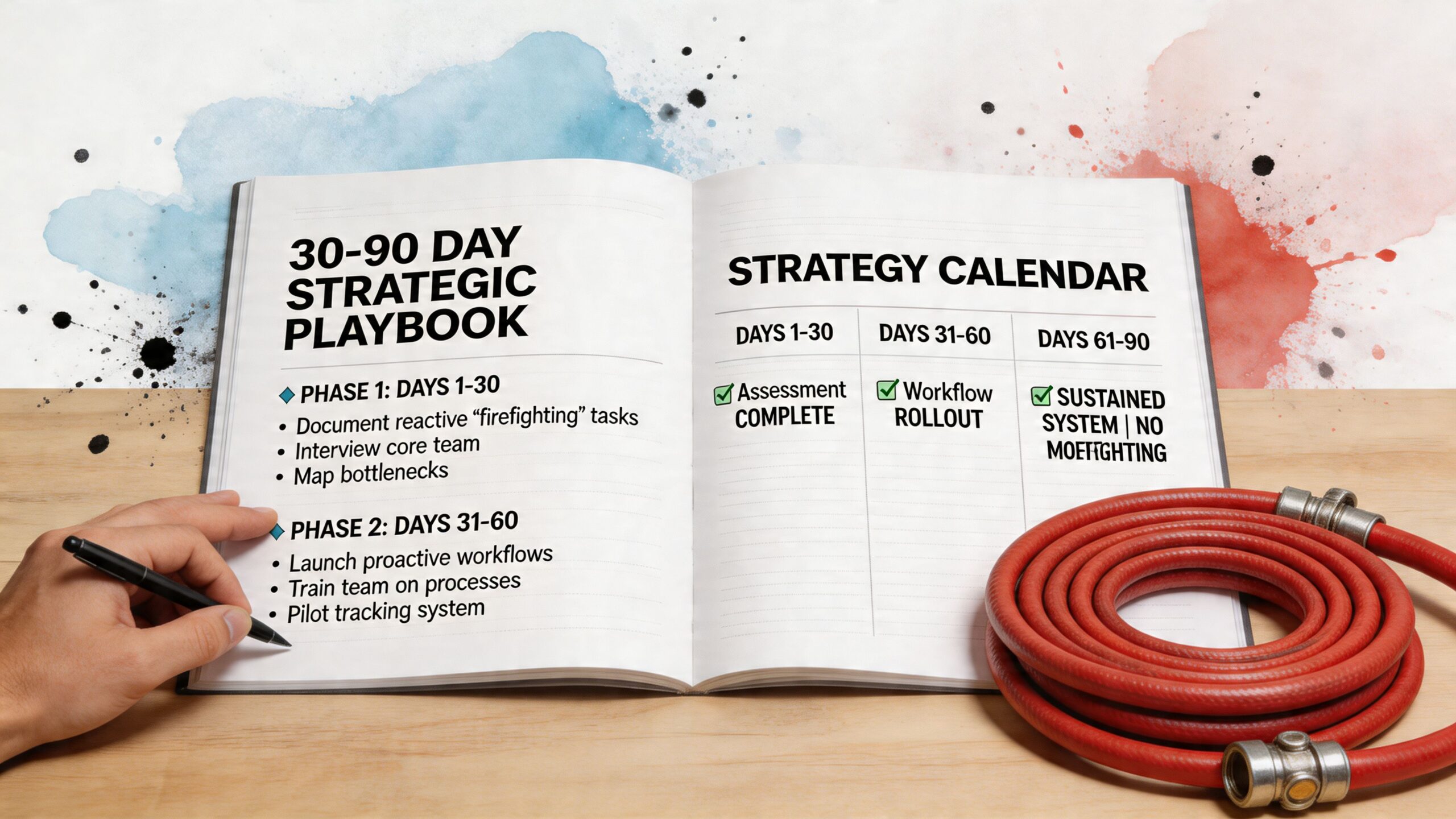
First 30 days make reality legible
The first month is not for grand redesign.
It is for seeing the actual business clearly enough to act without guessing. According to Integrate.io’s roundup on transformation outcomes, only 35% of digital transformations succeed, while high-performers using product-platform models achieve 3x success. The practical habits tied to better outcomes include mapping bottlenecks, installing a weekly operating rhythm with clear owners, and shipping quick wins. That same source notes this approach can reduce fire drills by 50%.
So the first month should focus on legibility.
- Map systems and vendors. List the platforms, integrations, major contracts, and what each one supports in the business.
- Map ownership. Name who decides, who executes, and where authority is currently vague.
- Name the top bottlenecks. Not twenty. The few issues creating most of the drag.
- Surface trust risks. The hidden areas where data, access, reporting, or dependencies could create a surprise.
Many leaders make a mistake. They start solving before they’ve made the environment visible.
Days 31 to 60 install a calm rhythm
Once the overall picture is clear, put a simple operating cadence in place.
That usually includes a weekly leadership review for technology and risk work, a visible owner-and-deadline dashboard, and a short decision log so the same issues do not get reopened every few days. The point is not more meetings. It is fewer ambiguous ones.
A solid rhythm does three things:
| Rhythm element | Why it matters |
|---|---|
| Weekly review of priorities | Keeps blocked work, trade-offs, and ownership visible |
| Owner-based tracking | Stops work from hiding behind teams, committees, or vague updates |
| Plain-English reporting | Gives CEOs and boards usable visibility without technical translation overhead |
This is also where onboarding improves. New leaders and managers can enter a system that already shows what matters, who owns it, and how progress is judged.
For companies trying to establish this at an executive level, this article on executive technology leadership is a useful companion because it focuses on governance and operating discipline, not just technical management.
If work only moves when the CEO asks about it, the system is broken.
Days 61 to 90 ship relief, not theater
By this point, the company should already feel different.
Not transformed. Calmer.
The new leader should be shipping early moves that reduce daily drag and prove the new model works. That often means simplifying one ugly workflow, reducing manual work in a repeated process, cleaning up a vendor ownership issue, or fixing a reporting blind spot that has been wasting executive time.
The point of early wins is not optics.
It is credibility. Teams need to see that clearer ownership and better cadence lead to fewer interruptions, better handoffs, and less confusion.
What better looks like
A healthier operating system is obvious when you see it:
- Leaders know who owns major decisions
- Status requests drop because reporting is already visible
- Fewer projects depend on one heroic person
- Vendor conversations stop sounding like roadmap meetings
- Board questions get answered without a scramble
- Teams spend more time finishing work and less time decoding priorities
That is what a technology leader for growing companies should build.
Not a bigger org chart. Not a prettier strategy deck. A business that can move without tripping over its own complexity.
If your company is growing but technology decisions still feel vague, reactive, or overly dependent on a few people, CTO Input helps make the current reality legible, install a calm operating rhythm, and define the first practical moves to restore control.