
You spot inconsistencies in your financial reports, leading to unreliable financial statements. Program fees collected do not match ledger entries. Board members ask tough questions. Funders hesitate on renewals. These gaps erode trust and slow decisions.
This 30-day plan fixes that. You gain clear visibility into data flows from programs to the general ledger reconciliation. Boards see reliable numbers. You lead with confidence.
Key Takeaways
- Map your current data flows in week one to spot hidden breaks.
- Reconcile discrepancies with simple rules by day 21.
- Automate checks to strengthen internal controls for ongoing accuracy and board-ready reports.
- Expect 80% fewer manual fixes after 30 days.
- Strong reconciliation supports growth without added risk.
Why Fix General Ledger Reconciliation Now
Weak links between program data and your ledger create real costs. Staff chase numbers instead of serving clients. Month-end closes drag on for days. Auditors flag issues that surprise leadership.
You feel the pressure. Growth adds volume. New grants demand proof of impact. Boards want metrics they trust for financial reporting. Delays here signal deeper internal controls problems.
Start with facts. Program data includes client fees, grants spent on services, and donations tied to outcomes. These must flow accurately to the ledger for a solid audit trail. Errors compound. One missed entry affects balance sheet accounts. General ledger reconciliation closes that gap. It confirms every dollar tracks right.
In short, you build trust. Reliable reports justify spend. They free you for strategy.
Days 1-7: Assess Your Current Flows
Pull your team together on day one. List all program data sources, including source documents like intake forms, service logs, donation platforms. Note how each feeds finance tools.
Interview staff next. Ask where they spot mismatches. Finance sees fees short by 5%. Programs report full collections. Pinpoint why.
Document flows simply. Use a spreadsheet. Columns for source, tool, handoff, and checks. You uncover breaks fast.
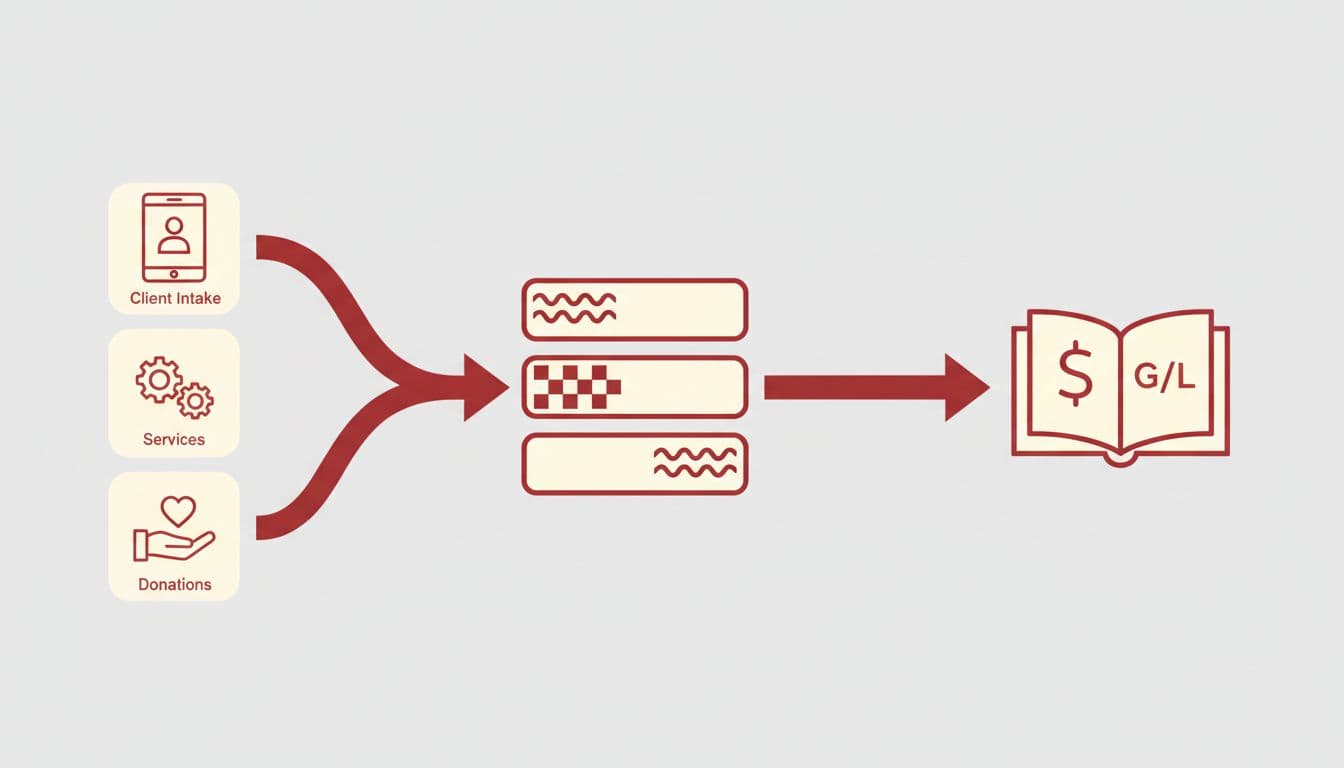
This map reveals truth. For example, a client payment hits your CRM but skips QuickBooks. Or grant expenses log twice. You now see risks. Assign owners to each flow. Set a baseline report for ledger account reconciliation. Compare program totals to ledger by day seven. Note variances over 2%.
Progress here sets pace. You avoid chasing symptoms later.
Days 8-14: Identify and Map Discrepancies
Now investigate discrepancies. Export program data for the last quarter. Pull ledger extracts. Match by date, client ID, or amount. Tools like Excel pivot tables work fine. Run a parallel bank reconciliation to ensure cash flow matches service logs.
Flag outliers first. A $500 service fee missing? Trace it. Duplicate donation? Delete one. Categorize issues. Timing differences top the list. Then classification slips.
Build a reconciliation log. Track each fix. Who found it. What caused it, such as data entry errors. How you resolve. This log becomes your playbook.
Talk to vendors if needed. Your subsidiary ledgers, like the CRM or donor platform, might truncate fields or fail to match the main books. Finance software could round oddly. Test fixes in a sandbox.
By day 14, quantify impact. Total unmatched amounts. Estimate staff hours wasted. Share a one-page summary with leadership. They see the stakes. For instance, board and funder reporting readiness checklist helps frame this for scrutiny.
You gain momentum. Discrepancies drop as patterns emerge.
Days 15-21: Build Reconciliation Processes
Standardize rules here. Define transaction matching criteria. Client ID plus amount equals a hit. Set tolerances. Ignore under $10 if documented.
Create templates for accounts receivable reconciliation and accounts payable reconciliation. Monthly reconciliation sheet with formulas. Auto-flag mismatches in red. Train two staff per area. They run checks weekly.
Integrate where possible. Automated reconciliation software like Zapier links CRM to ledger for real-time sync. Or schedule exports. Test end-to-end. Run a full cycle on prior month data.
Document exceptions. A grant refund hits programs but not ledger yet. Note it with deadlines for adjusting journal entries. Review weekly.
Link to broader reporting. Use metrics that matter one-page dashboard for quick views. Finance owns ledger side. Programs verify inputs.
Processes stick because you test them. Errors fall below 1%.
Days 22-30: Implement and Monitor
Roll out the reconciliation workflow live. Day 22 starts your first full reconciliation of the accounting period under new rules. Meet daily at first. Fix as you go.
Build dashboards. Simple charts show match rates. Variance trends. Share via Google Sheets or Power BI.

You review weekly now. Spot drifts early. Audit one random sample monthly. Confirm accuracy.
Train the team. Short session on rules. Role-play fixes. Assign backups.
By day 30, report outcomes. Match rate hits 98%. Month-end close time halves. Boards get clean numbers.
Ongoing, revisit general ledger reconciliation quarterly. Growth changes flows. Adjust rules then.
Common Pitfalls and How to Dodge Them
Skip assessments. You miss root causes. Always map first.
Over-rely on automation early. It hides bad data. Start with a manual reconciliation process to validate.
Ignore people. Staff resist without buy-in. Involve them from day one.
Neglect documentation or bank reconciliation. Rules fade without logs, and discrepancies persist in isolation. Keep it simple, current, and fully integrated.
See technology challenges for legal nonprofits for patterns like reporting fire drills.
FAQs
How often should you run general ledger reconciliation?
Monthly at minimum. Weekly for high-volume programs.
What tools help without big spend?
Excel, Google Sheets, or free Zapier tiers for trial balance reviews. Scale later.
Does this fix board reporting gaps?
Yes. Clean data builds trusted dashboards for compliance and audits. It also supports fraud detection.
What if variances persist after 30 days?
Dig deeper into reconciling items like accrued expenses or fixed assets reconciliation. Review external documentation for double-entry accounting issues. Vendor issues or process leaks. Re-run assessment.
Can fractional leadership guide this?
Absolutely. Experts align it to your growth. Schedule a call.
Reliable general ledger reconciliation restores control. Through ledger account reconciliation and investigating discrepancies, it enhances financial reporting and ensures accurate financial statements. You decide with facts. Boards trust your numbers. Growth accelerates without drag. Act now. Your next report proves it.
(Word count: 982)