

TL;DR: You need a fractional CTO when growth starts creating drag instead of momentum. Releases slow down. Reporting gets less trustworthy. Vendors start steering decisions. Teams stay busy, but ownership gets blurry and important work stalls.
A fractional CTO gives you executive technology leadership without committing to a full-time hire before the business is ready. The point is to fix operating problems: reduce coordination tax, set clear decision rights, tighten vendor control, and turn technical effort into business progress.
The catch is coordination overhead. Fractional support fails when the role is vague, the CEO delegates through layers, or nobody inside the company owns follow-through. Set a clear mandate, give the fractional CTO direct access to decision-makers, and make one internal leader responsible for execution.
If the business feels like it is working harder for less clarity, address the leadership gap now. Waiting usually means more rework, more tool sprawl, and more expensive cleanup later.
When Growth Starts to Hurt
At first, growth feels like validation.
Then it starts to feel expensive in ways your P&L doesn’t explain. Product releases slow down. Customer requests pile up behind internal dependencies. A change in one system breaks reporting somewhere else. Your senior people spend too much time translating between teams instead of deciding what matters.

What CEOs notice first usually isn’t “technology strategy.” It’s friction.
You see it in the weekly leadership meeting. Sales says a customer commitment is blocked. Operations says a workaround has become permanent. Finance says tool costs keep creeping up. Engineering says they’re buried in issues they didn’t create this quarter. Everyone is working hard. Nobody can show a clean line from effort to progress.
The visible pain is operational
This is the part many leaders misread.
They assume they have a delivery problem, a hiring problem, or a communication problem. Sometimes they do. More often, they have a technology leadership problem that shows up as coordination tax across the business.
When ownership is unclear, everyone stays busy and nothing finishes cleanly.
That tax is brutal because it hides inside normal work. Status meetings get longer. Decisions get revisited. Teams build around old shortcuts. One trusted person becomes the interpreter for everything, and now you’ve created a single point of failure without meaning to.
Why this gets worse as the business grows
A smaller company can survive a lot of informal decision-making.
A scaling company can’t. The same shortcuts that helped you move fast early on start breaking under more customers, more systems, more staff, and more commitments. The business becomes harder to run not because people got worse, but because the operating model stayed small while the stakes got bigger.
Typical symptoms look like this:
- Projects drag: Work starts with confidence and ends in negotiation, rework, or delay.
- The best people get trapped in triage: Your strongest engineers and operators spend their time unblocking others instead of building durable improvements.
- Leadership loses visibility: You can’t get crisp answers on priorities, risks, or what’s done.
- Spending feels disconnected from results: Tools, contractors, and cloud costs rise, but reliability and speed don’t improve with them.
If this feels familiar, the question isn’t whether something is wrong. Something is already wrong. The critical question is whether you want to keep paying for it in slower growth, avoidable risk, and management drag.
What Is a Fractional CTO in Business Terms
A fractional CTO is part-time executive technology leadership. Not extra advice. Not a project manager with a better title. Not an agency.
In business terms, a fractional CTO gives the company a senior owner for technology decisions that affect growth, risk, delivery, and spend, without requiring a permanent executive hire. The economics are straightforward. A fractional CTO typically costs $5,000 to $15,000 per month and can deliver 80% of the strategic value of a full-time CTO at 20% of the cost, while a full-time CTO often costs more than $300,000 annually, according to Justin McKelvey’s analysis of fractional CTO value and pricing.
That matters because most companies asking this question don’t need another person in meetings all day. They need senior judgment on the choices that are expensive to get wrong.
You’re buying outcomes, not hours
The value of a fractional CTO isn’t that they work fewer days.
The value is that they take ownership of the decisions your business has been deferring, scattering, or handing to the loudest vendor. They create a roadmap, set decision criteria, align technical work to business priorities, and stop the drift that turns every quarter into another cleanup exercise.
If you’re already exploring broader technology strategy consulting, this is the useful distinction. Strategy work can help frame choices. A fractional CTO stays engaged long enough to make those choices stick inside the business.
What a fractional CTO is not
Leaders often compare the wrong alternatives.
A consultant may produce a strong assessment and leave. An agency may build what you ask for. Internal IT may keep systems running. None of those options automatically provide executive ownership for architecture, vendor optimization, delivery discipline, and business-facing technical accountability.
A fractional CTO should reduce executive uncertainty, not just add another layer of commentary.
Technology leadership options compared
| Approach | Typical Cost | Core Function | Best For |
|---|---|---|---|
| Full-time CTO | $300,000+ annually | Permanent executive ownership of technology strategy, team leadership, and long-range direction | Businesses that need daily executive technology leadership and are ready for a permanent hire |
| Fractional CTO | $5,000 to $15,000 per month | Executive-grade oversight for roadmap, architecture, vendor decisions, team guidance, and risk reduction | Scaling companies that need senior leadership now without full-time executive overhead |
| IT consultant or agency | Varies | Delivers advice, implementation, or a scoped project | Specific projects, assessments, or specialist execution where executive ownership stays internal |
| CEO or founder managing tech directly | Internal time cost, usually hidden | Ad hoc decision-making without dedicated technical leadership | Very early-stage situations only, where complexity is still low |
When this model fits best
A fractional CTO is usually the right answer when the business needs ownership and judgment, but not five days a week of executive presence.
That often includes companies with a growing dev team, non-technical founders, a recent CTO departure, rising board scrutiny, enterprise customer onboarding, or a major systems decision coming up. In those situations, the cost of weak technical leadership is already real. It just isn’t labeled clearly on the budget.
The practical point is simple. If you need someone to own technology as a business function, but a full-time CTO is too early or too expensive, a fractional CTO is often the cleanest move.
Five Signals You Need a Fractional CTO Now
Monday starts with a customer issue, a missed delivery date, and a finance question about software spend. By Thursday, your head of product is chasing engineering for answers, operations is running part of the business from spreadsheets, and a vendor is setting your roadmap for you. That is not normal growth friction. It is a leadership gap in technology.
These signals rarely arrive as a single crisis. They show up as coordination tax, fuzzy ownership, and recurring delays that keep pulling senior people into problems they should not be managing.
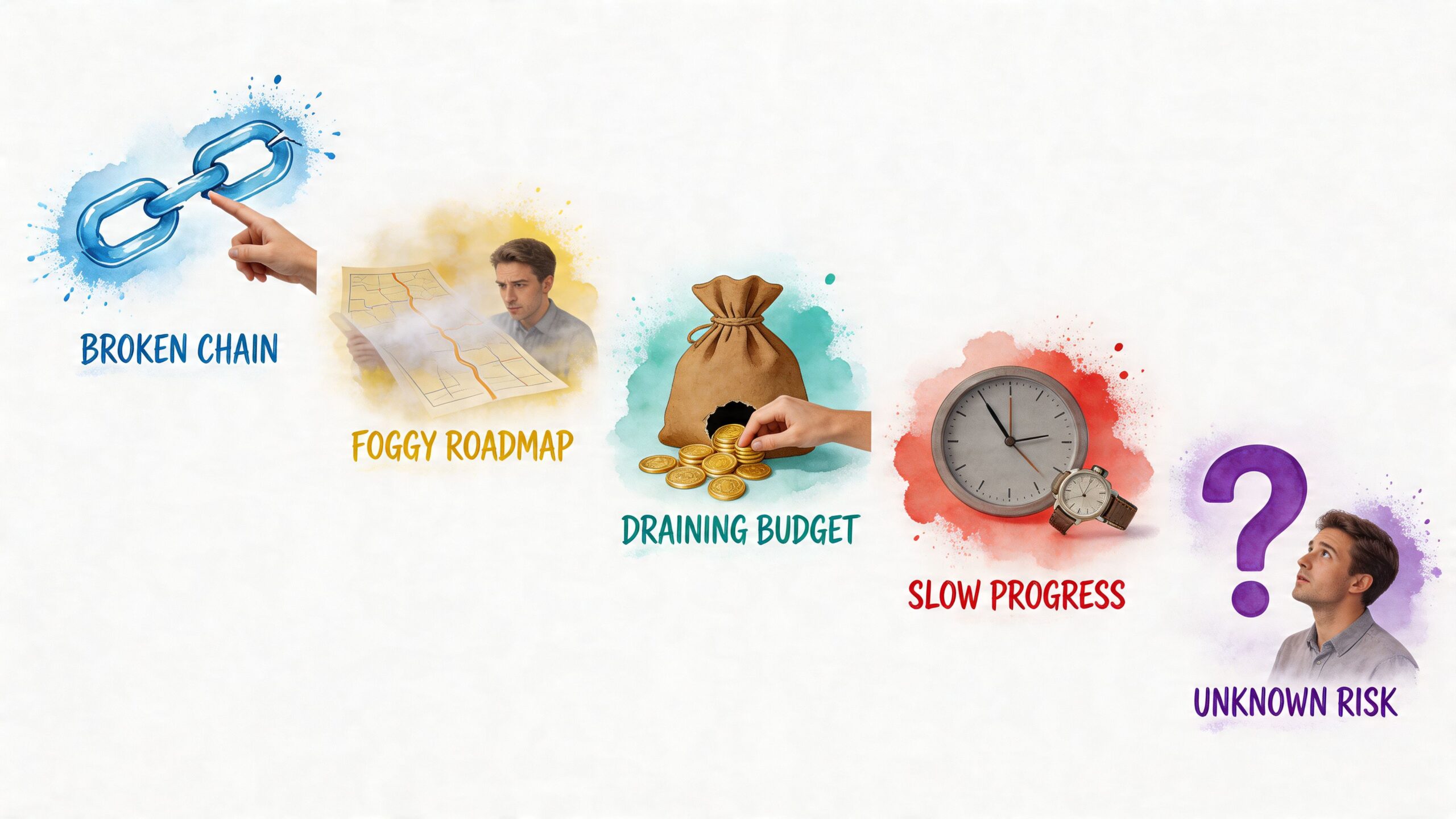
If you see several of these at once, stop treating them as isolated annoyances. They share the same root cause. No one is owning technology as a business function.
Signal one: growth is exposing weak systems
The business is selling more, onboarding more, reporting more, and changing faster. Your systems cannot keep up.
Manual work starts creeping into core processes. Teams build side spreadsheets to bridge gaps. Customer onboarding slows because systems do not connect cleanly. Reporting becomes an assembly job. As noted by Fractionus in its guide on when scaling companies need a fractional CTO, a small set of technical issues often creates a disproportionate share of business drag.
The problem is no longer technical debt in the abstract. It is operational drag with a cost attached to it. Revenue takes longer to recognize. Internal teams spend more time checking and correcting work. Leaders lose confidence in the numbers.
A fractional CTO should step in here to identify the few bottlenecks hurting the business most, set a sequence for fixing them, and stop the team from patching around structural problems.
Signal two: no one owns the hard decisions
Vendor choices sit with one leader. Developers report to another. Security questions bounce between IT, engineering, and operations. Product is setting priorities, but nobody is accountable for the tradeoffs underneath them.
That setup creates drift.
Architecture decisions get deferred. Short-term fixes pile up. Vendors fill the leadership vacuum and start shaping how the business operates. Teams work hard, but they work without a clear decision-maker.
You do not need more opinions. You need one person to make technical decisions in business terms, document them, and hold the line when priorities start colliding. That is a core fractional CTO job.
Signal three: the roadmap is slower every quarter, and fewer people believe it
You can feel this before you can measure it.
Dates slip. “Almost done” becomes a recurring status. Leaders ask for more updates because they do not trust the plan. The team spends more time reporting than finishing. The roadmap becomes a negotiation document instead of an execution tool.
Watch for these patterns:
- Delivery depends on heroics. The same one or two people keep rescuing deadlines.
- Late surprises keep changing priorities. Teams discover constraints deep into execution.
- Status sounds active, but nothing important ships. Work moves, outcomes do not.
- Cross-functional teams are waiting on engineering clarification. Product, sales, and ops cannot plan around vague delivery.
If your roadmap only works when top performers compensate for weak systems and unclear decisions, the problem is not effort. The problem is management.
Signal four: vendor sprawl is increasing cost and reducing control
Tool sprawl is usually a symptom, not the disease.
One team buys a workflow tool to fix an urgent gap. Another adds reporting software. A department signs a specialist vendor because internal systems are too slow to change. Nobody retires anything. Now you have duplicate tools, inconsistent data, overlapping contracts, and a stack that reflects a year of reactive decisions.
The cost shows up in the software budget. The bigger risk shows up in execution. Different teams are working from different systems, with different assumptions, under different constraints. Coordination overhead rises because nobody designed the whole picture.
A fractional CTO should rationalize that stack, decide what stays, and assign ownership for the systems that matter. If you want the relationship to work without adding more handoff friction, set it up with clear operating rules from the start, including best practices for working with fractional leaders.
Signal five: outside scrutiny is rising, and your answers are assembled on the fly
This shows up before fundraising, due diligence, enterprise deals, security reviews, insurance renewals, or board meetings.
The questions are basic and serious. What are the top technical risks? Why is delivery slipping? Which vendors are business-critical? What fails if one key person leaves? Who owns security decisions? What is the plan for the next 12 months?
If answering takes a Slack chase across three departments, you already have a credibility problem.
A fractional CTO earns their keep fast in these moments. They make the current state legible, turn scattered facts into a coherent operating picture, and give the business a defensible plan. That is the difference between sounding reactive and being in control.
The pattern is simple. If growth is creating drag, ownership is blurred, delivery is losing credibility, vendors are multiplying, and scrutiny is increasing, you do not need more technical activity. You need executive judgment with clear accountability.
How to Hire and Engage a Fractional CTO
Your CEO is still the tie-breaker on architecture. Product is waiting on engineering. Engineering is waiting on a vendor. The board wants a clean answer on risk and delivery, and every answer starts with, "It depends who you ask."
That is the hiring brief.
Do not start by searching for "a strong technical leader." Start by naming the operating failure you need fixed. In most companies, it is some mix of fuzzy ownership, vendor sprawl, slow decisions, and constant rework. If you cannot state the business problem in one plain sentence, you are not ready to hire. You are still shopping for reassurance.
The next mistake is just as common. A part-time executive dropped into a messy system can make the mess worse. The problem is coordination tax. If decision rights are vague and key context lives in meetings or Slack, a fractional CTO becomes another stop in the chain. Set the engagement up for written decisions, clear ownership, and asynchronous follow-through from day one. TechCXO makes the same point in its guidance on when to hire a fractional CTO.
Start with a decision checklist
Answer these questions before you talk to candidates.
- What business pain are we fixing: Name the problem in business terms. Missed launch dates, unreliable reporting, cloud cost drift, security confusion, vendor overlap, weak delivery accountability.
- Which decisions need a real owner: Architecture direction, vendor selection, roadmap tradeoffs, hiring priorities, delivery standards, security baselines, due diligence prep.
- Where does work currently stall: Founder dependency, no senior technical leader, a recent leadership exit, product and engineering misalignment, too many tools, no operating rules.
- What should be different in ninety days: Fewer escalations, faster decisions, cleaner ownership, a usable roadmap, stronger reporting, less rework.
- Who will execute after decisions are made: A fractional CTO sets direction and enforces standards. They do not replace the people needed to do the work.
If you skip this step, interviews turn into charisma contests.
Ask questions that expose judgment
Credentials matter less than how the person diagnoses a messy business.
Use questions that force the candidate to show how they think:
- What would you examine in the first month to decide whether our current setup can support growth?
- How do you separate decisions that need executive attention from decisions the team should own?
- How have you reduced vendor dependence without slowing delivery?
- How do you keep major technical decisions from being reopened every week?
- What do you need from me as CEO to move quickly and avoid another approval bottleneck?
Good answers are concrete. They connect delivery, cost, risk, and ownership. They sound like an operator speaking to a business problem, not a specialist performing expertise.
Structure the engagement so progress does not depend on meetings
This is the part companies routinely get wrong.
A good fractional CTO engagement runs on operating discipline, not access to one smart person. If every important call happens live, the company waits for the next meeting. If decisions are written down, assigned, and reviewed on a set cadence, the work keeps moving between touchpoints. That is how you get the benefit of senior judgment without adding more friction. For a practical model, review these best practices for working with fractional leaders.
Set these rules early:
- Decision map: Define which calls the fractional CTO owns, which are shared, and which stay with the CEO or another executive.
- One weekly leadership cadence: Review priorities, blockers, risks, and decisions in one disciplined meeting.
- Written updates: Use a shared document, Notion, Jira, or another simple system. The tool matters less than the habit.
- Decision records: Capture major choices, the reason behind them, and who approved them.
- Named internal counterpart: Assign one person to keep context current and push follow-up between sessions.
The risk in a fractional model is not lack of talent. It is unmanaged handoffs. Fix that upfront.
Know what good looks like in the first few weeks
You should see traction quickly.
A capable fractional CTO makes the current state legible, stops circular debates, challenges weak vendor assumptions, and creates an operating rhythm the team can follow. You should get sharper priorities, cleaner ownership, and clearer answers to basic executive questions.
If all you get is advice, you did not hire leadership. You hired commentary.
What to Expect A Sample 30-60-90 Day Plan
By the time a CEO asks about a fractional CTO, the pattern is usually clear. Product is slipping, vendors are pulling the roadmap in different directions, and nobody can say with confidence which technical decisions belong to whom.
Your first 90 days should fix that operating problem.
A good fractional CTO engagement creates order fast, then turns that order into better decisions and steadier execution. The point is not to produce more advice. The point is to cut coordination tax, name clear owners, and stop the business from burning time on avoidable rework. As Vention’s explanation of how fractional CTOs work in practice notes, strong fractional CTOs reduce costly mistakes by focusing senior judgment on high-risk decisions and lower firefighting by putting clear ownership and operating discipline in place.

Days 1 to 30 bring the current state into focus
Month one should make the business legible.
The fractional CTO should meet the people who carry context, review the systems and projects that drive revenue or create risk, inspect key vendor relationships, and identify where decisions are stalled. This period is also where coordination overhead gets exposed. Handoffs, duplicate work, competing priorities, and missing ownership usually show up quickly once someone examines the work across teams instead of inside one function.
Expect outputs you can use right away:
- A plain-English assessment: What is working, what is fragile, and where the company is losing speed, money, or control.
- An ownership map: Which decisions sit with engineering, product, vendors, the CEO, or nobody at all.
- A short risk list: Problems that can hurt delivery, security, cost, or credibility if left alone.
- A few immediate corrections: Pause weak projects, tighten one vendor scope, fix a broken handoff, or clean up a reporting blind spot.
If the first month ends without sharper visibility, the engagement is drifting.
Days 31 to 60 set direction and reduce waste
The second month should turn diagnosis into decisions.
Many companies finally see the problem. It is rarely only architecture. It is usually a messy mix of fuzzy ownership, too many parallel initiatives, and vendors making choices nobody inside the company is governing. A capable fractional CTO cuts through that. They force tradeoffs into the open and tie technology decisions back to the business plan.
A practical middle phase looks like this:
| Timeframe | Focus | Business Outcome |
|---|---|---|
| Days 31-45 | Prioritize major risks, simplify active work, challenge vendor sprawl | Less noise, tighter focus, fewer conflicting initiatives |
| Days 46-60 | Define roadmap, set architecture direction, align leadership on sequencing | Better executive confidence and fewer expensive reversals |
This is also the point where coordination overhead has to be managed on purpose. If the fractional CTO is adding another layer of meetings without producing clearer decisions, the model is being used badly. Keep one leadership cadence, one written plan, and one internal counterpart responsible for follow-through.
Days 61 to 90 turn plans into operating rhythm
By month three, the business should feel easier to run.
Weekly priorities should be visible. Ownership should be clear. Escalations should go to the right person. Leadership should get cleaner reporting without chasing people for status. Team leads should know which work matters now and which work can wait.
That is the test. A fractional CTO is worth the cost when the company stops relitigating the same issues and starts running on an agreed operating cadence.
For a more detailed view of this phase, see this guide to the first 90 days with a fractional CTO.
By the end of this period, the company should feel more governable. Fewer surprises. Fewer circular conversations. More decisions that stick.
Three months will not solve every deep technical problem. It should solve the management problem that keeps those technical problems expensive.
What Better Looks Like
A company without clear technology leadership feels expensive in ways that never show up cleanly on one line item. Product slips. Vendor bills rise. Leaders burn time chasing answers that should already exist. The team stays busy, but the business gets less control than it paid for.
Better looks different fast.
The first change is not more code. It is fewer collisions. Fewer duplicate tools. Fewer projects with three stakeholders and no owner. Fewer status meetings built around guesswork. A good fractional CTO cuts the coordination tax that builds up when growth outruns management discipline.
Without that discipline, technology becomes a drag on execution. Vetted Outsource’s guide to fractional CTO services notes that scaling companies can lose 20 to 40 percent of engineering capacity to technical debt and maintenance instead of new product delivery, and can see 25 to 50 percent gains in predictability when architectural governance and delivery patterns improve.

The CEO sees it in operating control
You stop acting as the backup system for technology decisions.
The business gets one clear view of priorities, risk, delivery, and spend. You know which projects matter, which ones should wait, and where execution is blocked. Reporting improves because someone has defined what gets tracked, who owns it, and when it gets reviewed.
That matters because clarity changes behavior. Teams stop escalating every conflict to the executive layer. Vendors stop filling a leadership vacuum. Decisions stick long enough to produce results.
The team sees it in day-to-day execution
People do better work when they are not translating chaos into progress.
A healthier operating pattern usually looks like this:
- Ownership is obvious: One person owns the decision, the timeline, and the follow-through.
- Roadmaps reflect real constraints: Teams stop pretending everything is urgent and sequence work against actual capacity.
- Architecture supports the plan: Core systems stop changing direction every time a new request appears.
- Vendors stay in their lane: External partners execute against internal priorities instead of setting them.
- Incidents stop consuming the week: Problems still happen, but they do not erase planned work.
This is the practical outcome CEOs are buying. Better throughput. Better forecasting. Better control.
There is one risk worth naming plainly. A fractional CTO can add overhead if the role is poorly scoped. If they create more meetings, more side channels, and more ambiguity about who decides what, you have added a coordinator, not a technology leader. Prevent that early. Give them a defined mandate, one internal counterpart, and authority over the operating cadence.
If your current situation feels familiar, read what unclear technology leadership really costs a business. It spells out the hidden operational losses that usually show up before a company admits it has a leadership gap.
Better means more control, not more ceremony
The right outcome is a company that runs cleanly. Technology decisions support growth instead of slowing it down. Leaders spend less time interpreting noise and more time making tradeoffs that matter. The business becomes easier to steer because ownership, priorities, and standards are finally clear.
Your Next Step Toward Clarity
If you’re still asking do I need a fractional CTO, use a simple test.
Look at the last quarter. Did technology help the business move faster, with better visibility and cleaner decisions? Or did it create more rework, more uncertainty, and more leadership overhead? If it’s the second one, the cost of inaction is already showing up in missed time, weaker control, and slower execution.
You don’t need a fractional CTO because the title sounds modern. You need one if the business has outgrown informal technology leadership and nobody currently owns the decisions that matter most.
A simple decision lens
A fractional CTO is usually the right move when these conditions are true:
- The business is growing, but systems and delivery aren’t keeping up
- Leadership lacks one credible owner for technical priorities, tradeoffs, and risk
- A full-time CTO would be premature, too expensive, or too slow to hire
- The company needs better visibility, stronger vendor control, and decisions that stick
The longer unclear ownership stays in place, the more the business normalizes friction that should never have become normal.
If that’s where you are, don’t start with a big transformation pitch. Start by making the current reality legible. Name the top bottlenecks. Name the top trust risks. Then decide whether a fractional CTO is the right instrument for this stage.
If technology is slowing growth, muddying reporting, or creating too much executive drag, a Clarity Call with CTO Input is a practical next step. It’s a working session to surface your top bottlenecks, identify where ownership is failing, and outline the first moves that would restore control.