

Technology doesn’t start feeling expensive when the bill goes up. It starts feeling expensive when nobody can tell you, cleanly, what the business is getting for the spend.
You ask for a status update and get a tour of activity instead of an answer. You approve another platform because the team says it’s urgent. A project that was supposed to fix reporting is still “in progress.” Security is “being handled,” but nobody can show you where the actual risk sits. The team looks busy. The business still feels exposed.
That isn’t a workload problem. It’s a leadership problem.
If you’re a CEO, COO, or board-level operator asking, “Why does technology still feel chaotic when we keep investing?”, the answer is usually the technology leadership gap. Not a lack of effort. Not a lack of smart people. A lack of clear ownership, decision rights, and executive-level control over how technology supports the business.
When Technology Feels Expensive and Unpredictable
A lot of companies hit the same wall.
They grew fast enough to accumulate systems, vendors, workarounds, and half-made decisions. At first, that was manageable. A strong IT manager kept things moving. A founder made product calls. A vendor filled in some gaps. Someone “owned” security because they cared the most. It worked well enough while the business was smaller.
Then the stakes changed.
Now the board wants sharper answers. Customers expect reliability. The sales team promises integrations the delivery team hasn’t vetted. Finance wants cleaner reporting. Operations wants fewer surprises. And technology starts showing up in every important conversation, but nobody seems to be steering it.
You see the symptoms in ordinary moments:
- A budget review turns into a hunt for duplicate tools and unclear contracts.
- A project update reveals three teams working on related issues with no shared owner.
- A security question gets routed through multiple people before anyone is willing to answer directly.
- A modernization effort starts with good intentions and ends in delay because the business never clarified who makes the tradeoff decisions. If that sounds familiar, this practical guide to legacy software modernization is useful because it shows how aging systems become a business drag when leadership decisions stay vague.
This is the coordination tax in real life. Meetings multiply. Firefighting becomes normal. One capable person turns into the hidden switchboard for everything important.
The business doesn’t lose control all at once. It loses control one vague decision at a time.
What makes this frustrating is that the team often isn’t failing from laziness. They’re working hard inside a system that hasn’t defined authority clearly enough to let work finish cleanly.
What the Technology Leadership Gap Really Is
The technology leadership gap is easy to misdiagnose.
Leaders often assume the problem is a hiring gap. They think they need more engineers, a stronger infrastructure lead, a better project manager, or a security specialist. Sometimes they do. But that’s usually not the core issue.
The deeper problem is that the business lacks executive-grade ownership of technology decisions. Nobody is consistently connecting technology choices to business priorities, risk tolerance, operating reality, and budget discipline.

Skills gap versus leadership gap
The distinction matters.
A skills gap means the team lacks certain capabilities. A leadership gap means the company lacks someone who can decide what matters, assign ownership, align functions, and make tradeoffs stick.
That’s why the headline numbers on hiring only tell part of the story. Nearly two-thirds of technology leaders report a critical skills gap on their team, with 62% saying it has worsened, according to Robert Half’s report on the tech skills gap. But the more dangerous issue is the leadership gap around those teams, because that’s what creates fuzzy ownership and execution chaos around priorities like cybersecurity and AI.
If you want a simple analogy, think of a ship with a competent engine room and no navigator. The crew may be capable. The vessel still drifts.
What this looks like inside a company
You usually see the technology leadership gap in companies that have outgrown informal management but haven’t yet installed real technology governance.
Common patterns include:
- IT without strategy. The team keeps systems running but lacks the authority to shape business decisions.
- Product without operational discipline. Features get prioritized without enough regard for support, data quality, security, or integration impact.
- Security without authority. Risks are identified, but no one has enough standing to force decisions across departments.
- Vendor-led roadmaps. The loudest supplier starts shaping priorities because the business hasn’t defined its own.
Why leaders miss it
Many executive teams confuse activity with leadership.
A busy tech function can look mature from the outside. Tickets are closing. Projects are moving. Vendors are engaged. But if no one can answer “who owns this decision?” or “what tradeoff did we make and why?” then the leadership layer is missing.
Practical rule: If technology decisions escalate through personality, history, or politics instead of defined authority, you don’t have a capacity problem first. You have a leadership problem first.
That’s why having “IT people” is not the same as having technology leadership. One keeps the lights on. The other makes technology legible, governable, and useful to the business.
How the Gap Silently Drains Growth and Profitability
The technology leadership gap sounds like a soft issue. It isn’t. It shows up in growth, margin, speed, and risk.
When leadership is weak, technology stops acting like an execution system and starts acting like a cost center with surprise behavior. Decisions take longer. Spend gets harder to defend. Risk accumulates in the cracks between teams.
Growth slows before anyone says it out loud
Most companies don’t say, “We have a technology leadership problem.” They say:
- “Why is this launch slipping again?”
- “Why do reporting fixes keep turning into bigger projects?”
- “Why do we keep paying for tools we aren’t using properly?”
- “Why does every cross-functional initiative stall once it hits data, integrations, or security?”
These are business speed problems.
A McKinsey analysis of the tech talent gap found that 60% of executives cite talent and leadership scarcity as a primary inhibitor to digital transformation, and that demand for skilled tech leaders is projected to outstrip supply by as much as four times. That matters because companies don’t compete on how many tools they buy. They compete on how reliably they can turn decisions into shipped outcomes.
Spend leaks through duplication and stalled work
Weak leadership creates expensive ambiguity.
One department buys a tool to move faster. Another buys a similar tool because the first one doesn’t solve their local pain. A vendor gets renewed because nobody wants the disruption of reviewing it. A project remains “active” long after the business case has faded because no one has clear authority to stop it.
That’s not normal overhead. It’s leadership debt.
You also see abandoned work. Teams start data, cloud, security, or workflow projects with real intent, then hit unresolved ownership questions and slow down. By the time someone forces a decision, the cost has already landed in internal time, vendor fees, and lost momentum.
Risk gets more expensive when nobody owns tradeoffs
This part is usually underplayed until a serious incident, customer complaint, insurer question, or diligence request forces the issue.
If nobody owns the architecture, vendor footprint, access model, and incident decision path, you don’t just have technical mess. You have commercial exposure. That’s why leaders should understand the broader cost of a data breach as a business issue, not just a security issue. Pain often includes customer trust, operational disruption, leadership distraction, and ugly conversations with boards and partners.
If a company can’t answer basic questions about systems, ownership, and risk without chasing five people, the problem is already operating at the executive level.
Burnout is often a governance symptom
The team usually feels this before the board does.
Strong people become single points of failure. They carry context in their heads because the system doesn’t carry it for them. They sit in too many meetings, approve too many edge cases, and absorb too much ambiguity from the rest of the business.
Then leadership misreads the problem as a resilience issue or a morale issue.
It’s often simpler than that. People burn out when they’re forced to compensate for missing structure. The company is asking for heroics because it hasn’t installed clarity.
Diagnosing the Gap in Your Organization
You don’t need a long transformation program to spot the technology leadership gap. You need a disciplined look at how decisions move through the business.
Start with one test. Ask five basic questions:
- Who owns our most business-critical systems?
- Who decides when we add, replace, or retire technology?
- Who can explain current risk in plain English?
- Who breaks ties when business priorities conflict?
- Who is accountable when a project drifts, not just who is “involved”?
If those answers come back fuzzy, inconsistent, or dependent on a single individual, the gap is already affecting execution.
The four places the gap shows up first
The problem usually becomes visible in four areas.
Decision-making
Decisions happen by default, through old habits, or in side conversations. The loudest function wins. Tradeoffs aren’t documented. People revisit the same questions because nothing really got settled.Execution
Projects move, but not cleanly. Teams depend on hidden knowledge. Work crosses functions and slows down because no one has authority across the whole chain.Visibility
Leaders can get updates, but not confidence. You hear status language such as “on track,” “being worked on,” or “almost there,” but there’s no crisp view of spend, risk, blockers, or accountability.Ownership
Multiple people feel responsible, which usually means no one is fully accountable. When something breaks, the company discovers ownership by following the smoke.
The underlying pattern lines up with broader market signals. The leadership gap is especially visible in governance and compliance, where 25% of leaders report shortages, and communication failures hinder over 40% of business-tech collaborations, according to Robert Half’s analysis of the expanding tech skills gap. That’s where the coordination tax shows up as dragged timelines and single points of failure.
Symptoms versus root causes
| Symptom You Feel | What's Actually Happening (The Gap) |
|---|---|
| Projects keep slipping without a clear reason | Cross-functional dependencies exist, but nobody owns the full outcome |
| Budget reviews reveal surprise tools or renewals | Vendor decisions were made locally without executive control |
| Reporting still feels unreliable after repeated fixes | Data ownership and system accountability were never defined |
| Security answers sound technical but not decisive | Risk is being discussed without decision rights attached |
| One trusted person is in every important conversation | The company has built around a human workaround instead of an operating model |
| Priorities change every few weeks | There is no stable forum where business and technology tradeoffs are made and enforced |
A blunt self-assessment
If you want a simpler diagnostic, use this checklist.
- You have a leadership gap if your executives ask for updates and get activity instead of decisions.
- You have a leadership gap if your IT or engineering leaders carry responsibility without equivalent authority.
- You have a leadership gap if vendors explain your roadmap better than your own leadership team can.
- You have a leadership gap if your board or insurer asks a direct question and the answer depends on assembling a temporary committee.
For a broader read on the threshold where informal management stops being enough, this guide on signs you need a CTO is a useful companion.
The test isn’t whether your team is talented. The test is whether the business can get clean decisions, clear ownership, and predictable follow-through.
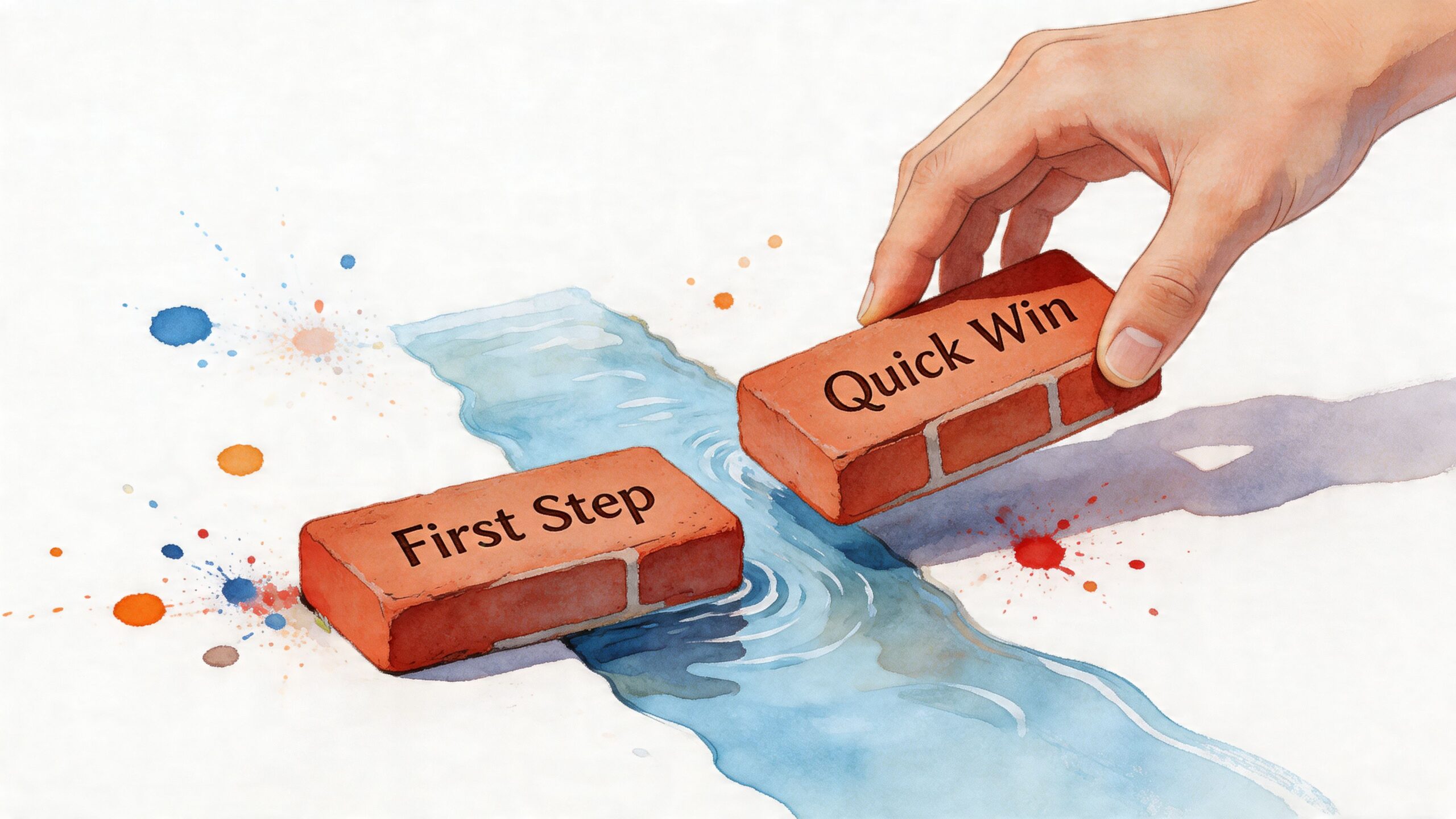
First Steps to Closing the Gap Quick Wins
Monday starts with a vendor escalation. By Wednesday, finance is asking why a tool was renewed without review. By Friday, your leadership team has spent another week reacting instead of deciding. That pattern will not improve with more effort from the team. It improves when you put authority, cadence, and decision rights in place fast.
Quick wins are useful for one reason. They show where leadership is missing, and they restore control before the next avoidable surprise hits.
Make the current mess visible
Start with a one-page operating picture of the technology estate. If you cannot see the decisions that matter, you cannot fix the way they are being made.
Your first version should name four things in plain English:
- Core systems the business cannot run without
- Key vendors and the executive owner for each relationship
- Active projects with a single accountable owner
- Decision rights for spend, risk, priorities, and changes
This is not an audit. It is a control document. If a CEO or CFO cannot read it in ten minutes and spot ownership gaps, it is too complicated.
Force decision-ready updates
Many companies ask technical leaders for status and get activity. Change the format.
From now on, every update on a project, vendor issue, security concern, or reporting problem should answer five questions:
- What decision is required
- Who recommends it
- What tradeoffs come with it
- What business outcome is affected
- When the decision expires
That shifts the conversation from explanation to accountability. It also exposes who has responsibility without authority, which is often the actual source of delay.
Put one weekly forum on the calendar
You need a standing decision meeting with a narrow purpose. Keep it weekly. Keep it small. Keep it tied to business impact.
Review only what requires executive clarity:
- Decisions that are blocked
- Risks that need an owner
- Projects that are off track
- Vendor or spend changes awaiting approval
- Actions due before the next meeting
Do not let this become a reporting ritual. The meeting exists to assign ownership, settle tradeoffs, and prevent local decisions from turning into company-wide problems.
If nobody on your current team can run that forum with enough business authority, decide that directly. An internal leader may be ready. You may need temporary executive coverage. This guide on whether you need a fractional CTO is a practical way to assess that choice.
Back one visible fix
Pick a single issue that has annoyed the business for months and close it.
Retire a duplicate tool. Reassign ownership of one critical platform. Stop a project that has drifted without a business case. Clean up one reporting dependency that keeps breaking trust with finance or operations.
One visible fix does more than ten promises. It proves that better leadership changes outcomes quickly.
CTO Input provides fractional and interim CTO, CIO, and CISO leadership for companies that need executive-level ownership and clearer operating discipline without starting with a full-time search.
Building a Durable Technology Leadership Model
Quick wins reduce the noise. They do not solve the problem on their own.
A durable fix requires a technology operating model that the business can inspect. That means clear authority, repeatable governance, and reporting that supports executive and board decisions instead of creating more translation work.

Put decision rights in writing
Most companies have implied authority. That’s not enough.
Write down who decides:
- strategic technology priorities
- system selection and retirement
- security and risk exceptions
- budget approvals for new tools
- incident escalation and response ownership
- data and reporting accountability
A lightweight RACI is often enough to start. The point isn’t bureaucracy. The point is eliminating ambiguity before pressure hits.
Create a standing governance forum
A real technology leadership model needs a place where tradeoffs are made consistently.
For most mid-market businesses, that means a small steering group with business and technology representation. Its job is simple: decide priorities, review risk, unblock cross-functional work, and stop ad hoc tool or project creep.
This forum should not try to manage every ticket or project. It should govern the decisions that shape spend, speed, and exposure.
Standardize how work gets approved
New projects and vendors should pass through a simple decision lens:
- What business problem are we solving?
- Who owns the outcome?
- What systems or data are affected?
- What risk does this introduce?
- How will we know whether it worked?
If your company doesn’t have a standard way to ask those questions, every new initiative becomes a fresh governance experiment.
Choose the right leadership model for your stage
Many firms get stuck at this point. They assume the only real answer is a full-time executive hire.
Sometimes that’s right. Often it isn’t the first move.
According to Raconteur’s analysis of tech leadership representation, tech C-suite representation remains at 12%, and fractional CTO models are emerging as a practical answer for mid-market firms that need immediate governance and ownership clarity without the cost and delay of a full executive search.
That gives you three viable paths:
- Develop an internal leader when you already have someone with judgment, trust, and growing business range.
- Use a fractional or interim leader when the business needs executive-grade structure now but the role shape is still emerging.
- Hire a full-time CTO or CIO when technology is central enough, and the scope stable enough, to justify a permanent executive seat.
Durable leadership means the business can function without relying on memory, heroics, or vendor persuasion.
The right model is the one that gives you decision quality, accountability, and traction now. Not the one that looks most impressive on an org chart.
What Better Looks Like A Calm and Predictable Business
Once the technology leadership gap closes, the first thing leaders notice isn’t excitement. It’s relief.
Technology stops feeling mysterious. It becomes easier to discuss because ownership is clear, priorities are visible, and risks are expressed in business terms. The temperature drops.

What changes in practice
Board conversations get shorter and sharper. Instead of vague reassurance, the company can explain what matters, what is on track, what is exposed, and what is being done about it.
Executive meetings improve too. Technology no longer appears only when something is late, broken, or expensive. It becomes part of normal operating discipline. Leaders can tie spend to outcomes and risk to ownership.
You also see it in the team.
- Projects finish more cleanly.
- Fewer decisions get reopened.
- Vendors stop dominating the agenda.
- Key people get out of the middle of everything.
- Reporting becomes more trusted because accountability is attached to the underlying systems and data.
What it feels like for leadership
The business feels calmer because it is calmer.
You can ask direct questions and get direct answers. You know who owns the customer system, the reporting stack, the security exceptions, and the major contracts. You know where the bottlenecks are. You know which issues need board attention and which don’t.
That’s what a real IT strategy and roadmap should lead to. Not a slide deck. A business that can move with less drama.
Better doesn’t mean perfect. It means inspectable, governable, and no longer dependent on guesswork.
A lot of leaders underestimate how much energy chaos consumes. Once that drain is removed, the business usually gets faster without adding more noise.
Your 30-Day Plan to Reclaim Control
If this article sounds familiar, don’t respond with another broad review of “technology strategy.” Start smaller and sharper.
Use the next 30 days to establish control. Not perfection. Control.
Week 1 and map the reality
Your job in the first week is to make technology visible enough to govern.
Ask for a single working document that lists:
- Business-critical systems and what each one does
- Current vendors and the internal owner for each
- Active projects with status, business purpose, and decision blockers
- Known risks or pain points that repeatedly affect operations, reporting, customer delivery, or security
Your executive decision right this week is simple. You decide what must be visible to leadership every week going forward.
If people struggle to produce this inventory, that’s not a reason to delay. It’s evidence that the gap is real.
Week 2 and assign accountable owners
Now force clarity where the business has been using shared assumptions.
For each business-critical system and each important in-flight initiative, assign one accountable owner. Not five stakeholders. One owner. Others can support. One person answers for the outcome.
Also define who has authority over these categories:
- Budget decisions
- Vendor approvals
- Project priority calls
- Security exception decisions
- Major change approvals
Your decision right this week is the most important one in the article. You decide who has authority, not just responsibility.
Week 3 and run a real operating cadence
Hold the first weekly technology leadership review.
Keep the agenda tight. Ask each owner to report using the same structure:
- What changed
- What is at risk
- What decision is needed
- What is blocked
- What will be done before next week
Don’t let this become a technical deep dive. It is a business control mechanism.
Your decision right this week is to enforce format. You decide how the business discusses technology, and you stop rewarding vague updates.
Week 4 and execute one visible win
Pick one issue that reduces friction and proves the new model works.
Good candidates include:
- Retiring a duplicate platform
- Clarifying ownership of a customer-facing system
- Stopping a low-value project
- Cleaning up one recurring reporting pain point
- Resolving one vendor ambiguity that has been lingering
The point is not scale. The point is confidence.
Your decision right this week is to choose what gets simplified first. You decide that visible relief matters more than abstract planning.
What to watch by day 30
By the end of the month, ask four questions:
- Are decisions getting made faster?
- Is ownership clearer?
- Are updates easier to trust?
- Has at least one source of avoidable friction been removed?
If the answer is yes, keep going. If the answer is no, you likely need stronger technology leadership than the current structure can provide.
If technology still feels expensive, vague, or harder to govern than it should, CTO Input can help you make the current reality legible, clarify decision rights, and outline the first practical moves to restore control.