

The fractional CTO cost in 2026 is not one neat number, despite growing pricing transparency in the market outlook. It depends on how much executive judgment, cleanup, planning, and pressure you want that person to absorb.
If your startup is growing, the real question is not, “What does a fractional CTO cost?” It is, “What kind of technology leadership do you need, and what happens if you buy too little of it?”
Key takeaways
- Most mid-market companies pay $8,000 to $15,000 monthly retainer for fractional CTO services. Hourly work usually lands around $150 to $400 hourly rate.
- You are paying for executive leadership and technology leadership, not task labor. Scope, urgency, and risk move the price more than title does.
- If the seat is empty and the business needs immediate control, interim CTO services usually cost more than advice, but still less than hiring full time.
What the 2026 price range looks like
Several 2026 pricing snapshots land in the same band, including Rewired’s fractional CTO cost guide and ConsultKit’s market-rate breakdown. For pricing transparency, the cost comparison below shows a simple pattern. You pay more as the work gets closer to ownership, execution, and board-level accountability.
| Engagement type | Typical cost in 2026 | Best fit |
|---|---|---|
| Advisory and oversight | $6,000 to $9,000 monthly retainer | Strategy calls, audits, vendor review, light board support |
| Standard fractional CTO | $8,000 to $12,000 monthly retainer | Ongoing leadership, roadmap work, architecture, team guidance |
| Executive-level fractional CTO | $12,000 to $18,000 monthly retainer | Heavier execution, hiring, reporting, vendor control for high-growth startups |
| Interim CTO | $15,000 to $25,000 monthly retainer | Leadership gaps, turnarounds, diligence, urgent transitions |
| Hourly support | $150 to $400 per hour | Short projects, due diligence, targeted fixes |
If you are comparing fractional CTO services, start with the outcome you need, not the rate card.

The middle of that table is where most growth-stage companies land. The edges are where the business gets unusual, messy, or urgent.
Why the price changes so much
Three things move the number fast: scope, urgency, and the quality of the problem. A clean strategy engagement costs less than a business with tool sprawl, shadow IT, poor architecture, technical debt, weak vendor management, and a board asking for better answers.
That is where fractional technology leadership earns its keep. You are not buying advice in the abstract. You are buying someone who can connect technology strategy, technical strategy, business-aligned technology strategy, and day-to-day decisions without adding more noise.
If you are sorting through when to hire a fractional CTO, look for these signals:
- You need a technology leader for growing companies, not another project manager.
- Founder-led technology decisions in startups are slowing down.
- You need stronger ownership, better reporting, and less guesswork.
- The business needs strategic technology planning, not another pile of tickets.
That is also why the title matters less than the job. A virtual CTO, outsourced CTO, part-time CTO, or embedded CTO can be the right fit when you need steady leadership a few days a month. An interim CTO is better when the seat is empty and the business needs someone to step in now.
If the issue is security-heavy, the better fit may be a fractional CISO, virtual CISO, or interim CISO. If the issue is enterprise governance or finance-IT alignment, a fractional CIO may make more sense.
When a fractional CTO beats a full-time hire
A full-time CTO can easily cost $300,000 or more once you add salary, bonus, taxes, recruitment costs, equity, and onboarding. A fractional leader gives you senior judgment without that fixed overhead, delivering strong ROI.
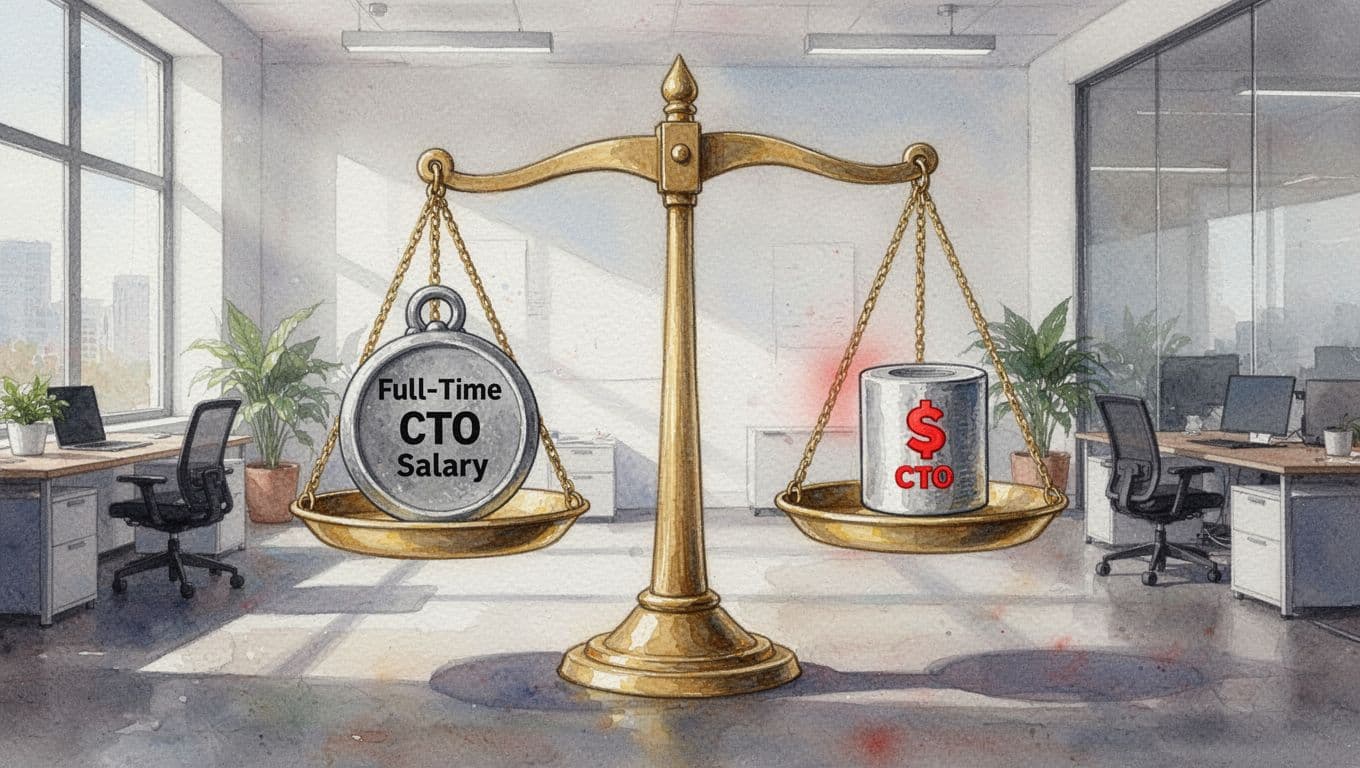
That matters when you need mid-market technology leadership or growth-stage technology leadership, but you do not need a permanent executive in the chair. For an early-stage startup, a technical co-founder might seem like an alternative, but it comes with its own risks. It also matters when you are still deciding how to hire a CTO. Sometimes the smartest move is to use a fractional leader first, then hire with better context.
A good rule is simple. If you need daily ownership, hire a full-time CTO. If you need judgment, structure, and momentum without a long hiring and recruiting cycle, a fractional model is usually the cleaner move.
For a deeper read on executive setup, executive technology leadership is the real job to understand. The title is just the wrapper.
What you should expect for the money
A solid engagement should give you more than advice calls. It should give you a working system.
- A technical roadmap that ties to business priorities, often in the form of a 12-month technology roadmap or a simple one-page technology strategy.
- A practical technology roadmap template you can reuse.
- Clear technology governance for CEOs and technology governance for boards.
- Board-ready technology reporting, including a board-ready risk summary and, when needed, board cybersecurity reporting.
- Better technology spend optimization, tech spending ROI, and IT cost optimization.
- Cleanup of tool sprawl, shadow IT, and technical debt management.
- Guidance for your engineering team, including software architecture and code review.
- Better vendor due diligence, vendor management, third-party risk management, and vendor offboarding.
- A clearer path for technology due diligence, acquisition readiness, and post-merger technology integration.
If you want a board view that leaders can actually use, board technology reports are a good benchmark. If the work goes into transaction territory, technical due diligence becomes part of the cost picture fast.
A strong engagement also touches AI governance, AI strategy, responsible AI, business continuity planning, disaster recovery planning, and incident response readiness when those risks are in play.
FAQ
Is hourly or retainer pricing better?
Advisory retainers are usually better for ongoing leadership. Hourly billing or project-based pricing can work for short audits, one-off fixes, or focused due diligence. If you need steady decision support, hourly pricing gets expensive fast and can create the wrong incentives.
How do you know if you need interim CTO services instead?
Choose an interim model when leadership has left, a major initiative is slipping, the board wants answers, or the business needs immediate control. That is a different job from ongoing advisory work.
What if you are not sure which model fits?
That is common. The real question is whether you have a technology leadership gap, a reporting gap, a vendor control issue, gaps in fundraising support, challenges managing a senior developer, or a broader technology strategy problem. Once you know that, the pricing conversation gets much easier.
If the numbers still feel fuzzy, Get an Executive Technology Clarity Check before you buy the wrong kind of help.
Conclusion
The fractional CTO cost in 2026 depends on the weight of the problem, not just the number of hours. If you need strategy and oversight, the price stays lower. If you need someone to step into a gap, clean up the mess, and restore control, it climbs for a reason.
You are not buying a title. You are buying clarity, ownership, and better decisions through executive leadership and technical strategy. That is what makes the spend worth it when technology has become too important to manage casually.