
You can have solid IT and still make bad technology decisions. That’s the part many leaders miss.
A managed IT provider and a technology advisor are not the same job, even if both touch the same systems. One keeps the lights on. The other helps you decide where the business should go, what matters first, and who owns the outcome. If those roles get mixed up, you usually end up with weak reporting, vendor dependence, wasted spend, or slower growth. If that sounds familiar, the real issue is often a Technology Leadership Gap.
The hard part is not finding help. The hard part is choosing the right kind of help for the problem in front of you.
Key takeaways for business leaders
- A managed IT provider is built for stability, support, and day-to-day operations.
- A technology advisor is built for executive judgment, direction, and business alignment.
- If your pain is uptime, tickets, or patching, you probably need support.
- If your pain is ownership, risk, roadmap clarity, or board pressure, you probably need leadership.
What each role is really meant to do

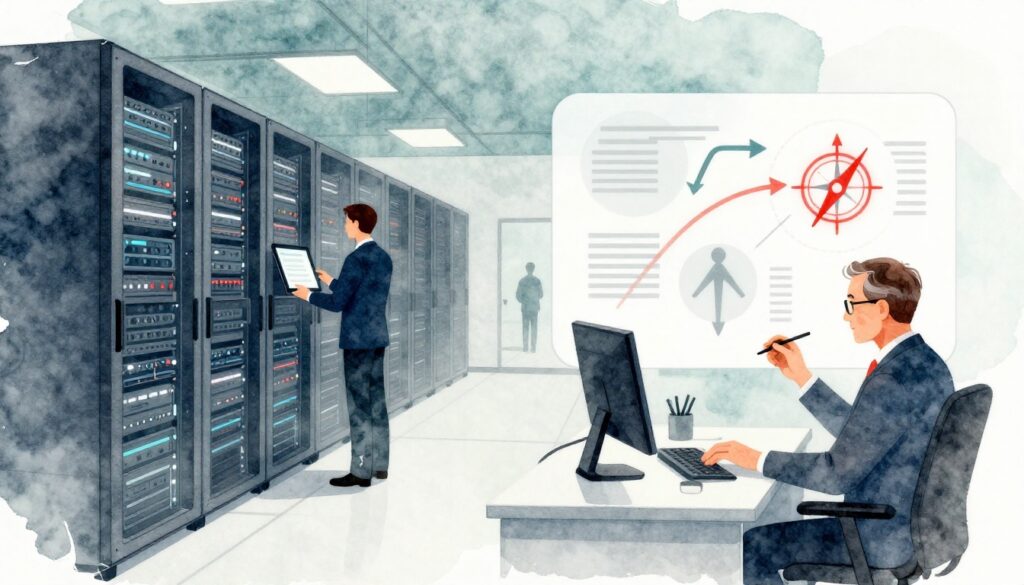
The simplest way to think about it is this, a managed IT provider keeps your environment running, while a technology advisor helps you make better decisions about that environment.
That sounds basic, but it changes everything. One role is tactical. The other is strategic. One reacts to incidents and maintenance. The other looks at business direction, risk, and decision-making.
What a managed IT provider usually owns
A managed IT provider usually handles the work that keeps your business day-to-day stable. That includes help desk support, device management, patching, backups, user setup, uptime, and basic cybersecurity tasks.
This is valuable work. If your laptops are failing, passwords are a mess, or your systems keep slipping, you need someone who can keep things under control.
Many providers do their best work when the technology plan is already set. They execute. They support. They keep the machine moving.
What a technology advisor usually owns
A technology advisor works at the executive level. You bring them in when you need clearer priorities, better judgment, and tighter alignment between technology and the business.
That can include roadmap planning, vendor oversight, board reporting, due diligence support, and decision support for major changes. It also includes the hard part, telling you what matters first and what can wait.
If your company is growing, changing, or under pressure, this role helps you stop treating technology like a service ticket queue and start treating it like a business function with real ownership.
Why the difference matters for your business

When you pick the wrong model, the symptoms show up fast. Decisions slow down. Reporting gets fuzzy. The team starts working around the problem instead of solving it.
That is where technology turns into drag. You spend more, but confidence does not rise. Tools multiply. Meetings multiply. Questions from the board get harder, not easier. If you want a deeper look at the shift from informal support to Executive Technology Leadership, that gap is usually where the pressure starts.
If you need the network fixed, hire for support. If you need the next decision made, hire for leadership.
What happens when strategy and support get mixed up
This is where companies get stuck. You ask a support provider to act like a strategic advisor, or you expect an advisor to run the help desk. Neither works well.
The provider may keep things moving, but nobody owns the roadmap. The advisor may give good guidance, but day-to-day issues still pile up. Then the business starts paying for extra meetings, extra vendors, and extra confusion.
You also get decisions that are technically correct and commercially wrong. That’s a bad trade. It looks efficient on paper and messy in real life.
How the wrong fit shows up in day-to-day work
You usually see the mismatch in ordinary places. Fire drills become routine. Board updates stay vague. Priorities keep shifting. Projects slip without a clean reason. Someone always knows the symptom, but nobody owns the cause.
And yes, tech spend can keep rising while confidence stays flat. That’s not a tool problem first. It’s a governance problem. If tool sprawl is part of the mess, tool sprawl is a governance problem is the right lens, because more software rarely fixes unclear ownership.
How to tell which one you actually need right now
Start with the problem, not the title. That’s where most leaders get twisted around. You do not need a smarter label. You need the right kind of help.
If the main issue is uptime, device management, user support, or routine maintenance, a managed IT provider may be enough. If the issue is leadership gaps, board scrutiny, growth strain, weak reporting, or confusing decisions, a technology advisor is usually the better fit.
If you need a board-ready technology risk view, you are probably past the point where support alone can carry the load.
Signs you need a managed IT provider
You probably need a managed IT provider when support tickets are piling up, systems are unstable, patching is falling behind, or backups are making people nervous.
You may also need this model if staff are wasting hours on basic IT issues. That is operational pain. It needs steady execution, quick response, and reliable maintenance.
This works best when strategy is already defined, or someone else is handling that layer.
Signs you need a technology advisor
You probably need a technology advisor when nobody clearly owns the roadmap, reporting is weak, or leadership keeps asking the same questions without getting better answers.
Other signs are harder to miss. You are preparing for acquisition or transition. A key technology leader has left. A major vendor decision is hanging in the air. The board wants more than activity updates. It wants judgment.
If that sounds close, Talk Through Your Technology Leadership Gap before you buy another tool or sign another contract.
Where a technology advisor adds the most value
This role matters most when the stakes are high and the business cannot afford fuzzy thinking. Growth, transition, diligence, recovery, and rising risk all expose the same problem, too many decisions, not enough structure.
That is why CTO Input is built for the middle ground. You may not need a full-time executive. You also do not need another generic support vendor. You need someone who can sort signal from noise and give leadership a clear path.
When growth starts creating drag
Growth looks good until it starts breaking your operating rhythm. Systems get messy. Vendors get more influence. Internal roles become harder to define. The business is still moving, but it takes more effort to get anything done.
This is not a failure of effort. It is a failure of structure. A good advisor helps you tighten ownership without slowing the business down.
When you need clearer answers for the board or investors
Boards and investors do not want a tech monologue. They want to know what is at risk, what is on track, and what needs attention now.
A strong advisor helps you report in business terms. That means clearer progress, clearer tradeoffs, and less noise. If you need board technology reports that leadership can actually use, that is the kind of work that changes the conversation.
If your situation also includes acquisition pressure or a major transition, Prepare Technology for Diligence or Transition is the right next step.
Questions to ask before you choose
You can make this decision faster if you stop asking, “Who is available?” and start asking, “What problem am I solving?”
- Are you trying to keep systems stable, or are you trying to change direction?
- Do you need someone to fix tickets and maintenance, or someone to help you decide priorities?
- Is the issue mostly operational, or is it tied to risk, reporting, and ownership?
- Would more IT activity help, or would better judgment help more?
Those questions cut through a lot of noise. They force the real issue onto the table.
Are you solving a support problem or a leadership problem?
Support problems show up in service levels, outages, and response time. Leadership problems show up in ownership, visibility, and decision quality.
If you are seeing repeat failures in basic IT functions, start with support. If you are seeing repeat failures in decision-making, start with leadership.
Do you need execution help, or do you need someone to help you decide?
If the work is already defined, a provider can usually execute it. If the work is unclear, conflicting, or tied to major business risk, you need an advisor.
Sometimes the biggest value is not doing more. It is deciding what not to do.
How to use both roles well without creating confusion

Some businesses need both roles. That is fine. The mistake is asking them to do the same job.
If you want a closer look at the service model behind this, fractional CTO services are built for leadership, while managed IT is built for operations. You want clean lanes, not overlap.
Keep strategy and support in separate lanes
One person or vendor should not be the fixer, the planner, the reporter, and the decision owner. That gets sloppy fast.
When you separate the roles, ownership gets cleaner. Reporting gets better. Follow-through gets easier. And nobody has to guess who is driving which decision.
Use the right partner for the right decision
Use the provider for stability. Use the advisor for direction.
That combination can calm the whole operating rhythm, because each partner is doing the work they are best suited for. The provider keeps the environment steady. The advisor helps leadership make choices that fit the business, not just the system.
Conclusion
Managed IT providers keep systems working. Technology advisors help you make smarter business decisions about technology. That is the whole split, and it matters more than most leaders think.
If your pain is support, hire for support. If your pain is direction, hire for leadership. Choose based on the problem in front of you, not the job title on a proposal.
If you are still sorting out which lane you are in, start with a clarity conversation. The goal is simple, better visibility, clearer ownership, and decisions you can stand behind.