

SEO title: Mastering Cyber Risk Reporting for Boards in 2026
Meta description: Cyber risk reporting for boards should drive decisions, not confusion. Learn what fails, what a defensible report includes, and a practical 30/90-day plan.
Slug: mastering-cyber-risk-reporting-for-boards-2026
If you're chairing an Audit Committee right now, you already know the feeling.
The cyber update lands in the board packet. It has heat maps, control summaries, maybe a list of incidents, and a few reassuring phrases about ongoing remediation. The presenter seems competent. The slides are polished. Then the meeting ends and the core question is still hanging in the air.
Are we within an acceptable level of risk, or are we just being briefed on activity?
That gap is where most boards get stuck. You are expected to govern. Regulators, investors, insurers, and fellow directors expect oversight. But the reporting you receive often makes that oversight harder, not easier. It shows motion without proving control.
That pressure is getting sharper. The NACD 2025 Public Company Board Practices and Oversight Survey summary shows a 25 percentage point increase since 2022 in directors focusing on the material and financial implications of cyber incidents, and 72% of directors undertook cyber risk education in the past year, up from less than half in 2022. Boards are paying attention. The reporting still hasn't caught up.
When The Board Asks Harder Questions
The usual failure starts in a familiar boardroom moment.
A CISO or CIO walks through an update. You hear about phishing attempts, patching cadence, endpoint tooling, third-party questionnaires, and a dashboard of red-yellow-green ratings. Nobody is lying. Nobody is hiding. But nobody is answering the business question either.
You're left trying to translate in real time. Which of these issues can disrupt operations? Which ones could trigger disclosure, customer fallout, or a covenant problem? Which ones need a decision from the committee today?
That's why so many directors feel uneasy even after a full briefing. The reporting is often built to prove diligence by the security team, not to support judgment by the board.
The pressure is real
Cyber isn't sitting off to the side anymore. For many boards, it's now a standing governance issue tied to resilience, legal exposure, operational continuity, and executive credibility.
The problem is that harder board questions usually collide with weak reporting habits:
- Too much technical detail: The packet shows what the team is doing, not what leadership needs to decide.
- Too little financial framing: Risk gets described as high, medium, or low when the board needs to understand business impact.
- No line to accountability: The report highlights issues but doesn't make ownership, deadlines, or escalation paths obvious.
Boards don't need to become technical. Management needs to become legible.
What the chair is really asking
Most Audit Committee Chairs aren't asking for more dashboards. They're asking for a way to answer a short list of governance questions with confidence.
Those questions usually sound like this:
- What are our most serious cyber exposures right now?
- Are those exposures within the risk tolerance the company says it accepts?
- Is management reducing the right risks, or just staying busy?
- What decision do you need from the board?
If your current cyber risk reporting for boards can't answer those questions in plain English, it isn't board reporting. It's technical briefing material.
That distinction matters. A board can govern through a concise, financially grounded narrative. It cannot govern through jargon and hope.
Why Most Cyber Reporting Fails The Business
Most cyber reporting fails for one blunt reason. It is written in the language of the operator, not the language of the governor.
Security teams talk about vulnerabilities, mean time to respond, control coverage, and attack paths. Boards talk about earnings impact, operational disruption, legal exposure, insurability, capital allocation, and acceptable downside. Those are not the same conversation.
When management sends the board technical updates dressed up as governance reporting, everyone loses. The board gets noise. The security team feels misunderstood. The company spends money without a clean line between investment and risk reduction.
More data usually makes it worse
A lot of teams respond to board frustration by adding more charts. That's the wrong move.
More data doesn't create better oversight. It usually creates more room for ambiguity. A thick packet can hide the fact that nobody has said which risk matters most, what management is doing about it, and where the board's intervention is required.
The SAFE discussion of cyber risk reporting and board oversight cites NACD 2025 data showing 74% of boards report receiving insufficient business translation in their cyber updates. The same source notes that decision-focused reports boost budget approval rates 3x compared to metrics-alone decks. That should tell you everything you need to know. The issue isn't volume. It's translation and decision design.
Practical rule: If a board packet can't end with a clear ask, it probably shouldn't start with ten pages of metrics.
Technical theater looks busy, not governed
I see the same reporting traps over and over:
- Blocked attack counts: Activity metric. It says almost nothing about exposure.
- Patch percentages: Useful operationally, weak on their own at board level.
- Compliance checklist progress: Necessary, but not a substitute for understanding material risk.
- Heat maps with no financial context: They imply precision without supporting decisions.
The board doesn't need every operational detail. It needs management's judgment backed by evidence.
That means the report should explain:
| Common board packet habit | Why it fails |
|---|---|
| Long status summaries | They reward completeness over clarity |
| Generic risk ratings | They don't show business impact |
| Tool-centric reporting | They focus on means, not outcomes |
| Open issue lists | They often lack prioritization and ownership |
The real failure is organizational
This isn't just a presentation problem. It's an operating model problem.
When cyber reporting is weak, it usually means the company hasn't fully agreed on three things:
- What the business is trying to protect first
- What level of cyber risk is tolerable
- Who owns the decision when exposure sits above tolerance
Without that foundation, the board receives updates that are detailed but unactionable. Management works hard. Oversight still feels thin.
That's why cyber risk reporting for boards has to be built backward from decisions, not forward from tools.
The Four Hallmarks of Board-Defensible Reporting
A defensible board report has four hallmarks. Miss one, and the whole thing starts to wobble.

Quantified in financial terms
The board does not manage cyber risk in CVSS scores or control maturity labels. It governs enterprise risk in terms of business impact.
That's why I want cyber risk expressed in financial terms wherever possible. The Meriplex explanation of board reporting and FAIR-based quantification describes FAIR as a model that quantifies cyber risk through loss event frequency and loss magnitude, producing Annualized Loss Expectancy (ALE). The same source notes that SEC cybersecurity disclosure rules effective since late 2023 require public companies to report on board oversight and management expertise in assessing material cyber threats. In practice, that pushes reporting toward dollars-and-cents translation.
You don't need perfect models on day one. You do need a serious attempt to answer, “What could this scenario cost us?”
A weak board statement sounds like this: “Third-party risk remains high.”
A stronger one sounds like this: “Our current third-party concentration creates meaningful financial exposure in a business-critical process, and management is prioritizing the vendors and controls that most affect loss potential.”
Tied to business objectives
Security doesn't protect “the environment.” It protects specific operations, revenue streams, customer obligations, and regulatory commitments.
If a report can't tie risk to a concrete business objective, it's too abstract for board use.
Good reporting connects cyber exposure to things like:
- Revenue continuity: Can we keep billing, shipping, serving, or transacting?
- Sensitive data obligations: Which data sets would create legal or trust consequences if exposed?
- Strategic initiatives: Which acquisitions, product launches, or partner relationships depend on better control?
Reporting discipline matters as much as slide design. A solid effective presentation structure helps, because the board needs a narrative arc, not a dump of evidence.
Forward-looking, not just rearview
Many cyber reports are basically incident recaps plus current-state metrics. That's incomplete.
The board needs a view of trajectory. Is exposure going down, staying flat, or drifting up? Which upcoming events could increase risk? Where is control debt building because the business moved faster than governance?
A board-defensible report should look around corners. It should identify leading concerns before they become public problems.
Past incidents matter. But for governance, trend and direction matter more than storytelling about last quarter's fire.
Decision-focused
This is the one most companies miss.
The report should end with a management recommendation, not a vague invitation for discussion. Boards govern best when they are asked to approve, challenge, prioritize, or escalate against a clear decision frame.
Here's what that sounds like in practice:
- Approve a risk treatment plan for a concentrated vendor dependency.
- Endorse a revised tolerance threshold for a critical business process.
- Direct management to report back on a specific remediation owner and timeline.
- Escalate an issue to full board review because it sits outside accepted appetite.
One option some teams use to support this style is CTO Input's executive cyber risk dashboarding approach, which is designed to show where risk meets money, who owns the next action, and what leadership needs to decide. That's the right category of solution. Whether you build it internally, use FAIR-aligned modeling, or use an outside advisor, the principle is the same.
If the report doesn't sharpen a decision, it's not board-ready yet.
Sample Dashboards and One-Page Narratives
Most boards do not need a bigger cyber deck. They need a better one-page summary backed by evidence that management can unpack if asked.
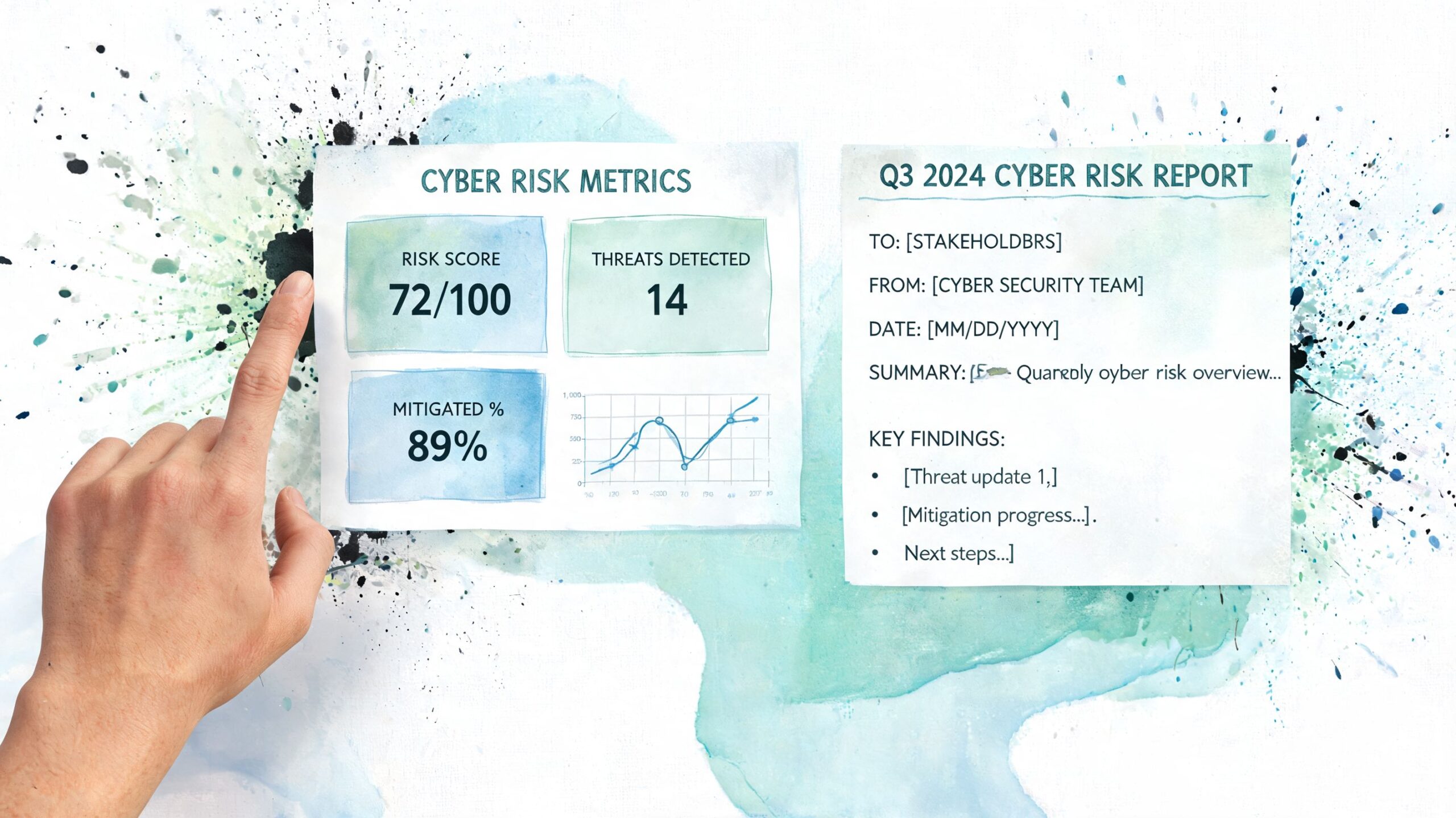
The first page should do one job well. It should answer three questions fast:
- Where are we most exposed?
- Is current spend reducing meaningful risk?
- What decision or guidance do we need from the board?
That's the core of useful cyber risk reporting for boards.
What the one-page summary should contain
I like a single-page narrative with five blocks.
- Top risk scenarios: A short list of the exposures management believes matter most now.
- Business impact statement: Plain-English explanation of what each scenario threatens.
- Risk position against tolerance: Whether exposure appears inside or outside accepted bounds.
- Remediation status: What management is doing, who owns it, and where blockers remain.
- Board ask: The one decision, endorsement, or escalation point needed in this cycle.
A one-page summary does not replace detailed appendices. It forces management to lead with judgment.
If your first page starts with tool counts, patch levels, or awareness training completions, you've already buried the story.
From Technical Activity to Business Impact
| Instead of This (Activity Metric) | Report This (Impact Metric) |
|---|---|
| Number of blocked attacks | The business areas where exposure remains concentrated despite defensive activity |
| Percentage of systems patched | Whether remaining gaps affect a critical business process or regulated data set |
| Security awareness completion | Whether human-risk controls materially support a high-consequence workflow |
| Count of open vulnerabilities | Which unresolved issues could create outsized financial or operational harm |
| Number of vendor assessments completed | Which vendor dependencies create the greatest exposure to revenue, service delivery, or compliance obligations |
| Incident ticket volume | Whether incident patterns suggest deteriorating resilience in a priority area |
That shift matters for public and private companies alike. The CyberSaint discussion of board reporting gaps cites a 2025 PwC survey showing 68% of private firm boards demand quantified cyber risk reporting, while only 22% receive it. The same source says HBR analysis links weak governance visibility to 15-30% valuation haircuts during diligence or acquisitions. If you're private, founder-led, PE-backed, or acquisition-bound, this is not somebody else's problem.
A better narrative format
A strong board narrative usually reads something like this in structure:
- Current exposure: The company remains meaningfully exposed in a small number of high-consequence scenarios.
- Why it matters: Those scenarios threaten a defined business process, revenue stream, or legal obligation.
- What management is doing: Named owners are executing specific risk reduction actions.
- What changed since last review: Exposure is improving, flat, or worsening, and management can explain why.
- What the board should decide: Approve funding, endorse prioritization, require escalation, or accept residual risk.
For teams that need a starting point, this board-ready cybersecurity reporting template is the kind of artifact worth adapting. Don't copy a template blindly. Use it to force discipline around what the board needs to see.
What not to include on page one
Leave these out of the lead page unless they directly support a board decision:
- Raw security tool outputs
- Long compliance status lists
- Dense vulnerability inventories
- General awareness campaign updates
- Technical architecture descriptions
Those belong in backup material for management, auditors, or working sessions.
The board page is for governance. It should read like an enterprise risk brief, not an operations log.
Establishing Governance and Escalation Controls
A clean report without a governance rhythm is just a nicer fire drill.

Many companies frequently stall at this juncture. They improve the slides, maybe even improve the metrics, then wonder why the board still feels underinformed. The answer is simple. Reporting only works when it sits inside a repeatable control system.
The FAIR Institute 2025 State of Cyber Risk Management report makes the gap plain. It notes that while nearly all mature organizations have formally approved risk tolerance levels, boards actively consume cyber risk information in less than half of cases. That tells you the issue isn't just defining appetite. It's building a rhythm that delivers usable information into oversight.
What a workable cadence looks like
You need at least three layers of review.
- Operating review: Management team members who own security, technology, legal, finance, and affected business functions review current exposure and blocked actions.
- Executive risk review: Senior leadership tests whether exposures remain within tolerance and whether investment decisions are aligned.
- Quarterly board or committee update: The board receives the decision-grade summary, trend view, and any required escalation.
The key is consistency. Same owners. Same decision points. Same escalation logic.
Define triggers before the meeting
Boards shouldn't be guessing when they need deeper involvement.
Set explicit escalation conditions such as:
- Exposure appears outside approved tolerance
- A critical remediation owner is blocked
- A third-party issue affects a material business process
- An incident or near-miss changes management's view of current risk
- Management needs a board-backed funding or prioritization decision
That discipline matters more than perfect formatting. A board can work with imperfect data if the company has clear ownership and clear thresholds. It cannot govern well when everything arrives as a one-off exception.
Good governance feels boring. That's a compliment.
Make ownership inspectable
A cyber risk report should point to named executives, not vague functions.
If the remediation for a vendor concentration issue depends on procurement, legal, IT, and operations, the report should say who is accountable for the outcome and who supports delivery. Otherwise the board gets a comforting sentence with no enforcement mechanism behind it.
This is also where many organizations benefit from a wider governance model that clarifies decision rights beyond security alone. A practical reference point is this guide on technology governance for boards, because cyber oversight usually breaks where enterprise ownership is fuzzy.
If you want defensible oversight, don't just improve the report. Improve the operating rhythm the report comes from.
Your 30/90-Day Plan for Defensible Reporting
You do not need a year-long transformation to fix this. You need a disciplined first month and a serious next quarter.
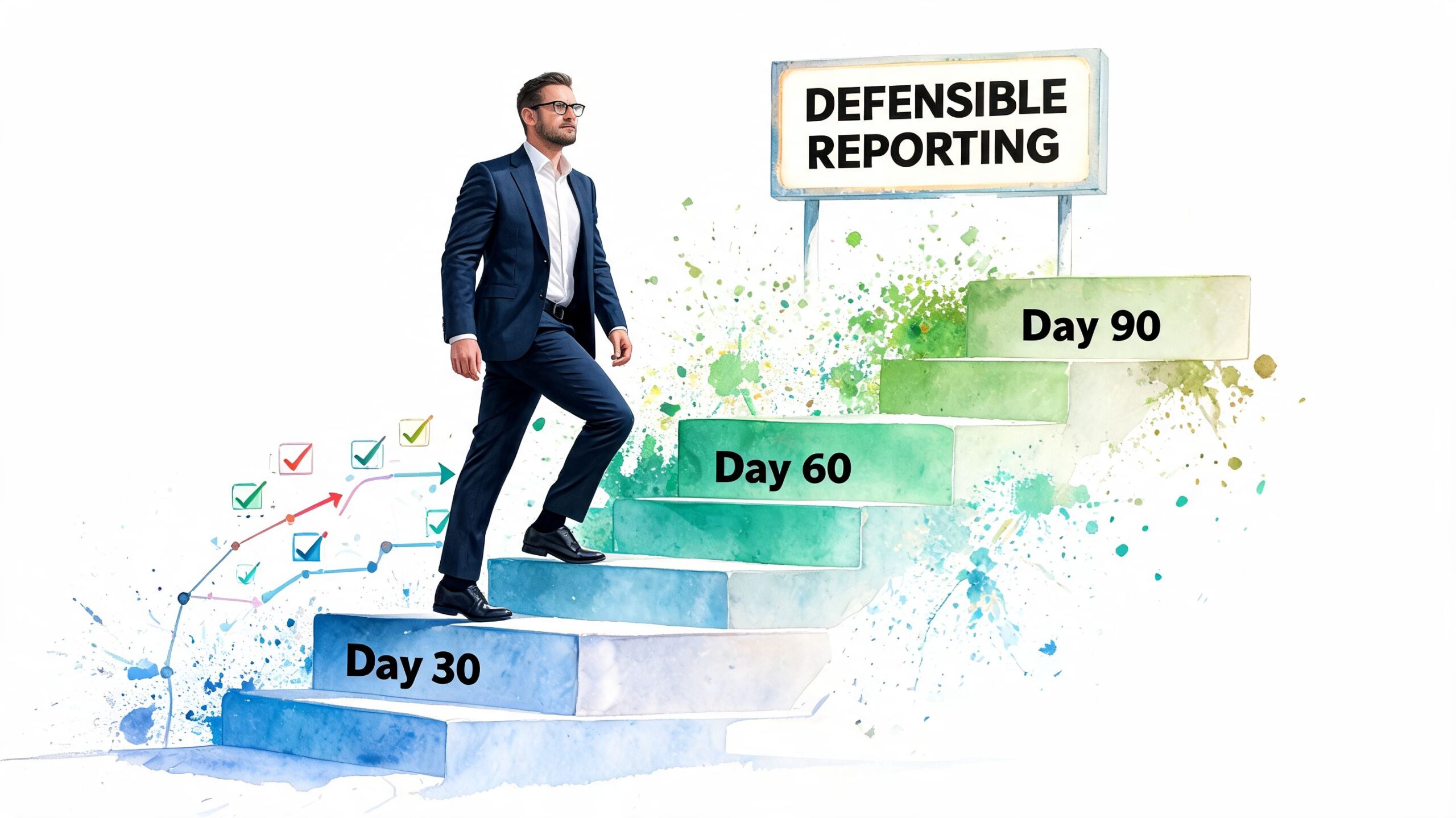
Most organizations can improve cyber risk reporting for boards quickly if they stop trying to perfect everything at once. Start with the smallest reporting system that supports real oversight.
In the first 30 days
The aim in the first month is clarity, not sophistication.
Identify the business-critical assets and processes
Pick the few systems, data sets, vendors, and workflows that matter most to revenue, service delivery, legal exposure, or customer trust. If the list is long, it isn't useful yet.Interview the CFO or finance lead
Get management aligned on what “material” means in your context. Don't delegate this to security alone. The board needs a reporting model that matches financial reality.List the top risk scenarios in plain language
Not every threat. The few scenarios that would genuinely hurt the business. Keep the language simple enough that a director can repeat it accurately after the meeting.Map current controls and known gaps against those scenarios In this stage, you separate real exposure from general security workload.
Draft a one-page v1 board summary
Use existing data, even if it's imperfect. A decent first draft beats another quarter of vague updates.
By day 60, tighten the mechanics
The second phase is about turning a good narrative into a repeatable management process.
Use this checklist:
- Set monthly management reviews: Put legal, finance, technology, and risk owners in the same discussion.
- Define escalation triggers: Pre-agree when issues move to the Audit Committee Chair or full board.
- Assign explicit owners: Every material issue needs one accountable executive.
- Create a board ask format: Each update should end with a recommendation, not an open loop.
- Build backup evidence: Keep detailed technical appendices ready, but off the lead page.
By day 90, make it board-defensible
By the end of the quarter, you want more than a cleaner report. You want a system the board can rely on.
That usually means:
Apply quantification to at least one priority risk area
Start where the business consequence is easiest to explain. Don't boil the ocean.Test the report in a live committee setting
Watch where directors still get confused. Fix language before adding more metrics.Connect reporting to risk tolerance and decisions
The board should see where management believes exposure sits relative to accepted bounds, and what response is proposed.Document cadence and escalation
Meeting rhythm, owner expectations, and reporting paths should be written down.Establish the next two quarters of board topics
This stops cyber from appearing only when something goes wrong.
A useful benchmark for the rhythm side of this is a documented board risk committee cyber reporting cadence. The point isn't to copy someone else's calendar. It's to make your oversight predictable, inspectable, and durable.
What success looks like by the end of that period
You'll know this is working when the board discussion changes.
Instead of asking, “What does this red box mean?” directors start asking, “Do we agree with management's prioritization?” Instead of debating terminology, the committee weighs tradeoffs. Instead of broad reassurance, the board gets named owners, timed actions, and a clear record of oversight.
That is what defensible reporting looks like. Not perfect foresight. Not zero risk. Just evidence that the company knows where it is exposed, who owns reduction, and when the board needs to act.
From Vague Updates to Calm Control
The goal isn't a prettier cyber deck. It's calmer control.
When cyber risk reporting for boards works, the conversation changes shape. Directors hear a concise view of current exposure, the business implications, the actions underway, and the decision in front of them. Management stops over-explaining. The board stops guessing. Oversight becomes something you can defend without pretending risk has disappeared.
That's the standard to hold. Clear translation. Financial framing. Named ownership. A steady cadence. Escalation rules that don't depend on personality or panic.
If your current updates still feel vague, the answer probably isn't more reporting volume. It's a better operating model underneath the report. Fix that, and the packet gets shorter, sharper, and far more useful.
If your board is asking harder questions and the answers still feel fuzzy, CTO Input can help you make the current reality legible, install a calmer reporting rhythm, and turn cyber updates into defensible oversight. A clarity call is a practical place to start.