

Growth makes weak operating habits impossible to hide. What worked when the company was smaller starts failing under pressure. Requests come in through side channels, incidents get handled by whoever notices first, and nobody can give a crisp answer on what technology owns, supports, or enables.
That's when “good enough” technology starts breaking the business. Handoffs leak. Priorities drift. Leaders spend time chasing status instead of making decisions. The issue usually isn't effort. It's the absence of a clear operating system for technology.
That's where ITIL best practices still matter. Not because executives need another framework deck, but because they need control. ITIL's modern foundation, ITIL 4 formalized 34 management practices around a Service Value System, and that matters for one reason: it gives leadership a common way to define ownership, service levels, governance, and continual improvement.
If your team feels busy but the business still feels exposed, start here.
1. Define What Matters with Service Portfolio Management
Most companies carry too many services, too many tools, and too many implied commitments. Nobody chooses that situation on purpose. It happens one purchase, one exception, and one “temporary” workaround at a time.
A service portfolio fixes that by forcing leadership to answer a hard question. Which services matter to the business, and who owns them?

A healthcare operator might discover it has several patient-facing tools that all do part of the same job. A fintech firm might realize some platforms directly support revenue while others mainly reduce operational or regulatory risk. A legal services organization might separate systems that touch sensitive client data from back-office tools that don't require the same level of scrutiny.
What leadership should require
Run a focused working session with your executive team and your top technology leaders. Keep it tight. Name every live service, the business outcome it supports, the owner, the primary vendor, and the last time anyone reviewed whether it should still exist.
Then put it into a one-page document and use it.
- Name the service clearly: Use business language, not product nicknames.
- Assign one owner: If two people own it, nobody owns it.
- State the business outcome: Revenue, client delivery, internal productivity, compliance, or risk reduction.
- Record the annual cost: If the cost isn't visible, the decision quality won't be either.
- Add a review date: Services need active decisions, not historical assumptions.
Practical rule: If a tool purchase or vendor renewal doesn't map to a named service, don't approve it.
This is also where adjacent governance work becomes easier. If you're reviewing exposure in cloud systems, a service portfolio gives you the business context you need for cloud security risk assessments.
A quarterly portfolio review is enough for many organizations. Value isn't documentation. It's deprioritization. Mature ITIL best practices help leaders stop funding yesterday's complexity.
2. Stop Firefighting with Disciplined Incident Management
At 9:12 a.m., a core system goes down. Customers feel it immediately. Your operations lead is asking for updates, the CIO is chasing facts, and three teams are working the same issue in parallel without a clear leader. That is not an IT problem. It is a control problem.
Disciplined incident management gives leadership a repeatable way to regain control fast. It answers three questions that matter in the first few minutes of disruption. Who owns the response, how severe is the issue, and when will stakeholders hear from you again.
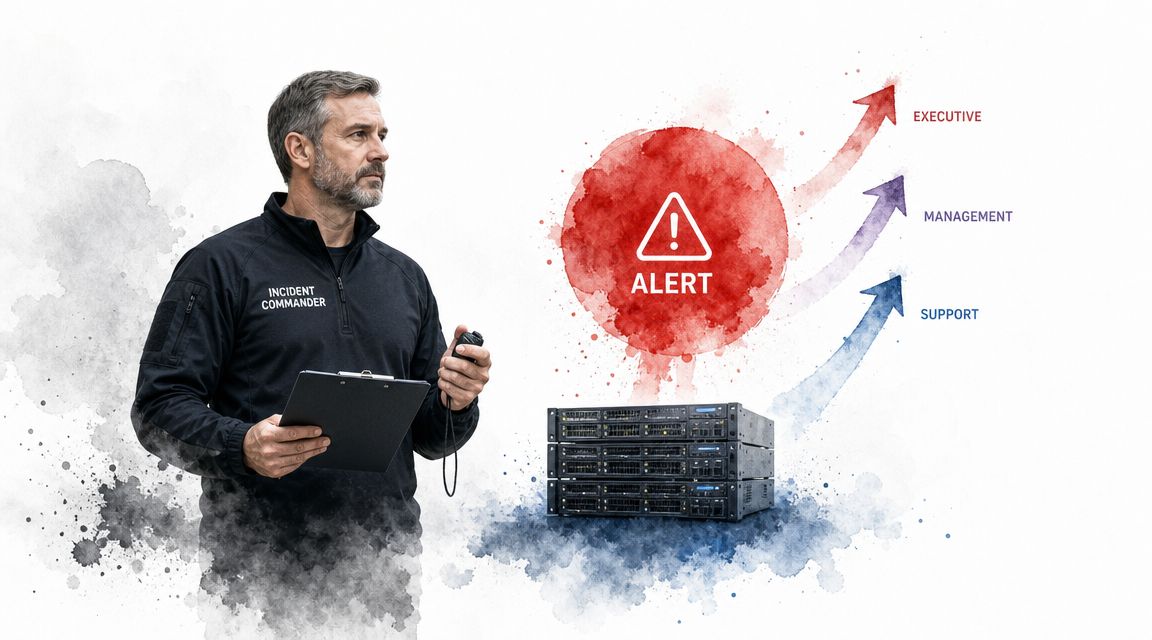
If you want less firefighting, stop treating incidents as a loose collection of tickets. Run them as a managed business event with one intake path, one operating cadence, and one accountable leader.
Build one incident rhythm
Start with a single front door for incidents. If employees, customers, and vendors report problems through different channels, your reporting will be weak and your response will stay inconsistent.
Then put a simple structure in place:
- Set severity levels: Define what counts as critical, high, medium, and low in business terms.
- Assign an incident commander: One person leads the response, makes tradeoffs, and owns escalation.
- Use one communication channel: Pick a dedicated Teams, Slack, or bridge channel for live coordination.
- Set an update cadence: During major incidents, stakeholders should know exactly when the next update is coming.
- Require a review afterward: Capture what failed, what slowed the response, and what must change.
For a practical operating model, use these incident management best practices as a reference point. Then connect that operating model to a clear change management process, because a surprising share of serious incidents start with poorly controlled changes.
The executive test is simple. After a serious outage, can you get a clean summary of timeline, owner, business impact, decisions made, and current status in minutes, not hours? If not, your incident process is still informal.
A SaaS company may need to distinguish customer-facing degradation from an internal tooling failure within minutes. A healthcare provider needs immediate escalation for any outage tied to patient data or clinical workflows. A multi-site operator needs every location hearing the same message, not five versions of the truth from five support teams.
During an incident, speed matters. Clarity matters more.
This is one of the fastest ITIL improvements a leadership team can make because it fixes fuzzy ownership, weak reporting, and operational confusion at the same time.
3. Make Decisions Stick with Clear Change Control
A leadership team approves a major update on Tuesday. By Thursday, a core service is unstable, customers are complaining, and nobody can give you a clean answer on who signed off, what risk was accepted, or how the team planned to reverse it.
That is not an IT paperwork problem. It is a control problem.
Clear change control stops avoidable disruption by making ownership visible before production is touched. It should protect the business without slowing routine work. If every change needs the same level of scrutiny, teams will bypass the process, and they will be right to do it.
Separate routine work from business risk
The fix is straightforward. Classify changes by impact, then match approval to that impact.
Use three lanes:
- Standard changes: Repeatable, low-risk work that can be pre-approved.
- Normal changes: Work that could affect customers, revenue, compliance, or critical operations and needs review.
- Emergency changes: Time-sensitive work with a fast, documented approval path and mandatory follow-up review.
Do not force low-risk changes through the same queue as high-risk ones. That creates delay, resentment, and shadow processes. Start with incident discipline and clear intake first. Then put a practical change management process around production changes so approval means control, not bureaucracy.
Run change review like an executive control point
A weekly change review should be short and decisive. It exists to prevent avoidable business damage, not to stage a meeting.
Every material change should answer five questions:
- What is changing?
- Who approved it?
- Which business service could it affect?
- What is the rollback plan?
- How will you confirm success?
If one of those answers is vague, the change is not ready.
The business value is immediate. A healthcare provider can stop a vendor update from disrupting clinical workflows. An e-commerce company can require tighter review for checkout and payment changes. A financial services firm can put stronger approval around identity, network, and access changes where one mistake creates operational and regulatory exposure.
Board lens: Unapproved change is one of the clearest signs that control exists on paper, not in practice.
This practice matters because it makes decisions stick. Leaders get clear accountability, cleaner reporting, and fewer surprises caused by informal work happening in production.
4. Align Spending and Growth with Practical Capacity Planning
Most companies don't fail capacity planning because they lack tools. They fail because nobody ties technology demand to business plans.
So the business grows, transaction volume rises, customer expectations tighten, and infrastructure or team capacity gets reviewed only after performance slips. That is an expensive way to learn.
Capacity planning is how you stop buying late, hiring late, and reacting late.
Track the few signals that matter
You don't need a giant forecasting exercise. You need a monthly view of the services that matter. For each critical service, track a small set of operating indicators that show whether demand is outpacing your ability to deliver.
That might include:
- Platform utilization trends: Where load is moving over time.
- Support demand patterns: Whether service demand is outgrowing team capacity.
- Storage and compute trajectory: Where infrastructure pressure is building.
- Vendor constraints: Licensing, throughput, or support dependencies that may become bottlenecks.
- Business growth assumptions: New locations, product launches, client volume, or hiring plans.
A SaaS company may find old replication jobs or unused environments are distorting spend. A healthcare provider may see patient volume and integration traffic rising against a database layer that was fine a year ago. A scaling services firm may realize the bottleneck isn't infrastructure at all. It's one overcommitted application owner.
Bring finance into the room
Quarterly reviews should include platform leadership and finance, not just infrastructure staff. If capacity decisions live only inside IT, they usually arrive too late for budget discipline and too disconnected from growth plans.
ITIL best practices work best when they stay tied to business value. Capacity planning is a strong example. It helps leadership choose where to spend early, where to simplify, and where to avoid overbuilding.
This is also where ITIL 4's guiding principles matter. Recent guidance highlights “keep it simple and practical,” “progress iteratively with feedback,” and “optimize and automate” in the seven guiding principles of ITIL 4. Capacity planning should follow that same logic. Start with a few critical services and improve the forecasting rhythm over time.
5. Eliminate Repeat Failures with Root Cause Discipline
Monday starts with a familiar outage. The service is restored by noon. By Thursday, the same failure is back under a new ticket number, a different owner, and the same weak explanation. That is not operational stability. It is expensive repetition.
Senior leaders should treat recurring incidents as a control failure. Incident management gets the business running again. Root cause discipline stops the business from paying for the same disruption twice.
Stop rewarding fast closure over real resolution
Repeated payment timeouts, recurring data sync errors, or the same vendor API issue every few weeks usually point to one leadership problem. Teams are being measured on ticket closure, not on whether the underlying failure is gone.
Set a higher bar. For any repeat issue tied to a critical service, require one named owner and five clear answers before the issue drops out of leadership view: what happened, why it happened, what contains it now, what will permanently fix it, and when that fix will be complete.
This changes behavior quickly.
It also helps you focus attention where it matters. Review repeat failures by business impact and recurrence. A minor annoyance can wait. A recurring issue that hits revenue, customer trust, or executive reporting belongs on a problem list with direct oversight.
Use a simple problem log and review it every month
Do not overengineer this. A spreadsheet or shared system is enough if the fields are clear and someone owns the updates.
Your problem log should include:
- Problem ID
- Service affected
- Symptom
- Root cause
- Current workaround
- Permanent fix
- Owner
- Target date
- Status
The format matters less than the discipline behind it. If the root cause is blank, the issue is still open. If the owner is vague, accountability is missing. If the permanent fix has no date, leadership should assume the incident will return.
For a practical starting point, use this root cause analysis template for recurring service issues.
A fintech firm might discover repeated rate-limit failures tied to a vendor dependency with no escalation path. A SaaS company may find one neglected database constraint behind weeks of performance complaints. A healthcare organization may uncover the underlying issue faster than expected. Nobody owns the handoff between two systems, so each team keeps closing only its own piece.
Fixing a repeat issue once is useful. Proving it stays fixed is control.
Strong ITIL best practices matter because they restore business control, not because they satisfy a framework. Root cause discipline is one of the few practices that directly reduces noise, sharpens ownership, and gives executives evidence that operations are improving.
6. Reduce Deployment Chaos with Coordinated Release Management
A lot of release pain gets mislabeled as a tooling problem. It usually isn't. It's a coordination problem.
Multiple teams ship on different rhythms. Dependencies aren't visible. Rollback thinking starts too late. Then leadership hears that the release was technically successful even though customers felt the disruption.
Release management creates one clear answer to a simple question. What is going live, when, with what dependencies, and under whose authority?
Put releases on a calendar
If several teams touch production, you need a release calendar that looks ahead far enough for conflicts to surface. That doesn't mean giant release trains. It means shared visibility.
A practical release discipline includes:
- A defined cadence: Weekly, biweekly, or another rhythm that matches business risk.
- A forward calendar: So overlapping releases can be spotted early.
- A release checklist: Testing, approvals, communications, validation, and rollback.
- Dependency mapping: Especially for changes across multiple systems.
- A post-release check: So success isn't declared before services are stable.
A healthcare provider might use this to prevent overlapping database migrations. An e-commerce operator might separate checkout-related releases from low-risk internal improvements. A financial firm might coordinate a platform upgrade across several integrated systems and ensure communications are aligned before go-live.
Don't confuse release with deployment
Many executive teams get poor signals when deployment and release are not clearly differentiated. A deployment is the technical act of pushing code or configuration. A release is the managed business event around that change. If you merge those concepts, the reporting gets fuzzy and accountability weakens.
A lean release process is fully consistent with modern ITIL best practices. It doesn't slow delivery. It removes surprise. That's especially important in scaling environments where the hidden cost isn't effort. It's coordination tax.
Good release management is what lets fast teams stay fast after complexity arrives.
7. Know What You Own with a Single Source of Truth for Assets
You can't govern what you can't name. Yet many organizations still run critical systems without a reliable record of what exists, who owns it, and what depends on it.
That's how renewals drift, certificates expire, backup assumptions go untested, and incidents take longer because nobody knows what else a failure might affect.
Start smaller than people expect
A useful CMDB or asset register does not need to begin as a giant enterprise program. It can start with a controlled list of critical assets and the few fields leadership needs.
Include:
- Asset name
- Type
- Owner
- Lifecycle status
- Primary vendor
- Dependencies
- Business service supported
A multi-location operator might use this to map systems that support frontline scheduling and reporting. A fintech firm might use it to identify certificate or integration dependencies before they become urgent. A healthcare organization might use it to show auditors that key backups, environments, and ownership records exist in one inspectable place.
Then tie updates to change control. If a meaningful asset changes and the record doesn't change with it, the register becomes fiction.
Asset truth supports service truth
This is one reason a service catalog and a CMDB work well together. One tells the business what services exist. The other tells the operators what those services depend on.
If your organization is trying to tighten license visibility, vendor exposure, or renewal discipline, adjacent practices in Zendesk IT asset management guidance can help frame the operational side.
ITIL best practices are often treated as process design. In practice, some of the biggest wins come from simple asset truth. Ownership becomes visible. Incident impact gets easier to assess. Cost conversations get cleaner.
8. Measure What You Manage with Business-Aligned SLAs
Monday's operations review starts the same way. Sales says support is slowing deals. Operations says outages are hurting execution. IT says the team is hitting its targets. If each group is using a different definition of success, the meeting turns into opinion, not management.
Business-aligned SLAs end that confusion. They set a small number of visible commitments for the services that matter most, then force regular review against business impact.
Start narrow. Pick the services tied directly to revenue, customer trust, operational continuity, or regulatory exposure. Then define measures an executive team can read in one page without translation.
A useful SLA set usually includes:
- Response and resolution targets by priority
- Availability for the business service, not just the underlying tool
- Time to acknowledge and communicate during major incidents
- Backlog health
- Customer satisfaction or business stakeholder feedback
- A named service owner accountable for performance
The point is control. If a metric does not help a leader decide whether to invest, escalate, redesign, or hold someone accountable, leave it out.
A good monthly SLA review should show:
- Performance against target
- Where the target was missed
- Business impact of the miss
- Trend over time
- Corrective action with an owner and due date
Many leadership teams lose the plot at this stage. They get dashboards full of activity and almost no signal. Ticket counts rise. Response times shift. Nothing connects those numbers to customer loss, compliance exposure, delayed revenue, or avoidable operating cost. That is reporting theater.
Use SLA reporting to make business decisions. A healthcare provider may set stricter commitments for patient-facing systems because delay carries clinical and regulatory risk. A SaaS company may find repeated breaches point to weak on-call coverage, not poor staff effort. A financial services firm may use chronic misses to justify platform upgrades or force a vendor into a serious contract discussion.
Industry guidance from AXELOS on service level management supports the same principle. Service targets should reflect business need, be actively monitored, and drive improvement when performance slips.
Adoption of ITIL is no longer the question. Discipline is. If an SLA is missed, say it plainly. Name the consequence. Fund the fix or change the target. That is how senior leaders turn service management from process paperwork into operating control.
8-Point ITIL Best Practices Comparison
| Practice | Implementation complexity | Resource requirements | Expected outcomes | Ideal use cases | Key advantages |
|---|---|---|---|---|---|
| 1. Service Portfolio Management (Define What Matters) | Medium–High, organizational alignment, 4–8 weeks to establish | Executive time, cross‑functional workshops, ongoing quarterly reviews | Prioritized services, board‑defensible roadmap, reduced vendor sprawl | Strategic realignment, tool rationalization, scaling or M&A | Clear ownership, prioritized investment, ROI‑driven decisions |
| 2. Disciplined Incident Management (Stop Firefighting) | Medium, process, roles, and tooling adoption | On‑call staffing, incident platform, training, runbooks | Lower MTTR, predictable response, audit trail for outages | Customer‑facing systems, compliance, high‑availability services | Faster resolution, clarified decision authority during outages |
| 3. Clear Change Control (Make Decisions Stick) | Medium, CAB, classification, and approval workflows | CAB time, change tooling, risk assessment templates | Fewer change‑related incidents, auditability, safer deployments | Frequent deployments, regulated environments, multi‑vendor systems | Balances speed and stability; enforces decision governance |
| 4. Practical Capacity Planning (Align Spending and Growth) | Medium, monitoring and forecasting practices | Monitoring/telemetry, analytics, finance coordination | Smoother scaling, cost control, fewer resource shortages | High‑growth/cloud environments, seasonal demand planning | Prevents panic buying; aligns spend to business demand |
| 5. Root Cause Discipline (Eliminate Repeat Failures) | Medium–High, investigative rigor and follow‑through | Engineering time for RCA, KEDB, regular problem reviews | Reduced repeat incidents, institutional knowledge, lower on‑call load | Recurring outages, high burn‑out teams, reliability improvement | Permanently fixes causes instead of treating symptoms |
| 6. Coordinated Release Management (Reduce Deployment Chaos) | Medium–High, cross‑team sequencing and gates | Release planners, CI/CD gates, dependency tracking, release calendar | Fewer deployment collisions, more predictable releases | Multi‑team delivery, complex interdependencies, frequent releases | Safer, coordinated rollouts with rollback preparedness |
| 7. CMDB (Know What You Own) | High, data model, integrations, initial population | Discovery tools, integrations, record ownership, audit effort | Accurate asset inventory, faster incident impact assessment, cost savings | Large/complex infra, compliance/audit requirements, cloud sprawl | Single source of truth for assets, dependencies and ownership |
| 8. Business‑Aligned SLAs (Measure What You Manage) | Medium, target definition and instrumentation | Monitoring/measurement, reporting cadence, stakeholder alignment | Measurable commitments, accountability, data for investment decisions | Customer‑facing services, executive reporting, contractual SLAs | Makes performance legible; drives prioritization based on impact |
From Chaos to Control in Your First 30 Days
Monday starts with the same pattern. A customer-facing issue is still unresolved, three executives want different answers, and nobody can say with confidence who owns the affected service, which change triggered the problem, or what gets fixed first. That is not a tooling problem. It is an operating model problem.
The first 30 days should restore control, not add paperwork. Use ITIL as a management discipline for ownership, reporting, and decision-making. Senior leaders do not need the full framework at once. They need a short sequence that makes the business legible again.
Start with the move that exposes confusion fastest. Run a ninety-minute leadership workshop and produce a one-page service portfolio. List the business-critical services, assign one accountable owner to each, and state why each service exists. This usually surfaces duplicate systems, missing ownership, and unsupported assumptions in a single session.
Then install two weekly habits. Hold a standing change review with a small decision group. Require rollback plans for anything that can affect production or customers. Require post-incident reviews for meaningful disruptions, and put repeat issues into a problem log with a named owner and a target fix date.
Keep the first month tight.
A practical first sequence
- Week 1: Stabilize intake and incident handling through one service desk and one escalation model.
- Week 2: Build the initial service portfolio and identify the services leadership cares about.
- Week 3: Start a weekly change review and connect every significant change to a named business service.
- Week 4: Review repeat incidents, open problems, and the first version of service-level reporting.
The order matters. Do not start with a broad transformation plan. Start where control breaks down first: intake, ownership, change decisions, and repeat failures. Once those are visible, the rest of the operating model gets easier to fix.
You also need proof that the work is improving the business. Set baseline measures before you change anything, then compare results after 30 days and again after 90. Track incident volume, time to resolution, service availability, change-related disruption, and support cost. Executives should judge progress by better service performance, clearer accountability, and fewer surprises, not by how much ITIL terminology the team can recite.
If your organization is stuck in status hunts, recurring incidents, fuzzy ownership, or change-related surprises, this is fixable. CTO Input can help leadership make the current reality legible, identify the few breakdowns causing most of the chaos, and install a practical operating cadence that restores control.
If technology feels busy but not controlled, CTO Input can help you clarify ownership, reduce coordination drag, and map the first 30 days of practical changes that make execution more reliable.