
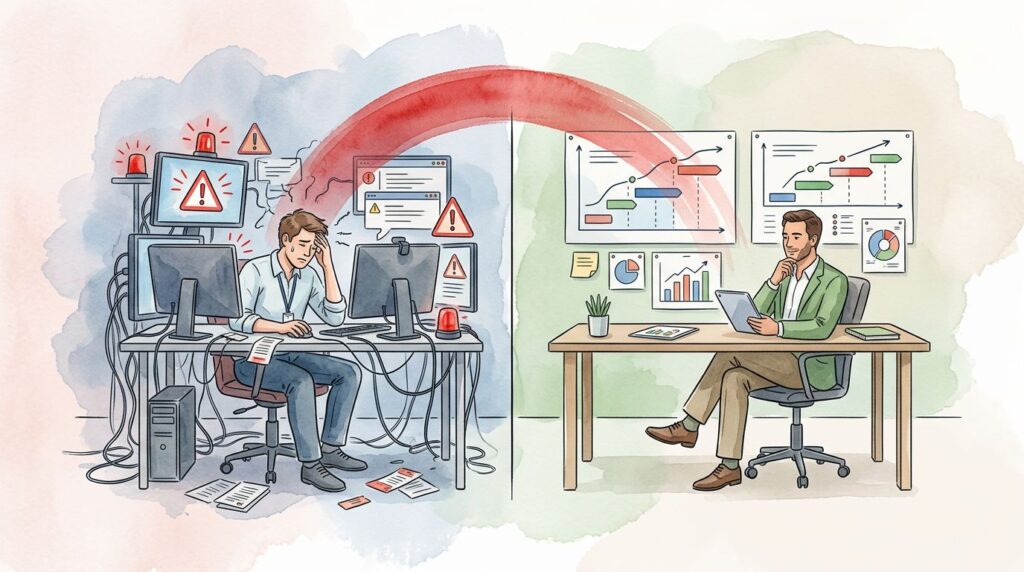
Your IT team can be busy and still be reactive. Tickets get closed, vendors get chased, dashboards get sent, and the business still feels one surprise away from a bad week because of the inherent limitations of reactive IT support models.
That is usually when leadership starts asking the wrong question. You do not need more activity. You need a team that helps you make better decisions, faster.
A reactive IT team keeps the lights on. A strategic team acts as a proactive IT support partner that helps you see what matters, what is drifting, and what needs executive attention now.
Key takeaways
- If your team only responds after something breaks, you are paying for urgency and frequent unplanned downtime with your margin, attention, and trust.
- Strategic IT shows up in planning, reporting, decision rights, and a roadmap clearly tied to business goals.
- If the pattern has lasted, the fix is usually not another tool. It is stronger technology leadership.
When technology feels like a constant fire drill
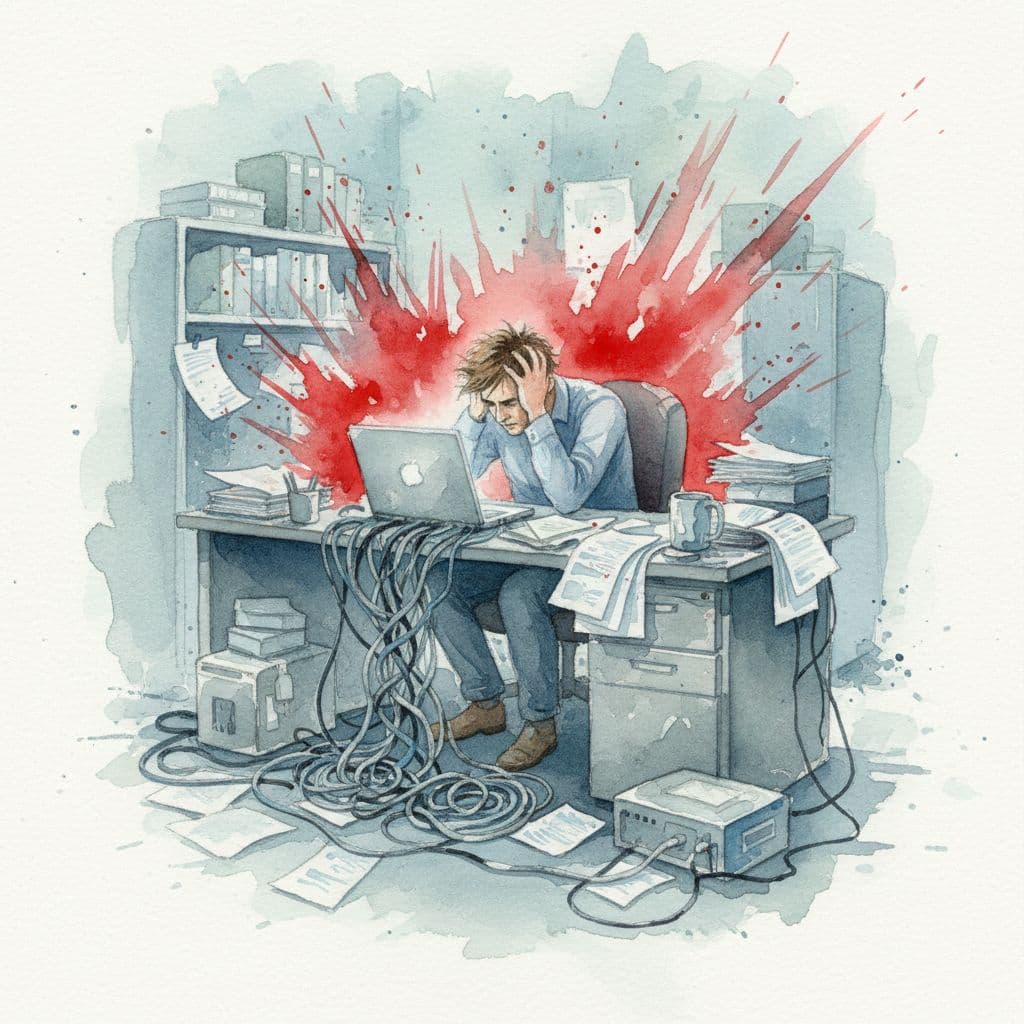
The clearest sign is the pace of operations. Everything is urgent, every issue is a priority, and every vendor points the finger elsewhere. This relentless cycle is the hallmark of a firefighting culture where no one can find the time to breathe.
That kind of rhythm drains leadership fast. It also hides the real problem, which is usually not a lack of effort. Instead, it is a lack of ownership, structure, and follow-through. Most of the team’s energy is consumed by unplanned work, leaving no room for long-term improvement.
If you want a plain outside read on the difference, this overview of reactive vs. proactive IT gets the basic split right. When you are stuck in a loop of reactive IT support, you quickly realize the limitations of a standard help desk. It is designed to fix tickets, not to solve systemic business problems. The business version is simpler still. Reactive teams wait for pain. Strategic teams plan for it.
If every request becomes urgent, your IT team is not managing priority. It is absorbing it.
You can feel this in meetings. Nobody talks about direction. They talk about exceptions. Nobody asks what should happen next quarter. They ask what broke yesterday.
That is not a strong operating model. It is a stress pattern.
The signs are already in front of you
You do not need a deep audit to spot the pattern. You can usually see it in how your team handles planning, reporting, and ownership.
| Reactive pattern | Strategic pattern | What it means for you |
|---|---|---|
| Fires drive the week | Business priorities drive the week | Reduced productivity loss and fewer surprises |
| Updates are technical | Reporting is business-focused | Increased visibility into what you hear |
| Vendors steer decisions | Leadership owns decisions | You keep control of the roadmap |
| Projects start without an ending | Work ties to outcomes and dates | You can see progress in plain language |
If the left column feels familiar, the issue is bigger than IT operations. It is a technology leadership gap.
A reactive team also tends to be stuck in short-term fixes. It can keep devices working, but it cannot explain why the IT infrastructure is getting harder to manage. Without performing a thorough root cause analysis, they simply patch the leak instead of solving the underlying problem. It cannot tell you whether tool sprawl, shadow IT, or technical debt is quietly dragging the business down. It can patch the leak, but it cannot design the roof.
That is where principles of executive technology leadership matter. The job is not to produce more noise. The job is to create clearer visibility, stronger ownership, and better decisions.
When the team is strategic, you hear different language. You hear tradeoffs. You hear risk. You hear options. You hear the cost of delay.
That is a healthier conversation.
The deeper warning signs show up in governance, spend, and risk
A reactive IT team usually shows its hand in three places: governance, spending, and risk.
Start with governance. If there is no clear technology governance for CEOs or technology governance for boards, decisions will drift to whoever speaks loudest. You end up with weak board technology reporting, vague board-ready reporting, and updates that are technically correct but useless for leadership. The board does not need more jargon. They need board-ready technology reporting, board cybersecurity reporting, clear cyber risk reporting to the board, and a comprehensive view of network security. Without this, even basic risk management becomes an impossible task for stakeholders to oversee.
Then look at spending. A reactive team often provides spending figures without a story. You may see invoices, licenses, and renewals, but not technology ROI or tech spending ROI. That is where technology spend optimization, IT cost optimization, and IT cost reduction become essential. You are not looking to slash budgets, but rather to connect every dollar to a business outcome. Good teams use technology dashboards and cost-per-outcome reporting, whereas weak teams hide behind empty activity.
A current systems inventory helps here, as does application portfolio rationalization. If nobody knows which tools are in use, you cannot make clean calls on software platform evaluation, technology vendor selection, or vendor management. You end up managing vendor risk instead of exercising vendor control. This also extends to basic hardware maintenance and patch management, which reactive teams often handle too late, leaving your infrastructure vulnerable. Whether you are using internal staff or managed IT services, you must demand clarity. If you are struggling with these basics, you might consider evaluating if your current managed service provider is truly aligning with your business goals.
The same pattern shows up in security. If the team cannot explain technology risk oversight, technology risk management, or a technology risk management framework in plain language, risk is likely being handled too late. If they cannot talk through third-party risk management, third-party risk reporting, vendor due diligence, vendor offboarding, or a vendor incident response plan, you are carrying more exposure than you realize.
That also applies to operational resilience. Strong teams speak clearly about business continuity planning, disaster recovery, incident response readiness, ransomware readiness, and an executive incident response checklist. They do not need a crisis to start preparing. They build readiness before the pressure hits. That proactive approach matters when cyber insurance renewal comes up, or when leadership asks for a straight cybersecurity risk assessment or IT security assessment.
If your team cannot translate risk into business terms, you do not have oversight. You have reassurance theater.
Strategic IT looks different in the room and on the roadmap
Strategic teams do not wait for the next emergency to decide what matters. They build a technology strategy, a business technology strategy, and a business-aligned technology strategy that match how the company grows, ultimately driving long-term digital transformation.
That does not mean a giant binder. Often, the best version is a simple one-page technology strategy paired with a realistic 12-month technology roadmap. If your current technology roadmap template is just a project list, it is not a strategy. It is a calendar.
A good roadmap connects business priorities to delivery. It answers what gets done, why it matters, who owns it, and what happens if you delay it. That is the heart of strategic technology planning, effective SaaS management, and real IT strategy and roadmap work.
It also changes how leadership operates. You get a technology operating rhythm, a clear decision rights map, and stronger stakeholder alignment. By shifting toward proactive IT support, you stop making founder-led technology decisions, CEO technology decisions, or COO technology strategy calls in the moment, with no structure around them.
That is why many growing companies bring in a fractional CTO, interim CTO, outsourced CTO, virtual CTO, or part-time CTO. Sometimes the right fit is adjacent leadership, like a fractional CIO, fractional CISO, virtual CISO, or interim CISO. The title matters less than the outcome. You need executive judgment, not just task completion.
If you are comparing fractional CTO vs full-time CTO or fractional CTO vs IT consultant, ask one question. Do you need someone to fix tickets, or someone to help leadership perform strategic planning and decide? That answer usually tells you whether you need fractional CTO services or interim CTO services.
For a closer look at how to stop reacting and start planning, this guide to turning firefighting into a 12-month technology roadmap is a useful reference point.
Why the gap gets expensive fast
A reactive team does not stay contained inside IT. It shows up in growth, deals, and board confidence.
If you are planning a sale, merger, or leadership change, the lack of structure becomes obvious fast. Technology due diligence, technical due diligence, cybersecurity due diligence, and an acquisition due diligence checklist all expose weak ownership. This is especially true when a company relies on reactive break-fix support rather than a proactive technical strategy during an acquisition readiness process. Without a robust post-merger technology integration strategy or a clear CTO transition plan, the value of the deal can quickly erode.
The same is true when new technology enters the business. If every department wants AI but nobody owns AI governance, AI adoption strategy, AI transformation strategy, or responsible AI, your team will end up cleaning up after unmanaged enthusiasm. You need an AI acceptable use policy, AI vendor due diligence, and an AI opportunity assessment before experimentation turns into a liability. Furthermore, implementing smart automation can help bridge these gaps, ensuring that scaling efforts remain efficient rather than chaotic. When tool ownership is neglected, it often leads to a fragmented digital employee experience, leaving staff to struggle with unvetted shadow IT.
This is where technology is holding back business growth stops being a warning and starts being your current reality. A reactive team can keep pace with the last problem, but it struggles to anticipate the next one.
You also see this in data. Weak data strategy, poor data quality, loose data privacy, and missing information governance turn every report into a debate. If leadership cannot trust the numbers, it cannot trust the plan.
That is why strategic teams care about the basics. Access control best practices, a current data governance framework, and a clean systems inventory are essential. Establishing a credible path for technology decisions for growth is what separates thriving organizations from those that are merely struggling to keep the lights on. None of it is flashy, but all of it matters for long-term stability.
What to do if this sounds familiar
You do not need to solve everything at once. You need a cleaner first move.
- Get the facts on paper. A technology audit, technology assessment, or technology health check will show where the real drag is, helping you evaluate the effectiveness of your current preventive maintenance routines and the reliability of your existing monitoring tools.
- Separate symptoms from causes. If the issue is reporting, ownership, vendors, or drift, name it clearly so you can move beyond simple incident resolution and address the underlying structural flaws.
- Build a short plan. A 90-day technology plan and a simple board-ready risk summary are better than another pile of status slides, especially when they help align your IT roadmap with your budget constraints.
- Decide what kind of leadership you need. That may mean deciding when to hire a fractional CTO, starting a full-time search, or utilizing technology leadership before hiring to ensure you shift toward more predictable costs.
If you need a clean starting point, Get an Executive Technology Clarity Check. A decision clarity call should tell you whether the problem is strategy, governance, security, vendor control, or something else entirely.
For growing companies, this is often the difference between managing IT and leading it. It is also the point where technology strategy for CEOs, technology strategy for COOs, and technology leadership for mid-market companies stop being nice ideas and start being operating requirements.
Frequently Asked Questions
How can I tell if my IT team is truly proactive or just better at firefighting?
A proactive team focuses on identifying systemic risks and business outcomes before issues occur, rather than simply responding quickly to support tickets. If your weekly updates consist of resolved incidents instead of progress on strategic goals and risk reduction, your team is likely still operating in a reactive state.
Does transitioning to a strategic IT model require hiring a full-time CTO?
Not necessarily, as many companies find success by leveraging fractional or interim executive leadership to bridge the gap. The goal is to obtain expert judgment and governance oversight to steer your technology roadmap, which can often be achieved through part-time leadership arrangements if you do not have the scale for a full-time role.
Why does reactive IT lead to higher costs over time?
Reactive IT creates a ‘hidden tax’ on the business through unplanned downtime, inefficient vendor management, and tool sprawl. By lacking a long-term technology strategy, companies often pay for redundant software and emergency fixes, which could have been avoided with proactive planning and cost optimization.
Conclusion
A reactive IT team is not always obvious at first. It can look busy, responsive, and even well-intentioned. Then you notice the pattern: more urgency, less clarity; more updates, less confidence; more spend, less control.
That is the real sign. It is not that your people are failing, but that your operating model is built for fire drills instead of long-term direction.
When you shift toward proactive IT support, the business feels different. Decisions get cleaner, reporting becomes easier to trust, and your system uptime remains stable. Whether you choose to refine your internal processes or partner with managed IT services, the transition allows you to regain control. Once you resolve these underlying issues, risk becomes easier to manage, and technology starts acting like a strategic business asset again instead of a constant interruption.