
A $500K software project is not a line item. It is a decision about speed, control, and trust.
If you approve work at that size with a quick nod in a meeting, you are taking on more risk than most teams admit. The cost shows up later in delays, rework, vendor dependence, and board questions you could have avoided.
An executive project scorecard gives you a cleaner way to decide. It helps you sort projects by business value, delivery confidence, risk, and ownership before the spend gets real.
Key takeaways for software projects over $500K
- A project this size needs executive review, not just technical enthusiasm.
- The scorecard should test business value, ownership, delivery confidence, and risk.
- If the answer is fuzzy, the project is not ready. Tighten scope before you commit.
- The scorecard should lead to clearer reporting, a cleaner roadmap, and better governance.
Why projects over $500K need a different kind of review
At $500K, you are no longer buying a feature set. You are buying a chain of promises.
You are trusting a vendor, a team, and a set of assumptions about timing, data, adoption, and change. If any one of those breaks, the project can still look “in progress” while value quietly slips away.
That is why founder-led technology decisions and CEO technology decisions need more than a status update. They need a scorecard that shows whether the project fits your technology priorities for growing companies, your technology strategy for CEOs, and your COO technology strategy in plain language.
If your team is still sorting out aligning IT projects with business strategy, the scorecard is the place to start. It forces the conversation out of opinion and into outcomes.
This matters even more when you have a technology leadership gap. Maybe you rely on a fractional CTO, interim CTO, outsourced CTO, virtual CTO, or part-time CTO. Maybe your support comes from a fractional CIO, a fractional CISO, a virtual CISO, or an interim CISO. The title matters less than the clarity.
You need executive technology leadership that can answer one question: is this project worth the money, the time, and the operational drag?
Some public organizations already treat large projects as executive items. The Agency of Digital Services FAQ is a simple reminder that big-ticket work belongs in a formal review lane, not a hallway conversation.
What your executive scorecard should measure
A strong scorecard is not a long spreadsheet. It is a decision filter.
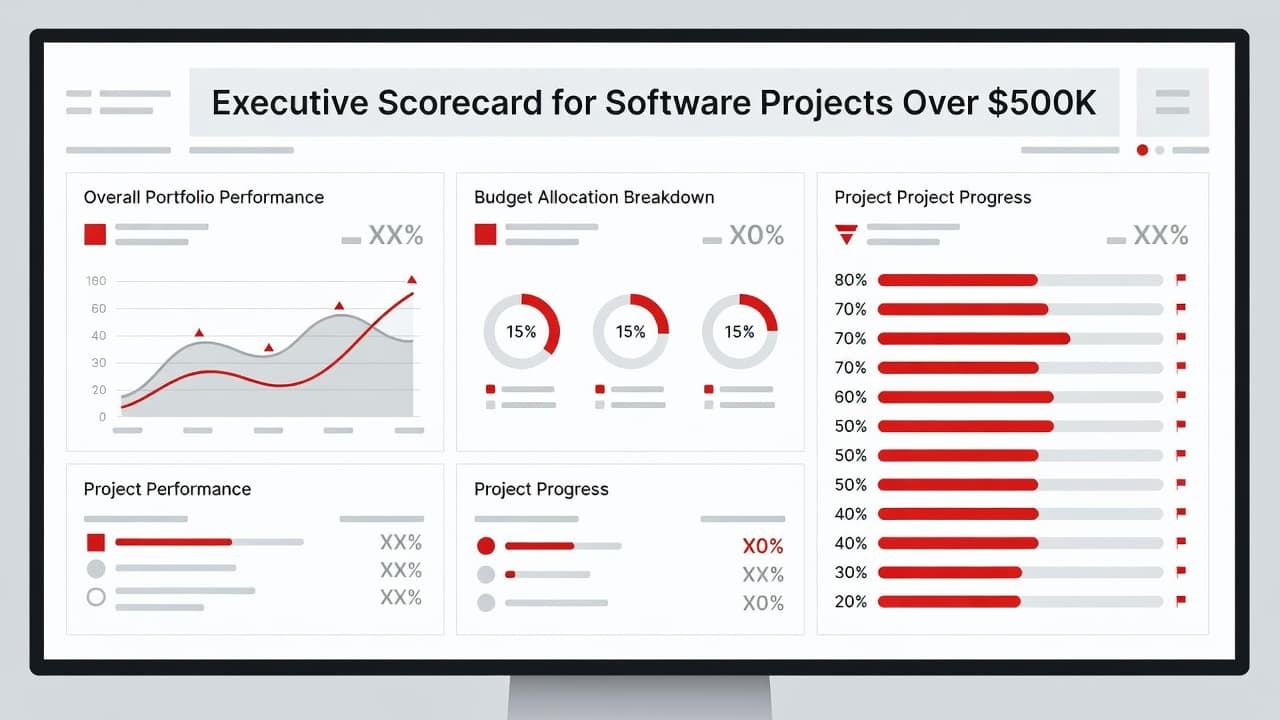
If you want a working model, start with the technology investment scorecard template. The point is not to add ceremony. The point is to make the business case visible before the contract is signed.
| Scorecard area | What to ask | What a good answer sounds like | What a weak answer sounds like |
|---|---|---|---|
| Business outcome | What business result changes if this ships? | “We reduce manual work, shorten cycle time, or improve customer conversion.” | “We need a better system.” |
| Named owner | Who owns the outcome, not just the implementation? | “This business leader is accountable for results.” | “IT will handle it.” |
| Delivery confidence | Can the team actually deliver on time? | “The scope is realistic and the dependencies are clear.” | “We hope it works out.” |
| Vendor control | Can you manage the vendor without being trapped by them? | “We have exit terms, service expectations, and offboarding plans.” | “The vendor said it should be fine.” |
| Data and integration | Does the project fit your data and systems reality? | “We know the source of truth and the integration points.” | “We will clean that up later.” |
| Risk and resilience | What breaks if this slips or fails? | “We have a fallback plan and a clear tolerance level.” | “We have not talked about that yet.” |
Those six lines do most of the work.
You are not trying to prove the project sounds exciting. You are trying to prove it deserves the money.
Business value is the first test
If the project cannot explain itself in business terms, pause.
A software project should connect to revenue, margin, customer experience, compliance, or operating speed. If it does not, the work may still be useful, but it is not ready for a $500K commitment.
This is where technology strategy consulting and strategic technology planning should earn their keep. The work should produce a business-aligned technology strategy, not a pile of disconnected requests. It should feed an IT strategy and roadmap, a technology roadmap, or a 12-month technology roadmap you can defend in a meeting.
A good scorecard also keeps tech spending honest. It should point toward technology spend optimization, technology ROI, tech spending ROI, IT cost optimization, and IT cost reduction. If a project cannot explain its cost-per-outcome, the room is probably pretending.
That is why investment priority framework for boards is such a useful companion. It reminds you that projects are not ranked by urgency alone. They are ranked by value, risk, and fit.
If the answer sounds like “we need the system” instead of “we need this result”, the project is not ready for a $500K commitment.
Ownership, vendors, and delivery need hard lines
Big software projects get messy when ownership is soft.
You see it in tool sprawl. You see it in shadow IT. You see it when internal teams, outside vendors, and business leaders all think someone else is holding the ball. That is not collaboration. That is drift.
Your scorecard should force stronger technology governance. For CEOs and boards, that means clear technology governance for CEOs and technology governance for boards, not a vague promise that someone is “watching it.” It should also support board technology reporting, board-ready technology reporting, and board-ready reporting that tells the truth in plain English.
Vendor control matters too. A project this size should include vendor risk management, vendor management, vendor due diligence, vendor offboarding, and a vendor incident response plan. If the vendor disappears, gets acquired, or misses the mark, you need a clean path forward.
If the project depends on a third party, treat third-party risk management and third-party risk reporting as part of the project, not a separate conversation.
A strong scorecard also keeps the team honest about delivery confidence. If the team is overloaded, if dependencies are unclear, or if the implementation relies on heroics, the project score should drop. No amount of optimism fixes a broken plan.
Risk, data, and resilience belong in the review
Software projects do not fail in a vacuum. They fail inside a business that still has to run.
That is why your scorecard should include technology risk oversight, technology risk management, and a simple technology risk management framework. If the project changes access, workflows, reporting, or customer data, you need to know what it does to control and resilience.
This is where technology dashboards can help, but only if they measure something useful. You want board-ready risk summary data, not pretty charts with no consequence. Cost-per-outcome reporting is better than a wall of status lights.
A high-stakes project should also surface cybersecurity oversight and board cybersecurity reporting. If the work changes your cyber risk appetite, it should be visible. If it touches incident response readiness, ransomware readiness, or business continuity planning, the scorecard should make that clear.
The same goes for disaster recovery planning, an executive incident response checklist, cyber insurance renewal, cybersecurity risk assessment, and IT security assessment. If a project affects access control best practices, data governance framework, data strategy, data quality, data privacy, information governance, or your systems inventory, you should treat that as real work, not background noise.
If AI is part of the project, the standard gets higher. AI governance, AI adoption strategy, AI transformation strategy, responsible AI, AI acceptable use policy, AI vendor due diligence, and an AI opportunity assessment should sit on the scorecard too. If you are not ready to explain those pieces, you are not ready to approve the spend.
How to score the project without gaming the result
Keep the scoring simple.
Use a 1 to 5 scale for each area. One means weak or unclear. Five means the business case is strong, the owner is named, and the risk is visible.
A good rule is this:
- 5 means the project is ready now.
- 4 means the project is strong, with only minor cleanup needed.
- 3 means the project has value, but scope or ownership still needs work.
- 2 means the project has serious gaps.
- 1 means stop and rework the case.
Do not average the score and pretend that solves the problem. A project can look good on paper and still fail if the owner is unclear or the vendor is in control.
The better move is to set a minimum bar for each category. If business value is weak, the project does not go forward. If risk is unclear, it waits. If vendor control is soft, you fix the contract and the exit path first.
This is where a simple technology roadmap template or one-page technology strategy helps. It turns the score into a decision, and the decision into a 90-day or 12-month plan.
What to do when the score is weak
A weak score does not always mean “no.” Sometimes it means “not yet.”
Maybe the scope is too broad. Maybe the data is messy. Maybe the vendor is fine, but the contract is weak. Maybe the team needs a shorter path that gets the same business result with less risk. That is a leadership issue, not a software issue.
If the project is tied to acquisition readiness, technology due diligence, cybersecurity due diligence, or an acquisition due diligence checklist, the bar should go up. If you are in a transaction, you need cleaner evidence, stronger reporting, and a more defensible posture. The same applies to CTO transition plan work and post-merger technology integration.
If you are in that zone, the project should live inside a broader technology assessment, technology audit, or technology health check. That gives you the baseline you need before you commit to a major build or replacement.
A weak score should usually lead to one of four moves:
- Narrow the scope.
- Reassign ownership.
- Reduce vendor risk.
- Pause until the data and controls are clearer.
That is not delay for its own sake. That is leadership.
How the scorecard fits board oversight
The board does not need a pile of status slides. It needs board-ready tech roadmap thinking, board-ready risk summary reporting, and enough context to decide whether the company is spending wisely.
If your leadership team is already feeling pressure, the scorecard gives you a cleaner board conversation. It shows what you approved, why you approved it, and what you expect to happen next.
That matters in technology leadership for mid-market companies, growth-stage technology leadership, and scaling technology leadership. When the company gets bigger, the old habit of “we’ll sort it out later” gets expensive fast.
It also matters when you are trying to decide when to hire a fractional CTO, how to hire a CTO, or whether you need fractional CTO services, interim CTO services, or a different kind of support. A good scorecard can expose whether you need a full-time hire or stronger fractional technology leadership first.
If you are still sorting out technology leadership before hiring, the scorecard is often the cleanest next step. It tells you what kind of help you need, what decisions belong above the technical team, and what belongs in a better operating rhythm.
Use it to tighten technology operating rhythm, define a decision rights map, and improve stakeholder alignment. Use it to keep the room focused on business technology strategy, not software politics.
When a project should not move forward
Some projects should not move forward, even if everyone is eager.
If the team cannot explain the business outcome, if the owner is unclear, if the vendor has too much control, or if the risk is hidden, the right answer is to stop. Not forever. Just until the scorecard says the project is ready.
That is where technology decisions for growth get clearer. The business stops buying motion and starts buying outcomes. The project queue gets shorter. The work gets easier to defend.
If you need a board-ready technology risk view, a cleaner technology strategy for COOs, or a practical way to think through CEO technology decisions, start with the scorecard. If your team needs help translating the mess into a plan, Get an Executive Technology Clarity Check and use the conversation to sort the real problem from the noise.
Conclusion
A $500K software project should never feel like a hopeful guess. It should feel like a decision you can defend.
When you use an executive scorecard, you force the right questions into the room. You see the business value, the ownership, the vendor risk, the data reality, and the board impact before the money is gone.
That is what stronger technology leadership looks like. Cleaner decisions. Less fog. Better control.
FAQ
What is an executive project scorecard?
It is a simple decision tool for major software spending. It helps you judge business value, ownership, risk, and delivery confidence before you approve the work.
Who should own the scorecard?
The business owner should own it, not just IT. A COO, CEO, founder, or executive sponsor should be able to explain why the project matters and what success looks like.
When should you use one?
Use it for any software project where the stakes are high, the budget is large, or the business will feel the impact if it slips. At $500K, it should be standard practice.