
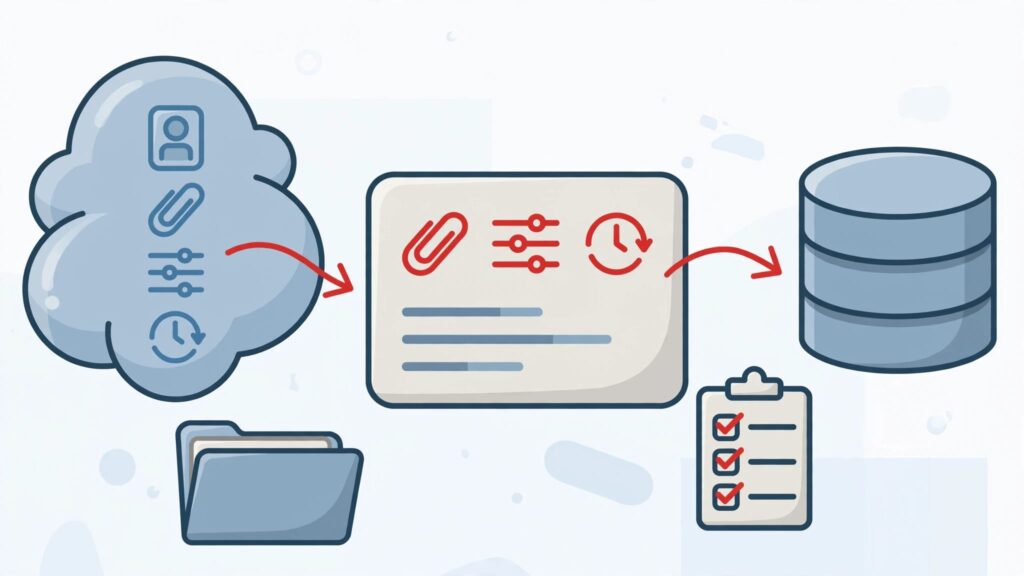
Before renewing a critical SaaS contract, require your team to export representative customer data and rebuild usable records elsewhere. SaaS data portability gives you meaningful control only when the exported information survives that test.
A download button can hide missing attachments, broken relationships, and expensive migration work. Your renewal decision needs evidence of a workable exit, gathered before your notice deadline removes your negotiating room.
Key takeaways
- Test whether another team can reconstruct customer records without undocumented help from the vendor.
- Include attachments, custom fields, permissions, and history in the export scope.
- Put export support, fees, retention, and deletion obligations into the agreement.
- Approve renewal against documented results, with clear ownership of unresolved risks.
Define what SaaS data portability must preserve
Start with the business information you would need to keep serving customers after leaving.
Separate ownership rights from usable access
Set a SaaS data ownership protocol that records your organization’s rights under applicable law and contract. Assign responsibility for access, modification, sharing, storage, and deletion.
Personal data ownership concerns information that identifies individuals. Institutional data ownership concerns information your organization generates, collects, or processes. Personal data ownership doesn’t cancel the privacy rights of individuals represented in those records.
Your contract may recognize ownership while leaving extraction slow, incomplete, or expensive. Proprietary formats, limited exports, and high exit fees create vendor lock-in despite reassuring ownership language.
Define a complete customer record
Your systems inventory should identify where customer information actually lives. A CRM export may omit documents stored elsewhere or support history held in another platform.
Include the records your operating teams need, plus their relationships. In legal aid, for example, intake forms, case notes, referrals, and grant reporting may all support service continuity.
Ask the business owner to define completeness. Technical teams can count rows, but they can’t decide which missing history would disrupt customer work.
Run the export before your notice deadline
Use your software contract renewal checklist to schedule testing before the contractual nonrenewal deadline, not merely the subscription expiry date.

Capture the actual extraction process
Ask SaaS providers to demonstrate the export rights included in your plan, then have your team repeat the process.
Use a representative extract covering active and closed records, attachments, custom fields, field definitions, stable identifiers, timestamps, relationships, permissions, and status history. For critical systems, follow this with a full-volume rehearsal.
Record elapsed time, required permissions, vendor assistance, and every charge. For API exports, capture pagination, rate limits, and errors. Also document how you would retrieve changes made between the initial export and final cutover.
Inspect formats and documentation
CSV and JSON are useful standard formats, but neither guarantees a complete migration. Require a field map, stable identifiers, and explanations of relationships.
Different export components need different checks.
| Export component | What your team should inspect |
|---|---|
| CSV tables | Field types, identifiers, timestamps, and relationships. |
| JSON files | Nested objects, schema, and omitted fields. |
| Attachments | Original files and their links to customer records. |
| API output | Coverage, pagination, limits, and repeatability. |
The useful deliverable is a documented package another team can interpret. PDFs may preserve readable documents, but they usually won’t reconstruct structured workflows.
Prove another team can use the data
A successful export is only the first half of your portability test.
Rebuild records outside the original platform
Import the extract into a controlled destination. This could be a replacement platform’s sandbox or an independent database with a basic viewing layer.
Then ask someone other than the original exporter to reconstruct customer records using the supplied documentation. They should be able to connect notes, attachments, ownership, and status history.
If only the vendor understands the data model, require knowledge transfer. Record which workflows also depend on proprietary automation or configuration. Those dependencies affect migration cost even when the underlying data transfers successfully.
Reconcile results and protect sensitive information
Compare source and destination totals by record type. Reconcile business reports and inspect exceptions rather than accepting a single overall row count.
Test missing identifiers, duplicate records, timestamp changes, and attachment failures. Preserve permission information where available, then map and test access in the destination.
Your data governance frameworks should cover role-based access controls, regular security audits, and backup and recovery processes. Also require safeguards against cross-tenant exposure in multi-tenant platforms. Protect test environments and transfer files as carefully as production data to reduce the risk of data breaches.
An export passes when your team can explain what arrived, what didn’t, and what business work can continue.
Put the tested exit into the contract
Your agreement should support the process your team just demonstrated.
Specify deliverables and transition support
Review the relevant legal documents together, including the MSA, terms of service, privacy policy, service level agreements, and data processing agreements. Our SaaS contract checklist for CEOs covers the surrounding commercial decisions.
Name the required records, formats, documentation, and export delivery obligations. Agree what SaaS providers must deliver after notice, including transition assistance, continued access, support levels, and any export, migration, or exit fees.
Also address termination rights, dispute escalation, and responsibilities if performance failures trigger an exit. A price increase, acquisition, or retired feature can make a structured departure necessary without a major incident.
Review data-use rights separately
Export rights don’t resolve whether a provider may use customer content for data monetization, grant data licensing rights, or use it for AI model training. Review those provisions separately as part of your AI vendor due diligence.
For example, Figma’s content-training settings default to on for Starter and Professional teams and off for Organization and Enterprise plans.
That distinction shows why plan-level settings matter alongside contractual language. Define approved uses, who can change settings, and what happens after termination. Otherwise, you may retain ownership while permitting uses your leadership team never intended.
Distinguish legal portability rights from business requirements
GDPR Article 20 gives individuals a qualified right to receive personal data they provided in a structured, commonly used, machine-readable format. It applies to automated processing based on consent or contract. Direct transmission applies where technically feasible. This right doesn’t create broad personal data ownership rights.
That right doesn’t guarantee export of every company record, configuration, or derived analysis. Your institutional migration requirements still need contractual protection.
Other laws address different obligations. California’s CCPA means California Consumer Privacy Act. It provides consumer rights concerning personal information. HIPAA governs protected health information for covered entities and business associates. GLBA protects financial information within its scope. Map CCPA consumer rights and HIPAA obligations to your export and transition process; neither law guarantees a complete company-data export.
Copyright can protect original selection or arrangement in databases and compilations, although raw facts generally aren’t protected.
For your renewal, compare the legal documents with your operational requirements, and distinguish legal duties, contractual promises, and operational needs. A vendor’s failure doesn’t automatically remove your own privacy responsibilities or potential liability.
Test retention, deletion, and access removal
Your exit plan must answer how long the provider retains data after cancellation, whether you can request permanent data deletion, and what happens to backups and logs.
Define how the provider’s data retention and deletion policies treat production systems, support copies, subprocessors, archives, and disaster-recovery copies. Where retention must continue, document the reason, access restrictions, and eventual disposal process.
Coordinate the provider’s data retention and deletion policies with migration acceptance. Premature deletion can destroy your recovery option, while indefinite retention creates unnecessary exposure.
Use our vendor offboarding checklist to connect data return with credential removal, integration shutdown, and completion evidence.
Your test should establish how deletion requests enter the vendor’s process and what evidence you receive afterward. A rehearsal needn’t delete live customer records. However, it should expose vague exclusions and unclear responsibilities.
Retain the final export according to your own approved retention schedule.
Give renewal approval an evidence threshold
Assign one accountable business owner. Your technical lead runs the rehearsal, legal reviews obligations, and finance captures the full exit cost. A fractional CTO can coordinate this work when you have a technology leadership gap.

Your board-ready risk summary should show the test date, scope, reconciliation results, unresolved dependencies, and remediation owners. Include extraction charges, transformation work, overlapping subscriptions, and transition support in the financial view.
Approve renewal when critical records reconcile and remaining exceptions have acceptable business consequences. Use the rehearsal findings to set negotiation priorities, assign remediation owners and deadlines, and schedule a rerun before accepting another long commitment.
If critical gaps remain, document an exit plan with a responsible owner, required transition support, and conditions for rerunning the test.
If the vendor refuses an export, document the refusal and escalate through contractual channels. Preserve existing access while leadership evaluates commercial and legal options.
An urgent renewal may require a documented risk exception. Assign it an owner and expiry date, and record the remaining exceptions before renewal.
FAQs about SaaS data portability
Does an API guarantee that you can leave?
An API can help, but its coverage may exclude attachments, audit history, or administrative settings. Rate limits can also make extraction impractical. Your test needs both complete data coverage and a workable extraction time at your actual volume.
Is a data export also a backup?
An export can support recovery, but it may lack the application configuration needed to resume operations. Business continuity planning and disaster recovery testing must address restoration separately. Test whether you can retrieve information and whether you can continue the service customers depend on.
Do portability initiatives solve SaaS migration?
The Data Transfer Initiative supports service-to-service portability. Google and Microsoft participated in the related Data Transfer Project. MyData promotes human-centric control of personal data, while Sir Tim Berners-Lee’s Solid uses personal data pods with permission-based app access.
These efforts don’t replace a tested exit for your particular SaaS platform.
Renew with evidence of a workable exit
Your renewal decision should rest on demonstrated control over customer data. A complete export, successful reconstruction, and enforceable transition terms give you a clearer view of the commitment.
Before the notice deadline, put one accountable owner in charge of the rehearsal and its unresolved findings.
If ownership or vendor dependence remains unclear, Get an Executive Technology Clarity Check to identify what needs executive attention before you commit.