

When an enterprise buyer requests a Software Bill of Materials (SBOM), agree on product scope, required format, and delivery obligations before you commit. Meeting SBOM requirements means producing a reliable software inventory and maintaining evidence behind it.
Your immediate decision is how to satisfy the buyer without promising coverage your team can’t support. That starts with release-specific evidence, clear ownership, and a response process.
First, separate the customer’s actual requirement from the broader compliance language surrounding it.
Key takeaways for enterprise SBOM requests
- Tie the inventory to the software release your customer actually receives.
- Separate legal obligations, contractual requirements, and voluntary guidance.
- Include dependencies, stable identifiers, and generation context, not just package names.
- Assign ownership for updates and flaw response before promising ongoing delivery.
Establish what the buyer actually needs
A Software Bill of Materials inventories software components and their relationships across the software supply chain. It supports software component transparency in procurement. Buyers can trace components and assess supplier exposure across open-source, proprietary, and third-party software.
Define the product and release boundary
Ask which product, deployment model, and release the request covers. A repository inventory can differ from the compiled application, container image, or older version still serving customers.
NIST’s SBOM guidance describes a record of components and supply-chain relationships. Your evidence should connect that record to a delivered artifact.
Include direct dependencies and transitive dependencies, the components your dependencies bring with them. Identify container contents and relevant commercial components, too.
Agree on the commercial commitment
Your buyer may want a one-time procurement artifact, an SBOM for every release, or continuing security-defect notifications. Each option requires different operating capacity.
If a buyer requests an SBOM attestation, confirm whether they mean a signed statement that the SBOM was generated and matches the release. The attestation doesn’t replace the inventory.
Before accepting contract language, settle the format and version, delivery channel, update triggers, confidentiality terms, and response expectations.
Sales should own customer communication. Engineering should confirm coverage and delivery feasibility. Legal should review disclosure and liability language. You need one executive accountable for resolving disagreements.
SBOM requirements by rule and date
SolarWinds and Log4Shell accelerated demand for component visibility. SolarWinds disclosed that fewer than 18,000 customers may have installed compromised Orion updates in 2020.
These milestones have different legal effects. SBOM compliance depends on the buyer, product, and jurisdiction.
| Milestone | What it means for your decision |
|---|---|
| 2021: EO 14028 and NTIA | Established federal software security and supply-chain direction for critical infrastructure, plus minimum SBOM elements. It didn’t create a universal vendor submission rule. |
| 2022: OMB M-22-18 | Established federal secure-development assurance expectations. Agencies can request supporting artifacts, including SBOMs aligned with federal guidance. |
| March 29, 2023: FDA authority | Applicable cyber-device premarket submissions require SBOMs under Section 524B(b)(3). Section 524B(c) defines a cyber device. |
| 2023: Germany’s BSI TR-03183 | Provides technical guidance on SBOM fields and formats. It isn’t itself a binding regulation. |
| March 2024: CISA attestation form | Supports federal assessment of secure development practices. Signing CISA’s form doesn’t replace requested SBOM evidence. |
| August 16, 2024: Army directive | Set February 2025 implementation for broad software acquisition coverage, including commercial off-the-shelf software. |
| October 2024: EU CRA adopted | Requires SBOM generation for covered products with digital elements. General application begins December 11, 2027. |
NIST 800-171 may govern how defense contractors protect controlled information, but it isn’t a general SBOM submission mandate.
FDA cybersecurity guidance also addresses lifecycle support, weakness assessment, and remediation. These extend beyond inventory fields.
The Cyber Resilience Act text requires a machine-readable SBOM covering at least top-level dependencies. It doesn’t require public publication.
The proposed FY2023 NDAA FedRAMP SBOM provision didn’t become law. Meanwhile, Log4Shell in late 2021 exposed how missing dependency records slowed exposure assessment.
Know what your SBOM must contain
Your acceptance criteria should name a baseline, required data fields, and any customer-specific additions. If a contract or applicable rule requires compliance, define the agreed baseline as a compliance criterion. “Provide a compliant SBOM” leaves too much room for disagreement.
Start with the core data
The 2021 NTIA baseline includes supplier name, component name, component version, other unique identifiers, dependency relationships, SBOM author, and timestamp. Use the NTIA baseline to agree on the minimum data fields your buyer needs.
Identifiers can include a package URL (PURL), Common Platform Enumeration (CPE), or SWID identifier. They help distinguish components that share similar names.
Require relationships that expose direct and transitive dependencies. Also document incomplete dependency chains. An unknown component should remain a visible gap, rather than becoming an implied assurance.
Licensing and provenance deserve attention because buyers also use inventories for intellectual property review, acquisition decisions, and tracing forks or backported fixes. Confirm whether the buyer needs a license field as part of the agreed baseline.
Account for the 2025 CISA draft
Released August 22, 2025, CISA’s draft Minimum Elements proposed four additional required elements: component hash, license, Tool Name, and Generation Context. The Minimum Elements draft builds on the NTIA baseline, but its proposed additions aren’t universal requirements.
The draft also clarified SBOM author and software producer roles. Generation context identifies whether collection occurred before, during, or after the build. That distinction helps explain differences between inventories and gives buyers context for comparing them with the NTIA baseline.
Treat those additions as proposed guidance unless your contract adopts them. A public-comment draft doesn’t create a universal legal duty.
A valid SBOM file can still describe the wrong release. Acceptance must include a match to the delivered software.
Choose a format the buyer can process
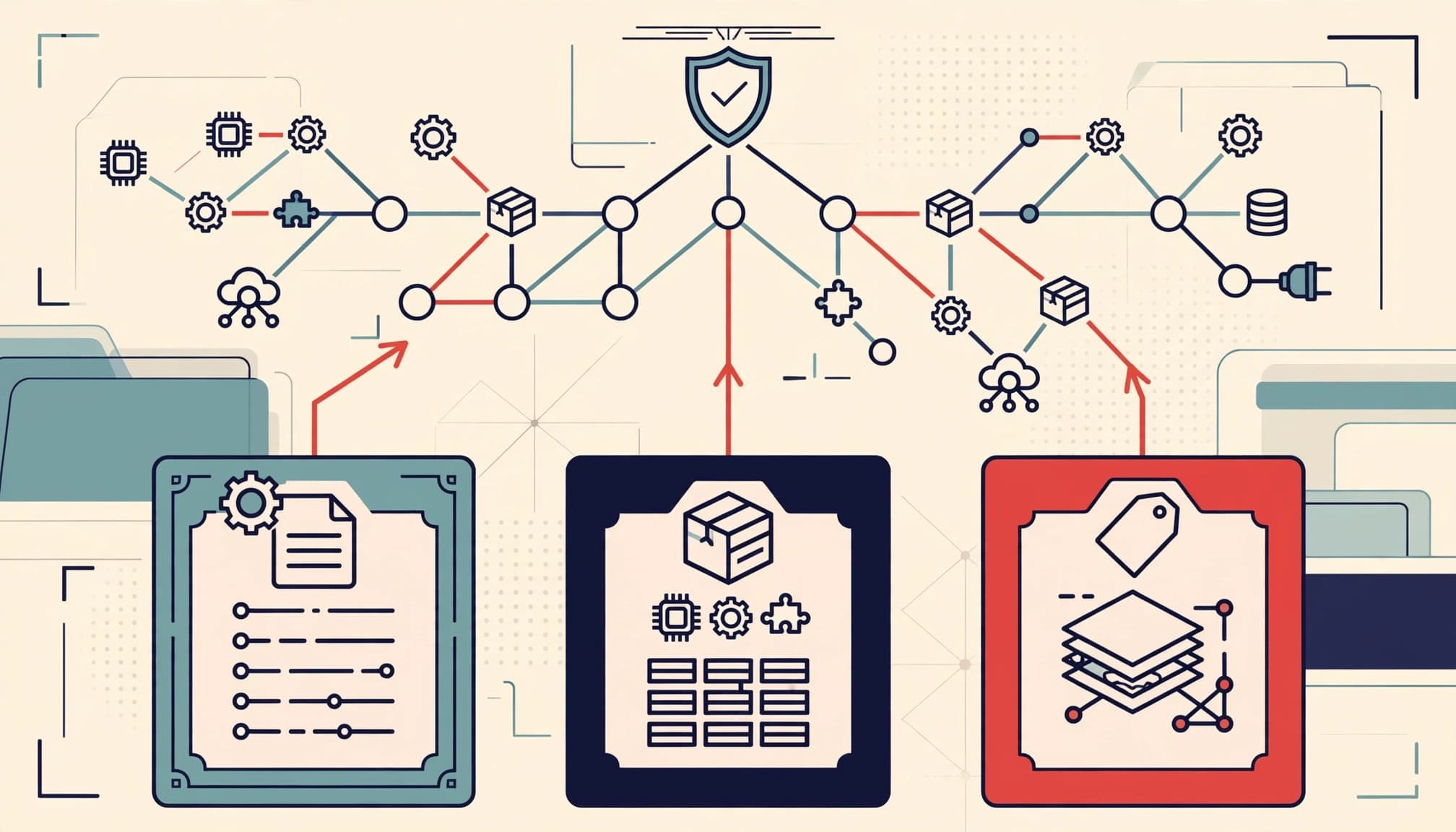
SPDX and CycloneDX are widely used machine-readable formats. SPDX became ISO/IEC 5962:2021 in August 2021. CycloneDX originated in the OWASP community in 2017.
The NTIA Minimum Elements report identifies SPDX, CycloneDX, and SWID tags as formats supporting automated exchange. However, your buyer may accept only a particular format and schema version.
In CycloneDX, component records can carry names, versions, suppliers, package URLs, hashes, and licenses. Dependency records connect those components. SPDX expresses comparable inventory information through package records and relationships, although details vary by version.
Require schema validation and a successful import into the buyer’s process. A PDF summary can help executives, but it shouldn’t replace structured data when machine readability is required.
Build a repeatable delivery process
Start with the product tied to the enterprise opportunity. Expanding immediately across every system adds cost before you’ve proved the process.
- Capture the acceptance criteria. Record the release boundary, schema version, mandatory fields, delivery date, and update obligations. Identify who can approve exceptions.
- Generate the Software Bill of Materials against the build. Use package-manager records, lockfiles, Software Composition Analysis, and artifact inspection. Select SBOM tools based on artifact coverage, then reconcile results with deployed software. Syft and cdxgen are established generation tools.
- Connect findings to decisions. Use vulnerability management to assess known issues and license obligations. Rank remediation by exploitability, customer exposure, and business consequence. Avoid blocking every release over an undifferentiated historical backlog.
- Automate and rehearse. Use automation to generate and validate the SBOM in your CI/CD pipeline. Retain the artifact association and delivery history. Then rehearse a newly disclosed vulnerability and measure how quickly the team identifies affected deployments.
Our guidance on open-source dependency risk connects these release controls to executive oversight of the software supply chain.
Keep these controls in your technology roadmap and normal release process as part of software security. Otherwise, evidence management becomes a manual task that breaks whenever a key engineer is unavailable.
The useful outcome is faster, defensible exposure assessment. A growing folder of inventory files tells you little about incident response readiness.
Assign ownership before buying more tools
An enterprise request often exposes a technology leadership gap: several people contribute evidence, but nobody owns the commitment.
Separate delivery, challenge, and approval
Engineering should own generation, build matching, and technical remediation. Security should challenge coverage and exposure assumptions. Legal should address licenses, confidentiality, and contractual promises.
An executive sponsor should approve funding, resolve competing priorities, and accept documented exceptions within the company’s cyber risk appetite.
A fractional CTO can establish the delivery model when executive capacity is missing. A fractional CISO can strengthen cybersecurity oversight and customer assurance. Either role needs decision authority, not merely responsibility for completing questionnaires.
Report business exposure and overdue decisions
Your board-ready risk management summary should show which critical releases have current inventories, where material gaps remain, and which remediation commitments are overdue.
Also report time to identify affected deployments during an exercise. Give each measure an owner, baseline, and threshold for escalation.
Connect vendor cyber risk oversight to supplier notification, patching, and support obligations. A supplier’s refusal or inability to provide evidence creates a management decision.
Keep package-level detail with the operating team. Board technology reporting should connect unresolved exposure to customer commitments, revenue at risk, and the decision required. Distinguish revenue supported by a product from revenue plausibly lost during an outage.
Frequently asked questions about enterprise SBOMs
Can you share an SBOM without publishing it?
Yes. Controlled delivery through an authenticated portal or agreed customer channel can support confidentiality.
Define access rights, retention, permitted use, and redistribution terms. Don’t automatically remove proprietary components if doing so would misrepresent coverage. Resolve the disclosure boundary before delivery.
How do VEX and CSAF fit alongside an SBOM?
An SBOM identifies components. Vulnerability Exploitability eXchange, or VEX, communicates whether a vulnerability affects a particular product and why.
The Common Security Advisory Framework, or CSAF, structures security advisories and can carry VEX information. These records add exposure context; they don’t replace the component inventory.
What should you do when a supplier cannot provide one?
Record the missing coverage and assess the supplier’s business importance. Seek alternative evidence, including dependency disclosures, support commitments, and vulnerability notification arrangements.
Then assign an owner and an expiry date to any exception. Avoid promising your customer complete coverage when a material supplier dependency remains unknown.
Make the next commitment defensible
Your strongest response to an enterprise SBOM request is evidence you can maintain. The inventory should match the delivered release, and your team should know how to respond when a component becomes a concern.
Before approving the commitment, settle scope and ownership. If those decisions remain fragmented, Get an Executive Technology Clarity Check to establish sharper priorities and a practical next step.