
You should assess open-source dependency risk by asking which components could interrupt revenue, expose customer data, or compromise your rights to distribute software. Then require evidence of clear ownership, timely remediation, and tested recovery.
Your board doesn’t need to inspect every library. It sets risk appetite and holds management accountable, while management inventories dependencies, assesses exposure, remediates issues, and tests recovery. The board needs evidence that management can identify affected products, explain business consequences, and act before customer commitments slip.
Start with the products your business depends on most.
Key Takeaways
- Assess dependencies against revenue, customer commitments, and recovery needs, rather than vulnerability counts alone.
- Require a release-specific software inventory that includes hidden dependencies, licenses, and accountable owners.
- Set remediation thresholds, risk acceptance authority, and escalation rules before an incident.
- Use board reporting to expose decisions and overdue actions, rather than scanning activity.
Assess Open-Source Dependency Risk Against Business Exposure
Identify the products that carry the business
Begin with customer transactions, subscription services, payment flows, and operational systems that support delivery. Identify the business owner, technical owner, recovery requirement, and customer obligations for each.
Ask management to map open source components and other dependencies against those products. Include software supplied by development partners and commercial vendors, not only code your employees maintain.
Separate revenue supported by a product from revenue plausibly lost during an outage. That distinction keeps financial exposure credible and helps you compare remediation costs with the consequence of delay.
Rank findings by likely business harm
Vulnerabilities have technical severity scores, but business risk also depends on exploitability and business consequences.
When assessing reachability, consider internet exposure and the attack surface, or whether an attacker can reach the affected code path. An installed package doesn’t automatically create an exploitable production weakness.
Uncertain reachability still needs investigation and a deadline. Apply the same discipline used in technology risk prioritization: put the exposures that threaten continuity or customer trust ahead of findings with impressive scores but limited consequences.
Understand How Dependency Failures Reach Customers
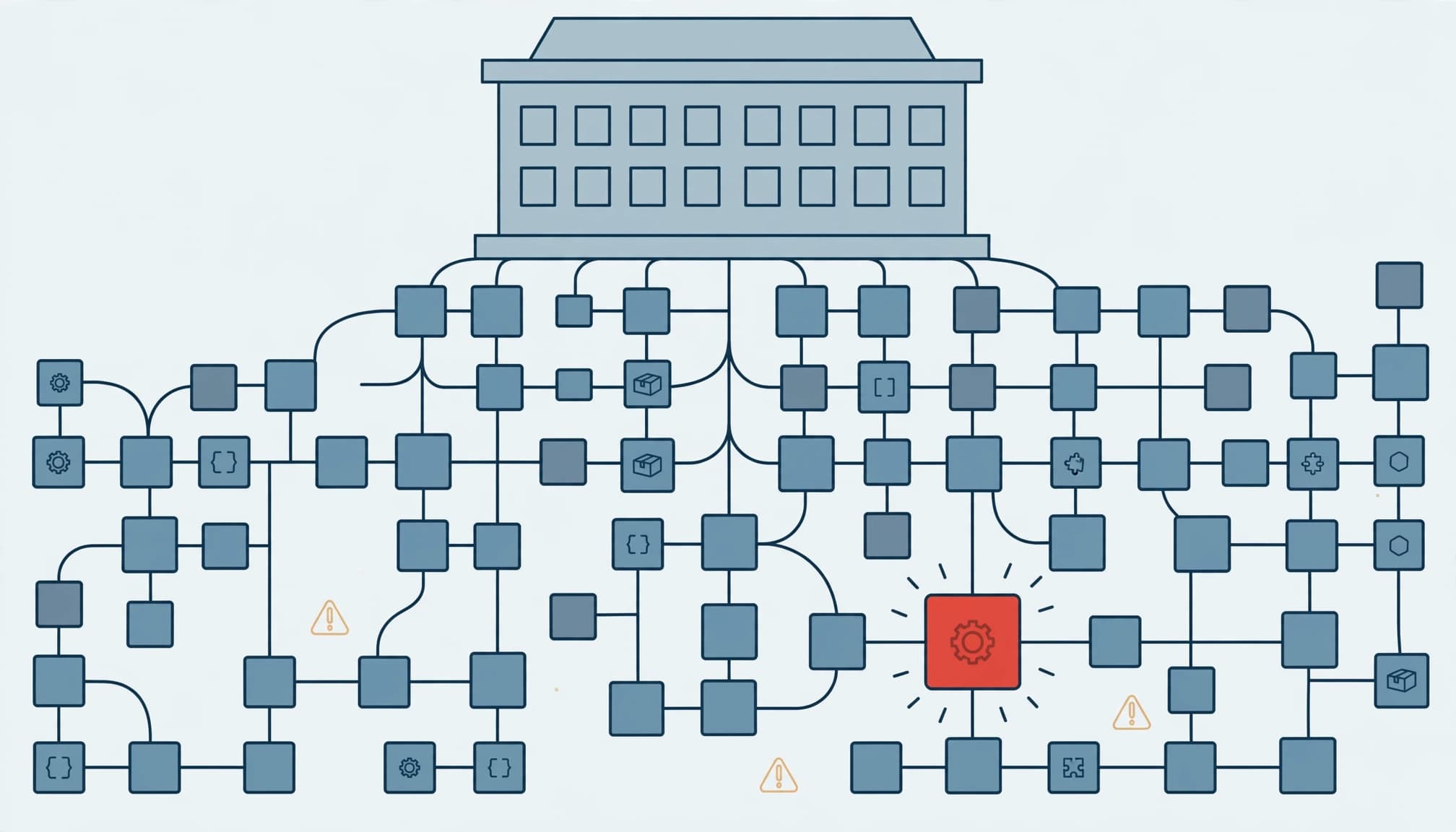
Open-source dependencies are external components your product relies on. Transitive dependencies are components those libraries bring with them. Secure.com describes a Node.js application with 12 direct dependencies expanding to 345 installed packages.
That hidden layer creates several distinct failure modes.
Known vulnerabilities can spread across products. Log4Shell, CVE-2021-44228, affected thousands of organizations because their software shared the Log4j library. Your attack surface can span multiple products and vendors at once.
Availability can fail without an attacker. In 2016, the 11-line JavaScript package left-pad, with about 2.5 million weekly downloads, was unpublished. React projects encountered npm ERR! 404 failures when builds couldn’t retrieve it. Unmaintained packages create a different problem: no reliable upgrade path when support disappears.
Malicious packages require another defense. Typosquatting uses names resembling legitimate packages. Dependency confusion exploits package-resolution behavior so a public package replaces an intended private one. Approved registries, namespace controls, and explicit package sources reduce both risks.
The 2024 XZ Utils compromise showed that an apparently trusted contributor can introduce a backdoor. Traditional malware scanning may miss carefully concealed attacks.
Sonatype’s 2024 research found peripheral components were 25 times more likely to contain malware than core components in its sample. The finding shows why overlooked parts of the software supply chain deserve scrutiny.
Require an Inventory That Matches Production
Make the SBOM release-specific
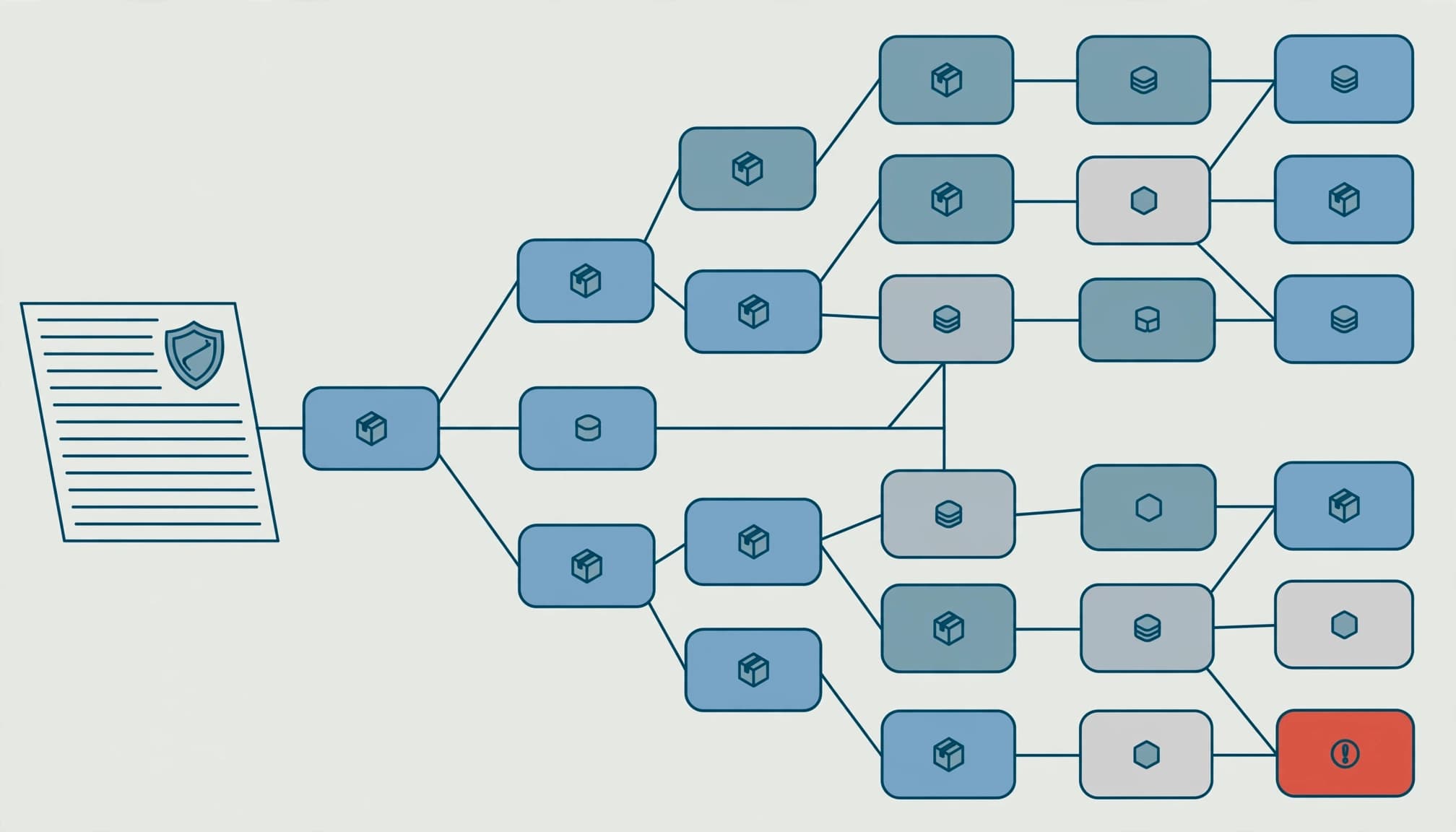
A Software Bill of Materials, or SBOM, inventories components, versions, and their relationships. NIST’s SBOM guidance describes a formal record of software components and supply-chain relationships.
Require one for each production release, including transitive dependencies, container contents, and relevant licenses. SPDX and CycloneDX provide machine-readable formats.
An inventory generated from a developer’s repository may differ from what customers use. Management should reconcile it with built artifacts and deployed versions.
Secure.com reports that SBOM users fixed vulnerabilities 264 days faster on average. Your measure should be how quickly your team identifies affected deployments.
Turn inventory into release controls
Software Composition Analysis, or SCA, tools identify components and flag known vulnerabilities. Options include Snyk, Mend, Sonatype Nexus products, and GitHub’s dependency tools. Restrict package sources to approved registries to help prevent typosquatting.
Set a quality gate in CI/CD pipelines to block merges or deployments that introduce unacceptable exposure. Continue monitoring released software because new vulnerabilities appear after release.
Pin approved versions in files such as requirements.txt or package.json, and retain lockfiles where supported. Version ranges alone don’t produce consistent builds.
Treat dependency management as a controlled process that pairs approved versions with timely updates, or yesterday’s approval can become tomorrow’s neglected vulnerability. Build evidence should record package sources, hashes, and available provenance.
Review License Obligations Before Distribution Decisions
License compliance belongs in technology governance because it can affect intellectual property, contracts, and acquisition readiness.
MIT and Apache are permissive licenses, but they still carry obligations such as preserving notices. Apache 2.0 also includes patent provisions.
GPL and AGPL are copyleft licenses. Depending on how covered code is modified, combined, distributed, or made available over a network, they can require disclosure of covered source code.
They don’t automatically require publication of every proprietary application that uses them. Your architecture and use determine the obligations. Have counsel assess material cases before deployment or distribution.
Ask management for an approved license policy, documented exceptions, and evidence of license compliance for vendor-supplied code. Include this in third-party risk reporting, particularly when a supplier controls the component inventory or release process.
Fund Remediation, Not Just Detection
Sonatype’s 2024 report found that 95% of downloaded components with known vulnerabilities already had a fixed version available. It also reported that 80% of application dependencies remained un-upgraded for over a year, leaving a sizable remediation backlog.
Secure.com similarly reports that over 80% of vulnerable dependencies remain unpatched beyond a year, even when fixes exist.
These findings point to an execution problem. Upgrades compete with product commitments. Older frameworks require testing. Ownership gets lost between engineering, security, and vendors.
Ask management to explain overdue exposure in those terms.
Set remediation windows by business impact, exploit activity, and available containment. An actively exploited weakness in a customer-facing service should trigger immediate action under your incident response plan.
A clean scan doesn’t prove recovery readiness. Management still needs to demonstrate that it can rebuild, patch, and restore the affected service.
Make dependency upgrades part of technical debt management and the technology roadmap. Repeated exceptions need funded corrective work.
Ask for a Board-Ready Risk Summary
Show exposure and response
Your board technology reporting should concentrate on the three to five material dependency risks. Keep the full technical register with management.
Use a compact view that connects evidence to action.
| Signal | What the board should see |
|---|---|
| Inventory coverage | Critical production releases with current SBOMs, plus known gaps |
| Overdue exposure | Material findings beyond agreed remediation windows |
| Response capability | Time to identify affected deployments and complete mitigation |
| Recovery readiness | Latest rebuild or recovery test against business requirements |
| Exceptions | Business consequence, owner, expiry date, and decision required |
Give each measure a definition, baseline, accountable owner, and threshold. Agree on the action when that threshold is crossed.
Set decision rights before pressure arrives
Management should own operational work, including component selection, assessment, remediation, and recovery testing. Security should challenge exposure assumptions, and legal should assess license obligations. A named executive must own the combined business response.
The board should oversee cyber risk appetite, material exceptions, and accountability. Risk appetite should distinguish a tolerable internal interruption from an outage that stops customer transactions.
Define who can accept exceptions and for how long. Material exposure outside appetite should reach the appropriate executive or board authority.
If a technology leadership gap leaves nobody accountable, a fractional CTO or interim CTO can establish ownership. A fractional CISO can support security oversight. Keep those responsibilities explicit.
Establish a 90-Day Dependency Risk Plan
Start with one revenue-critical product and one accountable team. Secure.com recommends piloting SCA this way and applying a quality gate to new code before tackling the legacy backlog.
- During days 1 through 30, establish the baseline. Inventory deployed components, generate an SBOM, identify owners, and assess the most consequential security and license findings. Record gaps openly.
- During days 31 through 60, control new exposure. Add dependency scanning to the release pipeline, establish approved sources, pin versions, and introduce documented exception approval. Avoid blocking every release over an undifferentiated historical backlog.
- During days 61 through 90, prove the response. Rehearse a newly disclosed vulnerability. Measure affected-product identification, containment, patching, and recovery. Assign corrective actions for delays.
Use your technology operating plan to track software supply chain health alongside budget, vendor commitments, and delivery capacity.
Your first board update should show the baseline, remaining uncertainty, and decisions needed.
Frequently Asked Questions
Is open-source software inherently risky?
Open source brings external dependencies, but commercial software does too. Your risk depends on component quality, maintenance, exposure, license obligations, and your ability to respond.
Commercial products can also contain open-source libraries that your team cannot directly inspect. Require evidence from suppliers rather than treating a paid license as assurance.
How can you find hidden transitive dependencies?
Use package-manager dependency graphs, lockfiles, SCA, and SBOM generation against built artifacts. Include containers and vendor-supplied software.
Reconcile those results with production deployments. A repository inventory alone can miss older releases still serving customers. Assign an owner to investigate incomplete dependency chains instead of marking unknown components as low risk.
Make the Next Board Conversation Specific
Your board should leave the discussion knowing which products are exposed, who owns the response, and what decision comes next.
Start with one revenue-critical product. Require evidence of control before expanding the program.
If that picture remains fragmented, Build a Board-Ready Technology Risk View. We help you connect technical findings with business consequences, clearer ownership, and decisions your leadership team can defend.