
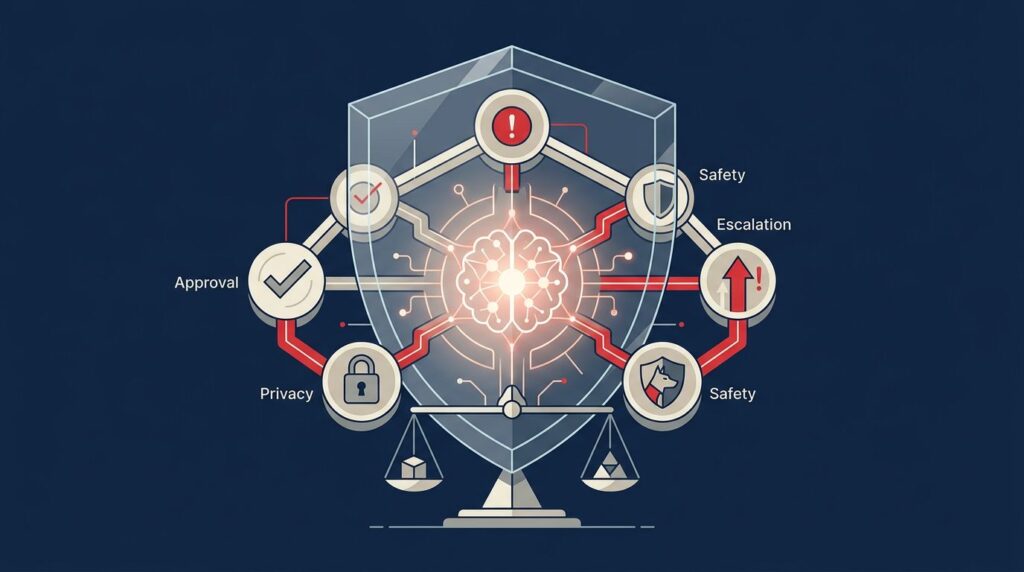
Customer-facing artificial intelligence systems can answer questions, recommend actions, route cases, approve requests, and shape how people experience your company. That makes AI liability a business issue before it becomes a legal one.
A wrong answer, exposed private data, or inconsistent treatment can create safety risks and encourage harmful reliance. Customers won’t blame the model provider first. They’ll blame your company. Before launch, you need clear answers about harm, ownership, evidence, escalation, and oversight.
Key takeaways before launch
- AI liability remains with your company, even when a third-party vendor supplies the model.
- A disclaimer cannot cure unsafe design or eliminate safety risks in a workflow that gives inaccurate or overconfident advice.
- Product liability, negligence, privacy, discrimination, consumer protection, and contract claims can overlap.
- Black-box behavior makes causation harder to prove, but poor records make your defense harder too.
- Every customer-facing AI use needs an accountable executive, approved data sources, defined boundaries, human escalation, testing, and a response plan.
- The board needs to know what the system can do, what could go wrong, who owns the risk, and what decision is required.
AI liability starts with the customer experience
Your customer does not see the model architecture, prompt design, retrieval system, or vendor agreement. They see your brand, website, support representative, or account portal, so AI liability follows the customer experience.
That changes the question. You are not only asking whether the machine learning model is accurate. You are asking whether it suits the customer decision and whether the entire service process is safe enough for the action you want customers to take.
A chatbot that answers general product questions creates one level of exposure. A system that explains insurance coverage, recommends a financial action, changes an order, denies service, or handles health-related information creates another. The output may be generated by software, but the customer experiences it as company guidance.

A statement saying that “AI can make mistakes” is not a complete control for safety risks created by authoritative outputs. It does little when the interface sounds authoritative, the workflow introduces safety risks, encourages reliance, or gives the customer no practical way to verify the answer.
Your stronger protection is process design. AI developers and deployers should assign responsibility for approved sources, refusal rules, confidence checks, and escalation. They should also give the system narrow instructions and a reliable path to a person. Review the source material on a defined schedule.
That is the first practical answer to this exposure. Do not treat the model as a black box. Treat the entire workflow as part of the service you provide, with clear accountability throughout.
What harm can the workflow cause?
Start with an AI liability and harm assessment before discussing vendors or model performance. Map the actions your system can influence and the safety risks those actions create.
Ask what happens if a system using machine learning generates an answer or ranking that’s wrong, incomplete, biased, or delayed. Consider actions taken outside its intended context, too.
Look beyond obvious technical failure. Customer-facing harm often comes from reasonable reliance on guidance that sounds more certain than the evidence supports. That overconfidence may create foreseeable concerns about negligence in care, though it doesn’t establish that a claim will succeed.
These failures may create civil liability when inaccurate, discriminatory, or unsafe outputs cause harm.
Potential harms include:
- A customer receives an inaccurate policy explanation and misses a payment, deadline, or required action.
- A support system exposes personal information to the wrong account holder.
- A recommendation produces different outcomes for customers based on protected characteristics or poor proxy data.
- An automated workflow denies access, changes an order, or escalates a dispute without meaningful human review.
- A customer follows advice that leads to financial damages, physical injury, privacy harm, or emotional distress.
- A generated response makes a promise your company cannot keep.
You should also ask whether the system can create indirect harm or introduce safety risks. A model may not make the final decision, but it may rank cases, shape an employee’s judgment, or determine which customers receive faster attention. Those effects create safety risks because they still influence the customer outcome.
Your risk review should cover the full workflow, not only the text produced by the model, because hidden safety risks can arise elsewhere. Include the data entering the system, the tools it can call, and the actions it can take. Review the people who handle exceptions and the records created after each interaction.
Who owns the answer when the model is wrong?
AI systems operate through a supply chain. AI developers may supply the foundation model. Another vendor may provide the customer service platform. Your team may add business rules, customer data, retrieval tools, and automated actions. Your company then deploys the result, joining the deployers responsible for customer use.
That structure can make AI liability difficult to assign after something goes wrong. Each party may point to another part of the chain. The model provider may say you controlled the prompt. Your implementation vendor may say you approved the workflow. Your internal team may say the vendor managed the integration.
The customer still experienced one service.

Your contract should define more than uptime and pricing. It should address training data practices, product liability exposure, data use, retention, security, model changes, audit rights, incident notification, subcontractors, testing evidence, indemnification, and vendor offboarding. It should also state that allocation terms don’t eliminate your customer-facing duties.
AI vendor due diligence should also examine how the provider handles model updates. A workflow that passed testing last quarter may behave differently after an update. Changes to the underlying machine learning model, safety layer, retrieval process, or tool permissions can create new safety risks.
This is part of third-party risk management, not a separate technical exercise. Your vendor management process should show who approves the use, who monitors it, and who can stop it. It should also identify who responds when provider changes create additional safety risks.
A supplier agreement is not a safe harbor from your responsibility to customers. It can give you better evidence, stronger remedies, and clearer expectations when the supply chain fails.
Can you prove causation when AI is a black box?
An AI liability analysis asks whether a plaintiff can connect an alleged defect or careless act to a specific injury. That connection may support a negligence claim. Complexity grows when the system uses a large model, changing prompts, hidden filters, external tools, and data you cannot fully inspect. These factors can obscure how safety risks contributed to the injury.
The question may not be as simple as, “What did the model do?” The burden of proof may involve several steps:
- What information entered the workflow?
- Which model and version produced the response?
- What instructions and retrieval sources were active?
- Did a human review or approve the output?
- What did the customer do next?
- What other facts contributed to the harm?
These questions help identify the facts at issue, but better logs don’t automatically determine who prevails.
System opacity can make the plaintiff’s case harder, but it can also weaken your defense when records are missing. Missing logs, undocumented model changes, unclear approval decisions, and inconsistent testing create uncertainty on both sides.
A U.S. tort law analysis describes how traditional negligence, product liability, and strict liability concepts may apply to AI-related harm. Some claims may also draw on common law theories, depending on the facts and jurisdiction. The practical lesson is straightforward. Courts may work with existing legal theories, but your evidence should show how the system was designed, tested, monitored, and used. Those records can clarify potential civil liability and claimed damages.
Keep records that answer the basic questions. AI developers and deployers may need to preserve logs, approval records, and evidence showing how safety risks were assessed. What did the system know? What did it say? What action did it trigger? What safeguards were active? Who reviewed the risk? What changed after launch?
Good documentation does not prevent every claim. It gives leadership and counsel a clearer account of what happened.
Is AI a product, a service, or both?
The legal classification of artificial intelligence systems depends on the facts, jurisdiction, claim, and delivery model. A customer-facing AI workflow may look like a service delivered by deployers, while software supplied by AI developers, including machine learning components, may be treated as a product in some claims.
That distinction matters because product liability can involve theories such as design defect, manufacturing defect, failure to warn, strict liability, and breach of warranty. Negligence claims ask different questions about civil liability, including whether reasonable care addressed foreseeable risks, industry customs, testing, and controls. A negligence theory may also focus on a specific failure.
Courts may also consider familiar common law tests. Under a consumer expectations test, the issue may be whether the system performed below what a reasonable customer would expect. Under a risk-utility test, the court may weigh the system’s benefits against design risks and available alternatives.
A recent AI product liability analysis describes early litigation questions around whether consumer AI applications should be treated as products, services, or a combination of both.
Proposals such as the bipartisan AI LEAD Act have also raised the possibility of more specific federal rules for software and artificial intelligence. A proposed law isn’t the same as an operating requirement. Common law may continue to shape civil claims while lawmakers debate legal certainty. Section 230 may offer a safe harbor in some disputes, but that defense isn’t universal and doesn’t replace design controls. You shouldn’t delay basic controls while waiting for Congress, nor should you assume one federal rule will replace state tort law.
The better launch position is to act as though the workflow will be examined as a business service with technical components. That means testing the customer outcome, not only the model output. Apply the consumer expectations test and risk-utility test to performance, foreseeable harms, and available alternative controls.
The First Amendment adds another layer when a system generates text or speech. In Garcia v. Character Technologies, most claims survived a motion to dismiss in May 2025, and the court did not accept the argument that the First Amendment ended the case at that stage. The parties later reported a settlement in principle in January 2026. No defendant was found liable in a merits judgment.
That case does not answer every question. It shows why speech arguments should not become a substitute for responsible product design, warnings, moderation, access controls, or age-appropriate safeguards that address safety risks. Those controls should also account for foreseeable safety risks across the customer experience.
What changes in the United States versus the European Union?
The United States does not have one comprehensive federal civil liability regime for every AI liability issue. Claims may proceed under state negligence or product liability doctrines, common law claims grounded in tort law, consumer protection statutes, privacy rules, discrimination law, contract terms, or sector-specific requirements.
That common law variation can affect how courts assess safety risks. A control that seems acceptable in one state may face a different standard elsewhere. Your legal team should review the states where customers live, where the company operates, and where the workflow creates a material decision or risk.
The European Union has taken a more structured regulatory approach through the AI Act, with European Commission guidance that may improve legal certainty. The AI Act distinguishes among risk levels. It places stronger obligations on certain high-risk AI systems, which may include conformity assessment requirements. Safety risks, fundamental rights, discrimination, transparency, human oversight, and data governance can matter even without physical injury.
Not all customer chatbots are automatically high-risk AI systems. Classification depends on their use and effect. A general information assistant differs from a tool influencing access to essential services, employment, credit, health, or other sensitive outcomes. For high-risk AI systems, the European Commission offers nonbinding implementation context, and any required conformity assessment follows the applicable route.
Your compliance plan should therefore avoid a narrow “Is this allowed?” question.
Ask what the system does, who it affects, and what evidence you need. Assess whether fundamental rights are implicated and whether AI developers or deployers carry obligations under the AI Act. Then confirm that any conformity assessment and related controls address fundamental rights, transparency, oversight, and market-specific safety risks.
Build a launch gate before customers see the system
Your AI adoption strategy needs a launch process that can stop an unsafe use and limit AI liability exposure. A useful technology governance process is not a long approval chain. It is a short set of decisions with named owners.
Use these questions before launch:
- What decision or action can the workflow influence? Document whether the system only provides information or can change records, recommend outcomes, route cases, or take action without review. Record related safety risks before launch.
- Which information sources are approved? Use current knowledge sources with named owners, review dates, version control, and a process for removing outdated material. AI developers and deployers should document these approved-use boundaries. Do not let the system answer from an ungoverned collection of documents.
- Where must the system refuse or escalate? Define sensitive topics, low-confidence conditions, conflicting source material, vulnerable customers, and requests that require a trained employee.
- What evidence will you retain? Keep prompts, relevant inputs, outputs, model versions, source citations, tool actions, human approvals, and customer complaints where lawful and appropriate. Preserve testing and approval records because they may help evaluate allegations of negligence.
- How will you test unequal outcomes? Test realistic customer questions, edge cases, ambiguous language, privacy boundaries, accessibility needs, and attempts to manipulate the workflow. Include failure modes and safety risks in the test plan. Test again after material vendor or model changes, and require those teams to document testing and change management.
- What happens when harm is reported? Your vendor incident response plan and internal incident response readiness should identify who investigates reported safety risks, who pauses the workflow, who contacts the vendor, who informs counsel, and who communicates with affected customers.
If the workflow operates in the EU and affects a material decision, assess whether the AI Act applies. Determine whether the workflow falls within the scope for high-risk AI systems and whether a conformity assessment is required. If so, identify the evidence needed for that conformity assessment, including testing, oversight, and potential impacts on fundamental rights. Review the conformity assessment after material changes. Do not assume every workflow needs one or that every answer requires human review.
The workflow should also fit your data governance framework. Limit sensitive data, define retention, control access, and document why the system needs each data field. An AI acceptable use policy can set company-wide boundaries, but it cannot replace workflow-level controls.
Add the approved use, material risks, owner, and next milestones to your technology roadmap to support legal certainty around the launch decision. If the use will affect customers for the next year, it belongs in strategic technology planning and the 12-month technology roadmap, not in an informal tool list.
Give executives a decision-ready risk view
Your board does not need a technical tour of the model. It needs a clear view of AI liability exposure and management action.
A board-ready AI report should answer:
- Where is AI being used in customer-facing work?
- Which uses can affect customer eligibility, money, privacy, safety, reputation, or fundamental rights?
- Which high-risk AI systems affect customers, and which AI developers and deployers are involved?
- What data enters each workflow?
- What controls prevent unsafe or unauthorized action, and what safety risks remain?
- In each relevant market, does an AI Act obligation apply, and is conformity assessment evidence available?
- Who owns the risk and who can stop the system?
- What incidents, complaints, exceptions, near misses, safety risks, or actual and potential customer damages have occurred?
- Which decision requires executive or board attention?
A formal AI governance framework can help connect AI risk to broader technology governance, vendor oversight, data privacy, and executive reporting.
You may also need an AI governance committee structure if multiple departments are adopting AI. The committee should review material uses, major vendors, data decisions, customer harm, and risk acceptance. It should not become a committee that approves every prompt.
The CEO, COO, or another senior executive should own the business tradeoff. The board should oversee material risk, investment, reputation, and control quality. Neither group should have to guess who is accountable.
When you need executive technology leadership
Many companies already have AI developers, IT staff, operations leaders, and vendors. The problem is that no one owns the full customer-facing AI decision or the resulting AI liability.
That is a technology leadership gap. It appears when AI developers, legal, operations, and Finance pull in different directions without an accountable executive to align them. Unclear decision rights make negligence harder to prevent or investigate.
A fractional CTO can provide continuing judgment when you need executive technology leadership without a full-time hire. Fractional CTO services may include AI governance, technology strategy consulting, vendor review, roadmap ownership, reporting on safety risks, and decision rights.
An interim CTO and interim CTO services fit a different moment. Use that model when a technology leader has left, trust has broken down, a major workflow is failing, or the company needs immediate ownership during a transition. An outsourced CTO, virtual CTO, or part-time CTO can fit when the cadence is clear and the work does not require a permanent executive seat.
If the issue covers enterprise systems and data, a fractional CIO may fit better. If cybersecurity and privacy risk dominate, a fractional CISO, virtual CISO, or interim CISO may need to lead the response.
If your team cannot agree on who owns the risk, start with Get an Executive Technology Clarity Check. The first step is not buying another tool. It is deciding what needs executive ownership before the workflow reaches customers.
Conclusion
AI liability is not a question you answer after an incident. You answer it when you define the workflow, approve the data, set the boundaries, choose the vendor, and assign the owner. Its exposure may involve negligence, product liability, or tort law, depending on the facts.
A customer-facing AI system needs more than a capable model. For high-risk AI systems, AI developers and deployers need controls matched to the use, affected customers, and fundamental rights. Evidence, judgment, clear escalation, vendor control, and trusted reporting help address safety risks early, prevent further safety risks, and reduce damages.
FAQs
Is a disclaimer enough to protect a company from AI liability?
Usually, no. A disclaimer may inform customers that an AI system can make mistakes, but it does not excuse unsafe design, inaccurate instructions, privacy failures, or a workflow that encourages reliance.
A disclaimer does not eliminate the company’s AI liability exposure. Courts may look at the full customer experience, including the wording, interface, apparent authority, available review, warnings, and the company’s conduct after learning about a problem.
Who is responsible when a third-party AI model causes customer harm?
Responsibility depends on the facts. The model provider, application vendor, integrator, and deploying company may each have different roles.
Depending on the jurisdiction, contracts, and each party’s role, product liability, negligence, or strict liability principles under tort law may apply. Your company may still face the first customer complaint or claim because it offered the service. Contracts should define responsibilities, but they do not automatically transfer every legal or operational duty away from the deployer.
Should every customer-facing AI workflow have a human in the loop?
Not every low-risk answer needs manual review. A system that provides basic product information may operate with automated responses and clear escalation.
Human review becomes more important for high-risk AI systems. That is especially true when they can affect money, access, safety, privacy, eligibility, fundamental rights, or vulnerable customers. The right question is not whether a person reviews every response. It is whether a person can review and correct material decisions before harm becomes difficult to reverse.
What should you do before launching an AI customer workflow?
Start with a short launch review. Identify the actions the system can influence and define approved data sources. Set refusal and escalation rules, then test realistic failure cases, including safety risks. Review vendor terms, create logs, and assign one accountable executive.
Then include the use in your AI governance process, technology roadmap, vendor risk review, and board reporting when the exposure is material. If the EU rules apply to the use, determine whether a conformity assessment is required. If those decisions have no clear owner, resolve the ownership problem before you launch.