
Your organization exists to serve a critical mission, but the technology meant to support that work feels like a source of constant friction. Case and program data are scattered across tools that don’t talk to each other. Grant and board reporting has become a recurring fire drill. The security and privacy of the communities you serve—especially where immigration, incarceration, or youth are involved—feels like a constant risk. Your staff spend too much time in spreadsheets and manual work, and not enough time supporting advocates or partners.
This isn’t a problem you can solve with another software subscription. The real issue is a lack of effective IT governance: the framework of rules, relationships, and processes that ensures your technology decisions align with your mission, manage risk, and deliver value you can prove. Without it, even well-intentioned investments lead to more chaos, not more capacity. Your systems become a quiet source of stress instead of a reliable backbone for the frontline advocates who stand with vulnerable people.
This guide moves beyond technical jargon to offer a calm, seasoned perspective on the best practices for it governance. It’s not a platform pitch. It’s a simple, believable modernization path that helps you reduce risk, free up staff time, and build a technology foundation you can defend to your board, funders, and community.
Key Takeaways for Your Leadership Team
- Governance is Leadership, Not Tech: IT governance isn’t an “IT project.” It’s a leadership responsibility for aligning technology with your mission, managing risk, and proving value.
- Start with Pain, Not Frameworks: Before adopting a complex system like COBIT, identify your organization’s most immediate technology-related pain points—like grant reporting or security risks—and solve those first.
- Clarity Over Complexity: Your goal is a simple, defensible plan. Focus on establishing clear decision-making roles (who decides on new software?), managing vendor risk, and measuring what matters to your mission.
- From Cost to Capacity: Effective governance transforms technology from a confusing cost center into a strategic asset that reduces staff burnout, protects sensitive data, and clarifies your impact.
1. Adopt a Governance Framework (But Start Small)
For organizations grappling with scattered systems and inconsistent data, a standardized approach is essential for growth. Adopting a formal IT governance framework provides a proven roadmap to align technology with strategic goals. The most widely recognized is COBIT (Control Objectives for Information and Related Technology). Think of it as a set of reliable blueprints that bridge the gap between technical work and your mission objectives.
This framework helps you answer critical questions: Are we getting real value from our IT investments? Are we managing the risks around our sensitive client data? COBIT isn’t just for Fortune 500 companies; its principles are scalable. A national legal advocacy nonprofit, for instance, can use COBIT to standardize data security protocols across its network partners, ensuring consistent protection of case information and satisfying funder requirements for cyber readiness.
Why This Matters
Implementing a framework shifts IT from a reactive cost center to a strategic partner. It creates a common language for executives, operations leaders, and your IT support, ensuring everyone is working toward the same outcomes. This systematic approach is one of the most effective best practices for it governance because it replaces ad-hoc decision-making with a clear, defensible process.
How to Get Started
- Start Small: Don’t attempt a full-scale, organization-wide rollout at once. Pilot the principles within a single program or department, such as grants management, to show quick wins and build momentum.
- Secure Executive Buy-In: Governance is a leadership function. Ensure your executive director and board understand that this isn’t just an “IT project” but a strategic initiative to reduce organizational risk.
- Customize to Your Mission: COBIT is a framework, not a rigid set of rules. Adapt its processes to fit the unique realities of your justice-focused work. You can find more insights on tailoring such frameworks by exploring resources related to IT governance best practices.
2. Align Your Technology Plan with Your Mission
When technology decisions feel reactive and disconnected from your core work, strategic alignment is the corrective measure. This is the deliberate process of creating a technology roadmap that directly supports your organization’s primary objectives. It ensures that every dollar spent on software, hardware, and IT staff time is an investment in achieving greater impact, not just keeping the lights on.
This approach transforms IT from a series of isolated purchases into a coherent, mission-driven strategy. For a national immigration legal network, this means moving beyond simply buying new laptops. Instead, their IT plan might prioritize a secure, cloud-based case management system that allows attorneys to collaborate safely across state lines, directly supporting the goal of serving more asylum seekers. It connects the tech to the mission.
Why This Matters
Strategic planning ensures that technology serves the mission, not the other way around. It forces critical conversations about priorities and trade-offs before a crisis hits. This proactive discipline is one of the essential best practices for it governance because it replaces fragmented, department-level tech requests with a unified, defensible roadmap. It gives your board a clear line of sight from strategic goals to technology investments.
How to Get Started
- Involve Program Leaders: Your strategic planning sessions must include the people who do the work—program directors and operations leaders. IT cannot build an effective roadmap in a vacuum; it needs deep insight into their daily pain points.
- Conduct Regular Reviews: An IT strategy is not a “set it and forget it” document. Schedule quarterly reviews to assess progress and make adjustments based on new funding, threats, or opportunities.
- Use a Simple Scorecard: Measure success beyond just being on budget. Track metrics that matter to the mission, like gains in staff efficiency, satisfaction with tools, and improvements in data security.
3. Manage Risk Before It Manages You
For organizations handling sensitive client data, from immigration status to incarceration records, a breach isn’t a technical problem—it’s a direct threat to the safety of the people you serve. Proactive risk management involves systematically identifying, assessing, and mitigating IT-related threats while ensuring you meet legal and funder requirements. This moves security from an abstract worry to a managed, measurable part of your operations.
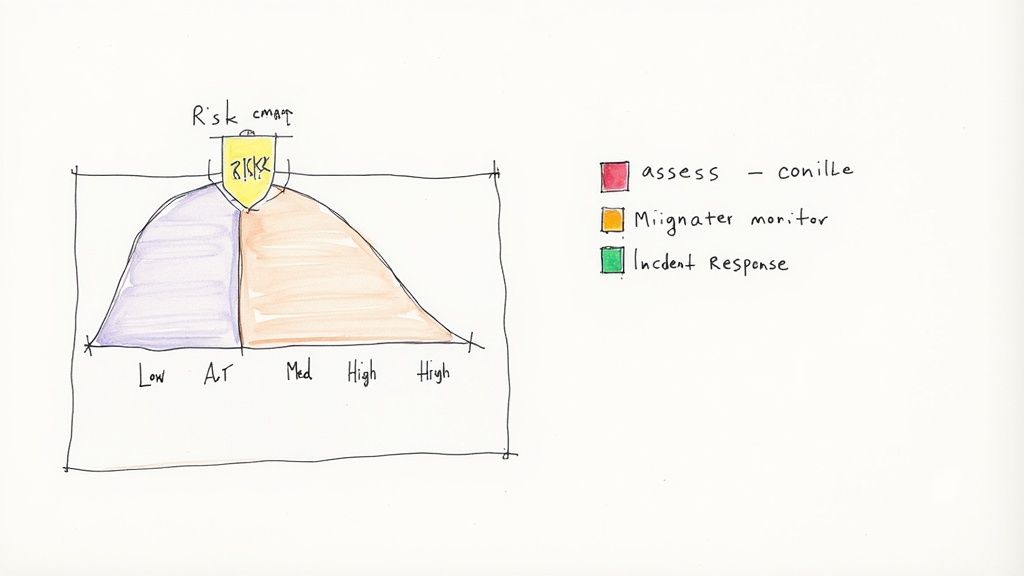
This process protects your clients, your data, and your reputation. For example, a legal network supporting refugee claimants can use a simple framework to assess vulnerabilities in their shared case management system. This ensures they meet the stringent data protection expectations of international partners and safeguard highly vulnerable clients from digital threats. It builds trust and resilience.
Why This Matters
Formal risk management transforms security from a reactive, crisis-driven expense into a forward-looking investment. It creates a documented process for prioritizing your efforts where they will have the most impact. This disciplined approach is one of the essential best practices for it governance because it ensures your security posture is aligned with your mission’s specific risks, not just generic checklists. It answers the question: “Are we protecting what matters most?”
How to Get Started
- Start a Risk List: Begin with a simple spreadsheet to document identified risks, their potential impact, likelihood, and what you’re currently doing about them. This central log is the foundation for all risk discussions.
- Form a Small Risk Committee: Create a committee with members from programs, operations, and leadership. This ensures that risk assessment is grounded in the reality of how your staff works and the data they handle.
- Test Your Response Plans: Don’t wait for a crisis. Regularly conduct simple tabletop exercises for common scenarios like a data breach or system outage to test and refine your disaster recovery and incident response plans.
4. Manage Your Tech Projects Like an Investment Portfolio
For organizations juggling multiple grant-funded initiatives and legacy system upgrades, it’s easy for technology spending to become fragmented. IT Portfolio Management (ITPM) provides a disciplined, strategic lens to view all technology projects as a single, coordinated portfolio. This governance process ensures your limited resources—staff time and grant funding—are allocated to the initiatives that deliver the most value to your mission. It moves the conversation from “can we do this project?” to “should we?”
A national immigration legal network might use this process to weigh a new case management system upgrade against a proposal for a secure data-sharing portal for its members. By evaluating both based on their alignment with strategic goals, risk reduction, and impact on frontline advocates, leadership can make a transparent, data-informed decision instead of funding whichever project has the loudest champion.
Why This Matters
Adopting IT Portfolio Management transforms technology spending from a series of disconnected expenses into a strategic investment plan. It provides a clear, defensible methodology for prioritizing work and ensuring every dollar spent on technology is tied to a mission outcome. This systematic approach is one of the essential best practices for it governance because it forces clarity on trade-offs and maximizes the return on every technology investment.
How to Get Started
- Establish a Governance Body: Create a small, cross-functional committee that includes program, finance, and operations leaders to review the portfolio. This ensures decisions reflect the entire organization’s priorities.
- Use a Simple Scoring Model: Develop a standardized way to evaluate potential projects. Criteria should include strategic alignment, impact on staff efficiency, risk reduction, and estimated cost versus benefit.
- Balance the Portfolio: Consciously balance your investments across different categories: “run” projects that maintain current systems, “grow” projects that expand existing services, and “transform” projects that introduce new capabilities.
- Review and Adjust Quarterly: The portfolio should be a living document. Hold quarterly reviews to assess project progress, re-evaluate priorities, and formally approve, pause, or cancel initiatives as required.
5. Deliver IT Support as a Reliable Service
When your staff sees the IT team as a black box where requests disappear and solutions emerge unpredictably, it creates friction and undermines trust. Implementing IT Service Management (ITSM) provides a structured, customer-centric way to deliver technology services. The most common framework for this is ITIL (Information Technology Infrastructure Library), which offers a set of proven practices for managing and improving IT services so they consistently meet your mission’s needs.
In plain terms, this means having a clear, repeatable process for when things go wrong. For a national legal network, this means a member organization has a clear way to report a case management system outage. The issue is logged, prioritized, resolved within a defined timeframe, and communicated about clearly—rather than relying on a frantic email to a single “tech person.” This predictability builds confidence and frees up staff to focus on their real work.
Why This Matters
Adopting these principles transforms IT from a reactive, unpredictable function into a reliable service provider. It establishes clear expectations for service quality, response times, and communication, making IT’s value visible and measurable. This systematic approach is one of the essential best practices for it governance because it ensures that technology support is a core, well-managed capability that enables your mission.
How to Get Started
- Start with Incident and Request Management: Don’t try to implement everything at once. Focus first on creating a reliable process for fixing what’s broken (incidents) and fulfilling standard requests like new user accounts.
- Invest in a Scalable Tool: Use a dedicated platform like Jira Service Management, ServiceNow, or Freshservice to manage tickets and automate workflows. Spreadsheets and shared inboxes do not scale.
- Define and Measure Service Levels: Establish clear Service Level Agreements (SLAs) for key services. For instance, define that critical system outages will be responded to within one hour. Track performance to demonstrate improvement and hold the IT function accountable.
6. Govern Security from the Top Down
For justice-focused organizations, cybersecurity is not just an IT issue; it is a core component of mission delivery and ethical responsibility. IT Security Governance establishes the essential policies, controls, and oversight to protect your information. This crucial practice ensures accountability for cybersecurity rests with leadership—not just a vendor or a systems manager—and embeds security into every program and process.
Effective security governance means answering tough questions before a crisis hits: Do we have a clear, tested plan for responding to a data breach involving client immigration records? Are our funders confident that we are adequately protecting the sensitive information they entrust to us? This transforms security from a technical checklist into a strategic function that protects your community and your reputation.
Why This Matters
Establishing formal IT Security Governance is one of the most vital best practices for it governance because it directly protects your reputation, funding, and the vulnerable communities you serve. It shifts the organizational mindset from simply buying security tools to actively managing cyber risk in alignment with your mission. This provides a defensible framework for making security decisions and demonstrating due diligence to boards and funders.
How to Get Started
- Establish Clear Ownership: Appoint a leader responsible for security, like a Chief Information Security Officer (CISO), even if it’s a fractional or part-time role. This person should report to the executive team and have the authority to implement necessary controls.
- Adopt a Zero Trust Mindset: Move away from the outdated “trust but verify” model. Implement a Zero Trust approach that assumes no user or device is inherently trustworthy, requiring strict verification for every access request.
- Test Your Defenses Regularly: Don’t wait for an attack to find your weaknesses. Conduct regular, independent penetration tests and vulnerability assessments to proactively find and fix security gaps. You can begin building your evaluation process with a comprehensive IT security assessment checklist.
- Develop and Rehearse Incident Response: Create a detailed incident response plan that outlines roles, responsibilities, and communication protocols. Test this plan through simple exercises at least quarterly to ensure your team is prepared.
7. Architect Your Systems with Intention
As organizations grow, their technology often evolves reactively, resulting in a tangle of disconnected systems and redundant data. Enterprise Architecture (EA) Governance provides a structured approach to tame this chaos. It’s the practice of defining and managing your IT systems so they align with long-term strategic goals, rather than just solving immediate problems. EA governance establishes a blueprint for how technology assets fit together.
This is not an academic exercise. For a national immigration network, a well-defined architecture ensures that a new case management system can seamlessly share data with a separate attorney portal, preventing duplicate data entry and giving advocates a unified view of a client’s journey. This disciplined approach prevents the creation of more information silos and ensures that every new technology investment builds on the last.
Why This Matters
Adopting EA governance moves an organization from building a collection of standalone tools to engineering an integrated, mission-driven ecosystem. It forces clarity on how current systems support operations and provides a clear roadmap for future technology decisions, preventing expensive mistakes. This strategic oversight is one of the core best practices for it governance because it ensures technology choices are deliberate and sustainable.
How to Get Started
- Establish an Architecture Council: Create a small, cross-functional group of business and technology leaders responsible for reviewing and approving major technology decisions.
- Document Current and Target States: Map out your existing technology landscape (“as-is”) and create a simplified diagram of where you want to be in 1-3 years (“to-be”). This visual roadmap guides investment priorities.
- Use Architecture Decision Records (ADRs): For any significant new system, create a simple, one-page document explaining the decision, the alternatives considered, and the rationale. This builds an institutional memory for your technology choices.
8. Manage Your Vendors as an Extension of Your Team
When your organization relies on external software, cloud hosting, or managed service providers, their security weaknesses become your risks. For justice-focused nonprofits handling sensitive client data, a vendor’s data breach can become a catastrophic mission failure. Vendor and third-party risk management is the systematic process of evaluating, monitoring, and managing the risks posed by these external partners.
This discipline moves beyond contract negotiation to a continuous cycle of due diligence. It means scrutinizing a new case management system vendor’s data encryption protocols before signing a contract and annually verifying that your cloud provider maintains critical compliance certifications. It’s about treating your vendors’ security posture as an extension of your own.
Why This Matters
Implementing a formal vendor risk management program is one of the most critical best practices for it governance because your security perimeter now extends to every third party with access to your systems or data. It replaces assumptions and trust with verification, providing a defensible process to show funders and boards that you are actively protecting sensitive information.
How to Get Started
- Develop Standardized Assessments: Create a tiered vendor assessment questionnaire. A vendor handling public website analytics needs less scrutiny than one hosting your client database.
- Mandate Proof of Compliance: For critical vendors that handle sensitive data, require them to provide a current SOC 2 Type II report or equivalent security certification as a contractual obligation.
- Establish Performance Scorecards: Track key metrics like system uptime and support response times. Review these scorecards quarterly with your most critical partners.
- Incorporate Right-to-Audit Clauses: Ensure your contracts give you the right to audit a vendor’s security controls, especially after a security incident. Understanding these safeguards is a core part of the best practices for vendor management.
9. Measure What Matters to Your Mission
If you can’t measure it, you can’t manage it or prove its value to funders. For justice-focused organizations, demonstrating the impact of technology often feels abstract. Implementing formal performance measurement using a balanced scorecard approach translates technical outputs into a language of strategic outcomes that boards and executive teams can understand.
This model moves beyond purely financial or operational metrics. It assesses IT performance across four dimensions: financial (Are we getting value for our spend?), customer (Are our staff and partners well-served?), internal process (Are our systems efficient and secure?), and learning and growth (Are we building capacity for the future?). An immigration legal network could use it to track not just system uptime but also the reduction in time staff spend on manual data entry—a metric that directly links technology to increased capacity for client services.
Why This Matters
A balanced scorecard forces a holistic view of IT’s contribution to the mission. It connects system reliability and security directly to program effectiveness and financial stewardship. This framework is one of the essential best practices for it governance because it replaces vague assertions of value with concrete, multi-faceted data. It provides the evidence needed to justify investments and align technology with strategic priorities.
How to Get Started
- Start with a Core Set: Resist the urge to measure everything. Begin with 5-10 key metrics across the four scorecard perspectives that are most relevant to your current strategic goals.
- Make Metrics SMART: Ensure every Key Performance Indicator (KPI) is Specific, Measurable, Achievable, Relevant, and Time-bound. For example, instead of “improve system speed,” use “Reduce average case file load time by 15% within the next quarter.”
- Communicate Transparently: Share performance dashboards with leadership and relevant program teams regularly. Transparency builds trust and helps everyone understand the trade-offs.
10. Clarify Who Decides What
When IT decisions are made in silos or by the loudest voice in the room, chaos ensues. A clear IT governance structure with defined decision rights is the antidote. This framework establishes who has the authority to make specific technology decisions, preventing the bottlenecks and turf wars that stall critical projects.
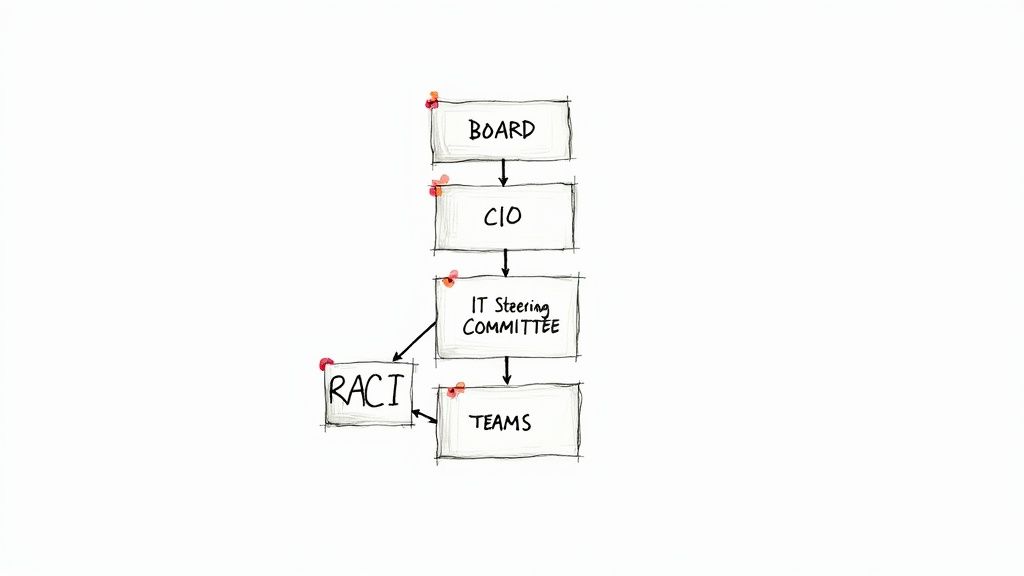
This structured approach moves decision-making from an ambiguous, personality-driven process to a formal, predictable one. For instance, a national legal network can establish an IT Steering Committee, chaired by the COO, to approve significant software investments. Simultaneously, a dedicated Security Council can be empowered to set data handling policies for sensitive asylum case files. This clarity accelerates action and builds trust.
Why This Matters
Establishing a formal governance structure is one of the most critical best practices for it governance because it replaces ambiguity with accountability. It ensures the right people are involved in the right decisions at the right time, balancing strategic priorities with operational realities. This framework prevents one department from making a technology choice that negatively impacts another and provides a clear escalation path when conflicts arise.
How to Get Started
- Define a Clear RACI Matrix: For key IT domains (e.g., budget, security, vendor selection), create a RACI (Responsible, Accountable, Consulted, Informed) chart. This simple tool documents who does the work, who owns the outcome, who must be consulted, and who just needs to be kept in the loop.
- Establish an Executive IT Steering Committee: Create a high-level committee chaired by a non-IT C-level executive (like the COO or CFO) to ensure business and mission alignment. This body should be responsible for major IT investments, strategy approval, and resolving escalated issues.
- Document and Communicate Decisions: Maintain a clear record of all governance decisions and the rationale behind them. Make this accessible to relevant stakeholders to foster transparency.
10-Point Comparison of IT Governance Best Practices
| Item | Implementation complexity | Resource requirements | Expected outcomes | Ideal use cases | Key advantages |
|---|---|---|---|---|---|
| IT Governance Framework (COBIT) | High — enterprise-wide, structured rollout | Significant — executive sponsorship, training, tools | Strong IT–business alignment; measurable governance maturity; risk controls | Large, regulated or multi‑region enterprises; digital transformation programs | Comprehensive, globally recognized; maturity models; regulatory support |
| IT Strategic Planning and Alignment | Medium–High — cross-functional planning and continual updates | Moderate — strategy teams, stakeholder time, analytics | Prioritized roadmap; optimized IT investments; improved ROI | Organizations aligning technology to long‑term business goals | Direct value alignment; better resource allocation; stakeholder buy‑in |
| Risk Management and Compliance | Medium — continuous program and regulatory mapping | Moderate — risk/compliance teams, monitoring, audits | Reduced breach and regulatory risk; incident readiness; documented controls | Regulated sectors or companies handling sensitive data | Protects assets and data; ensures legal compliance; enhances trust |
| IT Portfolio Management | Medium — governance, prioritization and review cycles | Moderate — PMO, portfolio tools, scoring models | Optimized investment mix; reduced redundancy; improved ROI | Organizations with many concurrent projects or constrained resources | Better prioritization; transparency; resource optimization |
| IT Service Management (ITSM) and ITIL | High — process redesign and cultural change | Significant — ITSM tools, training, dedicated teams | Improved service quality and availability; fewer incidents; consistent delivery | Service‑centric organizations and high‑availability operations | Consistent service delivery; operational efficiency; continual improvement |
| IT Security Governance and Cyber Risk Management | High — ongoing, adaptive security program | High — security specialists, monitoring tools, testing | Lower cyber risk and breach impact; compliance; executive visibility | Organizations facing cyber threats or strict compliance regimes | Protects critical data/systems; builds resilience and stakeholder trust |
| Enterprise Architecture Governance | High — long‑term, specialized governance & review | Significant — architects, EA boards, documentation tools | Reduced complexity; interoperable, scalable systems; guided technology decisions | Large IT estates, modernization or cloud migration initiatives | Ensures consistency; reduces redundancy; supports scalability |
| IT Vendor and Third-Party Risk Management | Medium — supplier assessments and monitoring | Moderate — vendor managers, assessment frameworks, audits | Lower third‑party risk; enforceable SLAs; continuity plans | Heavy outsourcing, cloud/SaaS reliance, regulated supply chains | Mitgates supply‑chain risk; protects data; improves vendor accountability |
| IT Performance Measurement and Balanced Scorecard Approach | Medium — define metrics, dashboards and review cadence | Moderate — analytics tools, KPI owners, reporting processes | Visibility into IT value; data‑driven decisions; accountability | Organizations needing measurable IT value and executive reporting | Aligns metrics to strategy; improves transparency; justifies investments |
| IT Governance Structure and Decision Rights Framework | Medium — design roles, councils and escalation processes | Low–Moderate — leadership time, documentation, meeting cadences | Clear accountability; faster decisions; reduced conflicts | Organizations with unclear IT authority or scaling governance needs | Clarifies roles and decision rights; improves coordination; reduces duplication |
From Constant Stress to Strategic Backbone
If you do nothing, the quiet stress of fragile systems will only grow louder. Grant reporting will remain a fire drill. Your staff will continue to burn out on manual workarounds. The risk of a data breach involving the vulnerable people you serve will keep you up at night. Your technology will continue to be a source of friction that holds your mission back.
But there is a different path. By intentionally applying these best practices for it governance, you can build a technology foundation that is calm, reliable, and secure. This isn’t about buying more tools; it’s about building the discipline to make smarter decisions. When your technology is governed effectively, your staff has more time for the mission. You have clearer evidence of your impact for funders. And your systems become a backbone that reliably supports the advocates on the front lines.
Your Simple Plan to Get Started
This isn’t an overnight transformation. It’s about taking small, practical steps that reduce risk and build momentum.
- 1. Identify Your Top Pain Point: In the next 7 days, gather your leadership team and name the single biggest technology-related headache from the last quarter. Was it a system outage during a critical campaign? A near-miss security incident? Start there.
- 2. Form a “Quick Wins” Council: In the first 30 days, assemble a small group—an executive, an operations lead, and a program lead—to tackle that one problem. Their only job is to implement one practice from this guide to solve it.
- 3. Draft a One-Page Governance Charter: Within 90 days, create a simple document that states the purpose of IT governance at your organization, names the decision-makers for key areas (budget, security, new software), and lists the top three risks you are actively managing. This makes governance real and understandable.
This is a journey of building institutional muscle. The result is a more resilient, effective, and trustworthy organization, one where technology accelerates your mission instead of getting in the way.
Feeling the gap between where your systems are and where they need to be? The team at CTO Input provides calm, seasoned advisors who start with your mission and help you build a simple, believable modernization path for technology, data, and governance. Schedule a call with CTO Input to translate these best practices for IT governance into a clear, actionable plan you can defend to your board and funders.