
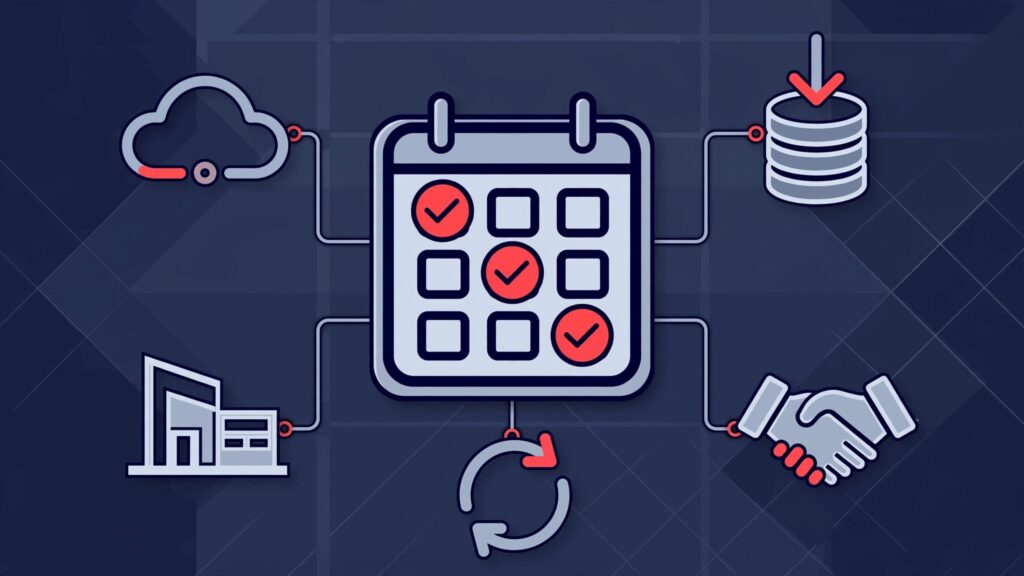
A business continuity plan can look complete and still fail on the day you need it. The failure usually isn’t a missing document. It is unclear ownership, old assumptions, or recovery steps nobody has practiced.
Business continuity testing turns a plan into evidence. It tells you whether the business can keep serving customers, paying people, protecting data, and making decisions when a system, vendor, or facility fails.
A good schedule makes continuity work visible and builds operational resilience before pressure makes every gap more expensive.
Key takeaways for business continuity testing
- Test the business processes that would hurt most if they stopped, not every system with equal intensity.
- Use recovery time objectives and recovery point objectives to set the pace and scope of each exercise.
- Start with tabletop exercises, then move toward technical restores and controlled cutovers where business risk justifies them.
- Track failures as named corrective actions with owners, deadlines, evidence, and executive decisions.
- Give the board a short view of test cadence, open risks, vendor dependencies, and risk acceptance decisions.
Build a business continuity testing schedule around business impact
Don’t start with “How often should we test?” Start with “What breaks first, and what would it cost us?”
Your business impact analysis should prioritize processes by business impact. Pair it with a risk assessment that considers likelihood and concentration risk. Then identify each process owner, system, dependency, fallback method, and recovery target.
That may include order intake, customer support, payroll, payments, production scheduling, or regulated reporting. Each process needs a clear owner and a practical recovery path.
Let RTO and RPO set the test standard
Your recovery time objectives, or RTOs, define how long a process can be unavailable. Your recovery point objective, or RPO, defines how much data loss the business can tolerate.
A payroll system with a two-day RTO does not need the same testing pattern as an ecommerce checkout system with a one-hour RTO. Tighter targets require more frequent, realistic evidence. A nightly backup job is not proof of data recovery if transactions must be restored to the last 15 minutes.
Effective bcp testing connects the business continuity plans maintained by different business units. Disaster recovery is the technical recovery component, while continuity testing also checks people, decisions, suppliers, and customer commitments.
NIST SP 800-34 Rev. 1 supports an organization-defined testing frequency based on risk and business needs. It does not mandate a universal annual test. Its contingency planning guide also supports testing individual recovery elements before testing the complete plan.
Use a calendar people can run
A workable annual schedule often has several layers:
| Cadence | Test type | Accountable owner | Success criteria | Evidence and documentation | Remediation deadline | Escalation path |
|---|---|---|---|---|---|---|
| Monthly | Readiness check for contacts, backup jobs, vendor changes, and open actions | Process owners | Contacts, dependencies, and jobs are current, with no unassigned items | Check results, exceptions, ownership changes, and documentation | Within 10 business days | Escalate overdue or unowned items to the continuity lead |
| Quarterly | Tabletop exercise for a high-impact scenario | Business unit owner | Decisions, roles, communications, and fallback steps meet defined targets | Scenario record, decisions, process gaps, and communication issues | Within 30 days | Escalate unresolved decisions to the executive sponsor |
| Twice yearly | Controlled restore, service recovery, and parallel tests | IT recovery lead and process owner | Selected services and data meet RTO and RPO targets, with dependencies working as expected | Recovery times, restoration results, system logs, and test records | Within 15 business days | Escalate missed targets or failed dependencies to technology and business executives |
| Annually | Cross-functional end-to-end test for the highest-impact business process | Executive sponsor and process owner | End-to-end performance meets RTO, RPO, and customer commitments | Results, decisions, issue log, and business owner sign-off | Within 30 days | Escalate missed commitments to executive leadership |
This is a starting point, not a compliance ritual. Compliance requirements may raise the cadence, but they are a baseline, not the whole testing strategy.
Trigger an earlier test after major system changes, new cloud platforms, or outsourced providers. Do the same after ransomware, cyber attacks, critical supply chain failures, acquisitions, leadership changes, or other disruptive events.
Choose the right test before asking for proof
Testing should build in difficulty. You wouldn’t send an unprepared team into a full cutover test. That is like asking someone to run a marathon before training for a mile.
Start with discussion, then test written steps, technical recovery, and controlled disruption. Each stage answers a different proof question.
Tabletop exercises test judgment
A tabletop exercise is a structured conversation. Leaders walk through a realistic disruption and make decisions in sequence.
For example, you might begin with a ransomware notice at 8:15 a.m. Then ask: Who declares an incident? Who speaks to customers? Can operations process orders manually? Who approves a shutdown? When does outside counsel join?
Tabletops are fast, low-risk, and useful for exposing vague decision rights. They test judgment and communications, not technical restoration. They don’t prove that systems restore, phones work, or vendors respond.
Walkthroughs and technical tests expose real friction
A walkthrough assigns people their actual steps. Walkthrough exercises test whether people can follow the written process.
Teams open the plan and locate emergency procedures. They call contact numbers, find credentials, confirm vendor escalation paths, and follow recovery steps without disrupting production.
Technical tests validate system restores, backup systems, and dependencies. Parallel tests validate recovery while production continues. A fully functional cutover test deliberately moves a workload, service, or process to its backup arrangement. It creates stronger proof, but it needs executive approval, customer safeguards, rollback criteria, and a clear stop point.
The documentation package should capture scenario injects, attendance, decisions, timestamps, system outputs, rollback results, and unresolved findings.
NIST SP 800-53 Rev. 5 links these practices to CP-3 contingency training, CP-4 contingency plan testing, CP-6 alternate storage sites, CP-7 alternate processing sites, and CP-10 system recovery. NIST contingency controls distinguish checklists, tabletop and walkthrough activity, simulations, parallel testing, full-interrupt testing, alternate-site testing, and comprehensive exercises. They also call for testing at an alternate processing site and recovering systems to a known state, as outlined in the NIST contingency testing controls.
Turn the test schedule into an operating rhythm
A test schedule fails when it lives in one person’s spreadsheet. It works when it supports the business continuity plan and joins the leadership rhythm. That rhythm should include operations, vendors, technology, and risk governance.
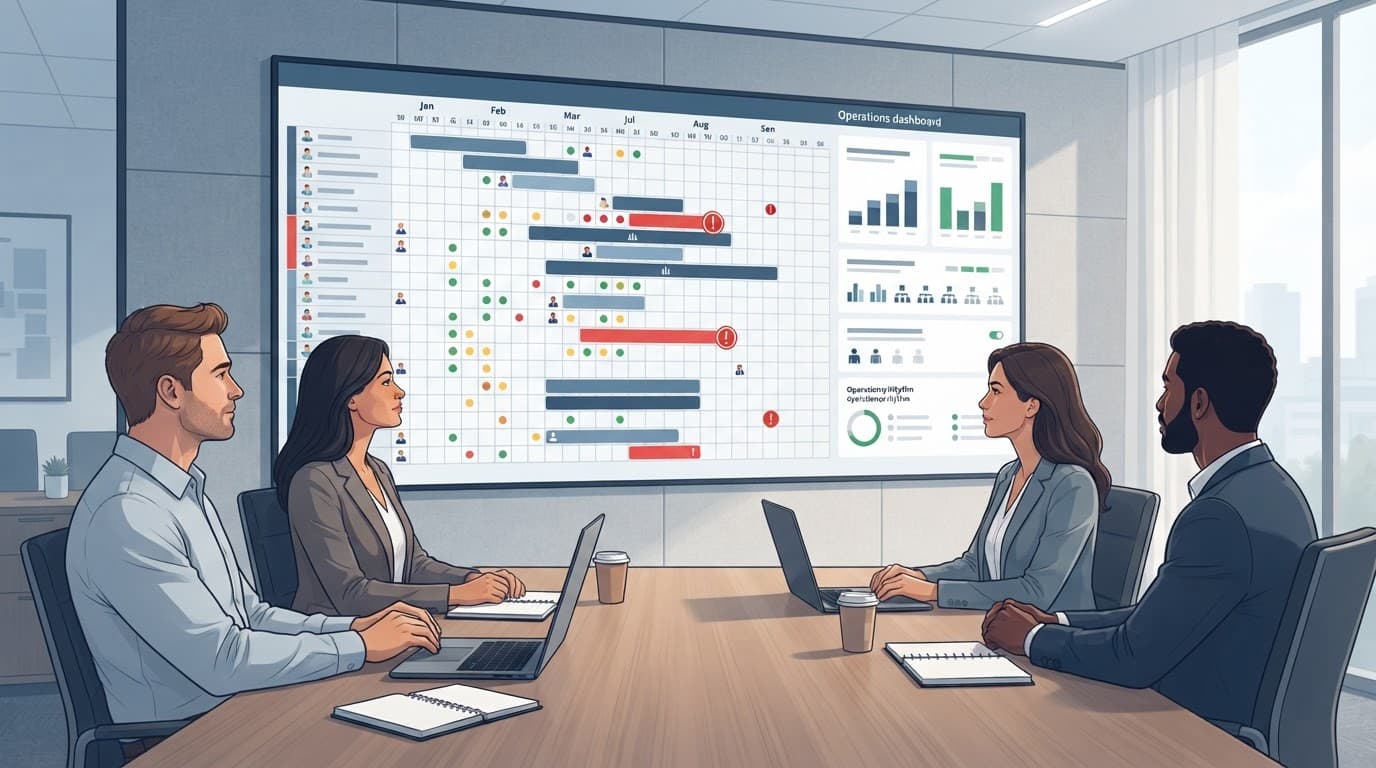
Assign one executive sponsor. Name a recovery manager for each major test. Then name owners for the affected process, test coordinator, technology, communications, legal, finance, and critical suppliers. One person can hold more than one role in a smaller company, but accountability must still be visible.
Put each test on a leadership calendar
For each exercise, record the scenario, affected process, dependencies, owner, participants, stakeholders, and test level. Also record RTO/RPO targets, success criteria, evidence, remediation deadline, executive decision, and escalation threshold.
Use controlled documentation to capture approvals, attendance, injects, results, and sign-off. Add a short pre-test review two weeks before the event. Confirm access, contacts, vendor participation, and business constraints at that review.
Use parallel tests only when they share dependencies or decision points. Schedule a fully functional annual exercise when a higher-risk process needs live validation of people, technology, and supplier decisions.
Include the schedule in your broader technology continuity planning. Use it to connect exercise decisions with incident response readiness, disaster recovery, and cyber insurance renewal. These efforts can have different owners, but they should share dates, assumptions, and evidence.
Completion is not the goal. The goal is evidence of improvement, with a clear decision, an owner, and proof that the next test will be stronger.
Run a network outage walkthrough that produces usable evidence
An unexpected network outage is a practical scenario for a business continuity plan because it tests more than servers. It tests communications, authority, customer promises, manual workarounds, and vendor response.
Start with the first 30 minutes
State the scenario clearly: the primary internet connection fails at 10:00 a.m., the backup circuit does not fail over, and cloud phone service is intermittent.
Ask the team to act in sequence:
- At 10:00, identify the outage and begin technical triage.
- At 10:05, assign the decision owner. Separate technical incident response from the decision to declare a continuity event.
- At 10:10, locate and follow the emergency procedures, including the relevant call tree, alternate communications process, and manual operating instructions.
- At 10:15, test the backup circuit and backup systems, then verify whether staff can use an alternate communications path. Treat the walkthrough as evidence of readiness, not proof of failover. In a later controlled test, move communications or a network service to the backup arrangement and confirm it is fully functional.
- At 10:20, measure downtime by department, identify which work stops first, and list manual workarounds and customer commitments at risk.
- At 10:25, use the vendor escalation path and confirm who can authorize emergency changes.
- At 10:30, apply stop conditions. Pause if testing could affect live transactions, corrupt data, or create a safety risk. Decide whether to continue, escalate, or declare the event.
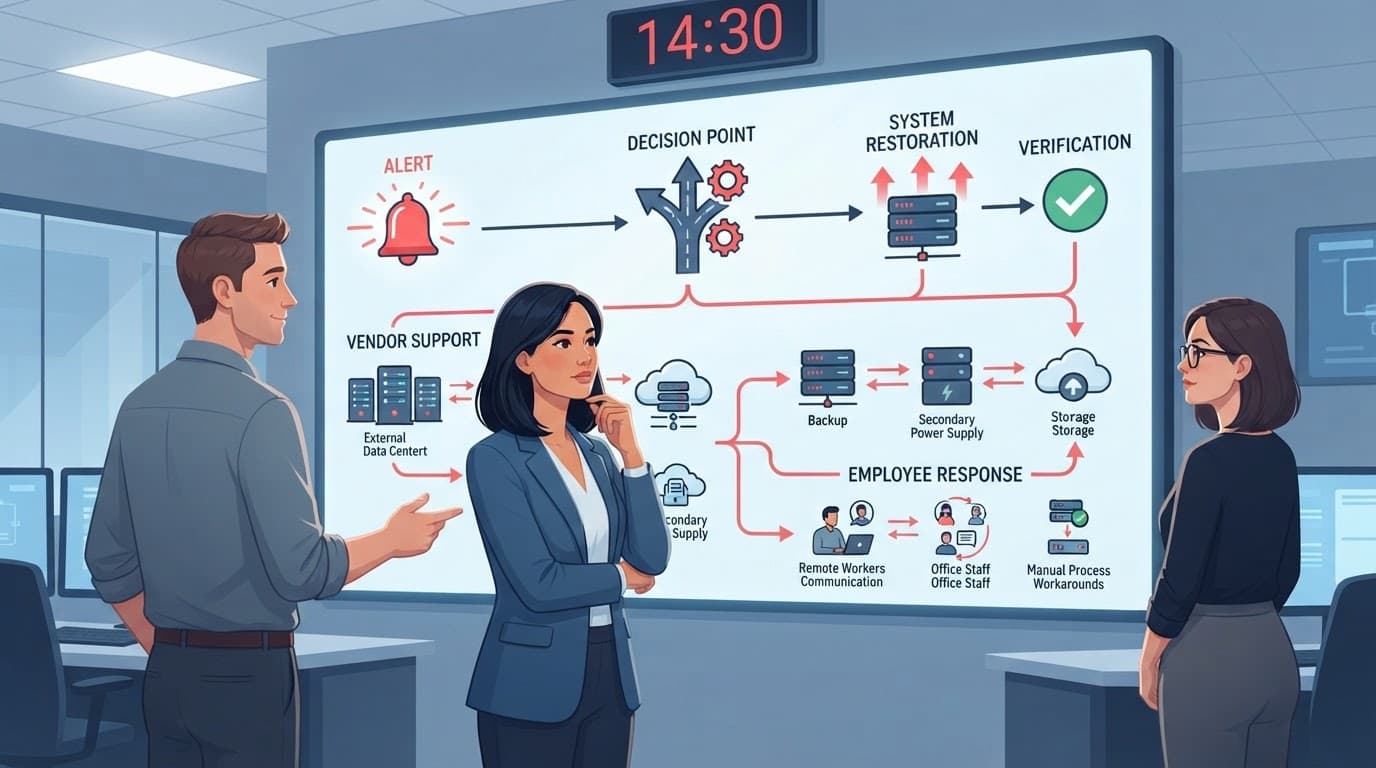
A walkthrough should also test the vendor’s role. Call the support line. Use the escalation path in the contract. Confirm who can authorize emergency changes. Record the vendor’s actual response time, not its promised response time.
Capture facts, not impressions
Close the exercise with four questions: Did the business meet its RTO? Did data loss stay within the RPO? Did people know their role? Did the fallback process work without creating new risk?
Create documentation that includes the declaration timestamp, actual vendor response time, availability of alternate channels, manual transaction count, customer impact, the RTO/RPO result, and a named follow-up owner.
“Communication needs improvement” is too vague to manage. “The customer service manager had no current vendor escalation number” is an actionable finding.
Treat corrective actions as business commitments
The post-test meeting is where many continuity programs lose value. The room agrees there were gaps. Someone takes notes. Then daily work takes over.
Every finding needs a precise condition, business consequence, severity, owner, due date, funding decision, required evidence, validation reviewer, and escalation date. Store closure evidence with the test record as documentation, including screenshots, restore logs, call records, timestamps, approvals, or retest results. Put each item in the same leadership view as major projects and material risks.
Separate fixes from decisions
Some failures have straightforward fixes. Update a call list. Rotate expired credentials. Restore a missing backup job.
Others need an executive decision. A failure found in a fully functional exercise may require executive remediation or a compensating control. You may need to accept a longer recovery time, fund a second connectivity provider, replace a weak vendor, or reduce dependence on one application. Don’t let those items disappear inside an IT task list.
Use a simple status model: open, accepted with an expiry date, in progress, ready for validation, or closed. Escalate overdue critical findings at the next leadership review, and escalate them sooner when they threaten a committed recovery target.
Track whether action plans reduce exposure and support continuous improvement. Compare restoration time, unresolved findings, vendor participation, and repeated failures across tests. These trends show where funding and prioritization are needed.
Test vendor dependencies before the vendor outage
Your business continuity plan is only as strong as the suppliers carrying your essential work. A cloud provider, payroll firm, payment processor, or managed service provider can become a single point of failure. So can a logistics or identity platform.
Start with a risk assessment that classifies vendors by business impact, substitutability, data access, geographic concentration, and recovery commitments. Map fourth-party dependencies and concentration risk across the supply chain, especially among critical service providers.
Ask each critical vendor what happens if its service fails, its support channel is unavailable, or a supplier goes down. Your internal business continuity plans must align with supplier plans and contract commitments. Then run a controlled, fully functional, end-to-end vendor outage or failover exercise, not merely a questionnaire. Can you export the data you need? Can you work manually? Who can communicate with customers? Does the contract support the recovery commitment you have made internally? Capture export tests, response-time records, alternate-provider tests, contract escalation confirmation, and manual-processing results.
This is more than vendor management. It is third-party technology risk that can affect revenue, customer trust, and your ability to operate.
Give leaders a short, honest risk view
Board-ready reporting should show business impact and crisis management decisions, not a list of technical logs. Include:
- The scenarios tested, processes affected, and business exposure.
- RTO and RPO results against target, including any impact on recovery commitments.
- Material gaps, named owners, deadlines, residual risk, and overdue corrective actions.
- Critical vendor participation, unresolved dependencies, and evidence supporting each result.
- Decisions required from management, the board, or affected stakeholders.
For a stronger reporting structure, use the same discipline described in technology risk oversight for boards. Keep supporting documentation in the board evidence pack. Directors need visibility into exposure, ownership, deadlines, decisions, and tradeoffs. They don’t need a tour of backup settings.
When continuity testing exposes a leadership gap
Repeated missed tests are rarely a scheduling problem alone. They may indicate a leadership gap or an inability to prioritize material exposure identified in a risk assessment.
An executive sponsor sets direction and resolves conflicts across operations, vendors, security, and finance. The recovery manager coordinates the schedule, process owners validate procedures and evidence, and the technology leader connects those decisions to the business continuity plan. Leadership must approve test risk, fund remediation, set escalation thresholds, and ensure evidence reaches the right decision-makers.
During a major disruption, the technology leader also supports crisis management and keeps accountability clear. A fractional CTO can bring the executive technology leadership needed to establish the schedule and keep corrective work moving. An interim CTO may fit when the leadership seat is open or an outage has exposed weak control. If cyber risk is the immediate concern, a fractional CISO can work alongside that leadership.
The title matters less than the ownership. Your technology leader for a growing company should connect business technology strategy, technology risk oversight, and operational reality. Fractional CTO services can help when you need that structure without rushing into a full-time hire.
Frequently asked questions
How often should you test a business continuity plan?
Review it at least annually and after major changes to systems, vendors, locations, processes, or recovery needs. Business continuity testing should become more frequent when impact is high, RTO/RPO pressure is tight, changes are material, or prior tests reveal weak evidence.
What is the difference between a tabletop and a full functional test?
A tabletop tests decisions, roles, and communication through a guided scenario. A technical test checks whether people, technology, alternate arrangements, and vendors can perform under controlled disruption. Define success before the exercise, then compare results with required recovery times and service levels.
Who should own the business continuity test schedule?
An executive sponsor should own the business outcome and set escalation thresholds. A recovery manager can coordinate the schedule, evidence, and follow-up, while process owners, technology leaders, security, operations, finance, communications, and vendors own assigned actions. Escalate overdue actions to the sponsor with an owner, deadline, and stated impact.
Build proof before you need it
A business continuity plan gives you a starting point. Business continuity testing builds evidence that the business can carry its promises under pressure.
For bcp testing, start with your most important process. Set the recovery target. Name the owner. Run the exercise, then review the result. Keep open items visible until they’re closed.
If your schedule, ownership, or reporting still feels scattered, Get an Executive Technology Clarity Check and bring the real continuity risks into view before an outage does it for you. That clarity turns remediation and retesting into continuous improvement.