

Growth often exposes technology problems that were easy to ignore at a smaller stage. The systems that felt efficient a year ago now seem to create friction, slow down projects, and drain resources.
If you have a nagging feeling that you are pouring money into technology without seeing a clear return, you are not imagining things. It is a common symptom of a deeper issue: a gap in technology leadership. When technology decisions are not directly tied to business goals, chaos and cost creep in.
When Growth Exposes a Leadership Gap

You can feel the problem in the daily operations. Projects get stuck in a loop of delays. Your best engineers spend more time fighting fires than building new features. The business has become so reliant on a few key vendors or one overworked internal expert that it has become a serious risk.
These are not just isolated tech problems. They are signs of a strategic leadership vacuum at the executive level.
The Real Cost of a Missing Strategy
When a company outgrows its informal "figure it out as we go" approach to technology, the pain is felt across the entire organization. This friction shows up in a few distinct ways:
- Slower Execution: Without a clear technical vision, teams work in circles. This leads to constant rework and missed deadlines that put the brakes on growth.
- Weaker Control: Vendor priorities quietly shape your roadmap and budget. You are left with bloated, expensive contracts and a loss of control.
- Rising Risk: A single point of failure emerges. Only one person truly understands a critical system, creating a massive key-person dependency.
- Eroding Confidence: Board members and investors start asking tough questions about risk and spending. You do not have the solid, data-backed answers they need.
These issues create a hidden "coordination tax" that silently drains profitability and makes every decision a struggle. The problem is not that your team is not working hard. It is that no one is connecting technology decisions to concrete business goals. What you need is strong technology leadership to restore order.
The core issue is that operational chaos is the direct result of a leadership gap. Without an executive-level guide, your technology function defaults to reactive, expensive, and fragile.
What a CTO Consultant Does
A CTO consultant is purpose-built to fill this exact gap. Their job is not to fix a single server or write code. It is to install a calm, predictable operating rhythm that allows the business to scale reliably.
They bring the executive presence needed to untangle complexity, establish clear ownership, and make sure every dollar spent on tech is pushing the business forward. This often includes assessing the engineering team’s structure. To scale capabilities effectively, many businesses Hire LATAM developers to build more robust, cost-effective teams.
Ultimately, a CTO consultant’s role is to turn technology from a source of friction into a predictable system for execution. They provide the strategic clarity needed to stop the fire drills and regain control.
What a CTO Consultant Is (and Is Not)
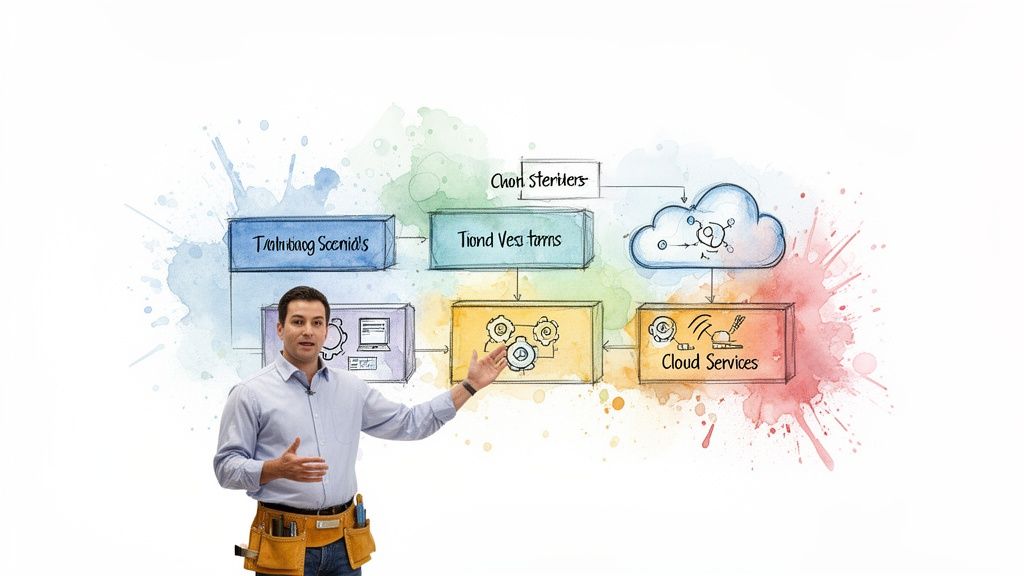
When technology causes more problems than it solves, many leaders look for the wrong kind of help. The word "consultant" often suggests someone who fixes a specific, isolated issue. A genuine CTO consultant is not a hands-on technician. They are an executive-level strategist focused on connecting your technology to your business goals.
Their job is not to patch a server or handle daily IT support tickets. Their purpose is to build a durable operating system for how your company makes technology decisions, manages risk, and gets work done.
To grasp this, it helps to compare their role against what an IT consultant is, whose work is often more tactical. An IT consultant might set up a new system. A CTO consultant maps out the entire strategic landscape.
A Strategist, Not a Technician
A CTO consultant is a business leader first and a technologist second. They operate at the executive level, translating technical jargon into plain business language for the board and leadership team.
Think of them as the general contractor for your technology function. A good general contractor does not hammer every nail. They create the blueprint, manage subcontractors, and ensure the project is built to code, on schedule, and within budget.
That is what a CTO consultant does for your technology. They bring order to chaos by creating the high-level strategy that all other technical work must align with.
A CTO consultant’s primary deliverable is not a fixed piece of software. It is a calm, predictable, and defensible system for running the technology side of the business.
Defining the Role by What It Is Not
Getting this distinction right is critical. Hiring a strategist for a technician's job leads to frustration. Asking a technician to solve a strategy problem is a recipe for failure.
A CTO consultant is not:
- A Managed Service Provider (MSP): An MSP handles day-to-day operational fires like helpdesk tickets. A CTO consultant designs the strategy and governance that prevent those fires.
- A Project-Based Developer: An agency builds a specific app. A CTO consultant builds the systems for execution so all future projects are delivered more predictably.
- A Compliance Auditor: An auditor checks boxes at a single point in time. A CTO consultant builds the underlying controls that make compliance a natural, ongoing result of well-run operations.
Understanding these differences is the first step to hiring the right help. You can explore the specifics in our guide to CTO responsibilities and duties. The goal is to ensure every dollar you invest in technology directly supports your company's growth, control, and resilience.
Choosing Your Engagement: Fractional, Interim, or Advisory
Not all technology leadership gaps are the same. The right solution depends on the specific problem you are trying to solve. While hiring a full-time executive is a massive commitment, a CTO consultant provides a more flexible path.
The key is picking the right engagement model. The three main options are Fractional, Interim, and Advisory. Each is designed for a very different business situation. Getting this choice right means you will not over-invest in the wrong help or under-resource a critical issue.
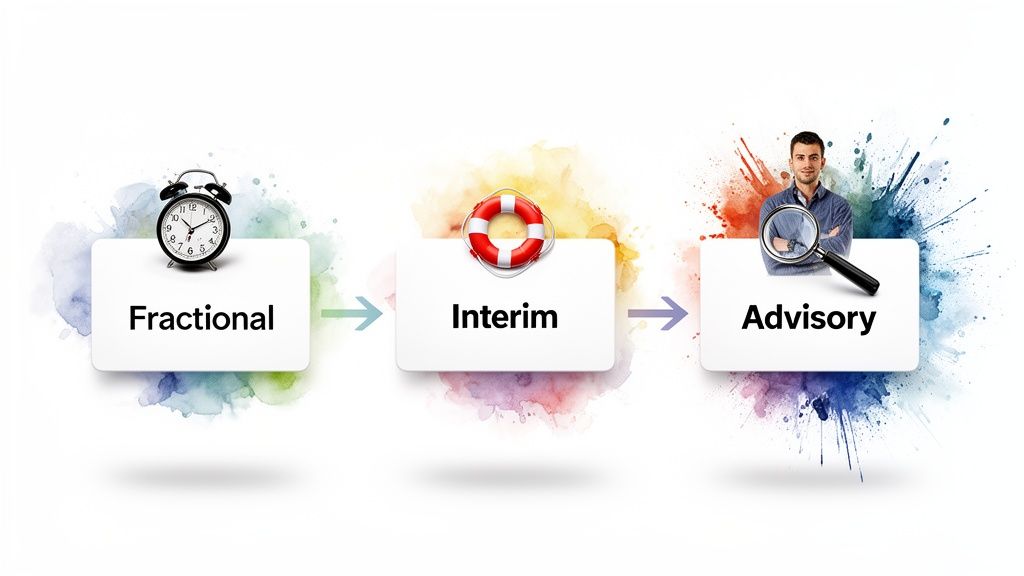
The Fractional CTO: Consistent Strategic Leadership
A Fractional CTO is your answer when you need ongoing, executive-level tech leadership but are not ready for a full-time hire. This is the most common model for growing businesses where technology is getting more complex.
A Fractional CTO acts as a permanent, part-time member of your leadership team. They bring a calm, consistent operating rhythm and make sure your tech roadmap is always aligned with your business goals.
- Best For: Companies needing long-term strategic direction, better execution, and risk management without the full-time executive cost.
- Typical Duration: 6-12+ months, usually on a retainer.
- Core Focus: Building a durable system for technology decisions, managing the team, and reporting to the board.
This model is about building stability and driving long-term value. For a deeper look, see our guide on what a fractional CTO does.
The Interim CTO: A Bridge During Transition
An Interim CTO is who you call to fill a sudden leadership void, like when a full-time CTO leaves unexpectedly. Their main job is to bring stability, keep momentum going, and prevent chaos.
They are a safe pair of hands to keep the ship running while you search for a permanent replacement. They often help define the new role and vet candidates.
- Best For: Organizations that lost their tech leader and need immediate, full-time coverage to maintain business continuity.
- Typical Duration: 3-6 months, often full-time at first and then tapering off.
- Core Focus: Stabilizing the technology department, de-risking the transition, and helping lead the search for a permanent hire.
The Advisory CTO: High-Stakes Expert Guidance
An Advisory CTO engagement is for short-term, high-stakes problems where you need a sharp, objective expert opinion. This is not about running the department day-to-day. It is about getting targeted analysis on a single, critical decision.
You bring in an advisor when the cost of getting a decision wrong is incredibly high. Their job is to provide a clear, well-researched recommendation and then step away.
Common situations include:
- Preparing for technical due diligence before a sale or acquisition.
- Evaluating a major new platform or vendor contract.
- Assessing cybersecurity posture for the board.
- Validating a new technology strategy.
This is a focused engagement designed to answer a specific question with authority and clarity.
CTO Consultant Engagement Models at a Glance
This table helps leaders understand the differences between Fractional, Interim, and Advisory CTO consultant models.
| Engagement Model | Best For | Typical Duration | Core Focus |
|---|---|---|---|
| Fractional CTO | Ongoing strategic guidance without a full-time salary. | 6-12+ months | Long-term strategy, team leadership, and process building. |
| Interim CTO | Filling a sudden leadership gap and ensuring stability. | 3-6 months | Crisis management, operational continuity, and hiring support. |
| Advisory CTO | Getting an expert opinion on a specific, high-stakes decision. | Days or weeks | Targeted analysis, due diligence, and risk assessment. |
This clear distinction is why demand for flexible expertise has skyrocketed. The global CTO-as-a-Service market, valued at $280 million in 2026, is projected to hit $557 million by 2033. This trend shows a shift toward on-demand executive talent. You can find more statistics on the rise of flexible CTOs to see how it is shaping modern business.
Why Ignoring This Problem Is So Expensive
Putting off the decision to hire strategic tech leadership can feel like saving money. In reality, it is one of the most expensive mistakes a growing business can make.
Those small friction points you see today quietly compound, bleeding profitability and grinding growth to a halt. It is the hidden price you pay when teams build constant workarounds, systems do not talk to each other, and you spend your days putting out fires.
Where the Real Costs Hide
These hidden costs show up in real ways, hitting your balance sheet and robbing you of opportunities. The drag on your business is happening in three key areas:
- Slower Speed to Market: When your tech is a tangled mess, every project takes longer and costs more. Those delays are a gift to your competitors.
- Lost Credibility: Ambiguous answers and foggy reporting kill trust. Your board and investors lose confidence when they cannot get a straight answer on tech risks. This can jeopardize your next funding round or a successful exit.
- Escalating Chaos: Without clear tech ownership, minor issues snowball into emergencies. This constant state of reaction burns out your best people and makes it impossible to build momentum.
The Million-Dollar Hiring Mistake
Seeing this chaos, many founders jump to the conclusion that they need a full-time CTO. But rushing that hire is a massive financial gamble.
A bad full-time CTO hire can easily cost a company between $500K and $1M in severance, lost productivity, and recruitment fees. It sets the business back by at least a year.
A CTO consultant lets you plug in executive-level expertise right away, without that enormous risk. It is a strategic move to stop the bleeding and de-risk your entire technology function.
The total compensation for a full-time US CTO can easily exceed $400,000. It is no wonder that engagements with fractional CTO consultants have jumped 57% since 2022. You can get started at a fraction of a full-time salary, representing a 75%+ saving while avoiding the catastrophic risk of a bad hire. You can explore more data on CTO service models to see how the numbers stack up.
Ignoring a leadership gap is not saving you money. It is an active decision to let hidden costs pile up until they become a crisis. A CTO consultant is not an expense. It is an investment in reclaiming the time, money, and focus your business is losing every day.
What to Expect in the First 90 Days
So, what actually happens when you hire a CTO consultant? A good consultant follows a proven plan to deliver real value, fast.
The first 90 days are not about fixing everything at once. That is a recipe for failure. It is about building momentum by systematically installing calm control. This journey is broken down into three distinct phases.

The goal is to shift your organization from reactive firefighting to predictable, forward-looking execution.
Days 1-30: Achieve Clarity
The first month is dedicated to discovery. You cannot fix a problem you cannot see clearly. The consultant's priority is to map out your technology world and translate it into a language that makes sense for the leadership team.
This is more than a list of software. It is about digging deep to understand the real story.
- Mapping the Ecosystem: We identify every critical system, track how data flows, and get a handle on all vendor relationships.
- Clarifying Ownership: We figure out who is actually responsible for each piece of the tech puzzle, especially when roles are blurred.
- Understanding Decision-Making: We observe how tech decisions are really being made, who approves them, and how they are communicated.
By the end of this phase, the consultant should have pinpointed the top three bottlenecks and the top three risks. This creates a shared, fact-based view of reality.
The output here is not a massive report. It is a short, prioritized list of the exact problems causing the most pain, giving you a clear target for immediate action.
Days 31-60: Install a Calm Operating Rhythm
Once you have a clear picture, the next step is to build the system that will do the fixing. The second month is about installing a predictable operational cadence.
The aim is to make technology execution feel less like a series of emergencies and more like a well-run factory.
Here is what that looks like:
- Establishing Clear Owners: We formally assign a single point of accountability for every critical system. No more finger-pointing.
- Creating Predictable Cadences: We set up simple weekly or bi-weekly meetings for making decisions and tracking progress.
- Developing Transparent Reporting: We build straightforward, board-ready dashboards that connect technology work to business outcomes.
This new rhythm ensures that decisions stick and leadership has a reliable view of what is happening. It is how you stop the endless cycle of fire drills that burn out your best people.
Days 61-90: Deliver Early Wins
With clarity and rhythm in place, it is time to deliver. The final phase is about translating groundwork into tangible results. The CTO consultant will now lead the execution of a few high-impact projects.
These are not massive transformations. They are small, targeted initiatives designed to provide immediate relief and show that progress is possible.
These early wins often focus on neutralizing a critical risk, untangling a painful process, or cutting an unnecessary cost. By getting points on the board in the first 90 days, the consultant proves their value and builds the confidence needed to tackle the larger roadmap ahead. This focused approach is a key reason the CTO-as-a-Service market is projected to hit $557M by 2033. You can learn more about the financial impact of strategic CTOs and how their guidance affects company performance.
How to Hire the Right CTO Consultant
Hiring a CTO consultant is not like filling most other roles. It is easy to look for a tech wizard. But that is not what you need.
You are looking for a strategic partner who can translate dense technology problems into plain English and make sure every tech dollar pushes the business forward. The wrong person gets excited about new tools. The right one gets excited about fixing broken processes.
Questions to Separate Strategists from Technicians
Your interview process should feel less like a tech quiz and more like a strategy session. A true strategic advisor will lean into these questions. A pure technician will look uncomfortable.
How They Create Clarity
A great consultant’s first job is to demystify your technology. They must cut through the jargon and show non-technical leaders what is really going on.
Use these questions to see if they are a good communicator:
- How will you make our entire technology landscape understandable to the non-technical leadership team in the first 30 days?
- Describe a time you had to explain a complex technical risk to a board. How did you ensure they understood the business impact?
- What is your process for identifying the three biggest sources of friction or waste in a company’s technology operations?
A great consultant does not just present data. They build a shared understanding. Their first deliverable is a clear, concise story about what is happening, why it matters, and what to do next.
How They Drive Execution
Clarity is useless without action. The consultant must install a calm, predictable system for getting things done.
Probe their process with these questions:
- Describe your process for establishing an operating rhythm for tech execution. What meetings do you run, and who attends?
- How do you create clear ownership and accountability when it has been ambiguous for years?
- Walk me through how you would manage our key vendor relationships to ensure they are delivering value, not just driving up costs.
How They Connect to Business Value
Every tech initiative must map back to business goals. A strong CTO consultant is obsessed with profitability, risk reduction, and competitive advantage.
See how business-focused they are with these questions:
- How do you ensure that technology initiatives are directly connected to improving profitability or market share?
- Our company may be preparing for a diligence process in the next 18 months. What steps would you take to get us ready?
- What are the first three metrics you would put in place to help our leadership team know if our technology spend is producing real value?
These questions are designed to get to the heart of a candidate’s philosophy. Do they see their role as solving isolated technical puzzles, or as building a stronger, more resilient business? Their answers will tell you everything.
Common Questions About Working With a CTO Consultant
Even after realizing they need strategic tech leadership, most founders have a few practical questions about the budget, the team, and what a "win" looks like.
Let’s tackle the most common questions head-on.
How Much Does a CTO Consultant Cost?
The price comes down to the engagement type. For a specific project, consultants often charge by the hour or a fixed fee, typically between $300 to $500+ per hour.
For fractional or interim work, you are usually looking at a monthly retainer. This can range from $8,000 to $25,000+ per month, based on business complexity and time commitment.
While that may sound like a big number, the fully-loaded annual cost of a full-time CTO can easily top $400,000. A consultant gives you executive-level firepower for a fraction of the cost and with far more flexibility. Contracts often start with a three to six-month term, giving you an agility you cannot get with a permanent hire.
We Already Have an IT Director. Why Would We Need a CTO Consultant?
This question gets to the heart of a crucial distinction. Your IT Director keeps the business running day-to-day. They manage current systems and support your team. Their job is to "keep the lights on."
A CTO consultant operates at a different altitude. Their focus is on executive-level strategy. Their job is to "design the next version of the house."
Think of it this way: Your IT Director is the plant manager, making sure the factory is running today. The CTO consultant is the industrial engineer redesigning the assembly line for a more profitable future. They are not competing. One enables the other.
The consultant provides the strategic roadmap that lets your IT Director shift from constant firefighting to focused, proactive work.
How Is Success Measured?
Success is measured in business results, plain and simple. The real proof is felt across the company.
In the first 90 days, success looks like this:
- Less Leadership Friction: Your leadership team spends noticeably less time being pulled into tech emergencies.
- Clear Ownership: The finger-pointing stops because every critical system has a designated, accountable owner.
- Predictable Reporting: Board updates become calm and consistent, building confidence with clear progress reports.
Long-term success is even more concrete. It is projects delivered faster. It is vendor costs becoming more predictable. It is seeing morale improve as your team escapes the chaos. Success is when technology stops being a source of frustration and becomes the reliable growth engine it was always meant to be.
If you are tired of paying the "coordination tax" that comes from a lack of clear tech leadership, let's talk. A CTO Input Clarity Call is a simple, direct conversation. We will help you identify the biggest bottlenecks and risks in your organization and map out a clear path forward. If we can help, we will show you exactly how. If not, you will walk away with a much clearer picture of what you need to do next.