
A data breach is simple to describe and hard to live through. It involves unauthorized access to information someone should not see, copy, or share. That could be a lost laptop, a compromised email account, or a system quietly siphoning data in the background.
For justice organizations, a data breach response plan for justice organizations is not the same as a corporate playbook. As nonprofit legal organizations, you hold high-stakes personal information and sensitive data such as immigration status, incarceration history, survivor shelter locations, youth records, and medical notes. Your systems are often fragile and scattered, and many leaders already feel one bad incident away from a crisis. The goal is not perfection. It is a clear, calm way to act when something goes wrong.
Key takeaways
- Focus on people first in risk management, not just systems or headlines.
- Name a small incident response team and give them a simple, written playbook.
- Document every step so you can meet legal, ethical, and funder duties.
- Turn each security incident into a chance to tighten security and clean up systems.
Key Goals of a Data Breach Response Plan for Justice Organizations
A good data breach response plan for justice organizations is about direction, not heroics. You are creating a script your leaders can follow on one of the hardest days of their work life.
At its core, the plan should help you act fast, protect people, and meet your obligations to clients, staff, funders, regulators, and the bench. It needs to sit inside the reality of justice work, where intake of personal information happens in one tool, case notes in another, and “real” personal information often lives in personal email or shared drives. Many organizations are already wrestling with technology challenges for legal nonprofits; a breach plan reduces the risk that this fragility becomes a disaster.
Protect people first, then systems and reputation
In justice spaces, a cybersecurity incident is not only about identity theft or credit monitoring. It can affect someone’s safety from an abuser, parole status, immigration relief, or eligibility for public benefits.
Your plan should push one fast question to the front: who could be harmed by this, and how. From there, it should guide you to short-term protection steps, such as safety planning with a survivor, urgent case review for a person in detention, or quick outreach to a community partner whose affected individuals might now be at risk.
Act fast, but in a controlled and documented way
The first few hours matter. You want people to pause, not panic. A named breach response team, with backups, lets you move quickly without chaos.
Your plan should include a one-page checklist that covers who to call, what to shut off, and how to start an incident log. Clear notes on “who did what, when, and why” help you speak with regulators, funders, cyber insurance, and your board later, without guessing.
Meet legal, ethical, and funder obligations
Justice organizations sit under privacy laws, bar rules, grant conditions, and sometimes court orders, including state laws. Many of these frameworks expect notice when certain kinds of data are exposed.
A written plan lets you follow a path instead of scrambling. It should point to your legal counsel, summarize key notification deadlines, and remind you to check relevant guidance, such as data protection best practices for nonprofits or your own ethics rules, before you send notices to protect your nonprofit legal work.
Step-by-Step Data Breach Response Plan for Justice Organizations
This is a simple, chronological path that a mid-sized justice nonprofit can use and adapt.
Prepare your breach response team and playbook before trouble hits
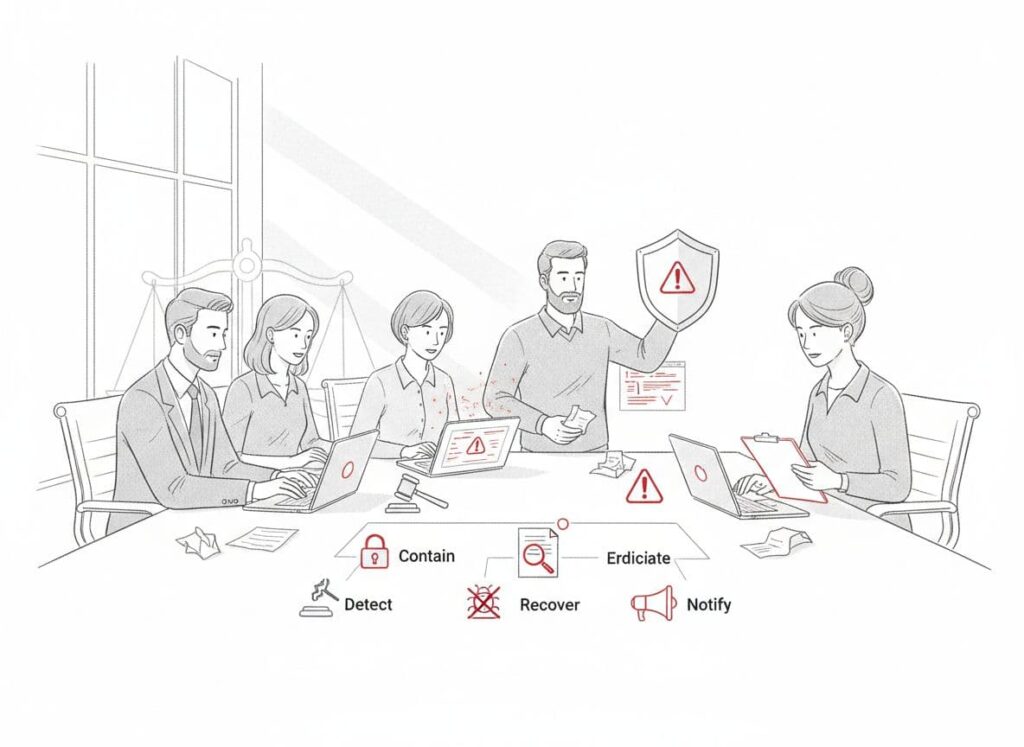
Name your incident response team as a small core group: an executive leader, operations or tech lead, communications lead, legal or privacy contact, a board liaison, and HR if staff data is in play. For each role, write down who backs them up if they are away.
Create a one-page “first hour” checklist, print it, and store it offline with key phone numbers. Keep a longer playbook in your shared drive. This prep should connect to your broader strategic tech roadmap for legal nonprofits so incident response is part of how you modernize, not a side project.
What to do in the first 24 hours after a suspected breach
Keep the language simple and easy for anyone on the team to follow.
- Pause and activate the team. Stop normal work on the affected system. Call or text your breach team.
- Initiate containment without deleting evidence. Disable accounts, reset passwords, or disconnect devices from the network to support a forensic investigation. Preserve data logs and do not wipe or reformat systems yet.
- Call key partners. Reach out to your cyber insurance carrier, a breach coach, outside counsel, or a trusted security advisor. Share only what you know so far.
- Start an incident log. Note dates, times, people involved, and facts found. Use plain language.
- Brief leadership and a board contact. Give a short summary, explain what you are doing, and set a time for the next update.
It is fine not to know the full scope. In day one, your job is to stop the bleeding, keep records, and show that adults are in the room.
If you need a deeper procedural template, resources like the Sedona Conference incident response guide can inform your internal playbook, while you still tailor it to justice work.
Assess who is at risk and plan trauma-informed communication
Once the situation is stable, shift to “risk of harm” for affected individuals whose sensitive data might be involved.
Look at three things: what kind of data was exposed, how sensitive it is, and how likely it is to be misused. Justice-specific red flags include immigration status, survivor shelter addresses, sealed or expunged records, youth information, and details that could reveal someone’s cooperation with law enforcement.
Your notices to affected individuals should be clear, kind, and free of technical jargon. Explain what happened, what information might be involved, what you are doing about it, and how you will support them. Assume some readers are already under stress or threat. Align your client notices with any messages to regulators, funders, partners, and privacy laws like GDPR or CCPA so your story is honest and consistent.
Recover systems, close security gaps, and learn from the incident
Once urgent risk is handled and notifications are moving, focus on repair.
High-level steps often include:
- Restoring systems from clean backups
- Changing passwords and turning on multi-factor authentication
- Tightening access to especially sensitive data
- Conducting remediation to fix the root cause, whether that is a vendor weakness, a misconfiguration, or a staff habit
Watch your systems closely for a period after the incident. Then hold a post-incident review with staff and leadership. What worked. What was slow or confusing. Which policies, tools, vendors, or vulnerabilities need to change.
Use this moment to strengthen security basics and align them with your broader legal nonprofit technology services, rather than only putting out the fire.
Turning a Breach Scare Into a Stronger Justice-Focused Organization
A breach or near miss does not have to define your organization. It can become a turning point in how you treat information, power, and risk.
A simple, living data breach response plan for justice organizations should sit next to your financial controls, HR policies, and program quality work. Keep it under attorney-client privilege to protect internal evaluations. It is part of governance. Over time, you can line it up with your risk register for personal information, audit schedule, and the privacy expectations that show up in grants, court partnerships, and state laws. Real incidents in courts and advocacy nonprofits over the past year have shown that organizations that prepare, document, and train bounce back faster and protect more people.
Build your breach plan into training, vendor choices, and governance
Fold the plan into annual staff training and new staff onboarding so it is not a mystery and staff can deliver a consistent story to stakeholders. Make sure vendor contracts speak to incident response, including notice timelines and cooperation when something goes wrong.
Bring your breach plan into board risk discussions with legal counsel, especially if you already struggle with scattered systems and “shadow IT.” The same work that cleans up vulnerabilities in fragile data flows will also make response easier. Keep these discussions under attorney-client privilege to protect internal evaluations. If you want to see what this looks like in practice, review client case studies for legal nonprofits that show how better systems and governance reduce both chaos and the risk of data loss.
Key takeaways and quick wins you can start this month
You do not need a large budget to make progress in 30 days. You can:
- Name a breach response lead and small team.
- Draft a one-page first-hour checklist and print it.
- Update contact details for cyber insurance, outside counsel, IT vendors, and your board chair.
- Test restoring one key system or shared drive from backup.
- Schedule a 60-minute tabletop exercise with senior staff to walk through a simple cybersecurity incident scenario.
Each of these steps sends a message to staff, boards, and communities: we take confidentiality seriously, and we are getting ready before something happens.
FAQs: Data Breach Response Plans for Justice Organizations
How big does a breach need to be before we activate the plan?
If you suspect that sensitive information may have been accessed by someone who should not see it, activate the plan. It is better to “overreact” in a security incident than to miss the early hours of a major one.
What if we do not have a cyber insurance policy?
You can still respond well. Focus on containment, documentation, legal advice, and clear communication. As part of your after-action work, consider engaging a breach coach or cyber insurance carrier, and decide whether cyber insurance should become part of your broader risk strategy.
Can we handle a breach without a full-time CIO or CISO?
Yes, many justice nonprofits handle breaches involving personal information without one. The key is to assign clear roles, build relationships with outside experts ahead of time, and keep your playbook in plain language that non-technical leaders can use.
How often should we update our data breach response plan?
Review it at least once a year (including to stay aligned with frameworks like GDPR), and after any real incident or major system change. Each review should be short and focused so the plan stays usable.
Conclusion
Justice organizations do not need a giant security team to be ready. They do need senior-level guidance, a simple plan, and the discipline to test and improve that plan as systems and risks change. A data breach response plan for justice organizations works best when it fits your mission, your size, and the communities you serve.
CTO Input helps leaders do exactly that. As a fractional technology and cybersecurity partner, we map your current systems, create a clear breach playbook with containment strategies, run tabletop exercises with staff, boards, and stakeholders to practice crisis communication, and tie this work into a wider modernization roadmap. Visit https://www.ctoinput.com to see how we support justice-focused organizations, explore deeper guidance on technology, data, and digital risk on the CTO Input blog at https://blog.ctoinput.com, and book a technology strategy call to put breach readiness on your board’s agenda this year. The challenge is simple: before your next grant cycle or audit, decide that data protection will be part of how you show care for the people you exist to protect and avoid consequences like identity theft.