

Technology is supposed to help you scale. Instead, it often becomes the reason everything feels harder.
You sit in the weekly leadership meeting, and the update sounds familiar. A project is delayed, but nobody can name the underlying blocker. Spend is up, but the business case is still fuzzy. A vendor says the issue is in another system. Your operations lead is frustrated. Your finance lead wants cleaner answers. Your board wants confidence. You leave the meeting with more motion, not more control.
That is not an IT problem.
It is a leadership operating problem. More specifically, it is an executive technology leadership problem.
If ownership is unclear, decisions do not stick. If decisions do not stick, teams build workarounds. If teams build workarounds, reporting turns vague, risk spreads, and every important initiative starts depending on heroics. You do not need more activity. You need a business operating system for technology.
When Technology Becomes the Source of Friction
Growth exposes weak joints.
What worked when the company was smaller starts to fail under pressure. The CRM no longer matches finance reporting. The ERP implementation keeps slipping. Security is treated as a side conversation until an insurer, customer, or board member asks a hard question. People start chasing status because no one trusts the last update.
What this looks like in real life
A CEO hears three different versions of the same project story.
The head of operations says the team is waiting on IT. The IT lead says the vendor still owns part of the timeline. The vendor says internal approvals are the primary issue. All three are partly right. None of them own the whole result.
That is the coordination tax.
You pay for it in slower launches, repeated meetings, duplicated tools, and key staff who become human routers for decisions that should already be settled. The business keeps moving, but it moves with friction.
Common signs show up fast:
- Updates stay vague: You hear activity, not outcomes.
- Ownership is fuzzy: Several people are involved, but no one is accountable.
- The same problems keep returning: Different projects, same failure pattern.
- Security becomes reactive: Training and basic habits lag until pressure rises. If your team needs a practical baseline, this short guide on how employees can improve workplace cyber security is useful because it focuses on simple behaviors leaders can reinforce.
- Priority changes break delivery: Every urgent request knocks another commitment sideways.
Why leaders feel this before they can name it
Most senior leaders do not first describe this as architecture debt, governance drift, or vendor dependency.
They describe it as exhaustion.
They are tired of asking, “Who owns this?” They are tired of hearing that everything is high priority. They are tired of spending real money and still feeling blind. They are tired of one strong operator holding the whole thing together through force of will.
Key takeaway: If technology updates create more anxiety than clarity, your issue is not effort. Your issue is operating control.
The mistake is treating this as a staffing problem alone. Sometimes you do need stronger people. But just as often, good people are trapped inside a bad system. Without executive technology leadership, technology becomes a pile of tools, projects, and vendors. It does not become a reliable execution engine for the business.
What Is Executive Technology Leadership
Most companies think they have technology leadership because somebody runs IT.
That is too low a bar.
Keeping laptops working, renewing Microsoft 365, managing tickets in Jira or ServiceNow, and maintaining core systems are all necessary. None of that, by itself, creates executive technology leadership. That is operations support. Useful, but incomplete.
Executive technology leadership is the layer that turns technology from a support function into a business control system.

The shift already happened
This is not a theoretical idea. In a 2025 Deloitte survey of over 600 US technology leaders, 80% said their roles had expanded beyond traditional IT management to drive core business objectives like revenue growth, and 65% of CIOs reported directly to the CEO, showing how central executive technology leadership has become in the C-suite (Deloitte).
The message is simple. Senior technology leaders are no longer expected to just keep systems running. They are expected to shape growth, execution, and risk posture.
Having IT versus having executive technology leadership
The difference is easier to see side by side.
| Area | Informal tech management | Executive technology leadership |
|---|---|---|
| Primary owner | IT director or senior admin | C-level or executive-grade technology leader |
| Main focus | Tickets, uptime, device support | Business priorities, decision rights, speed-to-value |
| Planning style | Reactive | Intentional and cross-functional |
| Vendor role | Advises and often steers choices | Supports decisions the business owns |
| Reporting | Activity updates | Business impact, risk, spend, and progress |
| Escalation pattern | Fire drills and exceptions | Defined ownership and operating rhythm |
| Success measure | Systems available | Work finishing, risk visible, value legible |
This is why many businesses feel stuck even with competent technical staff. They have administration, support, and delivery. They do not have a governing model.
The role is less important than the operating system
Do not get trapped in title debates.
You can call the person a CTO, CIO, VP of Technology, fractional executive, or interim leader. The important question is whether someone is doing the work of executive technology leadership.
That work includes:
- Clarifying ownership: Every critical system, vendor, and decision domain has a named owner.
- Linking spend to outcomes: Technology budgets support growth, resilience, and operational targets.
- Making tradeoffs explicit: Teams know what matters now, what waits, and why.
- Creating legible reporting: Leaders can see progress, risk, and drift without chasing updates.
- Protecting control: Vendors inform delivery. They do not own the roadmap without clear business oversight.
If you want a grounded view of what that senior role includes, this breakdown of CTO responsibilities and duties is a useful reference point.
Executive technology leadership is not a person with technical authority. It is a business operating system that makes technology decisions clear, enforceable, and useful.
When that system exists, meetings change. So does execution. You stop asking for heroic rescues and start seeing accountable delivery.
The Hidden Costs of Unclear Technology Ownership
Unclear ownership does not stay contained inside the technology team.
It leaks into finance, operations, customer experience, compliance, and board oversight. Leaders often notice the frustration first, but the bill is larger than the frustration.
The obvious cost is waste. The bigger cost is drag.
You can usually spot direct waste. Redundant software. Overlapping vendors. Projects that keep consuming budget without finishing.
The harder cost to see is drag.
Drag shows up when teams delay a launch because system dependencies are murky. It shows up when finance cannot reconcile spend cleanly across platforms. It shows up when a senior operator spends half a day finding out who approved a workflow change in Salesforce, NetSuite, Monday.com, or a custom application. The business pays in speed, confidence, and attention.
You also pay in people.
Strong employees burn out when they live inside a loop of vague priorities, repeated escalations, and unresolved dependencies. Good managers start working as translators between tools, teams, and vendors instead of running their function.
Delegation debt is real
A large part of this problem comes from over-delegation.
Executives often hand too many critical decisions to vendors, implementation partners, or system integrators because the internal team is overloaded or no one wants to slow the project down. That feels efficient in the moment. It creates delegation debt later.
MIT Sloan warns against deferring “too much to outside parties”, because it erodes internal control over roadmaps and creates risk. That risk becomes especially serious in acquisition settings, where vendor lock-in can damage valuation and expose weak governance (MIT Sloan).
That is the vendor control problem.
The vendor did not steal power. Your company leaked it.
What unclear ownership usually causes
The pattern is predictable:
- Roadmaps drift outward: The vendor’s release cycle starts shaping your priorities.
- Approvals become symbolic: Internal leaders approve plans they do not fully control.
- Risk gets harder to prove: You cannot show clean ownership for systems, data, or security decisions.
- Diligence gets messy: Buyers, auditors, and insurers ask simple questions that require painful detective work.
- Profitability suffers unnoticed: Work takes longer, coordination gets heavier, and expensive staff spend time on avoidable confusion.
If a vendor can answer more clearly than your executives can about what your systems are doing next, you have an ownership problem.
This matters now because growth, regulation, and scrutiny punish ambiguity. When the company is small, people patch over weak ownership with relationships and memory. As complexity rises, that stops working.
The deeper issue is not that vendors are bad. Good vendors are valuable. The issue is that external expertise should support your operating model, not replace it. If your business cannot explain who owns the decision, who carries the risk, and how progress is tracked, you are operating on trust alone.
That is not leadership. That is exposure.
A Practical Governance Model for Calm Execution
You do not fix this by writing a thicker policy binder.
You fix it by installing a simple operating rhythm that people can run. Good executive technology leadership is boring in the right way. It makes ownership clear, creates a dependable cadence, and turns reporting into something leaders can trust.
A Deloitte study of more than 1,175 global tech leaders identified the Engineer persona as especially effective because these leaders build and optimize business-technology capabilities, reduce rework, use data-driven management, and work across the C-suite to create value (Deloitte Insights).
That is the model to copy. Not genius. Not heroics. Systems.
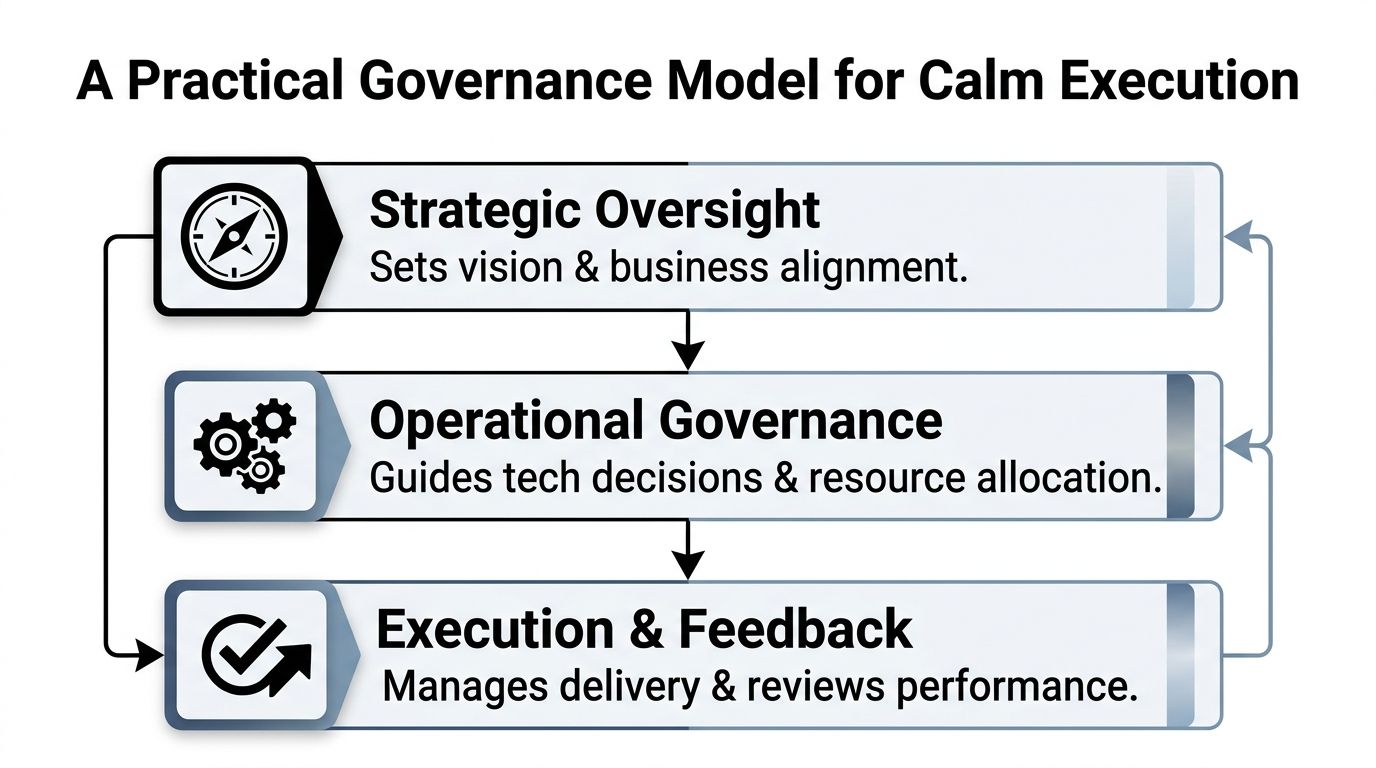
Pillar one is clear ownership
Start with a simple rule. Every critical system, vendor relationship, integration, and recurring technology process gets one accountable owner.
Not a committee. Not “IT and ops.” Not “the vendor is handling that.”
One owner.
That owner does not need to do all the work. The owner needs to answer four questions without guessing:
- What is this for
- Who depends on it
- What risks matter most
- What decision is pending
This one change removes an enormous amount of drift.
Most companies already have system lists inside spreadsheets, procurement tools, or a PSA platform. The problem is they are administrative inventories, not ownership maps. Turn the list into a control tool.
Pillar two is calm cadence
Once ownership is named, install rhythm.
Weekly and monthly routines beat irregular escalation every time. The point is not more meetings. The point is fewer ambiguous ones.
A workable cadence often looks like this:
| Rhythm | Purpose | Participants | Output |
|---|---|---|---|
| Weekly | Review blockers, decisions, near-term risks | Tech owner, ops lead, business stakeholders | Clear decisions and due dates |
| Monthly | Review spend, roadmap movement, vendor issues, risk status | Executive team and relevant leaders | Priorities reset and escalation choices |
| Quarterly | Reconfirm strategy, ownership gaps, major dependencies | Senior leadership and board-facing roles | Direction, investment, governance proof |
Tip: If the weekly meeting cannot end with named owners and dates, it is still a status meeting, not a governance meeting.
A strong cadence also keeps security and vendor management inside the same operating conversation. They should not sit in a separate drawer until something goes wrong.
If you need a broader framework for governance design, this guide to best practices for IT governance gives a useful companion view.
Pillar three is legible reporting
Most executive reporting on technology is too narrative.
It sounds informative, but it hides drift. “Making progress.” “In testing.” “Waiting on feedback.” “Working through issues.” None of that helps a board, CEO, or COO decide what to do next.
Legible reporting should answer:
- What changed since the last review
- What is blocked
- What risk increased or decreased
- Where spend is moving without value
- Which decisions leadership must make now
This does not require a giant BI initiative. A disciplined dashboard in Power BI, Tableau, Excel, or even a clean operating sheet can work if owners keep it current and leaders use it.
A practical setup can be built internally. Some companies also bring in an outside executive operator to establish the model. CTO Input is one example of a fractional leadership option that helps businesses map ownership, install operating rhythms, and create board-defensible reporting when internal capacity is thin.
When these three pillars are working together, technology stops being a vague support category. It becomes inspectable. That is what calm execution looks like.
Common Failure Modes and Why Leaders Miss Them
Most failed technology leadership efforts do not fail because people were lazy.
They fail because leaders solve for the wrong thing.
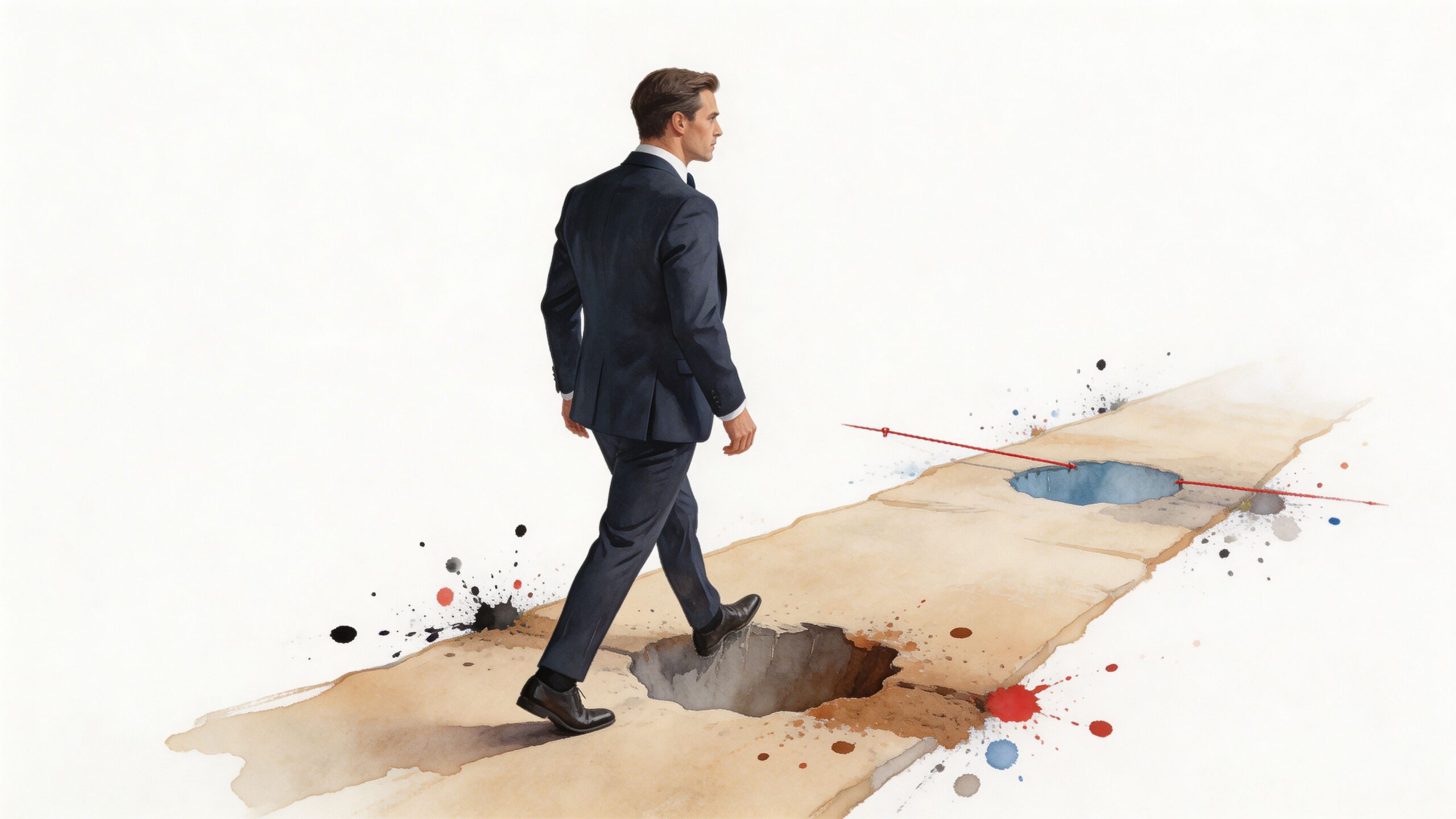
ABI Research argues that leaders need a structured framework for continuous visibility and alignment. Without it, companies fall into reactive decision-making, let vendor roadmaps and internal politics shape strategy, and pay for that with project drag, burnout, and wasted investment (ABI Research).
That is the pattern behind most failure modes.
Failure mode one is hiring for technical brilliance alone
A smart technologist is not automatically an executive leader.
You can hire someone who understands cloud platforms, cybersecurity controls, and software delivery in detail, then discover they cannot align finance, operations, product, and outside partners around a single decision path. The company ends up with better technical opinions and the same leadership confusion.
Executive technology leadership requires business judgment. Not just technical depth.
Failure mode two is buying tools to avoid fixing decisions
This one is everywhere.
A company adds a project management suite, a new reporting layer, another cybersecurity platform, or another integration product because the current system feels messy. Sometimes the tool is fine. The decision model is still broken.
If ownership is unclear, Asana will not save you. Neither will Monday.com, Smartsheet, Workday, Okta, or a new managed service contract.
Tools can support order. They do not create it.
Failure mode three is mistaking motion for progress
A large technology team can produce a lot of visible motion.
Tickets close. Sprints run. Vendors present. Dashboards update. Slack channels stay active. None of that proves the business is getting what it needs.
Ask harder questions:
- Did this work reduce rework
- Did it simplify execution
- Did it lower concentration risk
- Did it improve leadership visibility
- Did it protect or advance a business priority
If the answer keeps coming back as “sort of,” you are measuring effort, not value.
Failure mode four is delegating leadership to a committee
Committees are useful for input. They are weak instruments for accountability.
When a cross-functional group owns everything, nobody carries the whole burden of making the decision stick. The result is familiar. Deferred calls, half-decisions, side agreements, and project drift.
Practical rule: Use committees for perspective. Use named owners for outcomes.
Why leaders miss these traps
Senior leaders often miss these failure modes because the company still appears to function.
Revenue still comes in. Customers are still served. Teams still work hard. The pain arrives as slow erosion, not immediate collapse. A major launch slips. An audit gets uncomfortable. A key employee leaves. A board question exposes uncertainty. A diligence process becomes far more painful than expected.
That is when leaders realize they did not have an execution system. They had a collection of people compensating for one.
You do not need to panic about that. You do need to stop normalizing it.
Your First 90 Days to Restore Control
Do not start by trying to fix everything.
Start by making reality visible. Then install control where it matters most.
That discipline matters even more now because the demand for strategic technology oversight is rising. The technology leadership market is projected to grow at a 31.10% CAGR, while 45% of CIOs are increasing technology spending year over year. Their top investment priorities are AI/ML at 63%, data analytics at 50%, and cybersecurity at 43%, which tells you where executive attention and capital are moving (HTF Market Intelligence).
If your business is increasing spend without increasing control, you are going the wrong direction.
Days 1 to 30 make the current reality legible
The first month is not about transformation. It is about visibility.
You need a map before you need a roadmap.
Focus the first 30 days on these actions:
- Map systems and vendors: Build one working list of core platforms, integrations, outsourced partners, and major contracts.
- Name owners: Not the names on org charts alone. Name the people who make or influence decisions.
- Trace decision rights: Identify where approval lives, where recommendations come from, and where vendors have too much control.
- Create a simple risk register: Capture visible failure points, single points of failure, major dependencies, and known reporting gaps.
- Find the top chaos sources: Usually a few systems, handoffs, or vendors create most of the friction.
This is the stage where many leaders realize they have been operating from fragmented truths. Procurement has one list. IT has another. Security has a third. Finance has spend data that does not line up cleanly with either.
That mismatch is useful. It shows you where control has already slipped.
Days 31 to 90 install the operating rhythm
Once the operational environment is visible, start running the business differently.
A simple sequence works:
- Assign accountable owners for critical systems and recurring decisions.
- Stand up a weekly governance meeting with a short, fixed agenda.
- Build the first version of an executive dashboard.
- Decide which risks need immediate reduction and which need watchful containment.
- Resolve one or two obvious simplification wins.
Those wins matter.
Shut down a redundant tool. Clarify one broken approval path. Reassign one vendor relationship to a real internal owner. Consolidate one reporting stream. The point is to prove that the new system changes daily life, not just slide decks.
A structured plan helps. If you want a simple planning format, this guide on how to Create a Winning 30-60-90 Day Plan for Success is a useful model for turning broad intent into visible milestones.
What to include in the first dashboard
Keep it plain. The first version should show only what leadership needs to act.
Include:
- Priority initiatives: Status, blocker, owner, next decision
- Material risks: Description, severity, owner, mitigation status
- Vendor dependencies: Which outside parties are shaping delivery
- Spend watchpoints: Areas where cost is rising without clear business value
- Decision queue: The few unresolved choices that need executive attention
If you need a clearer picture of how a temporary senior operator can lead this setup, this guide to the first 90 days with a fractional CTO is a practical reference.
Tip: Your first 90 days should produce control, not perfection. If you can name owners, run a cadence, and show risk clearly, you are already moving out of chaos.
The goal is not to produce a polished transformation story by day 90. The goal is to make the company easier to run.
What Better Looks Like From Chaos to Confidence
The change is easier to feel than to describe.
Meetings get shorter. Updates get sharper. People stop speaking in vague, defensive language because the ownership map is real and the reporting is legible. Leaders stop chasing status through side conversations and Slack threads because the operating rhythm already surfaces what matters.
You can see control
A board question no longer triggers a scramble across inboxes and vendor portals.
Someone opens the dashboard, confirms the owner, shows current status, and explains the next action. That is not flashy. It is a major shift in institutional maturity.
The same thing happens in diligence, audit prep, insurer reviews, and major customer conversations. Instead of trying to reconstruct reality from memory, the business works from an inspectable system.

People get their time back
A healthy operating model reduces hidden dependence on a few heroic individuals.
One key person can take time off without everything stalling. A vendor issue does not instantly become an executive fire drill. Operations and finance stop spending so much time reconciling conflicting stories from different systems. Your technical team gets room to fix root causes instead of living inside interruption.
That matters more than most leaders realize.
Calmer teams make better decisions. Better decisions improve speed. Better speed supports growth without the same level of self-inflicted risk.
Leadership confidence changes
The best result is not “better IT.”
It is confidence.
You know who owns the important systems. You know where risk sits. You know which vendors support the plan and which ones are shaping it too much. You know what is delayed, why, and what decision would unblock it.
Better looks like this: no heroics, no mystery, no endless status hunting. Just a business that can move with evidence and intent.
That is what executive technology leadership should create. Not more complexity. More control.
Your Next Step Toward Calm Execution
If technology feels noisy, expensive, or strangely hard to govern, do not treat that as normal growth pain.
Treat it as a systems problem.
Executive technology leadership is not just about filling a role. It is about installing an operating system for ownership, decisions, reporting, and risk. When that system is weak, the business pays in friction. When it is strong, execution gets calmer and trust gets easier to earn.
A practical next step is simple. Identify your top three technology bottlenecks, your top three vendor or security trust risks, and who owns each one today. Most leaders learn a lot just by forcing those answers into the open.
If those answers are still vague, the operating model needs work.
If your business is tired of fire drills, vague updates, and vendor-shaped decisions, CTO Input can help you surface the top bottlenecks, clarify ownership, and outline the first 30 days needed to restore control through a Clarity Call.