

Your programs are growing. Grants are bigger. The tech stack that once held things together is now a tangle of case systems, spreadsheets, and shared drives. Staff feel the strain every day, but no one owns the whole picture.
You know you need senior tech leadership, but a full-time C-level hire feels out of reach. So people start tossing around options: fractional CTO, interim CIO, maybe a virtual something. The labels blur, and the risk of choosing wrong feels heavy.
This guide breaks down fractional cto vs interim cio in plain language, through the lens of justice-focused organizations. The goal is simple: help you match the right short-term leader to the problems you need solved next.
Key takeaways
- A fractional CTO focuses on future tech capabilities, data platforms, and products or tools.
- An interim CIO focuses on current operations, stability, security, and vendor control.
- Choose based on your loudest pain: building something new, or fixing what is breaking.
- Many orgs benefit from both, in sequence, as systems shift from crisis to long-term health.
What A Fractional CTO Actually Does For Your Organization
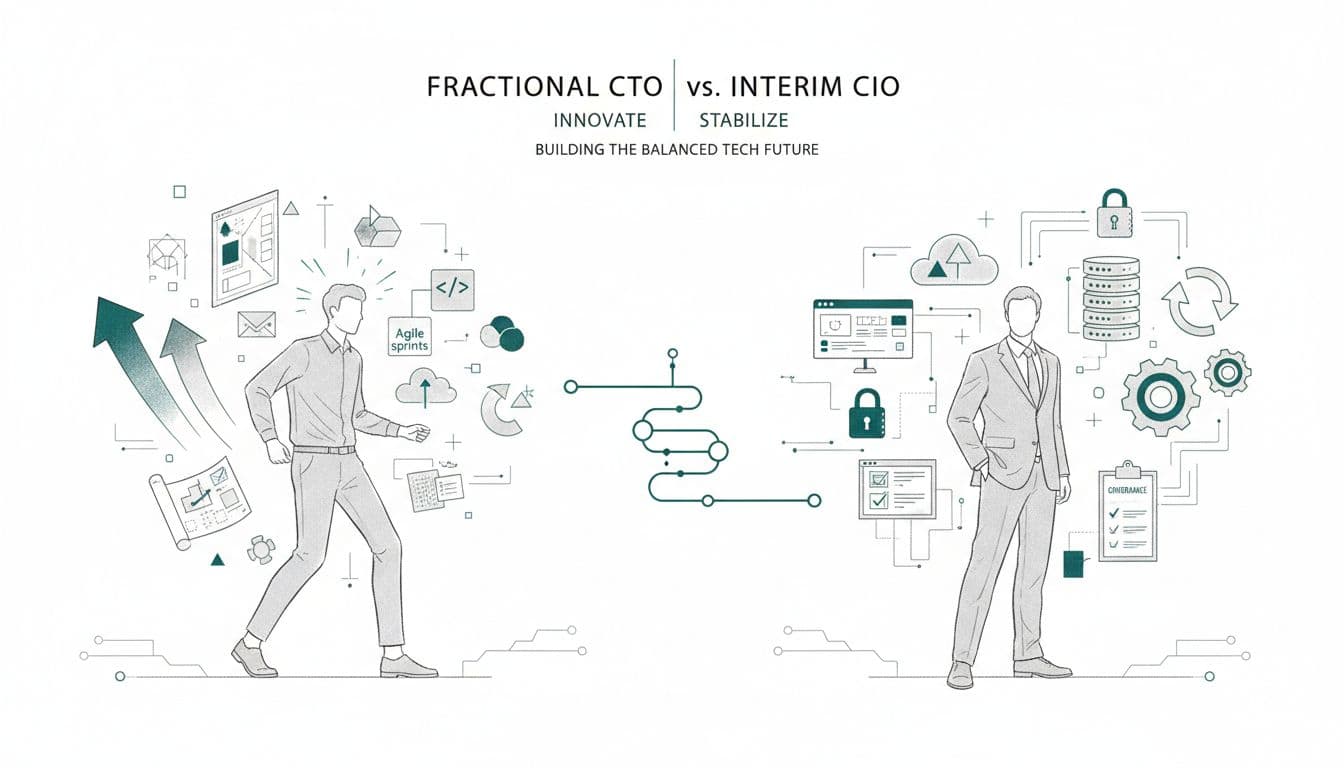
Fractional CTO and interim CIO roles connected through a shared tech roadmap. Image created with AI.
A fractional CTO is a part-time, ongoing technology executive who thinks about where your systems need to be 1 to 3 years from now. Their focus is less on “Why is the VPN slow today?” and more on “What should your data, tools, and integrations look like so your mission can scale?”
For a justice-focused organization, a fractional CTO often:
- Maps how program data, case records, outcomes, and reporting should fit together
- Designs a realistic tech roadmap that respects funding cycles and staff capacity
- Guides choices about core platforms, custom tools, and integrations
- Oversees external vendors so they build what you actually need, not what is easiest for them
- Coaches your internal “accidental tech people” so decisions stop living in one brain
Think of the fractional CTO as the architect of your future tech home. They do not have a hammer in their hand all day. They draw the plans, pick the materials, and watch the build, so you do not end up with three half-finished wings and no plumbing.
This role works best when you are trying to build or re-build something significant: a data warehouse, a network-wide case system, a shared intake tool, or a secure way to share data with partners.
What An Interim CIO Actually Does For Your Organization
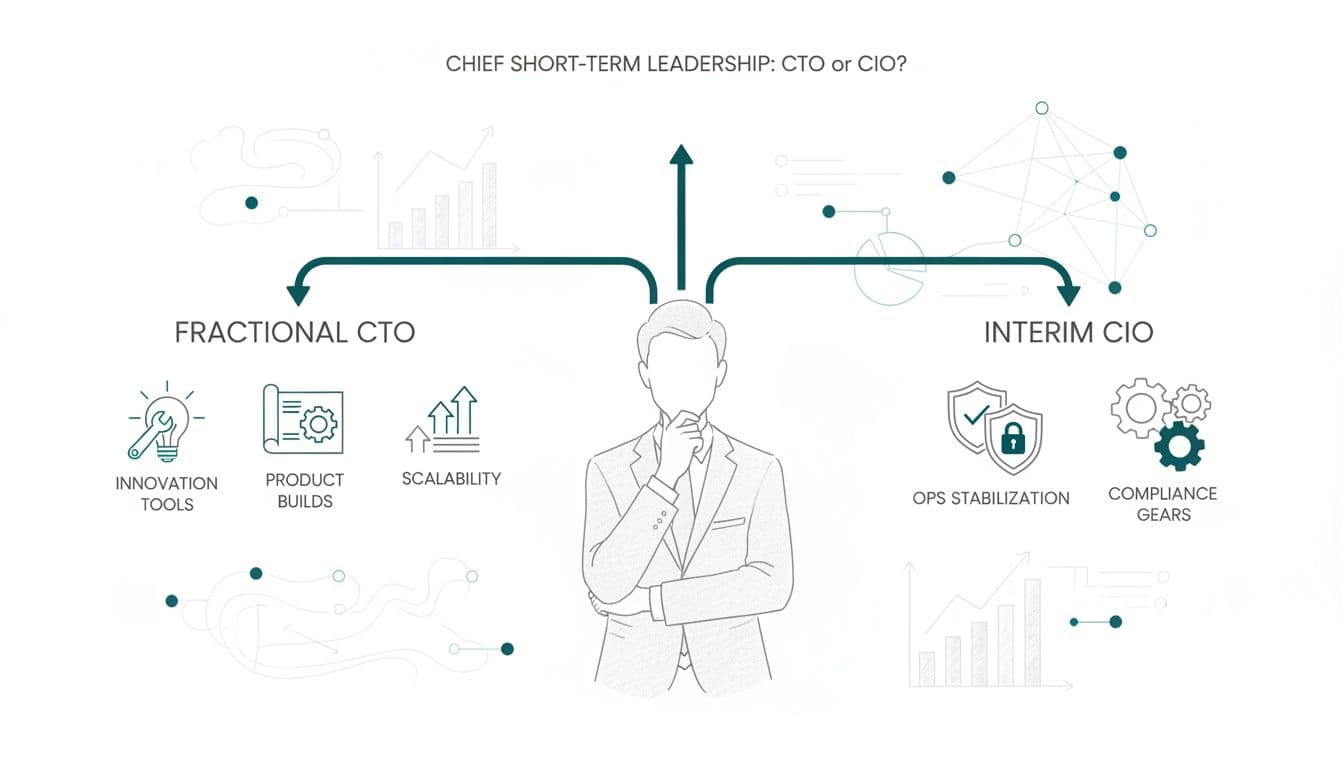
Executive weighing fractional CTO and interim CIO paths for short-term tech leadership. Image generated by AI.
An interim CIO is a temporary, hands-on leader who steps in when technology operations need immediate structure. They keep the trains running, while also tightening risk and untangling responsibility.
For justice organizations, an interim CIO often:
- Takes clear ownership of IT operations, vendors, and budgets
- Stabilizes major projects already in motion, like a case system migration
- Puts basic security and privacy controls in place, then closes obvious gaps
- Sets up ticketing, change control, and simple standards so staff know where to go for help
- Translates between leadership, vendors, and frontline teams so expectations match reality
If the fractional CTO is your architect, the interim CIO is your general contractor. They live in the daily details: which system is down, which vendor missed a deadline, which laptop went missing, which policy the board keeps asking about.
This role fits when things already feel messy or fragile. Maybe your IT director left mid-project. Maybe your board is nervous about data risk. Maybe staff are working around broken tools in ways that put sensitive information at risk. In those moments, an interim CIO can create enough order that you can breathe again.
Fractional CTO vs Interim CIO: Side-By-Side Comparison
At a glance, these roles sound similar. Both sit at the senior table. Both talk about systems, risk, and investment. The difference is where they aim their energy.
Here is a simple way to see the split.
| Dimension | Fractional CTO | Interim CIO |
|---|---|---|
| Main focus | Future capabilities, products, and data platforms | Current operations, reliability, and security |
| Guiding question | “What should we build next, and how should it fit?” | “How do we keep what we have working and safer?” |
| Typical time horizon | 12 to 36 months | 3 to 18 months |
| Day-to-day attention | Roadmaps, architecture, vendor direction, innovation | Tickets, outages, policies, vendor performance |
| Best fit when | You must design or re-design core systems and data flow | You are mid-crisis or mid-project and lack clear leadership |
For many justice-focused organizations, the honest answer to fractional cto vs interim cio is “both, but not at the same time.” You might bring in an interim CIO to stop the bleeding, then shift to a fractional CTO to build a better long-term structure on top of that stability.
How To Decide Which Role You Need Right Now
A simple way to choose is to listen closely to the problems that keep coming up in meetings.
You are mostly building if you hear things like:
“We need one shared view of our data.” “We want to support more partner orgs without drowning.” “Our tools do not fit how our programs actually work.” This points toward a fractional CTO.
You are mostly fixing if you hear things like:
“Systems go down at the worst times.” “No one knows who owns security.” “Our migration is off the rails.” This leans toward an interim CIO.
You are doing both if you hear both sets of sentences in the same week. In that case, you may start with whichever pain is creating more risk for communities and staff, then plan for a handoff. The key is to be honest about capacity: one person cannot design your future stack and run your entire help desk at the same time.
FAQs About Short-Term Tech Leadership
Can one person act as both fractional CTO and interim CIO?
Sometimes, yes, especially in smaller organizations. A senior tech leader can start in a more operational interim CIO mode, then shift into a fractional CTO focus as things stabilize. The risk is spreading them too thin. Make sure you are clear about which hat they are wearing in each phase.
How long do these short-term roles usually last?
For many nonprofits, interim CIO work runs 6 to 12 months, covering a crisis or a major transition. Fractional CTO work often runs longer, since it is tied to a roadmap and multi-year goals. The important part is setting clear checkpoints so you can decide whether to continue, shift scope, or build toward a permanent hire.
Who should the fractional CTO or interim CIO report to?
In most justice-focused organizations, they report to the executive director, COO, or a senior deputy. That keeps technology aligned with mission, not just with finance or facilities. They should also have regular time with program leadership, since that is where gaps and risks show up first.
What should we have ready before bringing in short-term tech leadership?
You do not need a perfect brief. You do need a shared story of your pain points, key systems, and non‑negotiables around security and community trust. A list of current vendors, major grants that depend on data, and any board or funder concerns will help a lot.
How CTO Input Supports The Right Short-Term Tech Leadership
Choosing between a fractional CTO and an interim CIO is partly a technical question, but it is mostly about your mission, timing, and risk. The right answer is the one that reduces staff stress, protects sensitive data, and creates space to plan instead of react.
CTO Input works as a calm, senior partner for justice-focused organizations that need short-term tech leadership without rushing into a full-time hire. That can mean stepping in as an interim CIO to steady fragile systems and vendors, or as a fractional CTO to design a clear, believable roadmap for data and tools.
If you want help sorting out which role you truly need next, and what a realistic first 90 days could look like, you can schedule a conversation with CTO Input and pressure-test your options: schedule a call with CTO Input. The challenge is simple: bring your real constraints, your hardest problems, and your hopes for your staff and partners, and see what kind of tech leadership would actually move those forward.