
In 2026, the pressure is on—technology is now the lifeblood of every organization. The difference between thriving and falling behind comes down to visionary leadership and decisive action.
This guide is crafted for the modern tech executive ready to lead in a rapidly evolving digital world. Here, you will find the insights and practical steps needed to excel.
We will break down the new expectations for tech executives, the leadership qualities you must master, the trends that matter most, and the strategies to build resilient, innovative teams.
Ready to shape the future? Let this essential guide be your roadmap. To learn more and connect with a member of the CTO Input team, visit https://www.ctoinput.com.
Spend a few minutes exploring the rest of the articles on the CTO Input blog at https://blog.ctoinput.com.
The Evolving Role of the Tech Executive in 2025
The landscape for the tech executive in 2025 is defined by rapid transformation and expanding influence. No longer confined to traditional IT oversight, today’s tech executive is central to shaping business direction, driving innovation, and ensuring ethical technology adoption. Mastering this new role is crucial for organizational survival and growth.
Shifting from Technical Expert to Strategic Business Leader
The tech executive is now expected to operate at the intersection of technology and business. Responsibilities extend far beyond IT management, with CEOs relying on tech executives to create and drive digital transformation strategies. According to Gartner, 77% of CEOs plan to increase investment in digital capabilities, underscoring this shift. For more on these evolving responsibilities, see Executive technology leadership explained.
Navigating the Boardroom and C-Suite
Success as a tech executive requires strong cross-functional collaboration and communication. Building influence among non-technical leaders is essential. Those who clearly articulate ROI see 30% more project approvals. The ability to translate technical opportunities into business outcomes is a defining skill for the modern tech executive.
Leading Through Uncertainty and Change
Tech executives must manage hybrid workforces, navigate global talent markets, and adapt to rapid industry shifts. Agile leadership and resilience are vital. Companies with adaptive tech leadership grew twice as fast after the pandemic, proving that a tech executive’s adaptability can be a direct driver of business success.
Talent Strategy and Workforce Evolution
Upskilling teams for AI, cloud, and cybersecurity is now a core responsibility. The tech executive must address the persistent talent gap, as 65% of organizations identify talent shortages as a major challenge. Fostering a culture of continuous learning and embracing diverse talent pipelines are central to workforce evolution.
Aligning Technology and Business Outcomes
A top priority for every tech executive is establishing KPIs that link technology initiatives to revenue, efficiency, and growth. Tech-led process automation, for example, delivers 20 to 40% cost savings. By aligning technology projects with measurable business outcomes, the tech executive ensures technology investments drive real value.
Ethics and Social Responsibility
Responsible AI, data privacy, and sustainability are no longer optional for the tech executive. Developing and enforcing ethical frameworks is vital. Tech executives play a key role in shaping organizational values, ensuring technology serves both business interests and broader societal needs.
How Fractional Leadership Empowers Tech Executives
Not every organization has in-house executive technology leadership. Fractional CTOs, CIOs, and CISOs deliver on-demand expertise and strategic alignment. This model offers cost-effective leadership tailored to evolving business needs. Organizations using fractional leaders report significant operating expense reductions and new revenue streams, demonstrating the value of flexible technology leadership.
To learn more and connect with a member of the CTO Input team, visit https://www.ctoinput.com.
Spend a few minutes exploring the rest of the articles on the CTO Input blog at https://blog.ctoinput.com.
Core Leadership Skills for Tech Executives in 2026
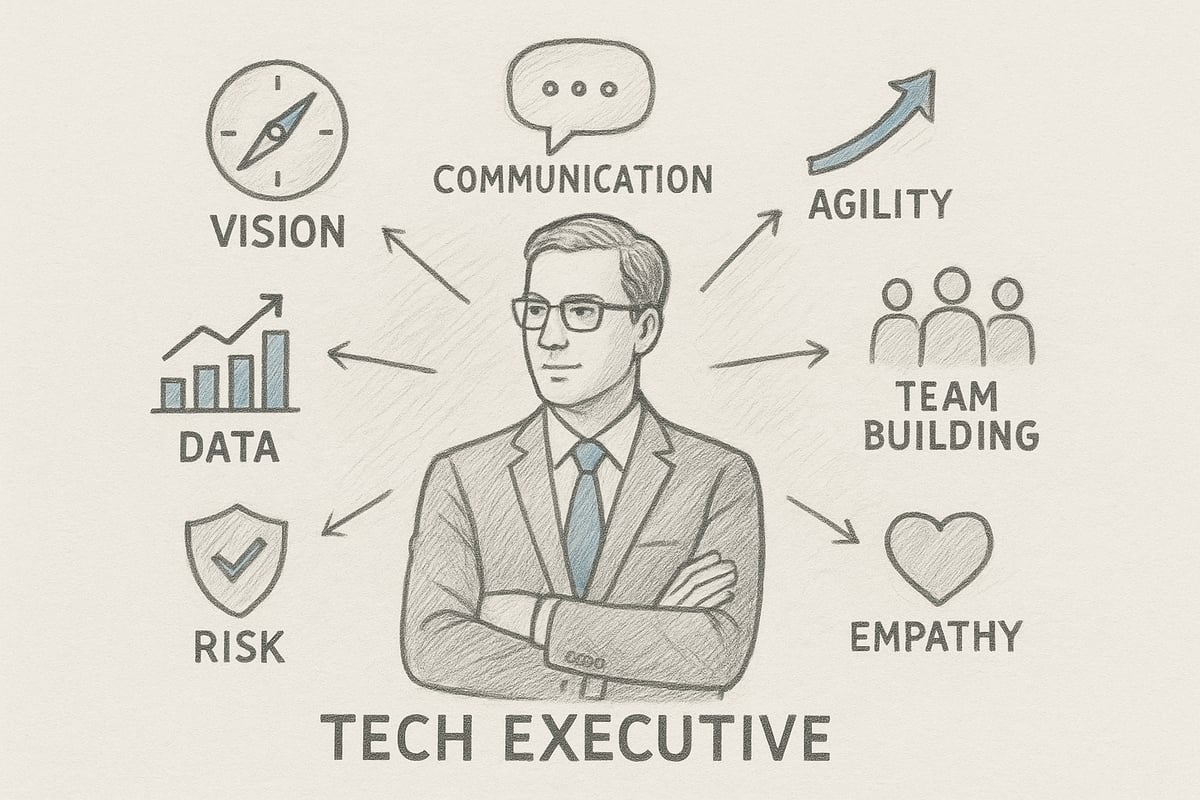
The tech executive role in 2025 demands a unique blend of technical mastery and people-centric leadership. To thrive, leaders must develop a skill set that empowers teams, drives transformation, and delivers measurable business value.
Visionary Thinking and Strategic Foresight
A successful tech executive anticipates market shifts and emerging technologies. Setting a clear digital roadmap is crucial for aligning teams and resources with future business goals. This proactive approach ensures organizations remain competitive and seize new opportunities as they arise.
Communication and Influence
Translating complex technical concepts into clear business value is a core expectation for every tech executive. Effective storytelling increases engagement with stakeholders and accelerates decision-making. Building strong relationships across departments enhances project support and organizational alignment.
Change Management and Agility
Guiding an organization through digital transformation requires agility and a readiness to adapt. A tech executive must foster a culture of continuous improvement and resilience, especially during periods of rapid change. Agile frameworks and transparent communication help teams embrace new initiatives with confidence.
Talent Development and Team Building
Mentoring the next generation of leaders is essential for long-term success. A tech executive invests in upskilling teams, prioritizing diversity and inclusion strategies. Diverse teams are proven to outperform, driving innovation and better problem-solving across the business.
Diversity and Inclusion Strategies:
- Encourage varied perspectives
- Support career development for all backgrounds
- Foster a culture of belonging
Data-Driven Decision Making
In 2025, a tech executive leverages analytics to guide investments and resource allocation. Making informed decisions based on data increases the likelihood of achieving strategic goals. Data-centric organizations adapt more quickly and identify growth opportunities ahead of competitors.
Risk Management and Cyber Awareness
Balancing innovation with strong risk management is a daily responsibility for every tech executive. Proactive risk assessment frameworks protect against threats while enabling progress. Building a cyber-aware culture ensures the organization can respond quickly to new challenges.
Risk Management Table:
| Area | Approach |
|---|---|
| Cybersecurity | Continuous monitoring |
| Compliance | Regular audits |
| Innovation | Controlled pilots |
Emotional Intelligence and Empathy
High-EQ leadership is critical for supporting teams through uncertainty and change. Emotional intelligence enables a tech executive to inspire trust, foster collaboration, and maintain high retention rates. For further insights on these essential skills, explore Human-centered technology leadership.
To learn more and connect with a member of the CTO Input team, visit https://www.ctoinput.com.
Spend a few minutes exploring the rest of the articles on the CTO Input blog at https://blog.ctoinput.com.
Critical Technology Trends Shaping the Executive Agenda
In 2025, the tech executive faces a rapidly shifting landscape. Staying ahead means understanding the trends that will define the executive agenda. From AI to sustainability, every tech executive must be ready to adapt, innovate, and lead. For deeper analysis on aligning technology trends with business outcomes, visit Strategic technology leadership insights.

Artificial Intelligence and Automation
Artificial intelligence is no longer experimental; it is central to every tech executive’s strategy. Generative AI, machine learning, and process automation are reshaping customer service, analytics, and operations. Sixty percent of organizations plan to increase AI investments in 2026, highlighting the urgency for tech executive leadership.
- AI-powered chatbots improve customer experience.
- Predictive analytics optimize business outcomes.
- Robotic process automation streamlines repetitive tasks.
A tech executive who champions AI can drive efficiency, innovation, and growth.
Cloud Transformation and Edge Computing
Legacy migrations to cloud-native architectures are accelerating. For the tech executive, cloud adoption offers cost savings, scalability, and flexibility. Edge computing allows real-time data processing at the point of need, which is critical in manufacturing, retail, and logistics.
- Cloud migration cuts IT costs by 30% on average.
- Edge solutions support IoT and smart devices.
- Hybrid models balance security and agility.
Embracing these trends is vital for the modern tech executive to future-proof operations.
Cybersecurity and Zero Trust Architectures
Cyber threats are growing in sophistication. A proactive tech executive must prioritize cybersecurity, moving toward zero trust frameworks to secure assets. With 68% of breaches originating from third-party vulnerabilities, vigilance is non-negotiable.
- Zero trust enforces strict access controls.
- Regular audits protect sensitive data.
- Vendor risk management reduces exposure.
A tech executive who embeds security at every level protects both reputation and revenue.
Data Governance and Privacy
Data regulations are evolving, and compliance is a must for any tech executive. Building a strong data stewardship program ensures responsible data use and protects against fines, which can reach 4% of global revenue for violations.
- Implement data classification policies.
- Train teams on privacy best practices.
- Monitor regulatory changes globally.
A tech executive who invests in governance builds trust with stakeholders and customers.
Sustainable and Green IT Initiatives
Sustainability is now a top priority. Tech executives must reduce the carbon footprint of their infrastructure by investing in energy-efficient hardware and software. Eighty percent of tech leaders cite sustainability as a critical objective.
- Optimize data center energy use.
- Choose cloud providers with green credentials.
- Promote recycling of obsolete equipment.
The tech executive who leads on sustainability drives both impact and innovation.
Digital Experience and Customer-Centricity
Modern customers expect personalized, seamless digital experiences. The tech executive must use technology to deliver omnichannel engagement and boost retention. Companies excelling in digital experience see 25% higher customer loyalty.
- Leverage data to personalize interactions.
- Integrate feedback loops into digital products.
- Measure customer satisfaction continuously.
A tech executive focused on customer-centricity fuels long-term growth.
Quantum Computing and Emerging Technologies
Quantum computing promises to disrupt security and computational power. Forward-thinking tech executives are exploring pilot projects and monitoring advancements to stay ahead.
- Evaluate quantum readiness in critical systems.
- Partner with research institutions.
- Monitor regulatory developments.
Early adoption can give the tech executive a strategic edge in a competitive market.
To learn more and connect with a member of the CTO Input team, visit https://www.ctoinput.com.
Spend a few minutes exploring the rest of the articles on the CTO Input blog at https://blog.ctoinput.com.
Cybersecurity and Risk Management for Tech Executives
Cybersecurity has become a defining responsibility for every tech executive. As threats grow more sophisticated and regulations tighten, the stakes for safeguarding data, operations, and reputation have never been higher. A tech executive must champion security at every level, embedding it into the organization’s culture and strategy.

Building a Security-First Culture
Establishing a security-first mindset is essential for any tech executive. This starts with executive buy-in and extends to every employee. Regular training, clear policies, and visible leadership involvement help engrain cybersecurity into daily habits.
- Conduct frequent phishing simulations
- Encourage incident reporting without blame
- Celebrate secure behaviors in team meetings
A tech executive who prioritizes security culture reduces human error and strengthens the organization’s first line of defense.
Zero Trust and Modern Security Architectures
Zero trust frameworks have become the gold standard for protecting digital assets. Rather than assuming trust within networks, tech executives insist on continuous verification for every user and device.
Key steps include:
- Micro-segmentation of networks
- Multi-factor authentication
- Least-privilege access controls
Zero trust adoption is proven to reduce breach costs and limit the impact of cyber incidents.
Regulatory Compliance and Data Protection
Staying compliant with global data regulations is a non-negotiable for the modern tech executive. Laws such as GDPR and CCPA demand transparent data handling and swift breach notification.
Best practices:
- Map data flows and storage locations
- Automate compliance reporting
- Regularly review regulatory updates
A tech executive who leads on compliance not only avoids fines but also builds customer trust.
Incident Response and Business Continuity Planning
No organization is immune to attacks, making proactive planning vital. A tech executive must ensure robust incident response and business continuity plans are in place and regularly tested.
- Develop clear escalation paths
- Practice tabletop exercises with leadership
- Update recovery protocols after each test
Quick, coordinated responses minimize downtime and reputational damage when incidents occur.
Third-Party and Supply Chain Risk
Vulnerabilities often enter through vendors and partners. Tech executives need rigorous processes to assess and monitor third-party risks.
- Require security certifications from vendors
- Use automated risk assessment tools
- Segment third-party access within systems
By managing supply chain risk, a tech executive protects the organization from external threats.
Cyber Insurance and Financial Risk Mitigation
Cyber insurance is now a key component of risk management. A tech executive evaluates coverage options to align with evolving threats and organizational needs.
- Analyze policy exclusions and limits
- Calculate potential loss scenarios
- Integrate insurance into financial planning
Proper insurance provides a safety net, helping organizations recover from costly incidents.
Metrics and Continuous Improvement
Effective tech executives measure cybersecurity success with clear KPIs, such as incident response time, number of vulnerabilities closed, and employee training completion rates. Benchmarking these metrics and sharing them with stakeholders enhances transparency and accountability.
Collaboration with the board and C-suite is crucial for continuous improvement. For further insights on strengthening these relationships, see The evolving board–CTO relationship.
To learn more and connect with a member of the CTO Input team, visit https://www.ctoinput.com.
Spend a few minutes exploring the rest of the articles on the CTO Input blog at https://blog.ctoinput.com.
Data-Driven Decision Making and Digital Transformation
Building a data-driven culture is a top priority for every tech executive seeking to lead in 2025. Empowering teams to leverage data at all levels ensures organizations can respond quickly to market shifts and outperform competitors. According to the Gartner Survey on Digital Leadership 2023, 45% of CIOs are now partnering with C-suite peers to co-lead digital initiatives, highlighting the collaborative nature of modern tech leadership.
Building a Data-Driven Culture
A successful tech executive knows that data-driven organizations make decisions faster and with greater confidence. Fostering a culture where data literacy is valued enables teams to ask better questions and challenge assumptions. This approach accelerates innovation and helps organizations adapt to change.
Leaders should:
- Promote data access and transparency
- Encourage data-driven experimentation
- Celebrate wins driven by analytics
A robust culture of data use gives every tech executive the foundation for sustainable transformation.
Modernizing Data Infrastructure
To support a data-centric approach, tech executives must modernize legacy systems. Investing in scalable data lakes, cloud-native warehouses, and real-time analytics platforms is critical. This shift allows organizations to process and analyze data efficiently, unlocking new business insights.
Migrating to the cloud offers flexibility and cost savings. Modern infrastructure also ensures that the tech executive can respond to evolving business needs and scale resources as demand grows.
Advanced Analytics and AI Integration
Integrating AI and advanced analytics is now a core responsibility for the tech executive. Predictive models and machine learning solutions allow organizations to anticipate trends, personalize experiences, and drive operational efficiency.
For example, retailers using AI-powered analytics report up to 15% higher sales growth. The tech executive must champion these technologies to deliver measurable results and maintain a competitive edge.
Data Privacy and Ethics
Balancing innovation with data privacy is essential. Tech executives are responsible for ensuring compliance with evolving regulations and creating ethical frameworks for data use.
Building trust with customers means prioritizing transparency and responsible stewardship. With 75% of consumers unwilling to buy from companies they do not trust with their data, ethical leadership is a business imperative.
Measuring ROI and Business Impact
Linking data initiatives to tangible outcomes is vital for the tech executive. Setting clear KPIs demonstrates value to stakeholders and aligns technology investment with business goals.
| Initiative | Outcome | ROI Example |
|---|---|---|
| Automated reporting | Analyst time saved | 30% reduction |
| Real-time analytics | Faster decisions | 5x speed increase |
| AI-driven personalization | Revenue growth | 15% higher sales |
Referencing the Gartner CEO Survey 2024, 62% of CEOs have identified growth as their top priority, reinforcing the tech executive’s role in delivering measurable impact.
Overcoming Common Barriers
Even with the right strategy, tech executives face obstacles such as data silos, legacy systems, and resistance to change. Overcoming these challenges requires:
- Cross-functional collaboration
- Strong change management practices
- Continuous upskilling
By addressing these barriers, the tech executive ensures successful digital transformation and positions the organization for long-term growth.
To learn more and connect with a member of the CTO Input team, visit https://www.ctoinput.com.
Spend a few minutes exploring the rest of the articles on the CTO Input blog at https://blog.ctoinput.com.
Building Resilient, Innovative Organizations
Building a resilient, innovative organization is now a top priority for every tech executive. In a rapidly changing environment, adaptability and creativity define long-term success. The following strategies empower leaders to future-proof their teams and drive sustainable growth.
Fostering a Culture of Innovation
A thriving culture of innovation is essential for any tech executive seeking to stay ahead. Encouraging experimentation and calculated risk-taking leads to breakthrough solutions and drives growth. Companies with formal innovation programs are proven to grow revenue 1.5 times faster than their peers.
This culture is also fueled by a workforce skilled in emerging technologies. According to the CompTIA Tech Jobs Report July 2025, AI-related job listings surged 153 percent, highlighting the demand for advanced skills. By prioritizing learning and cross-functional collaboration, organizations unlock creative potential and position themselves as industry leaders.
Organizational Agility and Adaptability
For a tech executive, agility is a competitive advantage. Implementing agile frameworks beyond IT empowers teams to respond rapidly to change. Agile organizations are 70 percent more likely to rank as top performers.
This adaptability extends to business models and customer engagement. Leaders who embed agility into daily operations enable faster decision-making, reduce time to market, and ensure the organization can pivot when disruptions arise.
Scenario Planning and Crisis Readiness
Preparedness is central to resilience. Scenario planning helps a tech executive anticipate market disruptions and black swan events. By mapping out potential risks and developing flexible response strategies, leaders can safeguard critical operations.
Key practices include:
- Conducting regular risk assessments
- Simulating crisis scenarios
- Establishing rapid communication protocols
These steps ensure the organization can withstand challenges and emerge stronger.
Technology Modernization and Legacy Transformation
Modernizing outdated platforms is a strategic imperative for every tech executive. Legacy systems often limit innovation and hinder efficiency. Upgrading to cloud-native solutions and automating manual processes deliver immediate gains.
For example, manufacturers that modernize ERP systems report 20 percent efficiency improvements. Continuous modernization also enables seamless integration of new technologies, supporting long-term growth and adaptability.
Stakeholder Engagement and Buy-In
Driving innovation requires broad support. Tech executives must engage business units, customers, and partners throughout transformation initiatives. Open communication and transparency foster trust and encourage collaboration.
Securing executive and board buy-in is equally critical. By aligning technology investments with business goals, leaders build consensus and accelerate the pace of change.
Measuring and Sustaining Innovation
Sustaining innovation demands clear metrics. Tech executives should define KPIs to track progress, such as time to market, customer satisfaction, and revenue from new products. Continuous improvement loops and regular feedback ensure initiatives remain aligned with strategic objectives.
By embedding innovation into the organizational DNA, leaders create a resilient, future-ready enterprise.
To learn more and connect with a member of the CTO Input team, visit https://www.ctoinput.com.
Spend a few minutes exploring the rest of the articles on the CTO Input blog at https://blog.ctoinput.com.
As you look ahead to 2026, it’s clear that tech executives who blend vision, agility, and business acumen will drive the most impactful change. We’ve explored what it takes to lead through uncertainty, foster innovation, and align technology with measurable outcomes. If you’re ready to put these insights into action but want expert guidance tailored to your unique challenges, now is the perfect time to connect with a seasoned partner. Let’s work together to assess where you are, clarify your goals, and build a roadmap for success—starting with a Book a 45 Minute Diagnostic Session.