
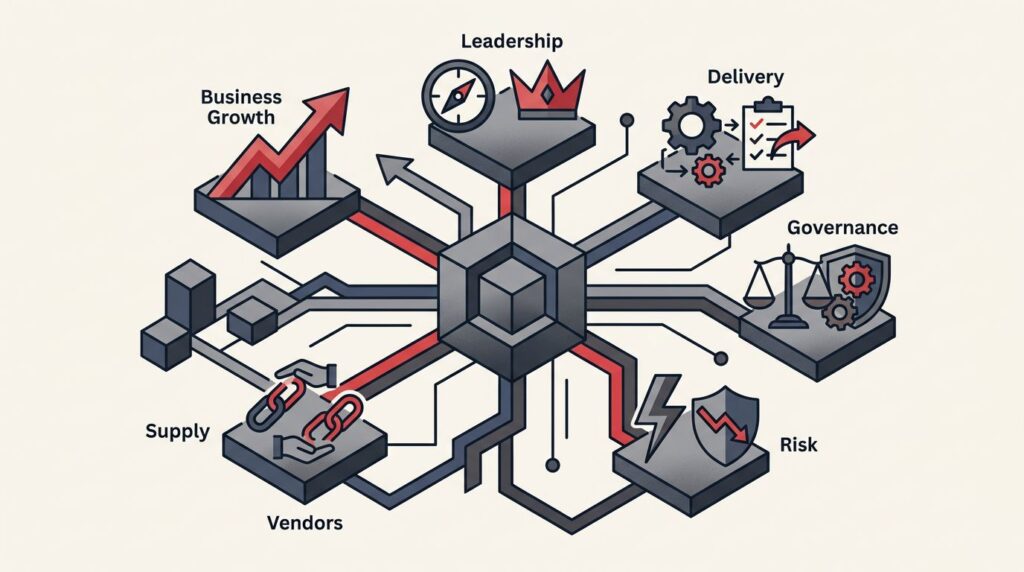
Your technology team can be capable, your vendors can be responsive, and you can still feel stuck.
That usually happens when decisions, priorities, and accountability are unclear. An IT operating model acts as the strategic blueprint for how technology work gets owned, planned, delivered, measured, and governed.
If you lead a growing company, you need technology that supports growth, margin, resilience, and customer trust. An operating model is not the same as a technology strategy, a roadmap, an org chart, or a stack of tools. It is the framework that ensures all those pieces work together in real life to consistently deliver business value.
Key takeaways
- A well-defined IT operating model provides clarity around ownership, decision rights, IT spending, risk management, and service delivery.
- It helps your team move beyond reactive tickets, endless vendor calls, and repeated firefighting.
- The right model aligns internal technology capabilities with your company’s broader strategic objectives, ensuring tech choices drive business outcomes rather than just technical activity.
- Outsourcing work does not outsource your executive accountability for performance and results.
- You do not need to be a large enterprise or have a full-time CTO to create stronger technology leadership and a more efficient organization.
What is an IT operating model
An IT operating model serves as the management system for how your company runs technology. At its core, it defines the essential integration of people, process, and technology to ensure your systems, vendors, funding, decisions, and performance measures work together effectively. It answers practical questions that often become complicated as you scale:
- Who can approve a new system or vendor?
- How does new work enter the roadmap?
- What remains with your internal team, and what is outsourced?
- Who owns cyber risk, service reliability, and recovery planning?
- How do you know technology spending is producing value?
A useful model is not merely a document that sits in a shared folder. It is the set of rules and habits that shape what happens when Sales wants a new CRM integration, Operations needs better reporting, or a vendor pushes an expensive platform change.
Ownership matters because technology choices affect the whole business. Without executive technology leadership, small decisions pile up. Before long, you have a leadership problem disguised as a technology problem.
How it differs from strategy, roadmaps, and org charts
Your IT strategy sets the direction. It might define your plan to improve customer data, reduce manual work, or strengthen security.
Your technology roadmap sequences the work. It defines what happens first, what can wait, and what requires specific funding.
Your organizational structure shows reporting lines, but it does not explain who has final authority when Finance, Operations, IT, and a vendor disagree.
The operating model connects all three. It explains how decisions move, how work gets prioritized, and who must answer for results.
Why reactive IT support is not enough
Outages, access requests, vendor calls, and ticket queues are real work. They also consume a team quickly.
If that is all your technology function can manage, projects slip. Manual workarounds multiply. Costs rise without better visibility. Technical debt grows because nobody has time to address the root causes behind repeat problems.
A busy technology team is not always a well-led technology function.
A stronger model helps you align technology with business goals and shifts the focus toward producing consistent business value, rather than simply managing technical output, which creates more room for growth, margin improvement, and operational control.
The core parts of a strong IT operating model
A robust IT operating model does not need to be complicated. Instead, it should make important decisions easier to visualize and harder to avoid, ensuring that your technology strategy aligns perfectly with business objectives.
Decision rights, ownership, and accountability
You need named owners for business outcomes, technology services, budgets, risks, and major vendor relationships. Proper IT governance provides the necessary framework to oversee these rights, ensuring everyone knows who is responsible for specific business impacts.
“IT owns it” is rarely clear enough. Finance may control spending, operations may own the process, and legal may set requirements. A software vendor may also influence the solution. Regardless of these inputs, someone must retain the authority to make the final call.
One executive should own the overall technology answer. Teams can retain delegated responsibilities, but the business should know who can say yes, no, or not now. If you need that judgment but are not ready for a permanent hire, fractional CTO leadership can provide steady executive ownership without full-time overhead.
Services, vendors, and delivery practices
Your model should define what your internal team owns, what a managed provider handles, and where specialist vendors fit within your value streams. By mapping how work moves through your organization, you can better define service delivery standards for both internal teams and external partners.
Your framework should set basic rules for project intake, prioritization, incident response, change approval, and service expectations. Vendors should support your roadmap, not decide it for you.
This clarity is especially important when tool sprawl grows. Too many overlapping systems create duplicate data, rising licenses, weak controls, and more work for the people trying to keep everything connected.
Funding, measures, and risk controls
Technology budgets require the same honesty as any other business investment. To manage this effectively, your sourcing strategy should account for the specific capabilities your organization needs to build in-house versus those that are better managed by external partners.
Track a short list of measures leaders can use: spending against planned outcomes, project value, service reliability, recovery readiness, vendor performance, cyber risk, and unresolved technical debt. A dashboard full of ticket counts will not help you decide what to fund, stop, or delay.
Clear technology risk oversight gives your board a view of ownership, exposure, and decisions that need attention. By focusing on these core components, you ensure your technology investments drive actual business growth.
Common operating model choices
There is no single right structure for an IT operating model. The best approach depends on your organization size, complexity, internal skills, regulatory pressure, growth plans, and tolerance for risk.
Centralized model
A centralized model puts most technology services and decisions under one function. This organizational structure can improve consistency, cost control, and security. However, it can also become slow if every business need requires a long approval path.
Decentralized model
A decentralized model gives individual business units more freedom. While this can improve speed, this organizational structure often creates duplicate tools, inconsistent data, and heavy vendor dependence.
Federated model
A federated model is often the practical middle ground. Shared standards, security rules, and core platforms sit centrally, while business units retain room to make local decisions within clear boundaries. The specific structure matters less than the decision rules; you need to know what is shared, what is local, and who resolves conflicts.
Internal, outsourced, and hybrid model
Internal teams usually bring better business knowledge and day-to-day control, whereas managed providers and specialists add capacity, skills, and round-the-clock coverage.
Most growing companies use a hybrid model. That is fine, but you should not assume a contract makes a provider accountable for your business outcomes. Outsourcing tasks does not outsource accountability. A fractional or interim CTO can steady leadership while internal teams and vendors continue doing the work.
How to build a model people will use
Start with an honest picture of your current and future state. Review your services, applications, vendors, contracts, team capacity, data flows, cyber controls, recovery plans, decision bottlenecks, and technical debt.
Look for the places where work stalls, ownership is vague, or spending has no clear business case. A technical due diligence review uses a similar discipline: find the risks and dependencies before they become expensive surprises.
Then, document a short target operating model. Ground your design principles in the actual needs of your organization, defining decision rights, service owners, sourcing choices, approval thresholds, escalation paths, governance meetings, and performance measures. By aligning these design principles, you can better support your broader digital transformation and build the capabilities required for long-term success. Keep it readable. A responsibility matrix can help, but it should not become a substitute for leadership.
Turn the design into a 90-day implementation roadmap:
- Confirm owners, urgent risks, critical services, and blocked decisions.
- Establish reporting, vendor controls, priority rules, and approval thresholds.
- Begin roadmap work, measure results, and correct what is not working.
The point is better decisions and delivery. It is not more meetings.
Signs your IT operating model needs to change
You likely need a reset if you see repeated firefighting, projects without business sponsors, vendors making strategic calls, or unclear technology spend. When you notice multiple teams buying similar tools or inconsistent data across departments, it is a clear indicator that your operational efficiency is suffering due to a lack of proper IT governance.
Other warning signs include weak incident follow-up, unclear recovery plans, and board questions nobody can answer plainly. These problems often point to a leadership gap, a reporting problem, or poor sourcing strategies. More software will not fix these fundamental issues.
If technology decisions feel scattered or too dependent on the wrong people, Get an Executive Technology Clarity Check. You need a clear view of what is slowing growth, where risk is building, and who should own the next decision.
What good looks like
You know who decides, why work is prioritized, and what each vendor must deliver. Success is defined by high levels of stakeholder engagement, where business leaders and IT teams are aligned on shared goals.
You can see the risks that need action. Spending has a clearer link to growth, reliability, or cost control. The board oversees direction, risk, and resilience, while management owns daily execution. With a refined IT operating model, you will experience fewer surprises, less tool sprawl, and a reduced dependence on individual heroes. Ultimately, this leads to consistent delivery of business value, ensuring your technology investments directly support the long-term success of the organization.
Conclusion
A well-defined IT operating model provides the structure you need to organize technology decisions, people, vendors, budget, delivery, and risk so your business can pursue its strategic objectives with confidence.
The best approach remains simple enough for teams to adopt, clear enough to govern effectively, and flexible enough to evolve as you grow. Start by identifying areas where ownership, reporting, vendor control, or spending remains unclear.
Building these internal capabilities is essential for effective change management, especially when a business transition, acquisition, or leadership change raises the stakes. If you are facing these pressures, Prepare Technology for Diligence or Transition before those weak spots become harder to explain.
FAQs
Does a small or mid-market company need an IT operating model?
Yes. Even if you do not require a massive technology department or a complex enterprise framework, you still need clear ownership, decision rules, vendor oversight, and reliable reporting. Implementing a structured IT operating model helps smaller organizations drive operational efficiency and ensures that technology investments are scaled appropriately to support business growth.
Who owns the IT operating model?
Management owns the model. In many organizations, the CEO or COO holds ultimate accountability for the IT operating model until a CTO, CIO, or another executive technology leader is appointed to take direct, day-to-day ownership.
Is an IT operating model only for internal IT teams?
No. It applies regardless of whether the work is handled by internal employees, managed service providers, software vendors, contractors, or a combination of all four. Because the framework integrates with your enterprise architecture, it provides a consistent set of rules to govern those relationships, ensuring that every vendor and team member works in harmony to meet your organizational goals.