
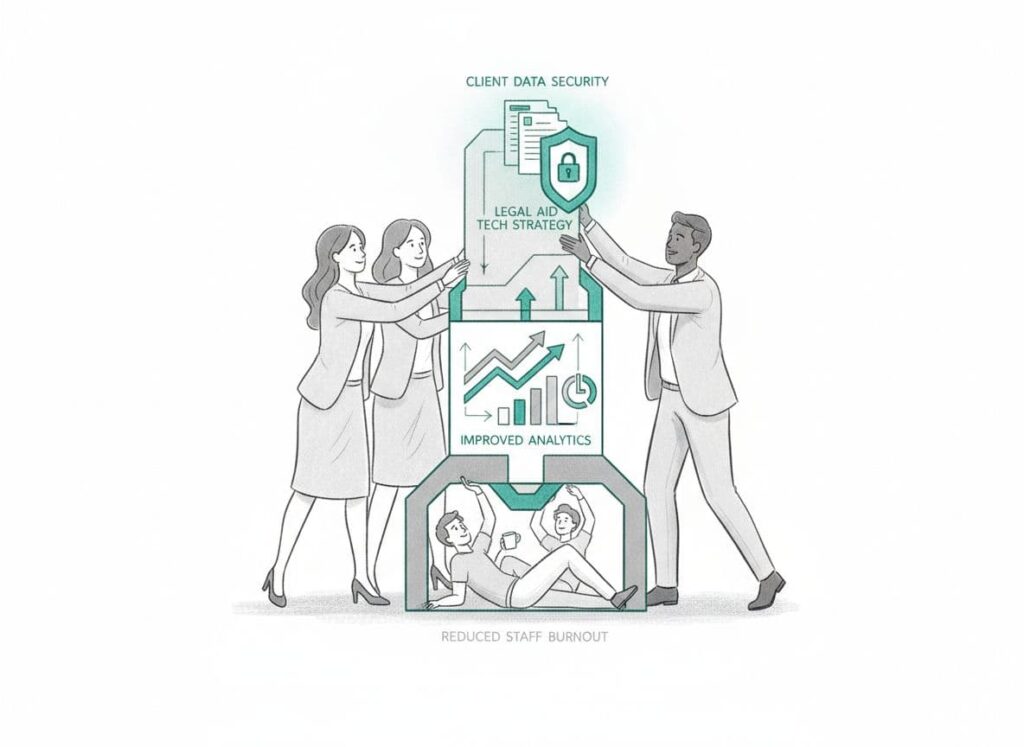
Staff are tired. Systems are scattered. Every grant cycle seems to bring one more spreadsheet, one more login, one more fire drillIf you lead a justice-focused organization, you feel it in your calendar and your inbox. Rushed reports. Security worries. Smart people doing copy‑and‑paste work instead of supporting advocates and partners. A clear legal aid technology strategy is simply a phased plan that ties your tools, data, and security to your mission. It helps you answer three questions: what problems matter most, what will we fix first, and how will we do it safely.
This guide is written for executive directors, COOs, CFOs, and operations or technology leaders who sit just behind the front line. It is practical, non‑technical, and something you can share with staff and board members.
Key Takeaways From This Legal Aid Technology Strategy Guide
- How to assess your current systems in plain language, without needing a technical background.
- How to turn daily pain points into 3–5 clear technology goals that board and funders will understand.
- How to build a simple Now / Next / Later roadmap for the next 12 to 36 months.
- How to bake security and privacy into your legal aid technology strategy, instead of bolting it on later.
- How to use tools like AI carefully, so they expand capacity without increasing risk to clients or staff.
Start With Your Mission, Not the Tools

Photo by Mikhail Nilov
The strongest technology plans do not start with a shopping list. They start with why your organization exists and who you serve.
For legal nonprofits, that usually means: faster and fairer access to justice, less chaos for staff, safer data for clients, and clearer proof of impact for funders and boards. Technology is simply the set of rails that carry that work.
If you begin from the mission, it becomes easier to say no to shiny tools and yes to simple fixes that free up time and reduce risk.
Clarify the problems you need technology to solve
Before you talk about systems, talk about pain.
Ask a few focused questions in staff meetings or quick surveys:
- Where are we wasting the most time?
- Where do errors or risks show up?
- Where do clients wait the longest?
You will hear familiar examples. Manual intake forms that must be typed into a case system. Duplicate data entry into case management, grant portals, and separate board decks. Ad hoc spreadsheets that only one person understands.
Many legal nonprofits grow fast on top of fragile tools. New programs get “patched in” with free apps and one‑off workarounds. That is how you end up with fire drills, access problems, and open security gaps.
Turn those pain points into 3–5 clear technology goals
Once you have the list of pain points, translate them into outcome goals.
For example:
- Reduce average intake time by 50 percent within 12 months.
- Cut manual hours spent on grant reporting in half by the next fiscal year.
- Centralize all case and program data in one secure system within 18 months.
- Standardize program codes so outcome data is consistent across sites and partners.
Keep the list short. Three to five goals is enough for most organizations. Each goal should connect directly to your mission and to real obligations, like funder reporting or regulatory rules.
Write them in plain language, with a target timeline. These become the backbone of your technology story with staff, board, and funders.
Build a Simple, Phased Legal Aid Technology Roadmap
A roadmap is your one‑page story of “what happens when.”
For most justice-focused organizations, a three‑phase view works well:
- Now (0–6 months)
- Next (6–18 months)
- Later (18–36 months)
You are not promising perfection. You are laying out believable steps that match your budget and staff capacity.
Across all three phases, keep your focus on three layers: foundations (data, security, basic tools), efficiency (workflows and automation), and insight (dashboards and impact). As you sketch your own plan, it can help to review common technology challenges for legal nonprofits and see where your gaps line up.
Now: Fix the foundations and reduce immediate risk
In the first few months, you are building a safer floor to stand on.
Typical “Now” moves include:
- Draw a simple map of current tools and where data lives.
- Choose one primary case or matter management system when possible.
- Tighten access controls so only the right people see sensitive records.
- Turn on strong passwords and multi‑factor authentication everywhere you can.
- Write short, plain‑language rules for how staff handle client data.
Look for small wins that staff can feel. One fewer login. A cleaner intake path. Fewer “who owns this spreadsheet” moments. Resources that outline common technology challenges for legal nonprofits can give you a checklist of quick security and operations fixes.
Next: Streamline workflows and reporting
Once the floor feels more stable, shift toward how work flows.
Between 6 and 18 months, many legal aid groups:
- Standardize intake and referral steps across programs or regions.
- Remove double entry between intake, case management, and grant reporting.
- Connect case data to program metrics, grant outcomes, and board dashboards.
- Add simple automation for routine documents, reminders, or status updates.
This is also where many start trying AI helpers for drafting letters or summarizing notes. Recent research shows that legal aid organizations are adopting AI at about twice the rate of other lawyers, as described in this LawNext report on AI in legal aid.
Start small. Pilot one or two use cases. Test for accuracy, bias, and equity impacts. Require human review for anything that might affect a client’s case or rights.
Later: Use data, AI, and integration to scale impact
After you have consistent systems and workflows, you can invest in deeper insight.
Common “Later” moves include:
- Dashboards that show program and funder metrics in near real time.
- More advanced AI use, such as triage suggestions, document review, or pattern spotting across cases.
- Better integration between systems so staff can see the full story of a client or partner without hopping across tools.
Here, strong privacy and security rules are non‑negotiable, especially for immigration, youth, and incarceration data. Every AI use case should include clear human review and audit trails.
You do not need to guess alone. Resources like the Legal Aid Tech Toolkits from LSC and stories from peer organizations show how better data and careful AI pilots can grow reach without burning out staff.
Make Your Strategy Real: Governance, People, and Outside Help
A roadmap on paper is only the start. To make change stick, you need clear ownership, staff support, and the right level of outside help.
Most justice-focused organizations will not hire a full‑time CTO or CISO. Fractional leadership and mission‑aligned partners can fill that gap.
Set light-touch governance and clear ownership
Form a small cross‑functional group to steer your technology work. Operations, programs, finance, and whoever owns data or IT should all have a seat.
Name one executive sponsor. This person owns decisions, keeps the board informed, and protects staff time for key projects.
Document a short technology charter, two or three pages at most. Include your priorities, basic security expectations, and how decisions get made. The goal is not more process. The goal is a calm, shared picture of what you are doing and why.
Invest in people, partners, and a realistic support model
Any technology shift, even a small one, is a people project.
Plan time for staff training, updated manuals, and office hours. Be honest about how much internal capacity you really have to design workflows, manage vendors, or run security checks.
For many organizations, it makes sense to work with a fractional technology leader who can design a step-by-step technology roadmap for legal nonprofits and guide implementation without adding a full‑time executive. Look for partners who understand legal aid, privacy expectations, and nonprofit constraints.
FAQs: Practical Questions About Legal Aid Technology Strategy
How much should a small or mid‑sized legal nonprofit budget for technology each year?
A common range is 3 to 6 percent of your overall budget, including systems, support, and security. If you are catching up after years of under‑investment, you may need a short period above that range.
What is a realistic timeline for a basic legal aid technology strategy?
Many organizations can stabilize foundations and simplify key workflows within 12 to 18 months. Bigger data and AI work often sits in a 2 to 3 year window, done in small pilots.
How do we use AI tools safely with sensitive client data?
Start with a written AI policy that covers confidentiality, consent, human review, and recordkeeping. Limit tools that store or train on your data, and never let AI make final decisions that affect legal rights without human sign‑off.
How do I explain this strategy to my board and funders?
Frame it around risk reduction, staff capacity, and clearer impact data. Share a short list of goals, a simple Now / Next / Later roadmap, and the specific client or program problems you expect to fix.
Conclusion: Owning Your Legal Aid Technology Strategy
A strong legal aid technology strategy is not a tech project. It is a mission project, written in systems and workflows instead of legal briefs.
You start with pain points and program goals. You turn them into a small set of clear targets. Then you walk through a phased roadmap, backed by light governance and real support for your people.
CTO Input works with justice-focused organizations to do this in a calm, staged way. That includes assessing your current systems and risks, designing a practical roadmap that board and funders can support, and providing fractional CTO, CIO, or CISO leadership to guide implementation.
If you want your systems to feel like a steady backbone instead of a hidden threat, this is the time to act. Share this guide with your leadership team, and then schedule a call with CTO Input to talk through what “Now, Next, Later” could look like for your organization.