
The real SOC 2 certification cost isn't a single line item. For a first-time audit, it's a strategic investment that will likely land between $30,000 and $100,000. That number isn’t just the auditor’s fee; it covers the essential prep work, new security tools, and, crucially, hundreds of hours from your team. Underestimating this total investment is one of the most common—and painful—mistakes a leadership team can make.
Why Your SOC 2 Budget Is Probably Wrong
You've got big enterprise deals on the line, and they all want to see a SOC 2 report. Simple enough, you think. But then the quotes start rolling in, and they're all over the map. One firm quotes $20,000, while another hints at something well into six figures. This ambiguity doesn't just stall budget planning; it puts those critical sales conversations on ice.
This isn’t a hypothetical. We see it play out constantly. A fast-growing SaaS company budgets for the auditor's fee, assuming that’s the main hurdle. A few months in, reality hits: the real costs are in the remediation projects, the new monitoring software, and the countless engineering hours pulled away from the product roadmap. The initial budget suddenly triples, the project grinds to a halt, and those enterprise deals remain just out of reach.
Unpacking the Total Investment
The confusion stems from a simple fact: the auditor’s fee is the most obvious cost, but it's rarely the biggest. A proper SOC 2 budget is a blend of several distinct components many leaders don't see coming.
To get the numbers right, you have to account for four key areas:
- Audit Fees: What you pay a CPA firm to conduct the audit and issue your report.
- Readiness and Remediation: The work needed to find and fix security gaps before the auditor arrives.
- Internal Labor: The opportunity cost of your team's time spent on documentation and project management.
- Tooling and Monitoring: Ongoing subscription costs for software that automates controls and proves compliance.
Getting a handle on these "hidden" costs is the only way to build a reliable financial plan. For many companies, the all-in cost for SOC 2 certification averages between $30,000 and $50,000. For larger or more complex businesses, that number can easily climb past $100,000. That massive range is driven by factors beyond the audit itself. You can find more details on how these costs break down in this SOC 2 cost analysis.
The single biggest mistake is viewing SOC 2 as an IT project. It’s a business initiative that proves you can be trusted with customer data. Budgeting for it requires a business lens, not just a technical one.
This guide will give you the clarity needed to build a budget you can count on. We'll break down the numbers and show you how to transform what feels like a mandatory compliance chore into a genuine business advantage. Helping leaders align these initiatives with their growth goals is a central part of our IT compliance services.
The Four Hidden Costs in Your SOC 2 Budget
To get a realistic handle on your SOC 2 certification cost, you have to look beyond the auditor's quote. Focusing only on that number is like planning a road trip by budgeting just for gas—you're ignoring the hotels, food, and emergency repairs that will inevitably pop up.
Let's break down the total investment into four key areas. Thinking this way gets you out of the compliance weeds and into a clear-eyed business conversation, helping you sidestep nasty budget surprises.
1. The Auditor Fee (The Price of the Report)
This is the most obvious cost and the one everyone asks about first. It’s the fee you pay a certified CPA firm to perform the audit and write the final SOC 2 report. Think of it as the official inspection and the certificate of occupancy for a new building. It's a required, non-negotiable line item.
Auditor fees typically land between $15,000 and $60,000. The final price hinges on the scope—how many systems are in play and which of the five Trust Services Criteria you're aiming for. A more complex business with more ground to cover will naturally see a higher fee.
2. Readiness and Remediation (Getting Your House in Order)
Here's where most budgets miss the mark. Before you let an auditor through the door, you need to prepare. This starts with a readiness assessment, a pre-audit that shines a light on all the gaps between what you're doing today and what SOC 2 demands.
It’s just like a home inspector finding a leaky roof before you list the house for sale.
Fixing those gaps is called remediation. This could involve anything from rewriting old policies and training your team to implementing new security protocols. The cost here is a huge variable, often falling between $10,000 and $50,000+, depending on your company's current security maturity. A business with solid processes might spend little, while a fast-growing startup may need to invest heavily to get its ducks in a row.
A thorough readiness assessment might feel like an extra expense upfront, but it’s the single best way to control your total cost. It lets you fix problems on your own schedule, avoiding the premium you’ll pay when an auditor finds them under a tight deadline.
3. The Internal Time Sink (Your Team’s Opportunity Cost)
This is the hidden cost that bites the hardest. SOC 2 isn't a project you can just hand off. Your own people—especially senior engineers, IT leads, and project managers—are going to spend hundreds of hours on this.
That time is eaten up by:
- Gathering evidence: Pulling countless screenshots, logs, and reports to prove your controls work.
- Answering auditor questions: Sitting in interviews and explaining how your systems operate.
- Managing the project: Juggling tasks, chasing people down, and keeping the audit on track.
Every hour your best engineer spends on compliance is an hour they aren't shipping features. This opportunity cost is massive. A first-time SOC 2 audit can easily consume 200-500 hours of internal staff time. Do the math on their loaded salaries, and you'll uncover a very real, very large expense.
4. Tools and Maintenance (The Automation and Upkeep Layer)
Finally, you’ll almost certainly need to invest in software to not only achieve but also maintain SOC 2 compliance. These aren't one-time purchases; they are recurring subscriptions that become a permanent part of your operational budget.
Common tool investments include:
- Compliance Automation Platforms: Solutions like Vanta or Drata that help manage evidence collection and continuous monitoring.
- Security Monitoring Tools: Systems for vulnerability scanning, endpoint detection, or log management.
- HR and Onboarding Systems: Tools that enforce background checks and track mandatory security training.
The annual cost for these tools can range from a few thousand dollars to $30,000+. While it's a real cost, good tooling often delivers a strong return by automating tedious manual work, freeing up your team and reducing the risk of costly human error.
To give you a clearer picture, here's how these components typically stack up for a mid-market company tackling SOC 2 for the first time.
Typical SOC 2 Cost Breakdown by Component
| Cost Component | Typical Price Range (Annual) | Key Driver of Cost | Business Impact |
|---|---|---|---|
| Auditor Fees | $15,000 – $60,000+ | Scope complexity and number of Trust Services Criteria | The non-negotiable cost of the final report and certification. |
| Readiness & Remediation | $10,000 – $50,000+ | Your company's current security and process maturity | One-time investment to fix gaps; good prep lowers audit risk. |
| Internal Time Cost | $25,000 – $75,000+ | Manual evidence gathering and project management overhead | The "hidden" cost of pulling your team away from their core jobs. |
| Tooling & Automation | $5,000 – $30,000+ | The need for continuous monitoring and automated evidence | Recurring expense that reduces manual workload and human error. |
By understanding these four cost centers, you can move from "getting through" a compliance audit to making a well-managed, strategic investment in your company's trustworthiness.
Benchmarking Your SOC 2 Costs by Company Stage
The SOC 2 journey for a 20-person startup looks completely different from that of a 250-person scale-up. The biggest factors driving your final SOC 2 certification cost are your company's size, system complexity, and current security maturity. Applying a one-size-fits-all budget is a setup for a nasty surprise.
To build a real financial plan, you need solid benchmarks. Let's walk through three common company profiles to give you a better feel for where you might land. This will show you how the main cost buckets—audit, readiness, and tooling—grow with your organization.
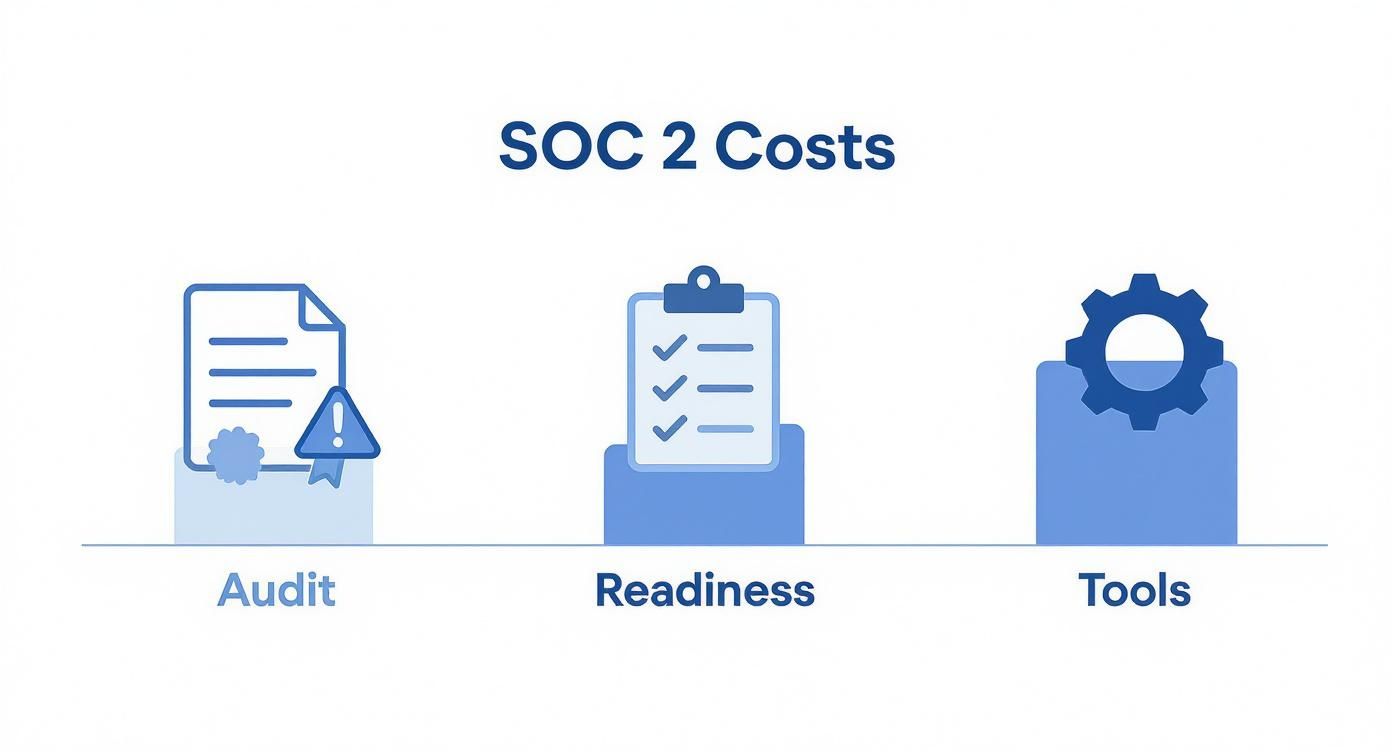
This visual gives you a quick breakdown of where the money typically goes. As you can see, the auditor’s invoice is just one slice of a much bigger pie.
The Startup Profile (Fewer Than 50 Employees)
For most early-stage companies, the push for SOC 2 comes from a single source: a huge potential customer is demanding it. The goal is to get the report in hand—often starting with a Type I—as fast as possible to unblock that deal. At this size, your systems are simpler and the team is small, which helps keep the process contained.
The catch? Security processes are often informal or nonexistent. That means a huge chunk of your budget will go toward building foundational controls from the ground up.
- Typical Type I Total Cost: $20,000 to $40,000
- Typical Type II Total Cost: $35,000 to $60,000
The game here is about speed and meeting an immediate business need. You aren't building an enterprise-grade security fortress; you're proving you have the essentials covered to earn your seat at the table.
The Growth-Stage Company (50-250 Employees)
At this stage, things get more complicated. Your tech stack has more moving parts, your team is larger, and you might have several product lines. All of this expands the audit's scope, which bumps up the auditor's fee and the internal hours needed. You're no longer just checking a box; you're building a security program that can scale with the business.
Your customers are more sophisticated, too, and many will expect a Type II report right out of the gate. There's simply more to audit, more people to train, and a bigger need for automation to manage it all without derailing your product roadmap.
As you scale, the cost of not having mature processes rises dramatically. A security issue that's a minor hiccup at 20 people can become a full-blown crisis at 200. This is the stage where SOC 2 transitions from a sales tool to an operational necessity.
- Typical Type I Total Cost: $30,000 to $60,000
- Typical Type II Total Cost: $45,000 to $75,000
The Mid-Market Organization (250+ Employees)
For an established company, SOC 2 isn't a "nice to have," it's table stakes. Your organization likely has dedicated IT and security staff, but you might also be wrestling with legacy systems and siloed processes that make an audit tricky. The scope is almost always large, often covering multiple services or business units.
While the total cost is higher, the investment is far more strategic. It's about demonstrating mature risk management to investors, board members, and regulators. At this level, the ongoing costs of recertification and tooling become a permanent and significant line item, often running $20,000 to $40,000 annually just for maintenance.
- Typical Type I Total Cost: $45,000 to $70,000
- Typical Type II Total Cost: $60,000 to $85,000+
Think of these figures as a starting point. For more on this, check out our guide on how executives use external benchmarks to guide tech investment without guesswork. They provide the foundation you need to build a realistic budget that matches where your company is today.
How Strategic Scoping Controls Your Final Cost
Once you have a general idea of where your company stands, the single biggest lever you can pull to manage your SOC 2 certification cost is the scope.
Think of it like building a house. You can build a modest two-bedroom bungalow or a sprawling seven-bedroom mansion. Both are houses, but the budget and complexity are worlds apart. A poorly defined scope is the fastest way to blow your budget and waste months on work you didn't need to do.
Getting this right isn’t a technical task—it’s about making two critical business decisions. Let's break them down in plain English so you can make smart choices that fit your needs and protect your budget.
Your First Choice: Type I or Type II
The first big decision is whether to get a Type I or a Type II report. This choice directly impacts how much time and effort your auditor—and your team—will need to invest.
Imagine you want to prove your company has a world-class security training program.
- A Type I report is a snapshot in time. The auditor checks your training materials and confirms that, on one specific day, you have a well-designed program in place. That’s it.
- A Type II report is more like a video recording. The auditor spends several months observing to make sure your employees are actually taking the training and that you're consistently enforcing the policy over time.
A Type I is faster and cheaper, making it a great first step to show you're serious. Most sophisticated enterprise customers, however, will eventually ask for a Type II. They want proof that your security controls aren't just well-designed, but are actually working day in and day out.
Your Second Choice: The Five Business Promises
Next, you need to decide which of the five Trust Services Criteria (TSCs) to include. Don't let the jargon intimidate you. Think of these as five distinct promises you can make to your customers about how you handle their data.
Only one is mandatory: Security.
The biggest mistake we see is companies assuming they need all five TSCs. You almost certainly don't. Each additional criterion adds complexity, cost, and time. Only include the promises your customers are actually asking for.
Here’s a simple way to think about each one:
- Security (The Foundation): This is non-negotiable. It’s the basic promise that you protect customer data from unauthorized access. Think locks, alarms, and access badges.
- Availability (The "Always On" Promise): Add this if your customers’ operations would halt if your service went down. It promises you have systems like backups and disaster recovery to handle outages.
- Confidentiality (The "Secret Keeper" Promise): This is for when you handle sensitive information like a client's business plans or intellectual property. It’s your promise to keep that data under wraps.
- Processing Integrity (The "Accuracy" Promise): Choose this if your system performs critical calculations, like in financial processing or e-commerce. It’s a promise that your system does exactly what it's supposed to, accurately and on time.
- Privacy (The "Personal Data" Promise): This applies if you collect or process personally identifiable information (PII)—things like names, addresses, or health data. It promises you handle that personal data according to your privacy notice.
Adding more criteria doesn't make you look better; it can be a costly mistake. A recent industry survey found that while 68% of organizations include three or more TSCs, doing so can inflate audit costs by 30-50%. These expanded audits also drag out the timeline, with many Type II reports taking between 3 and 12 months. That drives up the auditor's bill and the drain on your internal team. You can discover more insights about these audit trends on easyaudit.ai.
By carefully selecting only the TSCs you truly need, you prevent "scope creep" and ensure every dollar spent on compliance directly supports the promises you need to make to close deals.
Your 180-Day Roadmap to a Predictable SOC 2 Audit
Knowing the costs is one thing, but executing a plan that doesn't derail your business is another. A SOC 2 audit can feel like a massive, year-long technical beast. It doesn't have to be.
You can turn this complex initiative into a manageable, six-month project with a predictable outcome. Here’s a straightforward roadmap to guide your team, keep you on budget, and get to a successful audit without the chaos.
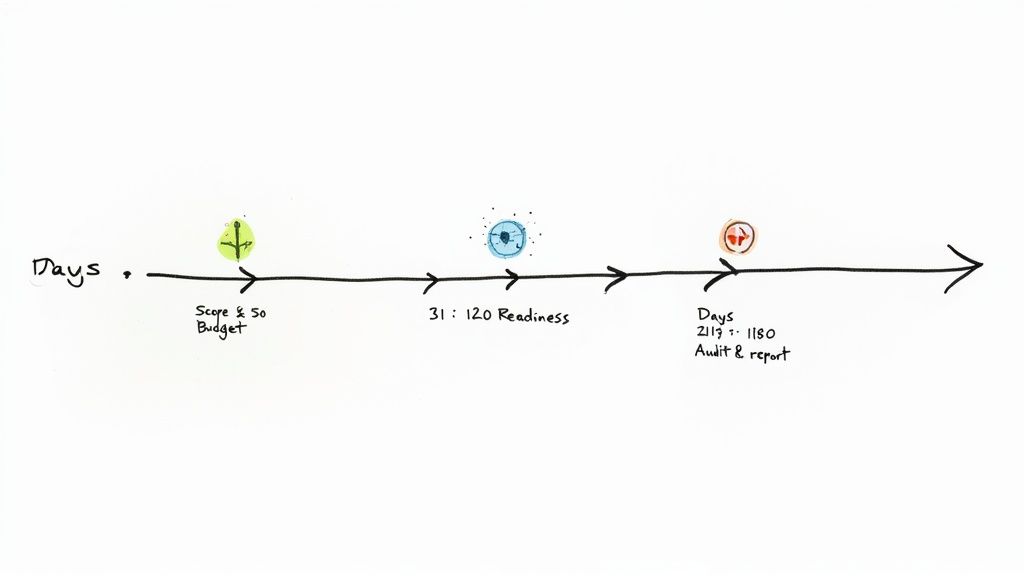
Phase 1: Scope and Budget (Days 1–30)
Your first month is about making the critical business decisions that will define the project. This isn't about technology; it's about strategy. The goal is a realistic budget and a crystal-clear scope everyone agrees on before any real work kicks off.
First, choose your report type. A Type I report is a snapshot of your controls on a single day, while a Type II looks at how those controls operate over several months. This decision is the single biggest driver of your initial SOC 2 certification cost. You can get a deeper understanding of the strategic differences by reading about the SOC 2 Type I and Type II report.
Next, nail down the necessary Trust Services Criteria (TSCs). Fight the urge to include all five. Start with Security—the only mandatory one—and only add others like Availability or Confidentiality if your most important customers explicitly ask for them. Every TSC you add expands the scope, timeline, and cost.
Finally, choose an audit partner. Don't just go with the cheapest quote. Look for a CPA firm with experience in your industry and with companies your size. The right relationship prevents costly headaches later.
By the end of this phase, you should have a signed agreement with an auditor and a clear, documented project scope. This document becomes your North Star.
Phase 2: Readiness and Gap Analysis (Days 31–120)
This is where the heavy lifting happens. Over the next three months, your team will get your systems, processes, and people ready to pass the audit on the first try. The focus is execution and closing any gaps between where you are today and what SOC 2 requires.
Your first move is a gap analysis, or a readiness assessment. Think of it as a pre-audit, often done with your chosen auditor or a consultant. It gives you a detailed punch list of every policy, control, and process you need to create or fix.
With this list, your team can start remediation. This is where the effort ramps up.
- Policy Development: Writing and getting approval for formal policies covering information security, access control, and incident response.
- Control Implementation: Rolling out new technical controls, like setting up multi-factor authentication, deploying endpoint security software, or implementing system monitoring tools.
- Evidence Collection: Starting the ongoing process of gathering the logs, screenshots, and documents that will act as proof for the auditor.
This phase is where compliance automation platforms provide a massive return. They can slash the manual effort of collecting evidence by over 80%, freeing up your engineering team to focus on building your product instead of taking screenshots.
Phase 3: The Audit and Final Report (Days 121–180)
You’ve made it to the final stretch. If you did the readiness work right, this part should be straightforward. The auditors will spend this time reviewing your evidence and talking with key team members to make sure your controls are designed properly and working as intended.
This period is about managing the relationship with your auditor and responding to requests promptly. Your project lead will be the single point of contact, making sure the process stays on track.
Once the auditors finish their fieldwork, they'll draft the SOC 2 report. Your team will review it for factual errors before they issue the final version. Getting that clean, unqualified opinion is the culmination of six months of focused work—and it sends a powerful signal to the market that your company is one they can trust.
Frequently Asked Questions About SOC 2 Costs
Even with a clear plan, budgeting for SOC 2 always brings up tough questions. Let's tackle the most common ones we hear from executives trying to get a handle on the real SOC 2 certification cost.
What’s the Real Cost Difference Between SOC 2 Type I and Type II?
Think of it like this: a Type I report is a snapshot, but a Type II is a feature-length film.
A Type I is a photograph of your controls at a single point in time. It shows an auditor that you've designed a solid security program on paper. It's faster and typically costs 30-40% less than a Type II, making it a great way to get a quick win and show prospects you're serious.
A Type II is the movie. It proves those controls actually worked as intended over several months. This is the gold standard that mature enterprise customers demand because it provides real assurance. The higher price comes from the auditor's extended testing period and the internal effort required to keep collecting evidence. Most companies start with a Type I, then level up to a Type II within a year.
The choice is a strategic trade-off. Type I gets you into the conversation quickly for less money. Type II proves you deserve to stay there and unlocks enterprise-level trust.
How Can We Reduce SOC 2 Costs Without Increasing Risk?
The goal is to be smart, not cheap. Cutting the wrong corners on security will always cost you more down the road, either in a failed audit or a real breach.
Here are four effective ways to manage your budget without compromising security:
- Be ruthless with your scope. Don't volunteer to audit all five Trust Services Criteria (TSCs) if customers only care about Security. Every additional TSC adds complexity, evidence, and cost. Stick to what the business absolutely needs.
- Invest in a readiness assessment. It's far cheaper to find and fix your own gaps before the auditors put you on the clock. Paying a consultant to find issues is a fixed cost; having an auditor find them during the formal audit can lead to delays and extra fees.
- Lean on compliance automation. Modern platforms can eliminate hundreds of hours of manual evidence collection. The ROI is a no-brainer—it frees up your best engineers to build your product instead of taking screenshots.
- Negotiate a multi-year audit deal. Many CPA firms will offer a discount if you commit to a two or three-year engagement. This gives you predictable annual costs and can reduce your recurring audit fees.
Do We Need a Consultant, or Can Our Team Handle This?
This comes down to one question: does someone on your team have direct, hands-on experience taking a company through a SOC 2 audit from start to finish?
If the answer is no, going it alone is a huge gamble. A single mistake in defining the scope, collecting evidence, or communicating with the auditor can derail the entire process. A failed audit means wasted time, money, and a major sales delay.
A good consultant or fractional CISO is your guide. They’ve made this journey dozens of times. They know how to right-size your scope, sidestep common pitfalls, and translate "auditor-speak" into clear tasks. The upfront cost for an expert is almost always paid back by avoiding expensive mistakes and getting a clean report faster, which unblocks revenue that much sooner.
What Is the Ongoing Annual Cost of SOC 2 Compliance?
This is a critical point many leaders miss: SOC 2 is a program, not a project. Budgeting for it as a one-time event is a recipe for a nasty surprise next year.
You should plan for an ongoing annual cost of roughly 50-75% of your initial total investment. This recurring expense breaks down into three main buckets:
- The Annual Renewal Audit: Your Type II report is only valid for 12 months. You'll need a new audit every year.
- Tool Subscriptions: Your compliance automation platform and any new security monitoring tools are recurring operational costs.
- Internal Program Management: The time your team spends operating controls and managing the security program doesn't disappear after the first report.
Smart leaders bake this recurring cost into their operational budget from the beginning. Doing so ensures the trust you’ve built with customers is maintained year after year, without painful, last-minute budget scrambles.
Navigating the costs and complexities of SOC 2 can feel overwhelming, but you don't have to do it alone. At CTO Input, we act as your trusted guide, translating technical compliance into clear business decisions. We help you build a realistic budget, right-size your scope, and turn a mandatory audit into a strategic advantage.
If you're ready to get control of your SOC 2 journey, schedule a no-pressure discovery call with us today at https://www.ctoinput.com.