

You sign off on six figures of tech every year. Case systems. CRMs. Data tools. Security. But when a board member asks, “What did we get for that?”, the room gets quiet. For justice-focused organizations, the question is not just profit. It is sustainability, staff capacity, and proof of impact. Still, you need to know if your tech spend ROI is real, or if you are just buying nicer chaos.
This guide to tech spend ROI walks through a simple way to tie technology to revenue, funding, and capacity you can explain to boards and funders without a 40-page slide deck.
Key takeaways on tech spend ROI for mission-driven CEOs
- Start from revenue moments, not from tools or vendors.
- Map tech to those moments in a short, believable cause-and-effect story.
- Pick a small set of metrics that link tech changes to money, time, or risk.
- Create shared ownership across finance, programs, development, and tech.
- Use the story externally, so funders see tech as impact infrastructure, not overhead.
Why tech spend feels disconnected from revenue

Illustration of a CEO reviewing a dashboard that connects tech investments to revenue outcomes. Image created with AI.
Most leaders in justice-focused orgs did not grow up in IT. You grew up in law, organizing, policy, or operations. Tech was something you picked up along the way.
So technology often shows up in budgets as a long, blurry list. Licenses. Support. “Platform fees.” Security. The line items climb each year, while staff still juggle spreadsheets and manual reporting.
Revenue, on the other hand, lives in a different world. Grants, contracts, law school funds, donations, clinic fees. Those stories are built around relationships and outcomes, not software.
The gap is simple. No one has translated “new case management system” into “this protects our largest grants and unlocks new ones.” Without that bridge, tech feels like rent. Necessary, but not a growth story.
Tech vendors rarely fix this. Their success story is about features. Your success story is about sustainable impact.
You need your own frame.
Turn tech spend ROI into a simple revenue story

Conceptual funnel of tech investments flowing into measurable outcomes. Image created with AI.
Start from “revenue moments,” the points where money becomes real for your organization. For most justice-focused groups, those look like:
- A funder renews a multi-year grant.
- A new jurisdiction joins your network as a paying member.
- A law school clinic doubles enrollment and sends more fellows to the field.
- A government partner extends a contract because compliance is clean.
Now work backward. Ask, very plainly: what has to go right, every time, for that revenue moment to happen and keep happening?
You will see patterns:
- Clean, reliable data for reports.
- Secure handling of sensitive information.
- Timely communication with partners.
- Staff who have enough time to do relationship work, not just paperwork.
Only now bring tech into the picture. For each major tech spend, finish this sentence in one or two lines:
“We pay for this system so that we can reliably do X, which protects or grows Y revenue stream.”
For example:
- “We pay for our case system so we can prove outcomes on time, which protects $3M per year in foundation grants tied to that data.”
- “We pay for secure cloud storage so we can work across states without risking exposure of youth or immigration records, which would put federal contracts at risk.”
If you cannot write a sentence like that for a tool, that spend is a red flag. Either the tool is not pulling its weight, or no one has designed the work around it.
Practical metrics that tie tech to growth
Once you have a clear story, you need numbers that make it feel real.
For tech spend ROI, the most useful metrics sit in three buckets: revenue, time, and risk. You rarely get all three at once. That is fine.
Here is a simple way to connect tech changes to impact:
| Tech change | Primary metric | Revenue story |
|---|---|---|
| New case management or CRM | Report preparation hours per cycle | Staff time freed for grant writing or clinics |
| Better intake or referral system | Completed intakes per staff per week | More people served under the same funding |
| Security and access controls upgrade | Incidents or near misses per year | Lower risk of a breach that could cost a grant |
You do not need perfect data. You need a clean before-and-after.
Pick one or two metrics per major system. Track them for three to six months. Keep it simple enough that managers can explain the change in a paragraph.
Then, link the metric to a money story:
- “Intake automation cut 15 hours per month for each staff member, which let us open a new clinic night without new hires.”
- “Fewer reporting fire drills let our development lead submit three extra grant applications this cycle.”
Boards and funders understand these stories. They hear the chain: tech decision, staff time, more capacity, stronger revenue.
Governance: who owns tech spend ROI
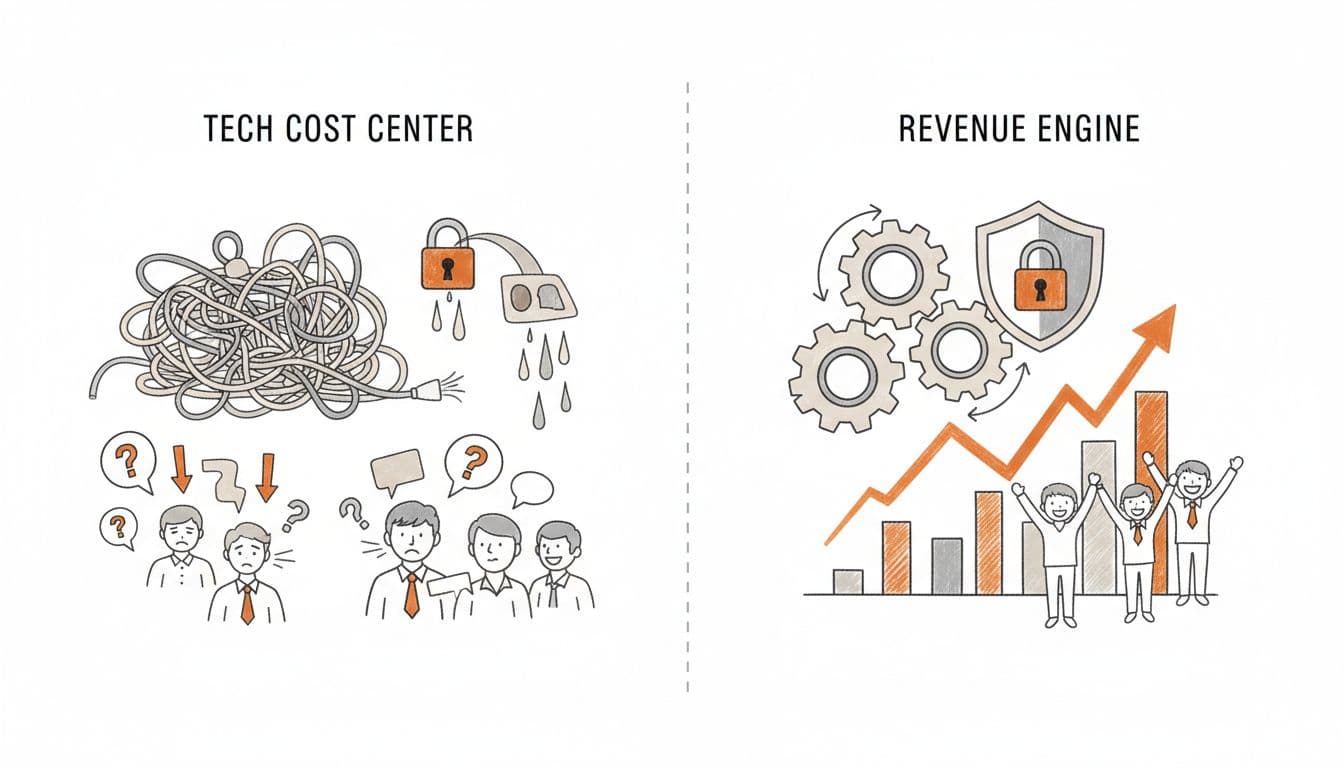
Side-by-side comparison of tech as a cost center versus a revenue engine. Image created with AI.
The hardest part is not picking metrics. It is deciding who watches them and acts.
If tech sits with an IT vendor, finance sits with your CFO, and data sits with a program manager, no one owns the full picture. Everyone sees a cost line, not a revenue engine.
You change that by naming an owner. In many orgs, it is the COO, CFO, or a senior director who thinks across programs.
Give that person three clear jobs:
- Keep a single, short list of major tech spends and their revenue stories.
- Convene a quarterly review with finance, development, programs, and tech support.
- Raise flags early when a system is not hitting its metrics.
This is light-touch governance, not a new committee with a charter. It is a habit. Over time, staff start to talk about tech in the same breath as grants, contracts, and compliance.
That is when your tech spend ROI becomes a shared concern, not just a line item.
FAQs about tech spend ROI for justice-focused organizations
Our revenue is mostly grants and contracts. Does tech spend ROI still matter?
Yes. Your “revenue” is the funding that keeps staff employed and services running. Tech spend ROI, in your case, means “Does this system protect the money we already have and help us win the next round?” Case systems, CRMs, data warehouses, and security investments all play direct roles in clean audits, on-time reports, and stronger proposals.
What if our last big tech project failed and staff do not trust new tools?
That story is common. Start smaller this time. Pick one visible pain point, such as reporting fire drills or duplicate entry across tools. Fix that with a focused change, then measure and share the win. People trust what they can see. A few concrete, well-told wins do more to rebuild confidence than a new platform promise.
How much data do we really need to track tech spend ROI?
Not much. You do not need a data science team. For each big tech spend, aim for one metric you can count today with reasonable effort. Hours saved, errors reduced, reports submitted on time, intakes completed. Track that over time, and pair it with a short story about the revenue or funding that metric supports.
Bringing your tech story back to revenue
When tech feels like a black box, it pulls energy from your mission. Staff feel tired. Boards feel uneasy. Funders sense strain around data and security.
You can change that without becoming a technologist. Start from the money that keeps your work alive. Tie each major tech spend to those revenue moments. Pick a few honest metrics, and review them with your leadership team.
Over a year, this shifts the story from “We have to pay for this software” to “This system protects $5M in grants and makes room for deeper work with communities.” That is tech spend ROI in plain language.
How CTO Input can help you prove tech spend ROI
If you want this, but your leadership team is already stretched, you do not have to build it alone.
CTO Input steps in as your fractional senior tech and security leader. Not to sell a platform, but to sit beside you, listen to how work really happens, and then:
- Map your current tech stack to your real revenue and funding streams.
- Design simple, defensible metrics and reports you can bring to boards and funders.
- Calm the chaos around vendors, security, and data, so staff get time back for advocates and partners.
The challenge: pick one major tech line item from your budget and try to finish the sentence, “We pay for this so that we can protect or grow X.” If you cannot do that with confidence, it is time to talk with CTO Input about building a clearer, safer path forward.