
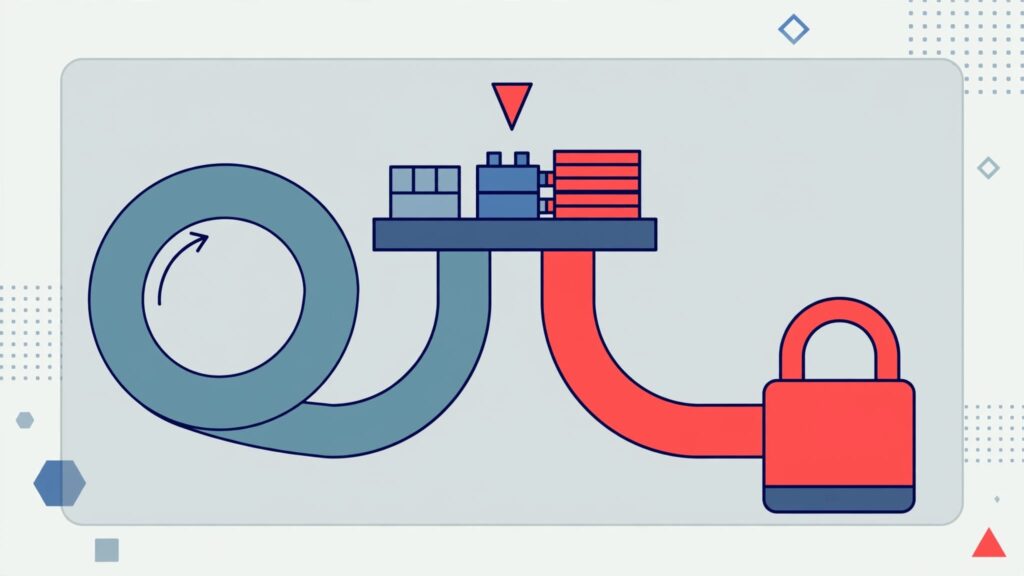
Technology decision reversibility is your ability to undo a choice without unacceptable cost, disruption, or lasting harm. When reversal is easy, you can move faster. When a commitment puts customer trust or business continuity at risk, you need stronger evidence before approving it.
The problem is that a short contract or small pilot can hide a lasting commitment. Your exit cost matters more than the purchase price.
Start by separating what you can change from what your business will have to live with.
Key takeaways for CEOs
- Judge reversibility by the effort, expense, and damage involved in changing course.
- Delegate contained experiments, but require stronger approval when funding or exposure increases.
- Preserve options through staged commitments, tested recovery, and clear vendor exit terms.
- Record what would justify reopening a decision so your team doesn’t confuse disciplined review with constant second-guessing.
Separate reversible choices from lasting commitments

Reversible decisions let you change course
A reversible decision can be undone or replaced with another choice. Everyday choices can be easy to undo: switching hats takes almost no effort. Cutting your hair is reversible over time because it grows back. Buying a book or studying a new field online lets you explore, then stop.
Technology equivalents include testing software with non-sensitive data or changing an internal reporting format. Classify reversible decisions by the effort and impact of changing course, not just the purchase price. A free tool can still expose confidential information.
In Amazon’s 2015 shareholder letter, Jeff Bezos distinguished consequential, nearly irreversible “one-way doors” from “two-way doors,” choices that are easy to change. The distinction helps you match decision-making effort to the commitment.
Irreversible decisions leave consequences behind
An irreversible decision generally cannot be undone. Some consequences are irreversible because you can’t fully restore what they affected.
Choosing a school, dropping out, making a career move, joining a company, leaving a job, marriage, and having children all involve consequences that a later change cannot fully erase. These aren’t equally irreversible. Their lasting effects make a simple reset impossible.
In business, deleting records without recoverable copies is irreversible. Replacing an ERP platform is usually reversible in theory, but reversing it may require another major project.
Treat reversibility as a continuum, rather than forcing every choice into two clean categories.
Judge technology decision reversibility by the exit
When evaluating a reversible decision, ask your team to explain the route back before approving a major commitment. Our technology decision checklist for CEOs places that discussion alongside business value, ownership, and risk.
Establish what restoration would require
“We can switch vendors” is an intention. You need evidence that switching would work.
Use these questions to expose the real exit conditions.
| Dimension | Evidence you need |
|---|---|
| Financial | Termination charges, migration effort, and parallel-running costs. |
| Operational | Expected disruption and a workable fallback process. |
| Data | Usable exports, retained history, and ownership rights. |
| Dependencies | Integrations, specialist knowledge, and downstream users affected. |
| Lasting harm | Customer, privacy, legal, or security consequences that survive reversal. |
The most serious unresolved dependency should set the approval standard. Don’t average away a major exposure because the other answers look comfortable.
Distinguish cancellation from recovery
A monthly subscription may be easy to cancel commercially while remaining operationally difficult to replace. As employees build workflows around it, the cost of leaving increases.
Similarly, restoring software doesn’t retract information already disclosed. Vendor offboarding must address access removal and data handling, not only contract termination.
Ask who can execute the exit, how long it would take, and what evidence supports that estimate. Include internal effort alongside vendor charges.
If your fallback depends on people, data, or capabilities you no longer retain, you don’t yet have a credible rollback plan.
Match decision speed to the actual downside
Stop spending executive time on contained choices
When downside is genuinely limited, prolonged deliberation has an opportunity cost and can lead to overthinking. Your team loses learning time while leadership attention shifts away from consequential decisions.
Set approved spending ranges and data boundaries in advance, with a lightweight structure for low-risk choices and exceptions. Accountable owners can decide quickly within those limits; escalate exceptions, not routine choices.
This also reduces shadow IT. When every small experiment requires an executive negotiation, people have an incentive to work around the process.
Speed is useful when the business can absorb a mistake and learn from it.
Don’t use commitment to escape discomfort
You can agonize over a reversible choice while rushing a lasting one under momentum, emotion, or the pressure to appear decisive.
Heavy emotional weight can encourage that rush. An irreversible commitment may feel attractive because it ends rumination. Meanwhile, anticipated regret can be greater than the regret people later experience.
The conceptual review The wellbeing implications of maximizing examines decision satisfaction, including reversible choices.
For you, relief after approval isn’t evidence of decision quality. Before approval, identify which consequences are irreversible, require alternatives, and challenge the assumptions. A deadline should focus the review, not replace it.
Preserve options through staged commitments

Separate platform evaluation from full migration
For an ERP replacement, avoid treating vendor selection, implementation, and retirement of the old system as one approval.
First resolve process fit and data portability. Next authorize a bounded implementation stage. Retire the fallback only after reconciliation and operational acceptance.
Compare the remaining business value with the remaining cost and risk at each gate. Staged approvals let you change your mind as evidence emerges, without approving the entire migration upfront. Include the expense of running both systems. That overlap buys an option to recover, but it also needs an end date.
A phased approach isn’t automatically safer. Dependencies can make partial migration more difficult than a coordinated cutover. Your technology leader must explain that tradeoff.
Use the same discipline to stress-test a technology roadmap before funding the full sequence.
Contain AI exposure before expanding use
For AI pilot planning, define the business outcome and permitted data before selecting features. Name the owner who can stop the pilot.
Measure value against the existing process. Time saved matters only after you account for review, correction, and operating costs.
AI governance also needs boundaries on external actions. An internal draft can be reviewed before release. An automated customer communication or transaction can create consequences before anyone intervenes.
Before expanding, vet AI features from software vendors for changed permissions, data handling, and connected capabilities.
Stage gates should occur where funding, exposure, or reversibility changes. A successful demonstration alone doesn’t justify the next commitment.
Give decisions clear owners and visible thresholds
Delegate within agreed decision rights
You shouldn’t have to carry every technical call. A decision rights map should clarify the decision-making structure.
The business sponsor owns the outcome. Finance challenges the cost model. Technology leadership explains delivery constraints and recovery options. Security leaders assess exposure against your cyber risk appetite.
The CEO or designated executive approves commitments above agreed thresholds. Board involvement should follow the organization’s governance requirements and materiality standards.
Amazon’s 2016 shareholder letter reinforces using a lighter process for reversible decisions. Apply that principle without treating an untested rollback claim as permission to bypass review.
If a technology leadership gap leaves vendors effectively approving their own recommendations, clarify ownership of technology decisions. A fractional CTO or interim CTO can provide executive capacity without making every choice dependent on the CEO.
Record assumptions and lead with the decision
Use a short decision record for significant commitments. Capture the business outcome, alternatives considered, rationale, accountable owner, and conditions that would change the recommendation.
Keep detailed test results available. For board-ready reporting, lead with the approval required and the exposure it creates. Directors need to understand what becomes harder to reverse after saying yes.
Put decision dates into your technology operating rhythm. Review renewals before notice periods expire. Use quarterly reviews to revisit roadmap assumptions and make explicit choices about what to accelerate, defer, or stop.
This makes technology governance a regular business discipline rather than an emergency meeting.
Frequently asked questions
Does a backup make a technology decision reversible?
A backup protects recoverable information. It doesn’t automatically restore service, reconnect integrations, or recreate lost customer trust.
Business continuity planning must cover the operating response while disaster recovery testing establishes whether restoration works within acceptable limits. You also need people with the authority and knowledge to act.
Before calling a migration reversible, require evidence that the fallback can support the business. Include reconciliation of transactions created after the change. Otherwise, returning to the previous system may introduce another failure.
When should you reopen a technology decision?
Make the best decision you can with the information available. Then reopen it when material circumstances change or a documented assumption fails.
A vendor’s terms may change. An acquisition may alter priorities. Pilot results may weaken the business case. Actions after approval also matter: retiring systems or losing specialist staff can make the original fallback unusable.
Scheduled reviews help you detect those changes. They shouldn’t become invitations to restart every settled debate. Record the trigger and the decision required so your team can act without constant second-guessing.
Make the next commitment deliberate
Technology decision reversibility helps you apply scrutiny where it earns its cost. Move quickly when consequences are contained. Require stronger evidence before your business gives up meaningful options.
For your next major approval, ask for the exit path and the conditions that would change the recommendation. Make the next commitment explicit.
If those answers still depend on informal conversations, Get an Executive Technology Clarity Check to establish sharper priorities, clearer ownership, and a practical next step.