

SEO title: Technology Strategy for Growing Companies A Practical 30 90 180 Day Playbook
Meta description: Technology strategy for growing companies should restore control, speed, and accountability. Learn a practical 30 90 180 day playbook to reduce chaos and support growth.
Slug: technology-strategy-for-growing-companies-playbook
Growth is up. Revenue is moving. New hires are joining. The board wants cleaner answers. Customers want more. And somehow the business feels less in control than it did six months ago.
That usually shows up in small ugly ways first. The monthly report takes a week of manual cleanup. A product change gets delayed because two systems don't agree. A key vendor contract is buried in someone's inbox. One manager becomes the person who knows how everything works, which means nobody else really does.
Technology strategy for growing companies stops being abstract. You're not dealing with a tech problem in the narrow sense. You're dealing with a control problem. Growth has outpaced the decision system, and now technology is where the confusion collects.
When Growth Starts to Punish Your Technology
A lot of companies mistake this stage for bad luck.
They think they need one more hire, one more tool, one more integration, one more dashboard. What they need is a way to make the current reality legible again.

A familiar pattern looks like this. The company grew on hustle, smart people, and quick decisions. Early systems were good enough. People used HubSpot, QuickBooks, Jira, Slack, Google Sheets, maybe a few no-code automations, and got on with it. That worked when the founder could still see most decisions personally.
Then the company added locations, products, teams, or service lines. The shortcuts stayed. The complexity didn't.
The signs leaders feel before they can name the problem
The CEO notices that every operating review turns into a debate about whose numbers are right.
The COO sees teams building workarounds because the systems don't line up. A support team tracks customer issues in one place, the delivery team uses another, and finance closes the month by manually stitching data together. Automation gets discussed constantly, but usually in a shallow way. If that's where your team is, a practical guide to implementing automation can help frame where automation supports operating discipline and where it merely hides process mess.
The founder notices something worse. Decisions don't stick. A priority gets agreed on Monday, challenged by Wednesday, and displaced by Friday because a vendor made a promise, a customer escalated, or a team found a new emergency.
Practical rule: If reporting, ownership, and delivery all feel harder at the same time, the business has probably outgrown its informal technology model.
What this looks like on the ground
Here are the symptoms I see most often:
- Manual reporting keeps expanding: The monthly pack exists, but people don't trust it until someone "cleans" it.
- One person knows too much: A long-serving operations lead, engineer, or admin becomes the unofficial system map.
- Buying gets ahead of design: New tools arrive faster than the business decides how work should flow.
- Customer experience becomes inconsistent: Teams mean well, but handoffs break because systems weren't built for the current scale.
- Leadership loses time to status hunts: Instead of reviewing performance, senior people spend meetings figuring out what is happening.
This doesn't mean the company failed. It usually means the company succeeded faster than its operating system matured.
That's why I often tell leaders to treat this as a growth signal, not a shame signal. If technology is now holding back business growth, the answer isn't panic. It's to replace implied ownership and tribal knowledge with a real system.
Why Your Current Technology Approach Is Breaking
The early version of a company runs on speed, trust, and heroics. That's normal.
The trouble starts when leadership keeps using a startup operating model after the company is no longer operating like a startup. What used to feel agile now feels slippery. Nobody is fully wrong, but nobody is clearly accountable either.
Informal systems don't survive complexity
A growing company often has capable people working hard. That's not the issue. The issue is that the original model depended on proximity.
The founder heard things quickly. The ops lead knew every workflow. The head of product could walk over to engineering. The finance manager could fix exceptions manually. Those habits stop working once more teams, more tools, and more vendors enter the picture.
Traditional frameworks for technology strategy often fail growing companies because they assume stable business goals and deliberate planning cycles. They don't address the coordination tax that appears when a company scales faster than its decision-making system. The result is what one analysis describes as strategy drift, where plans become obsolete within 90 days of hypergrowth and teams keep executing against ghost plans while real decisions happen elsewhere, as discussed in this analysis of technology strategy under growth pressure.
Three breakdowns create most of the chaos
The pattern is usually some mix of these three problems.
Fuzzy ownership
Nobody can answer basic questions cleanly. Who owns the CRM architecture? Who approves a new vendor? Who is accountable for data quality across systems? Who decides whether the business should customize, replace, or retire a tool?
When ownership is fuzzy, work still happens. It just happens through escalation, persuasion, and personality. That is expensive. It also means risk sits in the gaps between teams.
Vendor-driven roadmaps
Most companies don't intend to let vendors shape their future. It happens subtly.
A platform account manager pushes a module. An implementation partner recommends an add-on. A department head buys a point solution to solve an urgent pain. Six months later, the roadmap is a patchwork of commitments the leadership team never really chose.
The problem isn't vendors themselves. Many are useful. The problem is letting third parties make architecture decisions by default.
If your roadmap is mostly a stack of contract renewals, you don't have a technology strategy. You have procurement history.
Coordination tax from tool sprawl and technical debt
Tool sprawl is rarely just "too many apps." It is the accumulation of disconnected choices.
Maybe Salesforce doesn't match what's in the support platform. Maybe Jira workflow doesn't reflect how delivery works. Maybe finance exports data into spreadsheets because the source systems were never designed to answer leadership questions. Each workaround seems manageable in isolation. Together they slow the company down.
Why leaders often miss the root cause
Leaders usually see the symptoms and misread them.
They think the issue is execution discipline. Or middle management. Or a weak project manager. Sometimes they blame the technology team for "not being strategic enough" while giving that same team no decision authority over tools, processes, or vendor commitments.
The deeper issue is structural. The business is asking technology to support scale without giving anyone a real mandate to align systems, priorities, and tradeoffs.
A useful diagnostic is simple:
| Question | Healthy answer | Unhealthy answer |
|---|---|---|
| Who owns the decision? | One named role | "It depends" |
| Why are we doing this? | Clear business outcome | "We've been meaning to" |
| What happens if it slips? | Known impact and escalation | Confusion and blame |
| Which system is the source of truth? | One defined system | Several partial answers |
When a leadership team can't answer those questions quickly, the problem isn't effort. The problem is that growth has outrun governance.
The Real Business Cost of Technology Chaos
Technology chaos sounds operational. It isn't. It lands in margin, speed, risk, and trust.
That is why this deserves executive attention. Not because the stack is messy, but because poor control over the stack weakens the business.

Spend rises while value gets harder to prove
A budget can grow without capability improving.
Forrester notes that tethering IT spend to annual budgets without an explicit strategy leaves technology investments underperforming their potential by 20 to 30% in realized business value, and PwC's technology-strategy work indicates that companies that systematically map their tech stack to growth priorities typically realize 15 to 25% higher ROI on technology spend and reduce unplanned rework by roughly one-third compared with companies operating without a coherent strategy, as summarized in Forrester's technology strategy research.
That isn't a technical nuance. That's leadership value leakage.
Board confidence weakens before a major incident happens
Boards and investors rarely ask for perfect systems. They ask for clear answers.
Can leadership explain who owns critical platforms? Can they show how vendor risk is handled? Can they describe where sensitive data sits? Can they show what is on track, what is blocked, and who is accountable?
When answers are vague, confidence drops. The board starts hearing effort without evidence. That creates pressure on the CEO, the COO, and often the CFO, because they are now carrying a risk story they can't defend crisply.
Board reality: Weak technology oversight usually shows up first as vague reporting, then as concern about control, then as scrutiny over leadership judgment.
The business slows in places leaders can feel
The commercial team feels it when launching something new takes longer than expected.
Operations feels it when handoffs fail and staff build manual side processes to keep customers moving. Product feels it when roadmap promises are constrained by old system choices nobody formally approved. Finance feels it when close, forecasting, or cost attribution depends on manual reconciliation.
A chaotic environment creates a false sense of motion. People are busy. Tickets are moving. Meetings are full. But the business is paying a hidden tax in rework, delay, and distraction.
A simple way to translate chaos into business terms
Use this lens in your next leadership review:
- Profitability: Are duplicated tools, manual work, and avoidable rework eroding margin?
- Speed: How long does it take to make a decision, make a change, and see a result?
- Control: Can someone name the owner, system of record, and current risk for each critical area?
- Trust: Would a board member, insurer, acquirer, or major customer find the current answers credible?
If those answers are uncomfortable, that's useful. It means you're finally looking at the problem in the right language.
A 30-90-180 Day Playbook to Regain Control
Most companies don't need a giant transformation first. They need control first.
The mistake is trying to solve everything at once. That usually produces a workshop deck, a broad wishlist, and more fatigue. A workable technology strategy for growing companies needs a sequence. Stabilize. Prioritize. Then scale.
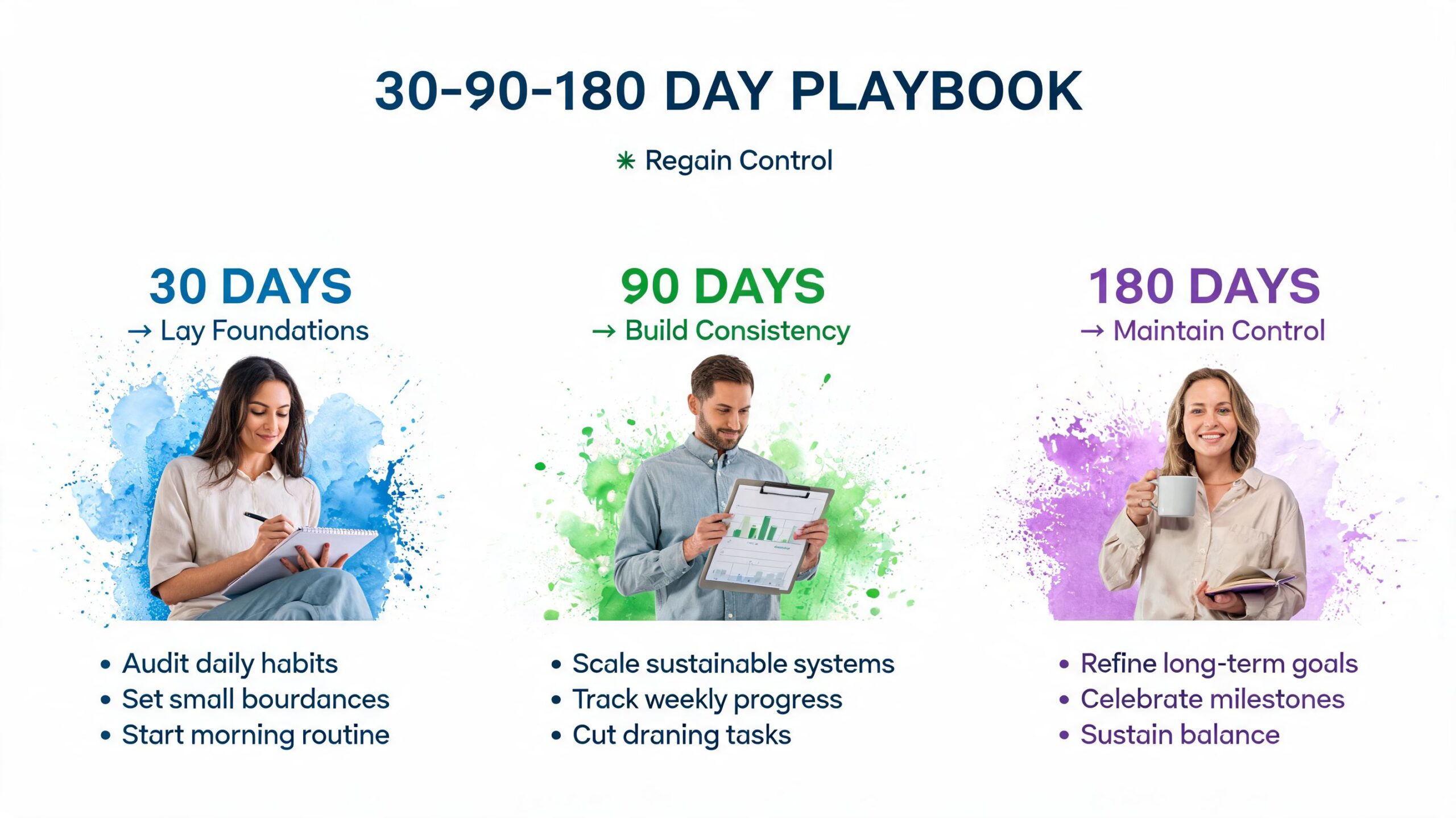
A solid planning cycle doesn't need to drag on forever. Effective IT strategy development requires a structured 8 to 10 week planning process, with success anchored in tracking just 5 to 7 core KPIs, clear governance, and data-driven prioritization methods such as ICE or RICE, according to this IT strategy development framework.
Days 0 to 30 diagnose and stabilize
In the first month, don't chase optimization. Make reality visible.
You need a current-state map that shows systems, vendors, owners, key dependencies, major risks, and active initiatives. Keep it practical. This is not the time for a glossy enterprise architecture diagram nobody will use.
Start by answering these questions:
- Which systems are business-critical: Focus on the platforms that affect revenue, operations, finance, customer delivery, and security.
- Who owns each one: Name the role, not the committee.
- Where are decisions getting stuck: Look for approval bottlenecks, vendor dependence, and recurring escalations.
- What breaks if one key person disappears: This exposes concentration risk fast.
Then establish a weekly operating cadence. Same day. Same attendees. Same format. Review open decisions, delivery status, current risks, and blocked work. The goal is to stop running technology through side conversations.
What to produce in the first 30 days
A strong first month usually ends with these artifacts:
| Deliverable | What it does |
|---|---|
| Current systems map | Shows the tools that actually run the business |
| Ownership register | Names accountable leaders for platforms and initiatives |
| Vendor list with renewal visibility | Prevents contract surprises and roadmap drift |
| Top risk log | Surfaces the issues that can slow growth or damage trust |
| Weekly governance rhythm | Creates decision discipline and escalation paths |
This is also where outside support can help. Some teams use internal operators. Some bring in an experienced advisor. One option is CTO Input's application portfolio rationalization approach when the problem is too many overlapping systems and no clear plan for simplification.
Start with legibility. You can't govern what nobody can clearly see.
Days 31 to 90 prioritize and simplify
Once the picture is visible, resist the urge to launch ten projects.
This phase is about choosing fewer things and finishing them. Use an ICE or RICE style lens to rank initiatives by likely impact, confidence, and effort. The point isn't mathematical perfection. The point is to stop letting volume and loudness dictate priority.
A typical shortlist in this phase includes:
- A reporting fix: Clean up one leadership report that currently depends on manual stitching.
- A vendor decision: Retire, consolidate, or renegotiate a tool that creates cost without enough value.
- A workflow repair: Remove one recurring handoff problem between teams.
- An ownership correction: Move a critical system from implied ownership to named accountability.
What to cut during this phase
Some things should stop immediately:
- Shadow projects: Work that has no sponsor, no clear business case, and no finish line.
- Speculative tooling: New apps bought to avoid fixing an underlying process problem.
- Committee ownership: Shared accountability that allows everybody to participate and nobody to decide.
At this point, many companies start feeling relief. Not because everything is fixed, but because noise drops. Work becomes inspectable. Fewer initiatives are active, and the important ones have owners.
Days 91 to 180 align and scale
By this point, the company is ready for a proper roadmap that reflects business priorities instead of inherited mess.
This phase is where strategy becomes durable. You take the lessons from the first ninety days and convert them into a board-defensible operating model. The roadmap should tie technology work to business outcomes such as delivery speed, customer reliability, cost control, resilience, and reporting quality.
Build the roadmap around a few categories
Don't organize the roadmap around vendors or internal silos. Organize it around business needs.
Run the business better
These are stability and control moves. Clean ownership, better support flow, clearer reporting, and reduced single-person dependency belong here.
Simplify the stack
Consolidate overlapping tools. Retire low-value applications. Clarify where core data should live.
Improve decision speed
Fix the places where approvals, exceptions, and unclear authority slow execution.
Reduce trust risks
Tighten vendor oversight, data handling, access control, and escalation paths so leaders can answer hard questions cleanly.
Keep the KPI set small and serious
Companies frequently track too much and learn too little.
Pick 5 to 7 KPIs that leadership will review and use. They should span business value, not just technical activity. Good examples include reporting timeliness, delivery predictability, unresolved critical risks, vendor concentration concerns, system reliability in customer-facing workflows, and initiative completion against plan.
A useful governance model has four parts:
- Named owner for every initiative.
- Acceptance criteria that define what done means.
- Escalation rule when delivery or risk thresholds are missed.
- Leadership review cadence that keeps decisions current.
What the first 180 days should change
By the end of this period, leaders should be able to answer three questions without scrambling:
- Who owns this
- What is the plan
- When will it be done
If those answers are finally evidence-based, not personality-based, the operating model is starting to work.
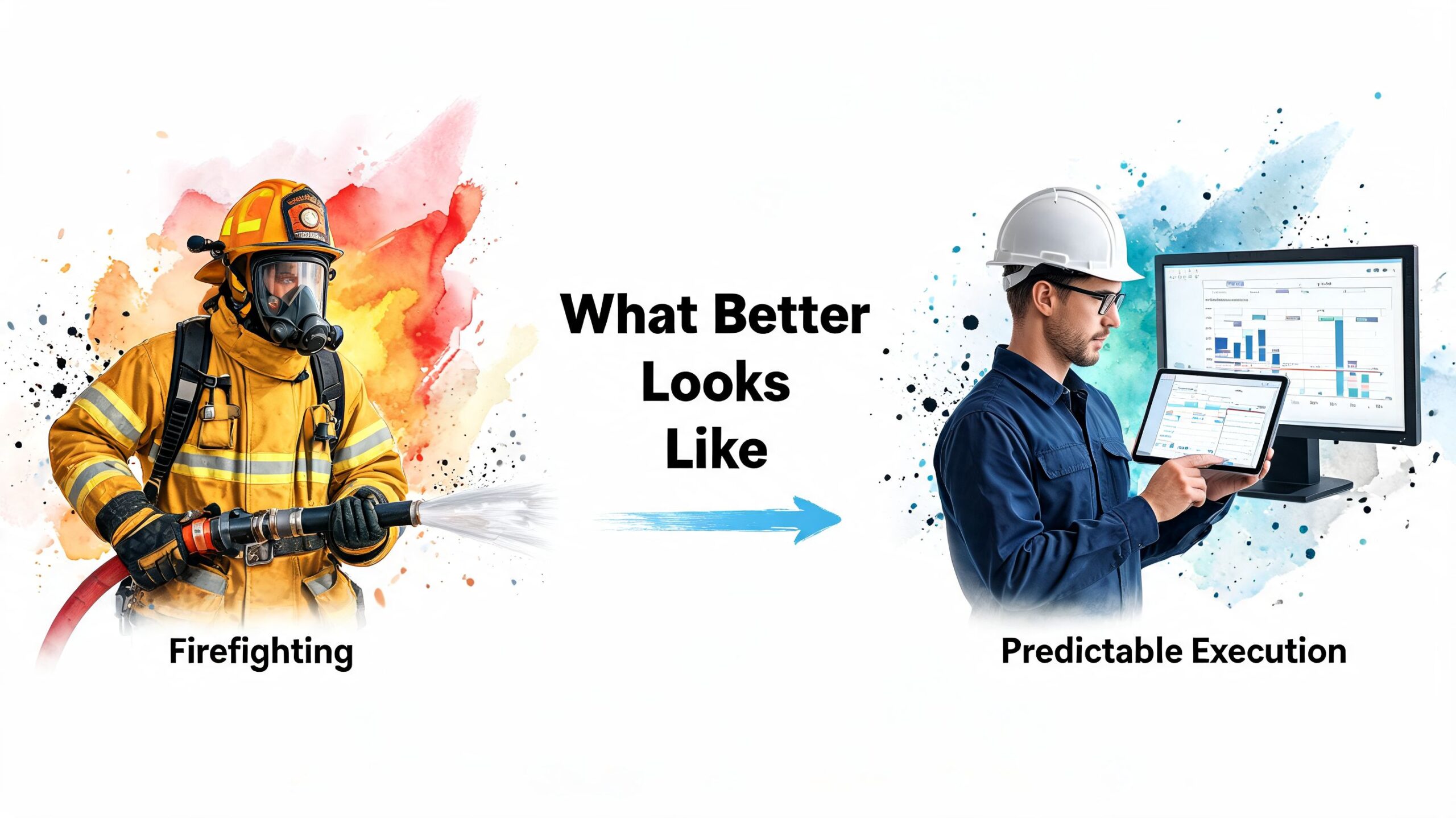
What Better Looks Like From Firefighting to Predictable Execution
The biggest change isn't that the company becomes slower and more controlled. It becomes calmer and faster at the same time.
That surprises people. They assume governance means friction. Good governance does the opposite. It removes repeat confusion so teams can move with less waste.
What changes in day-to-day leadership
The CEO stops chasing updates across Slack, email, and hallway conversations.
The COO can see where work is blocked without running a private investigation. The CFO gets cleaner reporting with less manual intervention. Department heads stop treating technology as a mysterious service desk and start working within a decision framework that has owners, tradeoffs, and follow-through.
You also see cultural changes that matter. Teams become less defensive because priorities are clearer. Vendors stop winning by default. Senior people stop relying on heroics from one or two overextended staff members.
Predictable execution doesn't mean fewer problems. It means fewer surprises and faster, cleaner decisions when problems appear.
What this means competitively
This matters even more because the external market isn't standing still. The global software industry is projected to grow at an 11.3% CAGR through 2030, and McKinsey finds that companies aligning technology, people, and capital around a clear strategy can improve technology ROI by up to 25% and compress time-to-market for new products by as much as 40 percentage points versus peers, as cited in HubSpot's analysis of fastest-growing industries.
In plain terms, leaders who treat technology strategy as an operating discipline give themselves a better chance to move quickly in a market that is getting more competitive, more software-driven, and less forgiving.
A practical picture of the after state
The before state sounds like this:
- "I think Sarah owns that."
- "We have three versions of that report."
- "Let's renew it for now and sort it out later."
- "We're waiting on one person."
The after state sounds different:
| Before | After |
|---|---|
| Decisions drift | Decisions have owners and dates |
| Reporting is a fire drill | Reporting is routine and trusted |
| Vendors shape priorities | Leadership sets the roadmap |
| Teams improvise handoffs | Workflows are defined and reviewed |
A useful next reference point is a clear IT strategy and roadmap guide that ties planning back to execution, especially if your leadership team already knows the pain but needs a cleaner model for ongoing oversight.
Your Next Step Toward a Calmer Faster Business
If this article sounds familiar, the issue probably isn't that your team lacks effort.
It's that growth has exposed a weak operating system. The business can no longer rely on implied ownership, scattered tooling, and memory-based management. That model might have helped you get here. It won't help you scale cleanly from here.
A good technology strategy for growing companies does three things. It makes reality visible. It assigns ownership that holds. And it creates a delivery rhythm that leadership can inspect without drama.
What to do this week
Don't start with a transformation program.
Start with a short leadership session and answer these questions thoughtfully:
- Which systems are critical to revenue, operations, and reporting
- Who owns each one today
- Where are we relying on one person, one vendor, or one workaround too heavily
- Which current initiative would we stop, simplify, or delay if we had to defend every hour and dollar
If the answers are fuzzy, that's your signal. You don't need more noise. You need a reset.
The standard to aim for
You are aiming for something simple and rare.
A business where technology decisions support growth instead of interrupting it. A leadership team that can answer hard questions without scrambling. An operating rhythm where important work finishes because ownership is clear and priorities stay real long enough to matter.
That is not a luxury for later. It is part of how a growing company protects speed, control, and trust.
If technology is slowing growth, reporting still feels harder than it should, or leadership can't answer "who owns this, what is the plan, and when will it be done" with confidence, a conversation with CTO Input is a practical next step. A Clarity Call can help surface the main bottlenecks, the trust risks behind them, and the first moves that would restore control.