

A data fabric is an architecture that connects your scattered data sources and lets people access and manage information without moving everything into one central database. Done well, it gives leaders faster answers with less integration drag, and estimates cited by Gartner say it can reduce integration design time by 30%, deployment time by 30%, and maintenance by 70% when implemented as part of a data fabric approach (dbt Labs on data fabric).
If your reporting feels slow, political, or unreliable, the problem usually isn't that you lack data. It's that your business runs on disconnected systems, inconsistent definitions, and too many manual handoffs. Finance has one number. Sales has another. Operations has a third. By the time someone reconciles them, the decision window has already passed.
That is the reason executives start asking what is a data fabric. They aren't shopping for another shiny platform. They want reporting they can trust, faster answers, and less time wasted on spreadsheet archaeology.
Your Data Is Everywhere But Answers Are Nowhere
A CEO asks a simple question in the Monday meeting: Why did margin slip in one region while revenue rose?
The answer should take minutes. Instead, finance pulls ERP data, sales exports CRM reports, operations checks a warehouse system, and someone on the data team starts stitching it together by hand. By Wednesday, three versions of the truth are circulating. None of them line up cleanly. Everyone is working hard, and leadership still doesn't have a confident answer.
That pattern is more common than often admitted. The business looks data-rich from the outside, but inside, people are compensating for fragmentation. Systems don't agree. Definitions drift. Reports rely on manual cleanup. The board gets polished slides, but the process behind them is fragile.
What broken reporting actually looks like
It rarely shows up as one dramatic failure. It shows up as a tax on everyday operations.
- Leadership delay: Important decisions wait because the team needs to “check the numbers.”
- Manual heroics: One analyst or engineer becomes the human glue between systems.
- Trust erosion: Department heads start arguing about whose report is right.
- Control weakness: Sensitive data ends up copied into side files and ad hoc reports.
If that sounds familiar, you're already paying for the problem. You're paying in slower decisions, staff frustration, and weaker oversight.
A lot of this starts when companies add tools faster than they add operating discipline. CRM, ERP, billing, product analytics, spreadsheets, warehouse tools, and cloud platforms all multiply. If you're also running across hybrid environments, even the supporting stack gets harder to manage. That's one reason leaders start looking at platforms for multi-cloud management as part of the wider visibility problem.
Broken reporting is usually an operating model problem wearing a technology costume.
Why leaders miss it for too long
The business often grows despite the mess, at least for a while. Teams build workarounds. Smart people compensate. Reports still get delivered, just with too much effort and too little confidence.
Then scale exposes the weakness. More systems. More vendors. More scrutiny. More consequences when numbers don't reconcile.
At that point, shadow reporting becomes the norm. If that's happening in your organization, start by dealing with the spread of side systems and unofficial tracking files. This piece on how to retire shadow spreadsheets gets at one of the root causes directly.
What you're feeling has a name. It isn't just “bad BI” or “messy reporting.” It's a fragmented data architecture with no reliable control layer over it.
What Is a Data Fabric in Plain English
A data fabric is not a database you buy and switch on. It's an architectural approach that creates a unified layer across distributed systems so the business can access, manage, and govern data where it already lives.
It's like a universal power adapter for your business data. Your systems all have different plugs, formats, rules, and owners. A data fabric doesn't rebuild every device in the company. It creates a consistent way to connect to them, understand them, and use them safely.
Why the concept exists
Traditional integration had a bad habit. Every new question triggered a new pipeline, a new export, a new data job, or a new one-off fix. That model gets expensive and slow.
K2view explains that the concept emerged to solve the immense cost and delay of traditional data integration and to make a company's data estate reusable across many applications instead of rebuilding for every question (K2view on what a data fabric is).
That's the part most vendor content soft-pedals. The point isn't elegance. The point is reducing repeated integration work so the business can stop reinventing access to the same underlying data.
What it is not
A data fabric is not:
- Another reporting dashboard: Dashboards sit at the end. A fabric deals with access, consistency, and governance underneath.
- A single product: Vendors sell pieces of the stack, but the architecture is what matters.
- A free pass on governance: If ownership is fuzzy now, a fabric won't magically fix that.
If you're trying to make sense of governance before you touch tooling, this data governance framework template is the right kind of starting point.
If your team is asking which vendor is the data fabric, they're asking the wrong first question.
The better first question is this: how will we create one governed way to access and use data across systems without copying everything into a bigger mess?
If you're surveying the market, even lightweight directories like the Flaex.ai Fabric AI listing can help you see how broadly the term gets used. That's useful mainly as a reminder to separate architecture from marketing.
How a Data Fabric Works for the Business
The cleanest way to understand a data fabric is to stop thinking about features and start thinking about jobs. What job does each part do for the business?
HPE describes data fabric as an architectural design, not a single product, built on capabilities such as data virtualization, federated active metadata, and machine learning to automate governance and optimize how data moves through the organization (HPE on data fabric architecture).
That sounds technical. Here is the executive translation.

It gives you a consistent access layer
Data virtualization means teams can work with data without making endless physical copies of it first. For the business, that matters because copied data drifts. One team updates its version. Another does not. The meeting becomes a reconciliation exercise.
A fabric aims to reduce that copy-and-confuse pattern. People get a logical view of the data, even when the actual records live across different systems.
It gives you memory about the data
Federated active metadata is the part most leaders should care about more than they do. In plain English, it's a living catalog that knows what the data is, where it came from, how it is used, and who should have access.
That matters because reporting doesn't break only from bad numbers. It breaks from weak context.
- Definition clarity: Revenue, customer, active account, and margin need agreed meanings.
- Lineage visibility: Teams need to know where a number originated.
- Policy enforcement: Access rules shouldn't depend on who happens to be helping that day.
If your current environment can't answer basic lineage and ownership questions, start with an integration inventory. Most organizations underestimate how many hidden handoffs exist between systems.
It automates parts of governance
Machine learning in this context is not the flashy part. It is the useful part. It helps identify patterns, classify data, support governance decisions, and optimize data pathways.
That means less guesswork and less reliance on tribal knowledge.
A good data fabric doesn't just connect systems. It reduces the number of judgment calls your team has to make by hand.
It works across the estate you already have
Most companies are not starting fresh. They have on-premises applications, cloud tools, warehouses, lakes, SQL databases, departmental apps, and vendor-managed platforms. A data fabric is valuable because it creates consistency across that mixed estate rather than pretending you can replace it all cleanly.
That is the business mechanism. Not magic. Not a silver bullet. A control layer that helps the company access distributed data with less copying, better context, and stronger governance.
The Business Benefits of a Unified Data View
Monday's leadership meeting starts the same way it ended last week. Sales has one revenue number. Finance has another. Operations says both are missing key accounts. Nobody is debating strategy yet because nobody trusts the inputs.
That is the primary business case for a unified data view. It fixes decision friction.
A data fabric improves business performance by reducing the time, cost, and management overhead required to get reliable answers across systems. The payoff is not technical elegance. The payoff is fewer delays, fewer reporting disputes, and fewer expensive workarounds hiding inside every planning cycle.
Faster execution and less operational waste
In companies without a fabric model, every new question turns into a small integration project. Someone has to locate the data, reconcile definitions, patch a pipeline, test a report, and explain why the number changed from last month. That is not analysis. That is rework.
A unified data view cuts that waste.
Teams can reuse shared data products, shared definitions, and shared access rules instead of rebuilding the same logic in different tools for different executives. That shortens the path from question to answer and lowers the cost of change. As noted earlier, Gartner-cited estimates point to meaningful reductions in design, deployment, and maintenance effort. The headline for leadership is simple. Your reporting stack stops behaving like a custom construction site.
Better decisions when the pressure is on
Pressure exposes weak data operating models fast. During a board meeting, a pricing review, or a supply disruption, leaders do not need more dashboards. They need one version of the truth they can defend.
When the numbers are consistent across functions, the conversation changes:
- Board reporting becomes more credible because finance can trace figures back to governed sources
- Operating reviews move faster because teams spend less time reconciling spreadsheets and more time making decisions
- Management accountability gets sharper because definitions, owners, and exceptions are visible instead of buried in email threads
That shift matters more than any dashboard redesign.
Reuse changes the economics of data work
The strongest business benefit is reuse. A fabric lets the company solve a data problem once, then use that solution across reporting, forecasting, customer operations, and compliance.
Without that model, each request gets funded like a one-off project. Budget gets consumed by plumbing. Delivery slows down. Institutional knowledge stays trapped with a few specialists who know which script still works and which table should never be touched.
That is how reporting becomes fragile even while spending goes up.
Control without creating another bottleneck
Many leadership teams respond to data chaos by trying to centralize everything into one platform. That often replaces one problem with another. You get a bigger backlog, a larger migration bill, and a new dependency on the central team.
A unified data view gives you a better operating model. Business units can keep using the systems they need, while the company applies consistent rules for access, quality, lineage, and definitions across the estate. That is the point CEOs should care about. You get tighter control over business information without forcing a full rip-and-replace program first.
The outcome is practical. Faster reporting. Cleaner accountability. Less political debate over whose number is right. That is what makes a data fabric worth funding.
Data Fabric vs Data Mesh and Lakehouse
Leaders usually hear these terms in the same conversation, then get sold as if they're interchangeable. They're not.
A data fabric is about creating a consistent layer of access, integration, and governance across distributed systems. A data mesh is more of an organizational model that pushes responsibility for data products closer to business domains. A lakehouse is a platform strategy that blends characteristics associated with lakes and warehouses in one environment.
If you confuse these, you end up buying the wrong thing for the wrong reason.
Data architecture at a glance for leaders
| Approach | Core Philosophy | Primary Responsibility | Best For |
|---|---|---|---|
| Data Fabric | Create one governed way to access and manage distributed data | Shared enterprise architecture and governance leadership | Organizations with fragmented systems that need consistency across environments |
| Data Mesh | Push data ownership toward business domains | Domain teams with strong accountability | Companies with mature teams that can own data as a product |
| Lakehouse | Consolidate analytics workloads on a common platform | Central data platform team | Businesses focused on analytics platform simplification |
Which one solves which problem
If your main issue is that data is scattered across tools, clouds, and operational systems, a fabric is often the most direct answer. It is built for connection and governance across sprawl.
If your issue is that central teams have become a bottleneck and your business units are capable of owning their own data products responsibly, mesh becomes relevant. But be careful. Data mesh sounds enabling until weak domain ownership turns it into distributed chaos.
If the challenge is mostly analytics platform design, a lakehouse may help. But it does not, by itself, solve ownership confusion or governance ambiguity across the wider estate.
The executive shortcut
Ask one question: where is the actual bottleneck?
- Integration and consistency problem: Look hard at data fabric.
- Ownership and organization design problem: Consider data mesh.
- Analytics platform consolidation problem: Evaluate lakehouse.
Most companies that ask what is a data fabric are not really asking for another platform slogan. They are trying to restore trust in answers across a messy operating environment. That is why data fabric tends to land closer to the core business problem.
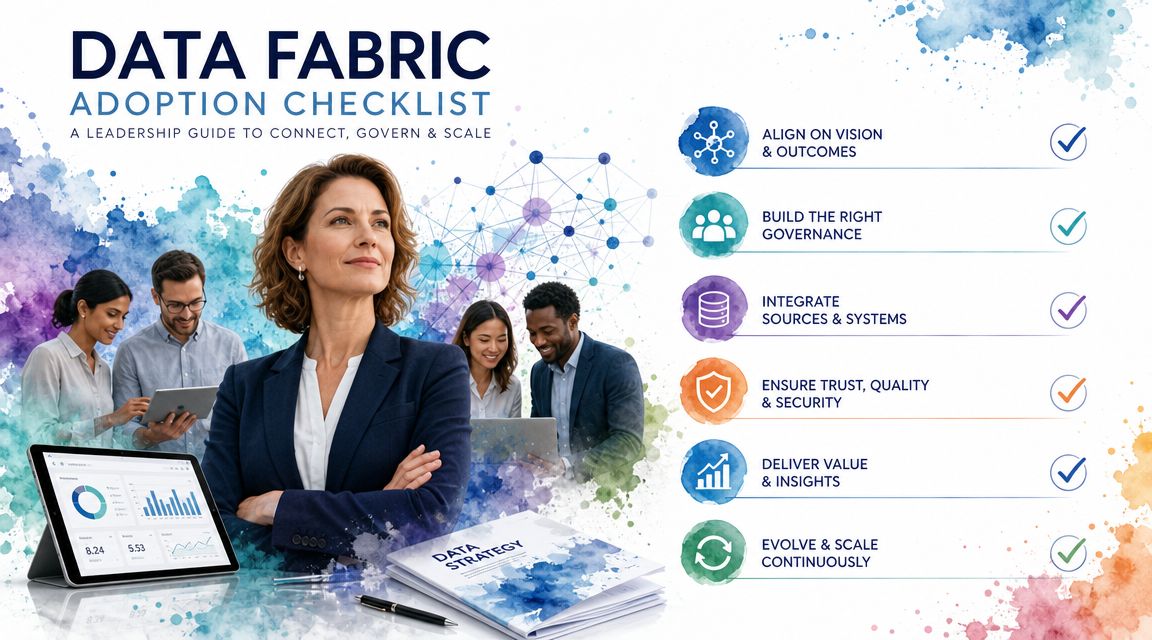
A Leader's Checklist for Data Fabric Adoption
Most data fabric projects fail before technology selection. They fail because no one defines the operating model. IBM's guidance is blunt on this point: the biggest risk is not the technology but the lack of a clear operating model, including ownership of metadata quality, access policies, and governance exceptions (IBM on data fabric operating model risk).
That is exactly right. If you don't settle ownership first, the fabric becomes another layer sitting on top of old confusion.
Start with business pressure, not tooling
Before anyone demos a platform, leadership should answer these questions:
Which business questions are too hard to answer today?
Don't start with architecture diagrams. Start with the few decisions that matter most. Margin by segment. Customer churn drivers. Inventory exposure. Contract profitability. Pick the questions that currently trigger manual scramble.Which data domains are mission-critical?
Customer, revenue, product, vendor, employee, case, asset. Be specific. A fabric needs priority lanes, not a vague mandate to “unify everything.”Who owns each domain?
Ownership cannot sit only in IT. Business leaders must own definitions, quality expectations, and exception handling for the domains they depend on.
Practical rule: If nobody can name the business owner for a critical data domain, you're not ready to buy anything.
Define the operating model
Executives either create control or accidentally fund a new mess.
- Metadata ownership: Who is responsible for keeping definitions, lineage, and classifications accurate?
- Access policy changes: Who approves them, and how are they documented?
- Exception handling: What happens when finance and sales definitions conflict?
- Incident response: Who acts when a data source breaks or disagreeing records create reporting risk?
These are governance decisions, not technical footnotes.
Run a small, high-value pilot
Don't launch a broad “enterprise data transformation” initiative. Pick one use case where the pain is visible and the value is obvious.
Good pilot traits:
- Cross-functional relevance: It matters to more than one department.
- Known reporting friction: People already feel the delay or inconsistency.
- Clear owner: Someone in the business will champion the result.
- Governance significance: The use case forces you to define access and quality rules early.
A pilot should prove that the operating model works, not just that a connector works.
What the first 30 days should look like
In the first month, a serious leadership team should aim to produce four things:
A decision list of priority business questions
Not every question. Just the ones that justify action.A named owner for each critical data domain
This removes the common “everyone assumed someone else had it” problem.A map of current systems and integration handoffs
You need to know where the current truth breaks.A governance path for policy, exceptions, and escalation
This is what keeps the future fabric from becoming another coordination tax.
What to avoid
Some mistakes are predictable.
- Don't buy a tool to create strategy: Software won't answer who owns data quality.
- Don't centralize every decision: Shared standards matter, but so do clear domain owners.
- Don't promise one version of truth overnight: Aim for reliable, governed access to the most important truths first.
- Don't leave legal, compliance, or security out of it: Access and policy decisions need their input early.
A good data fabric initiative is not an IT project with executive sponsorship. It is a business control initiative with technical implementation.
From Data Chaos to Calm Confidence
Monday morning. The CEO has one revenue number. The CFO has another. Sales has a spreadsheet nobody else trusts. The problem is not reporting. The problem is management. If leaders cannot rely on shared facts, the company starts operating on politics, workarounds, and memory.
A data fabric fixes that only if you treat it as a control system for the business. Companies that get this right build an advantage that compounds over time: faster integration after acquisitions, cleaner compliance reviews, less dependence on tribal knowledge, and more confidence when they enter a new market, change pricing, or face a board-level challenge. That advantage lasts longer than any dashboard redesign.
This is the point many teams miss. A data fabric should reduce key-person risk. If two people leave and your critical numbers become hard to reproduce, you do not have a data platform. You have an undocumented operating dependency.
The long-term win is not calmer reporting. It is institutional memory you can trust.
If your reporting still depends on manual stitching, unofficial spreadsheets, and a few people who know how the numbers really work, fix the operating model before you expand the tooling. Set ownership. Set policy. Set escalation paths. Then use technology to enforce those decisions consistently across systems.
If your organization is dealing with slow reporting, conflicting numbers, or fuzzy ownership around critical systems and data, CTO Input can help you make the problem legible and define the first practical moves. A clarity call is a good next step if you want to identify the top bottlenecks, the top trust risks, and what the first 30 days of a calmer operating model should look like.