

SEO title: Strategic Technology Planning That Isn't Chaos
Meta description: Strategic technology planning should reduce chaos, not add to it. Learn how to diagnose coordination tax, cut vendor sprawl, and build a calmer execution system.
Slug: strategic-technology-planning-that-isnt-chaos
You usually know the meeting before it starts.
Technology spend is up. The team is busy. New tools keep appearing. Priorities sound reasonable in isolation. But when someone asks the simple executive question, “What exactly are we getting for this, who owns it, and what finishes next?” the room gets vague.
That vagueness is expensive.
It shows up as stalled growth, duplicate systems, reporting fire drills, brittle vendor dependence, and a board that can feel the risk even if no one can name it cleanly. The issue usually isn’t effort. It’s that the business is paying a coordination tax every day through fuzzy ownership, leaky handoffs, and decisions that don’t stick.
That’s why strategic technology planning matters. Not as a binder. Not as a slide deck. As a practical operating system for control.
Why Tech Investments Feel Chaotic and Expensive
The pattern is familiar.
A CEO approves a CRM change because sales needs cleaner pipeline data. Operations adds another workflow tool because the current one feels slow. Finance wants better reporting. Security asks for tighter controls. Someone in a department starts using an AI tool because it saves time. None of those decisions sound reckless on their own.
Then six months later, the business has more software, more meetings, more exceptions, and less clarity.

Busy doesn’t mean controlled
What leaders feel in that moment is usually hard to articulate. The team looks overloaded. Projects seem active. Vendors keep promising relief. Yet the business still feels fragile.
That’s the coordination tax.
It’s the hidden drag created when no one can clearly answer:
- Ownership: Who owns the business outcome, not just the system?
- Handoffs: Where does work stall between teams?
- Decision rights: Who can say no to new tools, new integrations, or new priorities?
- Accountability: What gets reviewed every week until it’s done?
When those answers are fuzzy, technology stops acting like infrastructure for growth and starts acting like a collection of expensive exceptions.
The issue usually isn’t whether your people are working hard. It’s whether the work fits a system that leadership can inspect.
AI sprawl made an old problem worse
A lot of leaders assume this is just the cost of modern business. It isn’t.
Nearly 70% of enterprise strategy efforts fail due to weak execution, and the pressure gets worse with AI adoption, where only 22% of organizations have proper governance, according to Tech Impact’s strategic technology planning analysis. That matters because untracked tools create hidden data flow, unclear risk, and more executive time wasted chasing answers.
You feel it when:
- Board questions get harder: The answers take too long and rely on one key person.
- Projects keep slipping: Everyone is “involved,” but no single owner can move the blockage.
- Costs rise without confidence: Spend grows faster than trust in the plan.
- Risk spreads unobserved: Sensitive information moves through tools no one fully governs.
The business consequence is simple. You don’t just lose efficiency. You lose control.
The Real Problem Is a Lack of Legibility
Most technology chaos gets blamed on the wrong thing.
Leaders blame the IT team. The IT team blames capacity. Operations blames old systems. Vendors blame adoption. Everyone has a partial truth. None of that gets to the root.
The core problem is legibility.
If leadership can’t read the technology estate clearly, it can’t govern it. If it can’t govern it, it can’t prioritize well. If it can’t prioritize well, it funds noise and then wonders why execution feels slippery.
A plan is not a document
A lot of organizations say they have strategic technology planning because they have a roadmap slide, an annual budget, and a list of projects. That isn’t a plan. That’s inventory.
A real plan makes four things legible:
- What matters most
- Who owns each outcome
- What systems and vendors support it
- How progress and risk are reviewed
Without that, your strategy is just hope with a logo on it.
This is why more initiative volume rarely helps. Organizations are drowning in self-imposed complexity. The median number of projects in a strategic plan rose 60% from 2017 to 2024, yet even top-performing sectors complete only about 25% of them, based on ClearPoint Strategy’s analysis of strategic planning data. More projects don’t create progress. They create collision.
Complexity hides ownership failure
When a business loses legibility, a few things happen fast.
One person becomes the translator between systems, vendors, and departments. That person becomes a single point of failure.
Reporting becomes detective work. Metrics exist, but nobody trusts the lineage behind them.
Vendors start shaping the roadmap by default because they’re the only ones showing up with a point of view.
Teams then confuse motion with delivery. Work starts. Work expands. Work rarely finishes cleanly.
Practical rule: If your executive team can’t explain the top technology priorities in plain language, with named owners and visible tradeoffs, you don’t have strategic technology planning. You have accumulated requests.
Why leaders miss it
Executives often miss the legibility problem because they still receive updates.
There are dashboards. There are project statuses. There are steering committee meetings. There are budget reviews. On paper, that can look like control.
But those mechanisms often track activity, not decision quality.
The better test is this: can your team answer board-level questions without scrambling?
- What are the few technology priorities that matter most this year?
- Which vendor relationships carry the most operational or security dependency?
- Where are the current execution bottlenecks?
- What’s delayed because ownership is split or implied?
- Which decisions were made recently, and did they stick?
If the answers are slow, political, or person-dependent, the system is illegible.
That’s also why a simple decision discipline matters more than a fancier roadmap. If you need a clean way to separate urgent noise from strategic work, this decision-making framework is the sort of discipline most executive teams should install before they buy another tool.
A Concise Diagnostic to Make Your Reality Legible
You don’t need a months-long transformation to see the problem.
You need a short diagnostic that surfaces where coordination is breaking down. The point isn’t technical depth. The point is executive clarity.
Start with three maps: the work, the systems, and the decisions.

Map the work
Here you find handoff leakage.
Don’t start with architecture diagrams. Start with the business work that matters most. Revenue operations, client delivery, finance close, reporting, onboarding, security response, partner data exchange.
Ask:
- Who owns the outcome: Not the task, not the software. The actual business result.
- Where does work pause: Which approvals, queues, or missing decisions create delay?
- Which steps rely on heroics: Where does one person carry the process in their head?
- What breaks during absence: If a key manager is out for a week, what stops moving?
A lot of organizations discover that the biggest slowdowns aren’t technical faults. They’re ownership gaps disguised as process.
Map the systems and vendors
Now look at the stack through a control lens.
Most leaders are surprised by how much of the roadmap is shaped outside the business. Vendor influence is a major source of hidden risk and cost. In mid-sized firms, 67% report vendors influence more than 30% of IT decisions due to ownership gaps, and that can inflate technology costs by 15-25%, according to HFMA’s coverage of the issue.
That’s why vendor mapping isn’t administrative cleanup. It’s strategic control.
Ask questions like these:
- What are we paying for: Which systems are core, duplicative, underused, or poorly understood?
- Who selected each major tool: Was it a business-led decision, a vendor-led decision, or an inherited default?
- What data moves between tools: Which integrations matter, and who understands them?
- What happens if a vendor fails us: Who owns the contingency, the data, and the contractual advantage?
You don’t need perfection. You need enough visibility to stop buying blind.
Map the decisions
This is the part most companies skip.
Projects often fail because nobody studies the decision path that created them. Priority gets announced, but not operationalized. Tradeoffs get discussed, but not enforced. New requests arrive, and the organization accommodates them without removing anything.
Use these prompts:
How are priorities set
Is there a real forum where tradeoffs happen, or do priorities emerge from who escalates hardest?
Who has the authority to stop work
If everything stays on the list, nothing is prioritized.
What changed in the last quarter
Which decisions altered scope, budget, sequence, or ownership?
Which decisions were reversed
Reversal often signals unclear governance, not healthy flexibility.
If your team can’t name the last few meaningful technology decisions and who made them, execution is probably being driven by drift.
What this diagnostic should produce
A concise diagnostic should give you a small set of facts, not a giant report.
You want:
- A short list of critical workflows with broken handoffs
- A vendor map with obvious duplication or dependency
- A named owner for each priority area
- A list of stuck decisions
- A first view of where leadership attention is needed
That’s enough to make reality legible.
The Strategic Technology Planning Playbook
Once you can see clearly, the fix is not “work harder.” The fix is to install a simpler operating system.
Strategic technology planning works when it narrows focus, names ownership, and creates a weekly rhythm for decisions and delivery. It fails when it tries to represent every worthy idea in one master plan.
ClearPoint’s planning data makes the point bluntly. Plans with fewer than 40 total elements succeed 68% of the time, while plans with 60+ elements succeed only 8%, according to ClearPoint Strategy’s planning failure report. If your roadmap is sprawling, your failure mode is already baked in.
Start by cutting the plan down
This is the first executive move. Reduce the number of active priorities until the business can govern them.
That means choosing the few outcomes that matter most over the next year. Usually those sit in some mix of growth, reporting, resilience, customer operations, and risk reduction.
Your strategic technology planning should be small enough to fit in leadership’s head.
A useful constraint is:
- Business priorities: Keep them few enough that the executive team can repeat them without notes
- Projects: Only keep work that directly supports those priorities
- Measures: Track the handful of indicators that tell you if the work is helping
- Milestones: Define visible checkpoints that prove movement
If you need a broader operating view, this guide on business technology strategy is a useful companion to the planning discipline here.
Name one owner per initiative
Shared ownership sounds collaborative. In execution, it often means no ownership.
Every strategic initiative needs one accountable owner. Not five stakeholders. Not a steering committee. One person.
That owner may not do all the work. They may coordinate finance, operations, security, data, or vendors. But they own the outcome, the sequence, the blockers, and the reporting.
Use this rule set:
- One owner: Name the person who is accountable for the result
- One sponsor: Name the executive who clears major tradeoffs
- One review cadence: Decide where progress gets inspected weekly
- One definition of done: Clarify what “finished” means
This alone removes a lot of executive noise.
Install a weekly cadence
Quarterly reviews are too slow for execution problems. Annual planning is too coarse for technology risk. You need a calm weekly rhythm.
Not a bloated status meeting. A disciplined review.
A good weekly cadence covers:
| Weekly review topic | What leadership should ask |
|---|---|
| Priority movement | What advanced, what stalled, and why |
| Ownership clarity | Is any initiative drifting between teams |
| Decision backlog | Which unresolved tradeoffs are slowing work |
| Vendor exposure | Did any vendor issue create delay, cost, or new risk |
| Risk changes | What new concern needs executive visibility now |
Strategic technology planning becomes operational instead of ceremonial.
Good governance feels boring in the best way. The same priorities appear every week, the same owners show up, and the same blockers get resolved before they become crises.
Build vendor hygiene into the plan
Most organizations treat vendor management as procurement or legal administration. That’s too narrow.
Vendor hygiene is part of strategic technology planning because vendors shape architecture, data flow, workflow, cost structure, and operational dependency.
At a minimum, leadership should know:
- Which vendors are mission-critical
- Which tools duplicate capabilities
- Which contracts lock in poor choices
- Which systems hold sensitive or operationally vital data
- Which vendors are effectively making roadmap decisions for you
When a major platform decision comes up, use an explicit evaluation lens rather than a sales process disguised as strategy. For data and analytics choices in particular, a grounded resource like this Build vs Buy Data Platform decision framework can help leaders compare control, complexity, and operating burden before they commit.
Tie measures to business value
Many technology plans drown in technical output.
Servers migrated. Tickets closed. Features shipped. Integrations completed. Those may matter, but they don’t answer the board’s question.
The board wants to know whether technology is improving growth, control, speed, resilience, or trust.
So define metrics that connect work to the business. Depending on your context, that may include:
- Revenue operations: Is pipeline visibility cleaner and more trusted?
- Delivery operations: Are fewer handoffs breaking the client experience?
- Finance: Is reporting easier to produce and easier to trust?
- Security and governance: Are risk decisions visible and owned?
- Leadership time: Are executives spending less time hunting status and resolving preventable confusion?
Keep the measures few. If you need too many charts to explain progress, the system is probably still too complex.
Use a 30 90 12 month plan
Most businesses need a sequence, not a grand reveal.
The first month should restore visibility and control. The next phase should remove obvious friction. The longer horizon should lock in structural improvements.
Here’s a practical template.
| Timeframe | Focus Area | Key Actions & Decisions | Success Metric |
|---|---|---|---|
| 30 days | Legibility and control | Map critical workflows, list major systems and vendors, name owners for active priorities, identify stuck decisions, stop nonessential new tool adoption while review is underway | Leadership can state the top priorities, owners, and key bottlenecks clearly |
| 90 days | Simplification and execution rhythm | Remove duplicated tools where possible, clean up decision rights, install weekly reviews, define a short approved initiative list, assign executive sponsors, document key vendor dependencies | Decisions stick, blocked work surfaces quickly, and reporting becomes easier to produce |
| 12 months | Durable operating system | Align architecture and vendor choices to business priorities, strengthen governance, rationalize contracts, improve board reporting, build a repeatable planning cycle tied to execution | Technology planning supports growth, risk oversight, and operational speed without recurring fire drills |
Don’t outsource the thinking
Advisors, implementation partners, and vendors can help. They should not own the business judgment.
Some firms use a fractional technology leader to run the operating rhythm, clean up ownership, and translate technical reality into executive decisions. CTO Input is one example of that kind of executive-grade fractional CTO, CIO, and CISO support.
But whether you use an internal leader, a trusted operator, or an outside advisor, the principle stays the same. Leadership has to own the priorities and the tradeoffs.
A strategic technology plan is only real when the business can defend it under pressure.
Common Pitfalls That Derail Technology Plans
Most failed plans don’t fail because the original goals were foolish.
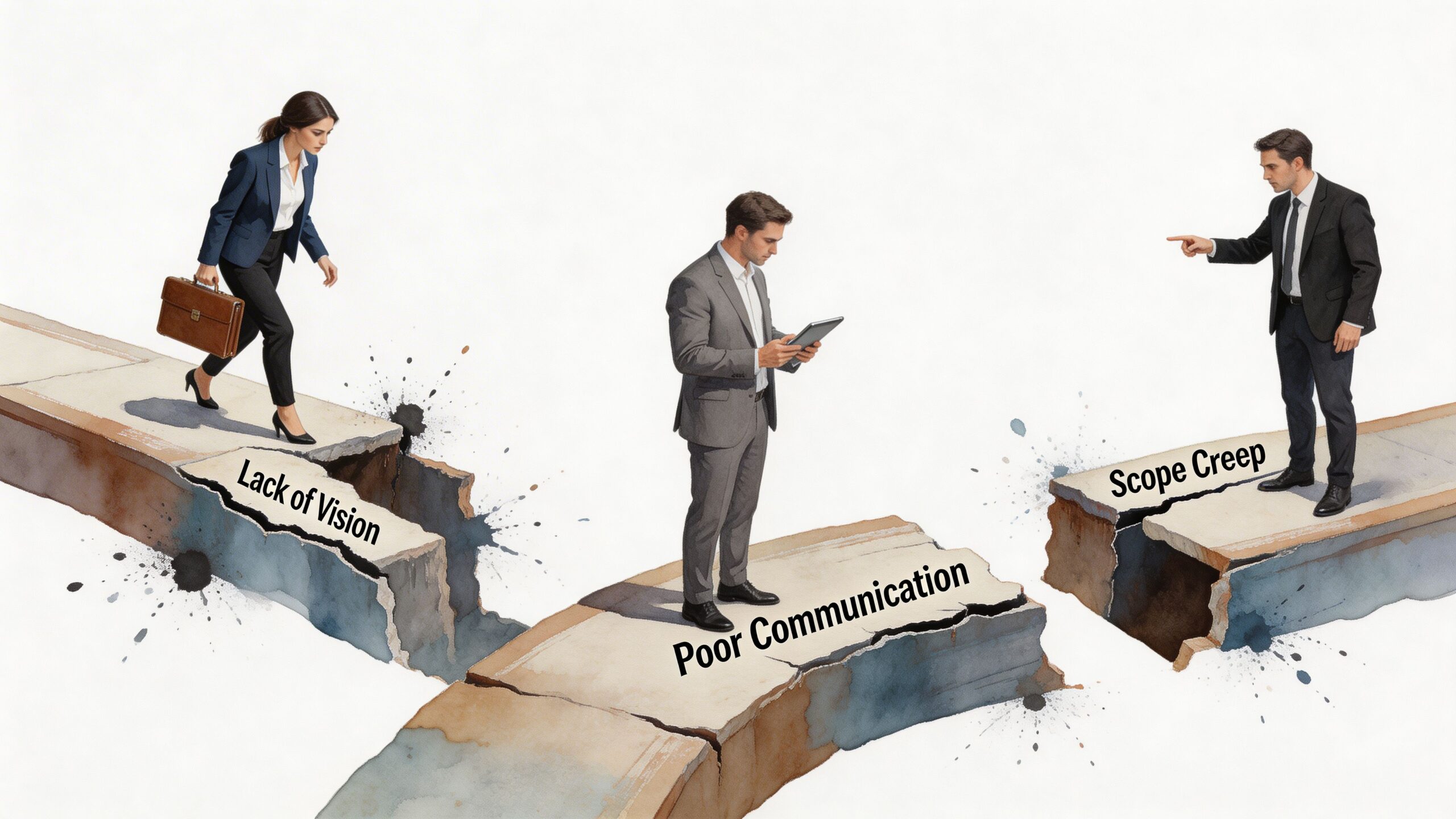
They fail because the operating behavior underneath the plan never changed. The language gets strategic. The mechanics stay chaotic.
Strategy gets treated as an annual event
The classic mistake is to do serious thinking once a year and then let execution drift.
That approach might work for ceremonial planning. It doesn’t work for operating reality. Priorities shift, risks surface, vendor issues appear, and teams take on unscheduled work unless someone governs the plan continuously.
The national-level version of this is instructive. Over two decades, China moved from leading in 3 critical technology research fields to 57 of 64, while the US lead fell from 60 to 7, according to ASPI’s two-decade critical technology tracker. The lesson for a CEO is straightforward. Long-term advantage comes from sustained, intentional planning. Reactive behavior loses ground.
Budget gets mistaken for a plan
A budget tells you what you’re willing to spend. It doesn’t tell you what matters most, what gets deferred, or who owns the outcome.
This mistake creates a lot of false confidence. Leaders approve technology line items and assume strategy exists because money was allocated.
It doesn’t.
A plan needs sequencing, ownership, decision rules, and review cadence. Without those, funded work competes inside a louder environment.
Vendors end up driving the roadmap
This happens unobtrusively.
A vendor proposes a platform expansion. Another offers AI features. A third warns about risk unless you buy the premium tier. If internal ownership is weak, the business starts making strategic choices through sales conversations.
That’s one reason vendor discipline matters so much. If this is already happening in your business, this piece on how to stop vendors from driving your roadmap will help you reassert control.
Shiny technology jumps the queue
Leaders don’t usually buy hype because they’re naive. They buy hype because they’re under pressure to move.
AI is the current example in many organizations. The tool may be useful. The problem is when adoption outruns governance, ownership, and use-case clarity.
Then you get scattered experiments, unclear data handling, inconsistent outputs, and a leadership team that cannot explain where business value is coming from.
The same pattern shows up in compliance. Companies often treat audits as a paperwork exercise instead of an operating discipline. If your board or customers are pressing on assurance, this explanation of the consequences of failing a SOC 2 audit is a practical reminder that weak planning eventually becomes a business issue, not just a technical one.
Reactive buying feels fast in the moment. It usually creates slower operations later.
Capacity and ownership are ignored
A final failure mode is pretending the organization can absorb unlimited change.
It can’t.
You can’t launch every system improvement, reporting initiative, security upgrade, and automation effort at once and expect calm delivery. If ownership is split and team capacity is already stretched, adding more work doesn’t increase output. It increases thrash.
That’s why ruthless prioritization isn’t harsh. It’s responsible.
What Success Looks Like A Calm and Fast Organization
When strategic technology planning is working, the mood changes before the metrics do.
Meetings get shorter. The same issues stop recurring. Leaders ask for fewer emergency updates because they already know where things stand. Teams spend less time translating between systems, vendors, and departments. Reporting becomes a routine, not a rescue operation.
That’s what a calmer organization looks like.
Decisions stick
This is the first sign.
A priority is named. An owner is assigned. A tradeoff is made. The organization acts accordingly.
You stop hearing five versions of the roadmap from five different people. You stop relitigating the same choices every month. Your teams know what matters now, what’s deferred, and who can unblock the hard calls.
Reporting gets cleaner
When reality is legible, reporting improves quickly.
Not because every system is perfect, but because ownership is clearer and the path from activity to business consequence is easier to trace. The board gets sharper answers. Audit and insurer questions create less scrambling. Due diligence becomes less of a reputational risk.
A healthy technology environment doesn’t mean nothing ever goes wrong. It means leaders can see what’s happening, explain it clearly, and respond without panic.
Growth stops tripping over the stack
A lot of companies discover their technology problem only when growth exposes it.
More customers create more handoffs. More teams create more exceptions. More reporting requirements expose more inconsistency. Without a real planning discipline, growth makes the business feel slower and more fragile.
With strategic technology planning, growth becomes easier to support. The business can add tools, people, and process changes with clearer guardrails. That's the principal benefit: Better speed with better control.
The board gets confidence
Boards don’t expect perfection. They expect oversight.
They want to see that leadership understands the major dependencies, has named owners, can explain tradeoffs, and isn’t relying on one exhausted operator to hold the whole system together. When that confidence is present, technology stops looking like a mysterious cost center and starts looking like a governed business capability.
That’s a much better place to operate from.
If this article felt uncomfortably familiar, that’s useful. It means the issue is visible now. The next move isn’t another planning workshop or another software purchase. It’s making your current reality legible, then installing the operating rhythm that turns intent into controlled execution.
If technology feels expensive, hard to explain, or too dependent on heroics, a conversation can help. CTO Input works with leaders who need clearer ownership, calmer execution, and board-defensible technology planning. A Clarity Call is a practical place to surface the main bottlenecks, name the trust risks, and define the first steps toward control.