

If your weekly leadership meeting keeps drifting into vague technology updates, you don't have a tooling problem. You have an ownership problem.
You hear the same pattern every week. A system issue delayed fulfillment. A vendor is "looking into it." A dashboard project is "in progress." Security needs attention, but nobody can explain what changed, who owns the fix, or when the risk will be closed. Spend keeps rising. Confidence doesn't.
That is what broken technology strategy for COOs looks like in real life. Not dramatic failure. Just slow, expensive drag that spreads through operations until every handoff needs a chase, every report needs interpretation, and every delivery date feels negotiable.
When Technology Creates More Problems Than It Solves
The meeting starts with good intentions.
Operations wants cleaner reporting. Finance wants fewer surprises. Customer teams want fewer incidents. IT says the roadmap is full, the vendors are behind, and the integrations are complicated. Everyone leaves with action items. Very little becomes simpler.
That's the coordination tax. Your business pays it in rework, delays, status hunting, and executive time.
One of the most useful truths here is also the least glamorous: in founder-led scaling operators, 70% of tech delays stem from implied ownership, not tool deficits, according to the angle summarized from HFMA's technology planning discussion. The issue usually isn't that you picked the wrong platform. It's that no one made ownership explicit enough for decisions to stick.
What this feels like on the ground
A COO usually notices the same symptoms first:
- Projects stay amber forever: Nothing is fully off track, but nothing lands cleanly either.
- Vendors shape your roadmap: Internal teams react to what outside providers can do, not what the business needs.
- Incidents expose the truth: The fastest way to find fuzzy ownership is to watch what happens when something breaks.
- Reporting takes translation: You get updates, but not control.
Technology chaos rarely starts with failure. It starts with decisions nobody fully owns.
This is why a lot of "digital transformation" advice doesn't help operators. It talks about platforms, innovation, and future-state architecture. Fine. But if nobody can answer who owns a decision, what the decision is, and when the result will be visible, you're still running on hope.
The real fault line
Technology creates more problems than it solves when the operating model around it is weak.
That means:
- decision rights are implied
- escalation paths are fuzzy
- vendor accountability is soft
- risk tracking is episodic
- incident response depends on heroics
If your team needs a better model for effective incident handling, it's worth studying how clear roles, escalation triggers, and response rhythm reduce confusion under pressure. Incident discipline often exposes the same gaps that undermine the broader technology strategy for COOs.
A COO doesn't need to become the technical architect. But you do need a system that makes ownership visible and execution inspectable. Without that, technology becomes a permanent source of operational friction.
What a Technology Strategy Means for an Operator
For a COO, a technology strategy is not a list of systems to buy.
It's an operational blueprint for how the business runs. It defines how technology supports throughput, control, visibility, and resilience. It connects spend to execution.

If you're a COO, think about the tech stack the way you'd think about a factory floor. You care about flow. You care about bottlenecks. You care about where work stalls, where defects appear, and where no one really owns the machine.
The operator's version of strategy
A CTO may focus on architecture, engineering capability, and technical debt. You need something different.
Your technology strategy for COOs should answer five operational questions:
- Which systems are mission-critical to daily execution
- Which decisions belong to which leaders
- Which vendors are strategic and which are just accumulated
- Which measures prove value
- Which risks must be visible before they become public problems
This is why cost and analytics sit so high on the COO agenda. In Grant Thornton's 2025 Digital Transformation Survey, 68% of COOs identified reduced operational costs as a top-three metric for ROI on technology investments, while 72% listed data analytics and business intelligence as top priorities for enhancements, as reported in Grant Thornton's 2025 COO tech efficiency survey.
That is a very practical signal. COOs are not asking for prettier roadmaps. They want tighter operations and better visibility.
What good looks like
A strong operating blueprint does a few things at once:
- It ties systems to business outcomes: not "implement CRM cleanup," but "reduce sales-to-ops handoff friction."
- It names owners: not committees, not shared inboxes, not "the tech team."
- It sets decision rules: what needs executive approval, what doesn't, and what gets escalated.
- It creates inspection points: weekly, monthly, and quarterly rhythm so work doesn't vanish between meetings.
Practical rule: If a technology initiative can't be tied to an operating constraint, it probably shouldn't be a priority.
Security belongs inside this blueprint too. If cloud platforms are central to your operations, then governance has to include them. For leaders thinking ahead, this guide to securing cloud applications in 2026 is useful because it frames cloud security as an operating issue, not just a technical one.
Don't confuse alignment with control
Many companies say technology is "aligned with the business." That often means leaders broadly agree on goals.
That is not enough.
Control means you can inspect progress, resolve conflicts, and hold owners accountable without chasing five teams for context. If you're comparing executive lenses, this piece on technology strategy for CEOs is helpful because it shows the difference between growth-level direction and the operational discipline a COO needs to make that direction real.
The operator's job isn't to pick every tool. It's to make sure the business can produce repeatable results with the tools it already has, and to change the stack only when that improves execution.
The Three Pillars of an Operations-Led Tech Strategy
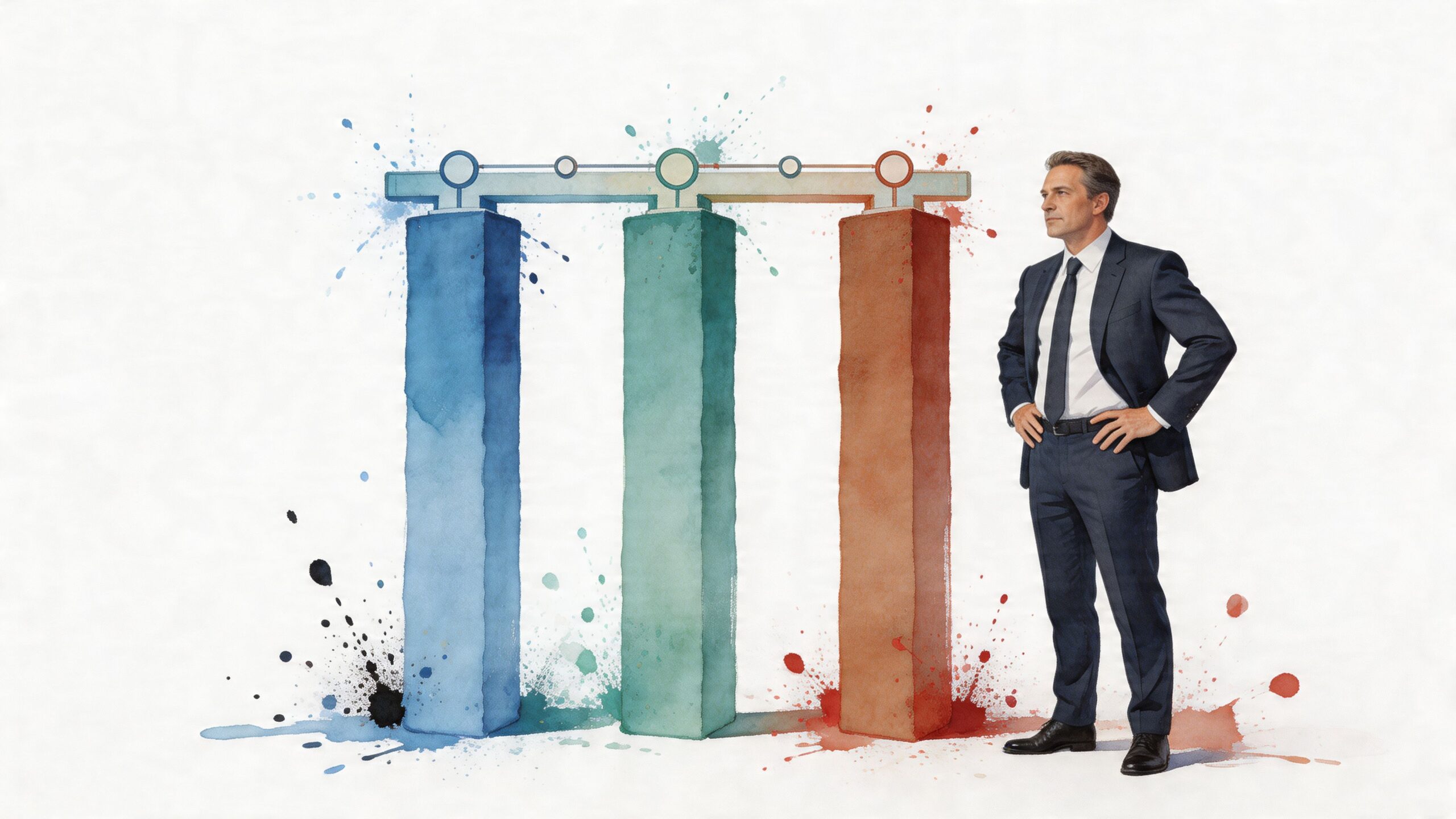
If you want calmer execution, focus on three pillars. Not ten. Not a giant transformation map. Three.
When these pillars are weak, technology creates drag. When they're strong, technology becomes governable.
Decision rights and governance
Most technology chaos is governance failure wearing a technical costume.
If your ERP issue affects billing, who decides priority? If customer data is duplicated across systems, who owns remediation? If a vendor asks for a policy exception, who can approve it?
Broken governance looks like this:
- leaders revisit the same decisions
- teams assume someone else is driving
- projects move until they hit cross-functional friction
- escalations happen late, when the cost is already higher
Working governance feels quieter. Decisions don't need to be rediscovered. Owners are named. Tradeoffs are explicit. Exceptions are documented.
A COO should insist on a simple decision map for major systems and cross-functional workflows. Not theory. Names.
If ownership is shared by everyone, it is owned by no one.
This matters most at the seam between departments. Sales to operations. Operations to finance. IT to security. Vendor to internal team. Handoffs leak where authority is vague.
Strategic vendor management
Vendor sprawl is one of the fastest ways to lose operational control.
It starts innocently. One team buys a niche platform. Another adds an automation tool. A third keeps an older system alive because migration is hard. Soon you have a stack nobody fully understands and a roadmap shaped by contract renewals, integration gaps, and support tickets.
That creates two problems. First, leaders can't see which vendors are essential. Second, nobody can prove where risk sits.
A practical vendor strategy includes:
- Tiering vendors by business criticality: separate core platforms from replaceable tools.
- Assigning executive owners: every critical vendor needs a business owner, not just a technical contact.
- Reviewing overlap and redundancy: if two tools do roughly the same job, one should probably go.
- Linking renewal decisions to operating value: not user complaints alone.
Integrated risk controls
A lot of companies still treat risk as a side process. That is a mistake.
Risk needs to sit inside daily operations. Security, resilience, access control, incident readiness, and vendor oversight should function as guardrails, not after-the-fact paperwork.
In board-watched organizations, many near-misses trace to untracked vendor sprawl, and weekly tracking reduces incidents 25% more than compliance theater, according to the source summarized in this governance and risk discussion. That matters because board-defensible oversight doesn't come from thicker policy binders. It comes from calm routines leaders can inspect.
Here's the test. Can you answer these questions quickly and clearly?
| Question | Weak answer | Strong answer |
|---|---|---|
| Who owns this risk | "IT is handling it" | "The operations systems director owns it, with finance sign-off" |
| What is the plan | "We're working through options" | "Vendor consolidation this quarter, access review this month" |
| When will it be done | "Soon" | "Tracked weekly, due by the next monthly review" |
How the pillars work together
These pillars reinforce each other.
Governance without vendor discipline still leaves outsiders shaping execution. Vendor cleanup without risk controls leaves blind spots. Risk controls without governance become bureaucracy.
When the model works, you see a different pattern:
- meetings end with decisions, not vague next steps
- vendors answer to business priorities
- incidents reveal a process, not a scramble
- leaders spend less time chasing status and more time removing constraints
That is what a real technology strategy for COOs should do. It should restore control at the operating level.
Your First 90 Days to Restore Predictable Execution
You do not need a grand transformation in the first 90 days. You need legibility, ownership, and momentum.
The best early work is boring in the right way. It makes the current mess visible. It names owners. It installs rhythm. Then it delivers a few simplification wins that everyone can feel.
EY's framing is especially useful here: leading COOs cut handoff leaks by 50% by mapping decision rights through RACI matrices, installing weekly cadences with predictive dashboards, and prioritizing first wins like vendor consolidation, as outlined in EY's view of the evolving COO role.
Days 1 to 30 make reality legible
Start by replacing assumptions with a map.
You want a plain-English picture of how technology supports operations today. Not an architecture diagram built for engineers. A business control map.
Your first-month checklist:
- Map critical systems and workflows: List the platforms that affect revenue, fulfillment, reporting, customer service, and compliance. Include systems like NetSuite, Salesforce, Microsoft 365, ServiceNow, Jira, Slack, Power BI, or whatever your business uses.
- List every meaningful vendor and renewal point: Put them in one place. Note owner, contract status, core dependency, and whether the tool is operationally critical or merely convenient.
- Document decision rights: Build a simple RACI for key technology decisions such as new tool approval, policy exceptions, integration priorities, security remediation, and major changes.
This phase often surprises leadership. The stack is usually wider than expected. Ownership is usually thinner than expected.
Advisor's view: If your current state can't fit on a few pages that leadership understands, you don't have a controllable system yet.
Days 31 to 60 install rhythm and narrow the field
Once reality is visible, stop trying to fix everything.
Pick the top three sources of drag. That might be duplicate tools, one unstable system, weak reporting, or a vendor nobody is really managing. Then create a weekly operating rhythm around those issues.
Your second-phase checklist:
- Launch a weekly technology execution review: Keep it tight. Review open decisions, blocked work, major incidents, top risks, and owner-by-owner progress.
- Assign one accountable owner per top problem: Shared accountability creates drift. Use named accountability, even when multiple teams contribute.
- Choose one simplification win: Consolidate one category of overlapping tools, remove one manual reporting loop, or retire one risky workaround.
A lot of leaders need stronger air cover at this stage. If that's your situation, this perspective on executive technology leadership can help clarify what belongs at the leadership layer versus the delivery layer.
Days 61 to 90 make the system inspectable
By this point, the goal shifts from cleanup to control.
You're building a mechanism leaders can trust. That means regular evidence, clear accountability, and a small set of measures that matter.
Use the third phase to lock in habits:
- Create a monthly performance view: Track budget, vendor performance, incident themes, system issues, and progress against the few current priorities.
- Standardize escalation rules: Define what gets raised immediately, what waits for weekly review, and what needs executive approval.
- Prepare a board-safe summary: Not technical detail. A concise view of top operational risks, active mitigations, and any decision requiring leadership support.
A useful 90-day lens looks like this:
| Timeframe | Main objective | What should be true by the end |
|---|---|---|
| First 30 days | Visibility | Leadership can see systems, vendors, owners, and key friction points |
| Next 30 days | Execution rhythm | A weekly cadence exists and top problems have named owners |
| Final 30 days | Inspectable control | Progress, risk, and vendor issues can be reviewed without a fire drill |
What not to do in the first 90 days
A few moves create more noise than progress:
- Don't start with a platform replacement: If ownership is weak, a new tool will inherit the same chaos.
- Don't let vendors define success: Their implementation milestones are not the same as your operating outcomes.
- Don't build a giant steering committee: Small, direct, decision-capable groups work better.
The point of the first 90 days isn't perfection. It's restoring enough order that execution becomes believable again.
A Simple Governance Cadence That Actually Works
Most technology governance fails for a simple reason. It is either too loose to matter or too heavy to survive.
A workable cadence should do three things. Surface issues early. Force decisions to stick. Give leadership clean visibility without turning every week into a reporting exercise.
The rhythm
The easiest model is a three-tier cadence. Weekly for execution. Monthly for performance. Quarterly for strategy and risk posture.
Good governance is not more meetings. It's fewer surprises.
Here is a practical version you can run without creating another bureaucracy.
COO's Technology Governance Cadence
| Meeting | Frequency | Purpose | Key Attendees | Primary Output |
|---|---|---|---|---|
| Weekly operational sync | Weekly | Review blockers, incidents, open decisions, and priority progress | COO or delegate, operations lead, IT lead, security/risk lead when needed, business owners for active priorities | Updated action list with named owners, due dates, and escalations |
| Monthly performance review | Monthly | Review spend, vendor performance, operational KPIs, risk themes, and delivery health | COO, finance partner, IT leadership, key functional owners | Performance summary, budget decisions, vendor actions, and priority resets |
| Quarterly strategic review | Quarterly | Align technology priorities with business goals, major risks, and board-level concerns | COO, CEO, CFO, senior technology leader, risk or compliance leadership, board-facing stakeholders as needed | Strategic decisions, approved tradeoffs, and a board-ready risk and progress view |
What each meeting should and should not do
The weekly operational sync is not a status recital. It exists to remove blockers and force clear decisions. If people leave with more ambiguity than they brought in, the meeting failed.
The monthly performance review should examine whether technology is supporting operations. Spend, service levels, vendor performance, incident themes, and reporting quality all belong here. During this review, decisions are made on vendor retention, process redesign, or risk escalation.
The quarterly strategic review is where leadership confronts tradeoffs. Delay one initiative to reduce risk. Consolidate vendors. Fund a control improvement. Accept that one area needs executive intervention. At the review, technology becomes a business decision, not a specialist conversation.
Two rules that keep the cadence honest
- Keep one source of truth: The same core issues should roll from weekly to monthly to quarterly, not get reformatted into three different stories.
- Track decisions, not just tasks: A missed task matters. A fuzzy decision causes more damage.
If your current rhythm depends on heroic follow-up, it isn't a cadence. It is a memory test.
The Difference Between a Cost Center and a Strategic Asset
The difference is not how much you spend. It is whether leadership can trust what technology is doing for the business.
In the cost-center version, technology is a recurring negotiation. Projects slip. Reporting is noisy. Teams work around systems instead of through them. Every issue becomes a one-off explanation.
In the strategic-asset version, technology is still imperfect. But it is governable. Leaders know what matters, who owns it, and how progress is tracked.

What the cost center feels like
A cost center drains confidence.
- operations waits on unclear technology decisions
- security shows up as friction
- vendor renewals happen from habit
- board questions trigger a scramble for answers
- teams compensate with spreadsheets, side channels, and manual checks
That is expensive even when nobody can isolate the line item.
What the strategic asset changes
A strategic asset improves operating confidence. Not because every system is perfect, but because the business can see and steer the system.
In PwC's 2023 Cloud Business Survey, 97% of US business executives reported that cloud technology increased productivity, as cited in Oracle's summary of COO priorities. The important point for a COO isn't "move to cloud" as a slogan. It's that well-run platforms can give the business a more integrated view of operations, which supports cleaner execution.
When technology becomes inspectable, board reporting gets calmer and operational decisions get faster.
If you want the broader leadership lens on that shift, this article on technology strategy is a useful companion. The core distinction is simple: unmanaged technology consumes management attention, while governed technology returns it.
The practical before and after
Before:
| Area | Cost center behavior | Strategic asset behavior |
|---|---|---|
| Reporting | Late, manual, debated | Timely, owned, decision-ready |
| Vendors | Too many, weak oversight | Tiered, owned, reviewed |
| Risk | Episodic, reactive | Visible, tracked, operational |
| Delivery | Slips and surprises | Predictable tradeoffs and follow-through |
A COO is usually not looking for "innovation" in the abstract. You are looking for steadiness. Dates that hold. Owners who know their role. Risks that don't arrive as public surprises. Technology strategy for COOs should deliver exactly that.
Take the First Step to Regain Control
If technology feels like a source of drag, the answer isn't more dashboards, more software, or a louder steering committee.
The answer is an operating system for ownership.
That means clear decision rights. A short list of real priorities. Vendor accountability. Risk that is tracked in plain business language. A cadence that makes progress and slippage visible early enough to matter.
This is why technology strategy for COOs should start with execution, not aspiration. You do not need to master architecture diagrams. You need to make the current reality legible and then install a rhythm that prevents chaos from regenerating.
Start with three questions:
- Who owns the most business-critical technology decisions today
- Which vendors or systems create the most operational drag
- What gets reviewed every week that changes outcomes
If those answers are fuzzy, that is the work.
Don't wait for a major incident, a failed project, or board pressure to force clarity. By then, the cleanup costs more and the trust damage is harder to repair. The calmer path is to name the mess early, simplify what you can, and build a routine leaders can inspect without chasing people for updates.
Control is not a feeling. It is a system.
If you're tired of paying the coordination tax, CTO Input helps leaders make technology and security legible, assign clear ownership, and install the operating rhythm needed for predictable execution. A Clarity Call is a practical first step. You’ll surface the top bottlenecks, the main trust risks, and the first moves that would restore control.