
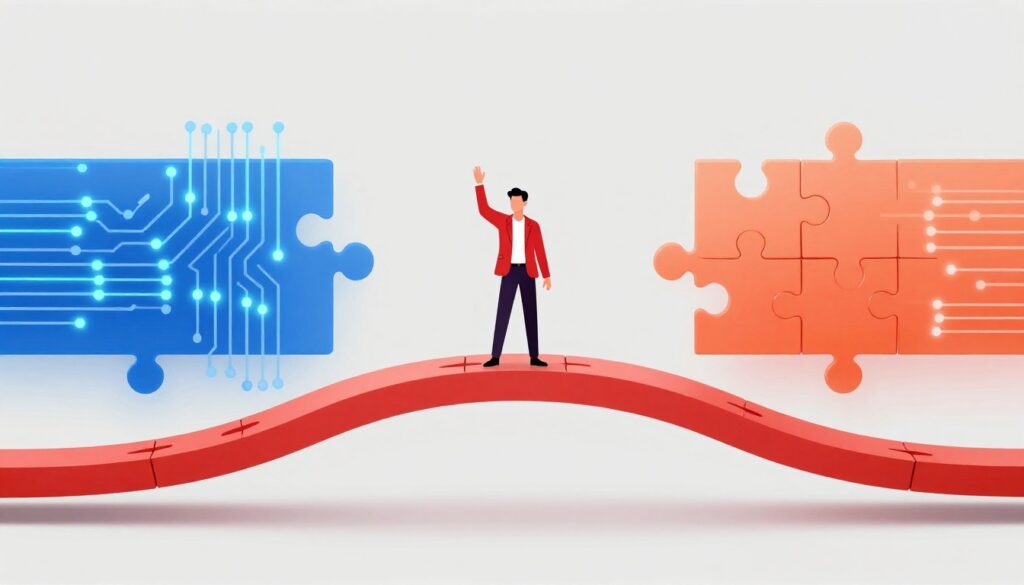
Merging two tech stacks is a high-stakes challenge that frequently arrives when you acquire a company, launch a new business unit, or replace a core platform. Whether you are navigating complex mergers and acquisitions or simply consolidating internal systems, you suddenly find two teams relying on different infrastructure, data models, vendors, and workflows. Everyone expects immediate answers, but rushing the process often leads to costly downtime.
The goal is not to force one perfect technology stack into existence by next Tuesday. Instead, the goal is to protect revenue, customer service, delivery speed, and month-end reporting while you create a clear path forward. If you are a CEO, COO, founder, CFO, or board member, you must keep scope, sequencing, ownership, and risk under control to ensure the integration process remains efficient.
Key Takeaways for Merging Two Tech Stacks Without Losing a Quarter
- Start with the business outcomes you must protect this quarter, not a diagram of every application, to ensure your system integration supports core operations.
- Map dependencies before changing systems, especially identity, finance, customer data, reporting, and vendor access.
- Choose one system of record for each critical data set, even when both platforms remain in use.
- Separate urgent connections from later cleanup, automation, and modernization work.
- Put one executive in charge of the tradeoffs, with a clear delivery lead beneath them.
- Use staged releases, live monitoring, and tested rollback plans instead of one high-risk cutover.
A business-aligned technology strategy and a practical technology roadmap keep your tech stack integration from turning into an uncontrolled transformation program.
Why Add-On Integration Projects Lose Time and Momentum
An add-on integration is not the same as a full replacement. You are connecting enough of two environments to keep the business moving. A replacement asks you to retire one environment and move everyone onto another.
Leaders lose time when they treat both jobs as the same thing.
The temptation is understandable. You see duplicate tools, overlapping vendors, and inconsistent data. You want to standardize everything at once. However, rushing to fix deep-seated tech debt or attempting to rewrite legacy code often backfires. Then sales cannot find customer records, Finance cannot close the books, and the support team builds spreadsheets to keep promises made to customers.

The technical work is rarely the only issue. When companies attempt to bridge systems, they face significant technical integration challenges. Data cleanup takes longer than expected, and identity or access rules often fail to match. Furthermore, cultural alignment becomes a hurdle, as teams with different habits struggle to unify their workflows. This creates rigid data silos that prevent the organization from seeing the whole operating picture.
That is why one executive must own the business tradeoffs. Without clear ownership, merging two tech stacks becomes a collection of disconnected projects. It needs the same discipline as technology strategy ownership, not another project plan with no decision-maker.
Apply first principles to your business outcomes
Begin with three to five outcomes that matter now, focusing on your goals through first principles rather than focusing on the software diagram. Preserve order flow. Keep customer support working. Protect month-end reporting. Reduce duplicate entry for the operations team. Meet a transaction deadline without creating a customer problem.
Write down what will not change in the first phase. You may leave CRM workflows, payroll, or reporting tools alone for 90 days. That is not failure. It is control.
If your first release cannot be explained in plain business language, the scope is still too wide.
Find the hidden dependencies before you connect anything
Customer IDs, product codes, billing rules, permissions, APIs, batch jobs, spreadsheets, data warehouses, and compliance obligations all carry hidden dependencies. A spreadsheet used by one finance analyst may be the only bridge between two order systems.
Build a short technology assessment and dependency map before changing production systems. Include vendor contracts, renewal dates, security controls, and who owns each workflow.
Duplicate platforms are not only a technical inconvenience. They can become a decision and oversight issue. That is why tool sprawl is a governance problem, especially when nobody can explain which system holds the right data.
Build an Integration Plan That Protects the Current Quarter
Use a 30, 60, and 90-day plan to organize your roadmap. The first 30 days should stabilize the environment, confirm dependencies through a thorough gap analysis, and stop new surprises. The next 30 days should connect the minimum data flows needed for the business, including any initial data migration required to synchronize platforms. The final phase can improve workflows, remove duplication, and decide what stays or goes.
Create an integration boundary. State which systems, data fields, users, and workflows are inside the first release. When integrating modern tech stacks, keeping a strict scope is vital. Everything else waits unless it creates a real revenue, customer, security, or compliance risk.
A one-page technology strategy is often enough to keep priorities, owners, decisions, and risks visible. You do not need a wall of slides. You need a document leaders can use in a hard meeting.
Choose a system of record for every critical data set
Two systems should not both be treated as authoritative for the same customer, employee, product, order, or financial record. That is how duplicate invoices, access errors, and bad reporting spread. Effective database management and rigorous attention to cybersecurity are essential when choosing these systems to ensure data integrity and system safety.
Use a simple decision table.
| Data set | System of record | Update method | Fallback |
|---|---|---|---|
| Customer account | CRM | API sync | Daily reconciliation |
| Order status | ERP | Event or batch feed | Manual exception queue |
| Employee access | Identity provider | Automated provisioning | Approved access request |
Temporary duplication can be acceptable. It must be controlled, monitored, and given an end date. Otherwise, the temporary bridge becomes the operating model.
Sequence the work by risk and business value
Rank each connection by revenue impact, customer impact, operational dependence, security exposure, and effort. Start with low-risk, high-value connections before you change core workflows.
Keep must-have work for this quarter separate from cleanup and modernization. You may need customer records to flow between systems now. You probably do not need to redesign every reporting dashboard before the first release.
Do not let a vendor set the order of work because its product is ready to sell. Your roadmap should follow your business priorities, not vendor pressure. The same discipline helps you stop vendors from driving your roadmap.
Give every decision a clear owner
You need a named executive sponsor who owns the business outcome. You need a technology lead who owns delivery. You also need business owners for major workflows such as sales, fulfillment, finance, and customer support.
A project manager can coordinate work. An integration vendor can build connections. Neither can make the business tradeoffs for you.
A project without executive ownership can look busy for months and still fail the business.
That is the difference between implementation work and executive technology leadership. Someone must decide what gets protected, delayed, funded, or stopped.
Connect the Stacks Safely Without Disrupting Operations
Whether you are syncing back-end technologies or aligning front-end infrastructure, options like APIs, middleware, batch files, event-driven connections, and identity providers all have a place. Your choice depends on data volume, timing, system limits, security needs, and the cost of failure. When designing these connections, consider how your cloud infrastructure will handle increased loads and whether your chosen architecture, such as microservices, offers the necessary scalability for future growth.
A nightly batch file may be fine for management reporting, but it is not sufficient for order status updates that customers expect to see in minutes. While an API design might work well initially, you must account for rate limits, poor error handling, or legacy platform constraints that create failures at peak volume. Always choose the simplest pattern that safely meets the business need, as complexity carries an ongoing maintenance cost.
Test real workflows, not just individual interfaces
A successful connection test does not prove the business process works. Test your quote to cash, order fulfillment, customer onboarding, employee access, and financial close cycles from end to end.
Check data quality, permissions, duplicate prevention, error handling, performance, and reconciliation against source systems. Test the edge cases as well. What happens when an address is missing, a customer exists twice, or a payment fails halfway through the process? Your team should know exactly who sees the exception, who is responsible for the fix, and how long the resolution can wait.
Use a phased rollout with monitoring and rollback
Start in a test environment, run a limited pilot, and utilize a parallel run when practical. Schedule the cutover with named decision-makers available to intervene, rather than relying on a weekend window when no one is available to approve a difficult call.
Track failed transactions, processing time, data mismatches, support tickets, customer complaints, and revenue-impacting errors. Set clear triggers for pausing or rolling back the release. Remember that a rollback plan written during an incident is not a plan at all; test it thoroughly before launch.
Protect identity, security, and vendor access
Integration expands your attack surface. Connected systems can pass bad access decisions, sensitive data, and vendor privileges into places they did not reach before. Strengthening your cybersecurity posture is essential when linking environments.
Review least-privilege access, service accounts, secrets management, logs, encryption, privacy requirements, and third-party access. Remove old credentials once the connection is live. Your board does not need technical noise; it needs visibility into risks, owners, thresholds, and decisions. Use technology risk oversight to frame that conversation before a control failure forces it.
Know the Cost and Right Level of Leadership Support
Integration cost is more than just licenses and implementation fees. You must include data cleanup, testing, training, duplicate platforms, support coverage, downtime risk, and the ongoing cost of maintaining the connection.
Build a simple cost and value view. What business problem does the work remove? What does delay cost? What manual effort or customer risk remains if you do nothing? That is how technology spend ROI becomes a decision tool instead of a vague savings promise.
When a bridge is better than forced consolidation
Keeping both stacks for a period may be the safer move when an acquisition is still settling, a core platform is unreliable, data quality is poor, or the business cannot absorb downtime. By prioritizing the customer experience during this transition, you avoid the service disruptions that often plague aggressive migrations.
A bridge needs controls. Name the owner. Reconcile key data. Review access. Cover support hours. Set a date when leadership will decide whether to extend, replace, or retire it.
Temporary coexistence is fine. Indefinite coexistence is expensive confusion.
When you need fractional or interim technology leadership
Your IT manager or implementation partner may handle delivery well, but they may not have the authority to settle cross-company priorities, vendor conflict, operating risk, and executive reporting. These scenarios require a deep level of domain understanding to align technical strategy with overall business health.
Fractional CTO services fit when you need steady executive ownership without rushing into a full-time hire. Interim leadership fits when the technology seat is open, trust is damaged, or the integration needs immediate stabilization.
If you cannot tell whether the real issue is technical, operational, or an ownership gap, Get an Executive Technology Clarity Check.
Questions Leaders Ask Before They Merge Two Tech Stacks
Should you integrate or replace one of the systems?
Integration is usually safer when continuity matters and both systems support useful work. Replacement may be better when one platform creates unacceptable security, support, cost, or data problems. When considering a move from a monolith to microservices, you might use the Strangler Fig pattern to incrementally modernize your infrastructure without a risky “big bang” migration.
Make the decision based on business impact, total cost, risk, and time. Do not choose the newer platform simply because it feels cleaner; choose the path that resolves your technical integration challenges while keeping the business moving forward.
How long should an add-on integration take?
A narrow connection can take weeks. Multi-system work involving data migration, identity, finance, and customer workflows can take months.
Avoid false precision. Define a first release that delivers visible value inside the current planning window to ensure your team maintains momentum.
What should you measure after launch?
Track successful transaction rates, data accuracy, processing time, support volume, manual effort removed, system availability, customer impact, security events, and cost against budget.
Beyond these metrics, track the effectiveness of your ongoing refactoring efforts to ensure the systems remain performant and maintainable. Tie each measure back to the business outcome you set at the start. That gives you a clear basis to continue, adjust, or stop the work.
Clear Decisions Keep the Quarter Intact
Merging two tech stacks is a business continuity and ownership problem before it becomes a technical task. To succeed, you must define the outcomes, map dependencies, choose sources of truth, and release the smallest useful connection first. Effective system integration is not just about moving data; it is about protecting the customer experience throughout the transition.
You do not need a perfect future-state architecture before making progress. Instead, you need visible control, tested safeguards, and one accountable leader who can make the hard calls. When your team stays focused on these core priorities, you ensure that the project supports your business goals rather than hindering them. If you are currently in the process of merging two tech stacks, prioritize clear decision-making to maintain momentum and safeguard your operational performance.