risk governance

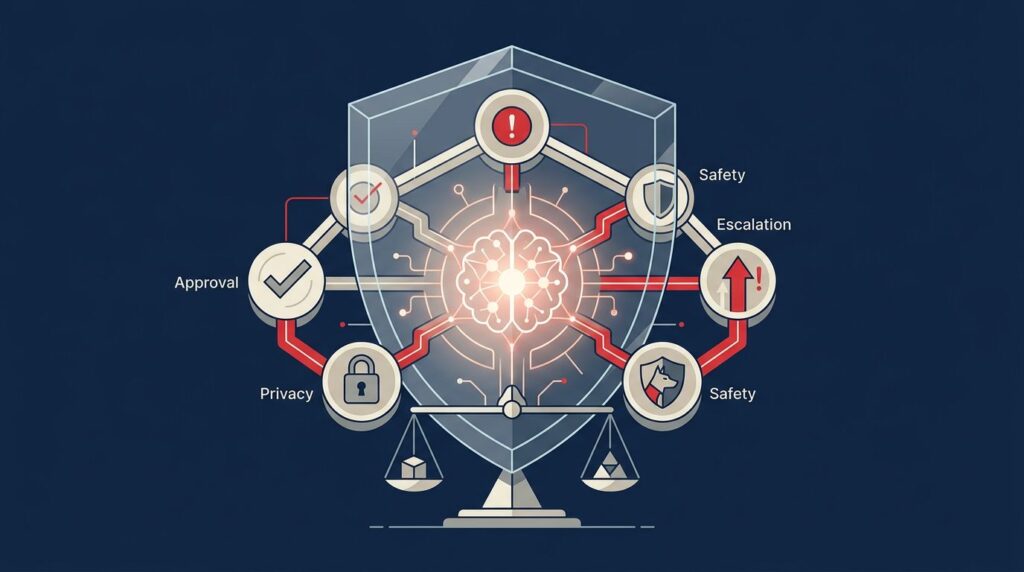
A glowing workflow network inside a glass shield, connected to approval, privacy, safety, and escalation symbols.

AI Liability Questions to Answer Before Customer Workflow Launch

Customer-facing artificial intelligence systems can answer questions, recommend actions, route cases, approve requests, and shape how people experience your company. That makes AI liability a business issue before it becomes a legal one. A wrong answer, exposed private data, or inconsistent treatment can create safety risks and encourage harmful reliance. Customers won’t blame the model […]

AI Liability Questions to Answer Before Customer Workflow Launch Read More »

Split illustration comparing a structured certification system with a flexible risk management pathway.

ISO 42001 vs NIST AI RMF for Mid-Market Companies

Most mid-market companies don’t need another AI policy sitting in a legal folder. They need clear ownership, sensible controls, and practical AI governance that helps decide which risks deserve attention now. The ISO 42001 vs NIST AI RMF decision matters because the two frameworks support different kinds of leadership. The choice isn’t only about compliance.

ISO 42001 vs NIST AI RMF for Mid-Market Companies Read More »

A glowing tech hub with a red security shield and organized data pathways.

Shadow AI Is Already in Your Company: Set Guardrails That Work

Your employees may already be using ChatGPT, Claude, Gemini, Microsoft Copilot, AI meeting notes, coding assistants, and generative AI features inside software you already pay for. The question isn’t whether shadow AI use exists. It’s whether you can see it, understand the data involved, and decide who owns the risk. Knowing how to manage shadow

Shadow AI Is Already in Your Company: Set Guardrails That Work Read More »

A balance scale illustrating technical debt on one side and a fragile trust bridge on the other.

Trust Debt vs. Technical Debt: The Board Blind Spot

When Ward Cunningham originally coined the financial debt metaphor, he intended to explain how shortcuts in software development lead to long-term costs that accrue interest over time. Today, board members are generally comfortable funding these issues, such as server replacements or ERP upgrades. Because technical debt has a visible invoice and a clear project timeline,

Trust Debt vs. Technical Debt: The Board Blind Spot Read More »

A business leader controlling a glowing holographic risk dashboard in a modern office.

Agentic AI Risk: What Leaders Need to Control

AI is moving past answering questions. It can now review invoices, update customer records, route work, open tickets, recommend purchases, and deploy autonomous AI agents to execute agentic workflows across systems with limited human input. That shift creates agentic ai risks for business leaders that are operational, financial, and reputational. You don’t need to learn

Agentic AI Risk: What Leaders Need to Control Read More »

Six professionals seated around a conference table looking at a glowing red AI brain hologram.

AI Governance Committee Structure for a 200-Person Company

AI use spreads faster than ownership. Your marketing team may test generative ai models for writing, operations may automate documents, and customer teams may use AI summaries, while nobody holds the full picture of risk, cost, or artificial intelligence governance. A clear AI governance committee structure gives you a place to make decisions without turning

AI Governance Committee Structure for a 200-Person Company Read More »