
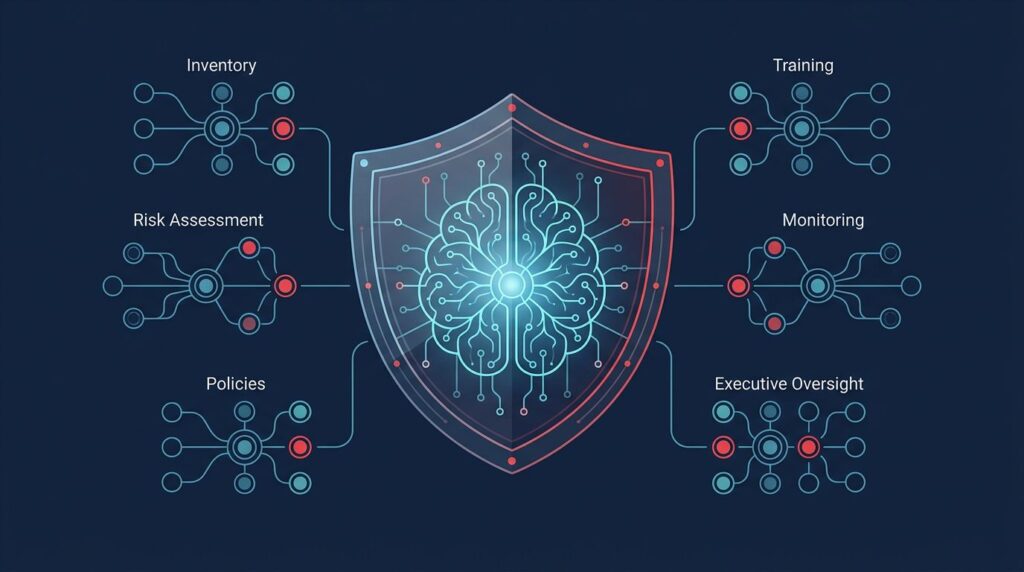
Your company may already be using public AI tools, embedded features, custom models, or employee-built automations without a shared policy, making generative ai governance increasingly important. That doesn’t mean your team is careless. It means enterprise ai adoption often moves faster than leadership structure.
If you’re asking how to start an ai governance program, the answer isn’t to block every useful experiment. You need enough visibility, ownership, and control to use AI safely and create business value. This 90-day plan gives you a practical path to building an ai governance framework through inventory, risk classification, policies, controls, training, reporting, and ongoing ownership. If your AI decisions feel scattered, start with an Get an Executive Technology Clarity Check.
Key takeaways
- Start with business outcomes, not AI tools.
- Build an inventory that includes shadow AI use, including tools and workflows employees adopt outside formal approval channels.
- Use an AI governance framework to match controls to risk instead of applying one burden to every use case.
- Give management ownership of responsible AI governance execution and the board visibility into material risk, strengthening stakeholder trust.
- Treat the first 90 days as the beginning of a responsible AI governance operating rhythm that builds stakeholder trust, not a completed compliance project.
The 90-day AI governance program for a company that has none
Your first 90 days don’t need to produce a perfect enterprise framework. They need to create a usable AI governance framework that answers five questions:
- Where is AI being used?
- What risks does each use create?
- Who owns each decision?
- What controls apply?
- How will leadership know whether the program works?
That is executive technology leadership, not an IT paperwork exercise. A technology leadership gap makes uncontrolled adoption more likely because no one owns the full picture. Stronger executive technology leadership connects business goals, vendors, delivery, risk, and reporting.
Use the NIST AI Risk Management Framework, the EU AI Act, ISO/IEC 42001, relevant privacy obligations, security standards, and other risk management framework concepts as reference points. Your legal duties still depend on your industry, location, customers, data, and use cases. A framework can guide judgment and support regulatory compliance, but it can’t replace it.
Set business outcomes and risk boundaries first
Start with the reason you want AI. You may want to reduce service costs, improve customer response time, support employees, accelerate analysis, or increase operating capacity.
That keeps governance tied to a business-aligned technology strategy, rather than turning it into a separate compliance project. Then define three boundaries:
- Unacceptable uses that the company won’t permit.
- High-risk uses that require formal review.
- Low-risk uses that can move through a lighter process.
Examples include confidential data entered into public chatbots, automated employment decisions, customer-facing advice, financial recommendations, and AI-generated code. The question isn’t whether AI is involved. The question is what could happen if an artificial intelligence system produces an incorrect or biased output, exposes sensitive information, or acts without appropriate review.
Name the people who own AI decisions
Create a small governance group made up of cross-functional teams and business leaders. An executive sponsor should lead it, with support from technology, security, privacy or legal, human resources, finance, operations, and the business owners using AI.
Keep decision rights clear for each artificial intelligence system. Approving a use case is different from implementing it. Monitoring performance is different from accepting residual risk. The board should receive oversight, not manage daily AI operations. That distinction belongs in your broader technology risk oversight and board technology reports.

## How to start an AI governance program in your first 30 days
The first 30 days are about discovery and containment. Begin with an executive sponsor, a short charter, and a clear statement of what the AI governance program must deliver.
Then map current AI use, identify urgent risks, and publish interim rules. Pause only uses that create immediate danger. Stopping every experiment will push activity further underground and reduce honest reporting.
Tie this work to a practical technology strategy and a focused technology roadmap. Each AI priority needs a business reason, an owner, timing, and a decision path. A roadmap without ownership becomes another list that leadership can’t defend.
Create an AI inventory that includes shadow AI
For every AI tool or artificial intelligence system, capture:
- Business purpose, department, vendor, and model type.
- Data used, users, outputs, integrations, and decision impact.
- Human review, contract terms, renewal date, and accountable owner.
Use employee surveys, interviews, expense reviews, browser or identity data where appropriate, and vendor questionnaires. Make the process practical and non-punitive. If employees believe disclosure will lead to punishment, they will hide the shadow AI tools you most need to understand.
Shadow AI matters because tool sprawl creates overlapping costs, inconsistent controls, and unclear data flows. It can also create regulatory compliance gaps when teams adopt systems without privacy, security, or legal review. Review tool sprawl as a governance problem and check whether vendors are driving your roadmap.
Publish interim rules people can follow today
Your interim policy should fit on a few pages and establish policy-driven governance for everyday AI use. Cover approved tools, account security, prompt and output handling, disclosure of AI use, human review, copyright concerns, records, and incident reporting.
Include practical ethical guidelines that reflect your organization’s approach to AI ethics and governance. Employees should never enter passwords, regulated personal data, trade secrets, client files, or confidential deal information into an unapproved AI service. Give people a review path for legitimate exceptions. Make the rules easy to find, easy to understand, and easy to apply during a busy workday.
Rank AI use cases by impact and exposure
Use risk assessments with a simple score based on data sensitivity, decision impact, scale, autonomy, explainability, external exposure, and potential harm.
Productivity assistance is different from a system that affects customers, workers, credit, healthcare, safety, legal rights, or financial outcomes. Risk tiers should determine the depth of testing, approval, documentation, monitoring, and human oversight, while ethical guidelines help teams evaluate potential harm beyond technical performance.
Document why each use is allowed, restricted, or rejected. That decision record will matter when a customer, employee, regulator, auditor, or board member asks how you reached the decision. It also gives your AI ethics and governance program a clear basis for consistent future reviews.
Build safer AI controls from days 31 to 60
The second phase turns your inventory and risk tiers into repeatable controls within an AI governance framework. Those controls should apply proportionately across artificial intelligence systems, because a meeting summary tool shouldn’t carry the same approval burden as a customer eligibility model.
Your controls should reflect your cyber risk appetite, vendor exposure, data sensitivity, and business consequences. The same logic should support third-party risk reporting and broader technology oversight.
Create an approval path for new AI use cases
Use a lightweight intake form that records the purpose, expected benefit, data sources, users, vendor, model behavior, risks, fallback process, owner, and success measures. For generative ai governance, include the intended prompts, output use, human oversight requirements, and any accountability mechanisms.
A manager may approve a low-risk internal use, while privacy, legal, security, or executive review may be required for sensitive data, external communications, material decisions, or high autonomy. The approval path should define who provides human oversight and when a use case must be escalated.
Keep a decision log with clear audit trails. Add an expiration or reassessment date to every approval, along with the accountable owner and review criteria. An approval shouldn’t last forever because the vendor, model, data, or business use may change.
Control data, access, vendors, and model behavior
Apply data classification, least-privilege access, logging, retention limits, encryption, environment separation, prompt controls, and output validation. These safeguards should support data privacy from initial collection through storage and use. Confirm whether the vendor trains on company data and whether you can restrict that use.
Your contract review should address data use, model training, data privacy, breach notice, subprocessors, deletion, audit rights, service changes, and intellectual property. Vendor control is part of technology governance, not a procurement detail.
Test higher-risk models for accuracy, bias detection, security, privacy leakage, harmful output, model explainability, transparency and explainability, drift, and failure under unusual inputs. Establish continuous monitoring for key performance and risk indicators. A model that performs well in a demonstration may behave differently with your data, users, and operating pressure.
### Put human review and incident response into the workflow
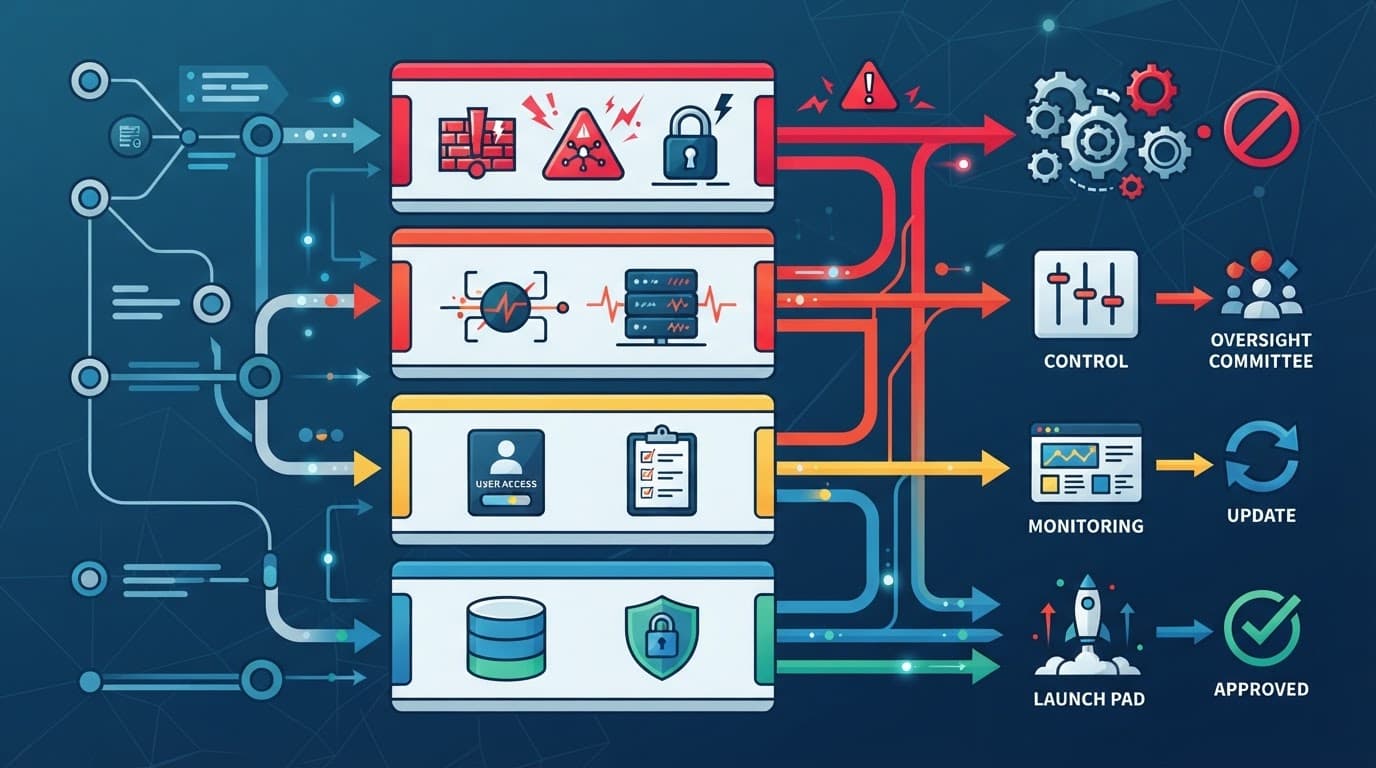
Human oversight must mean more than clicking approve. A reviewer should verify facts, challenge recommendations, document material decisions, and stop automated actions when the result is unsafe or unsupported. Define these responsibilities in the workflow so human oversight becomes an operating control rather than an informal expectation.
Your AI incident process should cover data leakage, harmful output, security compromise, biased results, inaccurate customer communications, model drift, and vendor outages. Continuous monitoring can surface unusual behavior before it becomes a larger incident, while escalation procedures should identify who can pause or disable a system. Use board-ready cybersecurity reporting and guidance on what to report to the board about cyber to translate technical events into business language.
Train employees without creating fear
General AI literacy is not enough. Role-specific training should show employees how to use approved tools, protect sensitive information, support data privacy, verify outputs, disclose AI assistance when required, spot manipulation, and report incidents.
Short examples, manager guidance, office hours, and a clear question channel work better than one annual course. Explain when human oversight is required, how to document decisions, and how to handle data privacy questions in everyday work. Good governance helps people use AI with confidence. It shouldn’t force useful experimentation into hidden channels.
Test, report, and make the program real in days 61 to 90
The final phase tests the program on real work. Your goal is a working AI governance framework for artificial intelligence systems, not a binder of policies.
Use a one-page technology strategy and concise board technology reporting to show priorities, risks, owners, and decisions without burying leaders in technical detail.
Pilot the process on low, medium, and high-risk use cases
Choose several real examples, such as an internal drafting assistant, a customer support tool, and an AI system that influences a material business decision. Include machine learning projects where model behavior, training data, or ongoing performance creates additional oversight needs.
Walk each use through the AI lifecycle, including intake, classification, approval, testing, deployment, human review, continuous monitoring, and retirement. Check model explainability, bias detection, data handling, and evidence requirements at each stage. Record where the process is slow, unclear, or missing evidence, then fix those weaknesses before requiring every department to follow the workflow.
Measure control and business value
Track inventory coverage, approved versus unapproved tools, review time, training completion, incidents, near misses, data exposure events, model performance, human override rates, vendor findings, adoption, time saved, revenue impact, and avoided cost. Use continuous monitoring to identify changes in risk, performance, and control effectiveness after deployment.
Include regular risk assessments and evidence of regulatory compliance in the measurement process. Report risk and value together, using evidence when connecting AI investment to technology spending ROI and aligning technology with business goals. Don’t promise savings you can’t trace.
Give your board a clear AI risk and investment view
Directors need to see important AI use cases, risk tier, accountable executive, control status, incidents, material changes, key metrics, open decisions, and planned investment. Board reporting should also show how the company addresses risk assessments, regulatory compliance, data privacy, and stakeholder trust.
Lead with business impact, legal exposure, customer trust, resilience, and tradeoffs. Management owns execution. The board challenges risk appetite, oversight, and major investment choices.
For an acquisition or ownership change, Prepare Technology for Diligence or Transition helps organize systems, vendors, risks, and reporting before scrutiny increases. A focused technical due diligence review can test whether your documentation matches operational reality.
Set the operating rhythm for the next year
Name a program owner. Schedule quarterly risk reviews, annual policy updates, vendor reassessments, model monitoring, continuous monitoring of critical systems, incident exercises, employee refreshers, and retirement reviews for weak or unused tools.
You may need a permanent AI leader, fractional CTO, fractional CISO, legal support, or specialist model expertise. Fractional CTO services can provide ongoing judgment without a rushed full-time hire. An interim CTO can stabilize ownership when the leadership seat is open. Read more about fractional CTO leadership and when to hire a fractional CTO.
What your 90-day AI governance program should deliver
By day 90, you should have an AI governance framework that supports responsible AI governance, including:
- An AI inventory, risk tiers, policy, intake form, approval matrix, decision log, and audit trails.
- A vendor review checklist, data and access controls, testing records, ethical guidelines, and human oversight rules.
- Cross-functional teams with clear roles, an incident plan, training materials, metrics dashboard, board-ready report, and 12-month roadmap.
The program should not become a ban on useful AI, a checklist with no owners, a tool-buying exercise, or a source of bureaucratic roadblocks that slow enterprise AI adoption and effective generative AI governance.
If leadership still can’t see who owns AI decisions, Talk Through Your Technology Leadership Gap. If you need help building the operating model, Book the 90-day AI governance engagement.
Frequently Asked Questions
How quickly can a company start an AI governance program?
A company can establish a practical foundation within 90 days by creating an inventory, setting risk boundaries, assigning owners, publishing interim rules, and piloting controls. The first 90 days create an operating rhythm rather than a finished compliance program.
Who should own AI governance?
An executive sponsor should lead the program with support from technology, security, privacy or legal, human resources, finance, operations, and business owners. Management owns execution, while the board provides oversight of material risk, investment, and stakeholder trust.
What should be included in an AI inventory?
The inventory should record each AI tool or artificial intelligence system, its purpose, vendor, data, users, outputs, integrations, decision impact, and accountable owner. Include shadow AI use so that unapproved tools, inconsistent controls, and hidden data flows become visible.
How should AI use cases be prioritized?
Classify use cases according to data sensitivity, decision impact, scale, autonomy, explainability, external exposure, and potential harm. Low-risk productivity assistance can use a lighter process, while customer-facing, employment, financial, healthcare, safety, or legal decisions require stronger testing, approval, and human oversight.
What should the board receive about AI governance?
Board reporting should summarize important AI use cases, risk tiers, accountable executives, control status, incidents, key metrics, material changes, and planned investment. Lead with business impact, legal exposure, customer trust, resilience, and tradeoffs rather than technical detail.
Conclusion
You don’t need perfect policies or a large AI department to establish responsible AI governance and protect stakeholder trust. You need a clear starting point, visible ownership, risk-based controls, and a review process that improves with experience.
Responsible governance protects customer trust, reduces surprises, supports growth, and helps leaders defend technology choices. Ongoing executive oversight of AI ethics and governance, supported by continuous monitoring, keeps the program aligned as systems, risks, and regulations evolve. If you need executive support, talk to a fractional technology executive about the right next step for your business technology strategy.
Over time, aligning your risk management framework with requirements such as the eu ai act and strong data privacy practices can build lasting compliance resilience. The goal is simple: better control, clearer tradeoffs, and confident decisions when AI becomes part of how your company operates.