
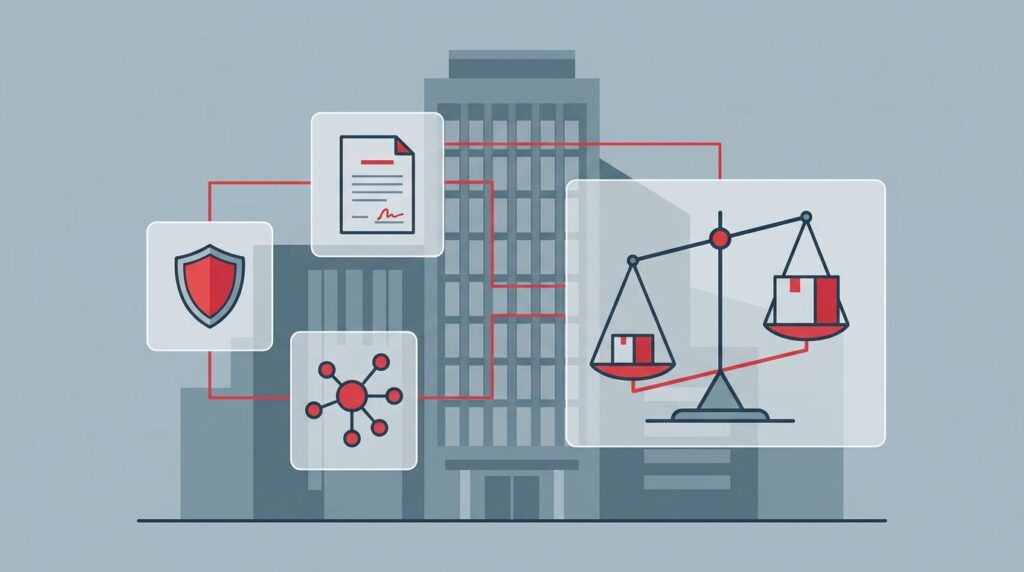
A $15,000 software purchase can create more risk than a $250,000 infrastructure project. The price is not always the primary concern. The real problem is what the decision commits you to, such as sensitive data exposure, a five-year contract, a vendor dependency, or a system your team lacks the capacity to support.
Implementing formal technology approval thresholds helps CEOs maintain oversight without slowing down innovation. By adopting rigorous standards similar to those found in federal procurement, organizations can significantly improve their governance controls. Establishing clear acquisition thresholds ensures that routine decisions do not become operational bottlenecks, while simultaneously preventing high-risk initiatives from slipping through the cracks due to unclear oversight.
You do not need more meetings to manage these risks. You need better decision rights, clearer ownership, and a simple, defensible rule for when an issue must move up the chain.
Key Takeaways
- Technology approval thresholds should reflect risk, commitment, and business impact, rather than purchase price alone. By establishing risk-based thresholds, organizations can better align financial oversight with potential exposure.
- Your CEO, COO, CFO, technology leader, and board should each have defined approval responsibilities to ensure accountability.
- Cybersecurity, data, vendors, AI, and acquisition work need lower escalation thresholds than routine operational purchases to ensure internal compliance.
- A well-defined approval workflow and technology operating rhythm keep decisions fast without making them casual or creating unnecessary administrative burden.
- Good thresholds produce reporting leaders can trust, replacing a pile of approval paperwork with clear, actionable data.
Why Technology Approval Thresholds Matter
Without formal approval thresholds, your company usually falls into one of two bad patterns.
In the first, every purchase lands with the CEO. Small decisions pile up, and leaders are forced to wait. The CEO becomes a manual routing desk for software renewals, laptop purchases, and minor vendor changes. Implementing hierarchical thresholds prevents this bottleneck by ensuring the right level of leadership handles the right level of spend.
In the second pattern, teams buy tools and sign agreements with little executive oversight. That is how tool sprawl, shadow IT, weak vendor management, and technology debt build up. Without a clearly defined approval workflow, you often discover later that three departments bought overlapping products, customer data sits in an unreviewed platform, or a vendor contract lacks a usable exit clause. These inefficiencies erode your pocket margin, making it vital to standardize purchasing processes.
Technology governance for CEOs is not about controlling every decision. It is about deciding which decisions carry enough cost, risk, or long-term commitment to deserve executive attention.
A clean approval model supports a business-aligned technology strategy. It connects technology decisions for growth to revenue, margin, customer trust, delivery, and risk. It also makes your technology strategy for COOs more practical because teams know where authority sits before a project stalls.
If nobody can explain who approves a decision, the decision is already carrying more risk than it should.
The goal is not bureaucracy. The goal is faster decisions with stronger ownership.
Set Thresholds Based on More Than Spend
Spend matters, but it is only one signal. A low-cost AI tool that can access customer records may deserve more scrutiny than an expensive server replacement. A renewal can also deserve a higher approval level if it quietly extends a poor vendor relationship for another three years. To manage this effectively, many organizations establish a micro-purchase threshold for low-risk, routine items to streamline operations, while reserving the simplified acquisition threshold for more significant procurement projects.
Use four tests when setting technology approval thresholds:
- Financial commitment: Consider the total contract value, implementation cost, internal labor, and renewal exposure. Always evaluate the full financial impact rather than approving based only on the first-year subscription fee.
- Business impact: Ask whether the decision affects revenue, customer experience, delivery capacity, reporting, or a major operating process.
- Risk exposure: Raise the approval level when a decision affects data privacy, access controls, cybersecurity oversight, business continuity planning, or regulatory commitments.
- Reversibility: A tool you can cancel in 30 days is different from a platform migration, ERP replacement, or custom integration that will shape your operating model for years.
A simple approval structure might look like this:
| Decision type | Typical approval owner | Escalate when |
|---|---|---|
| Routine operational spend under micro-purchase threshold | Department leader | It exceeds the approved budget or adds a new vendor |
| Software platform evaluation | Technology leader and business sponsor | It affects customer data, core systems, or multiple departments |
| Major technology vendor selection | CEO, CFO, and technology leader | It creates long-term dependency or material implementation risk |
| Cybersecurity control or incident decision | Technology leader and executive sponsor | It affects risk appetite, insurance, customer commitments, or the board |
| Strategic platform, acquisition, or AI decision | Executive team, sometimes board | It changes business strategy, enterprise risk, or valuation |
The dollar amounts will vary by company. A $5 million business and a $100 million business should not use the same limits. What matters is that the threshold fits your size, cash position, and operating risk.
Give Each Leader a Clear Approval Role
Approval thresholds work only when people know the difference between input, recommendation, and final authority. To formalize this, many organizations establish a technology review council to manage escalation levels and ensure complex projects receive appropriate executive scrutiny.
The CEO should approve decisions that affect business direction, major capital commitments, customer trust, or material risk. These acquisition thresholds define where the CEO’s final authority begins, covering major technology roadmap shifts, high-stakes vendor contracts, or decisions that change the company’s cyber risk appetite.
Your COO should own decisions tied to operating performance. That can include workflow systems, service-level commitments, implementation readiness, and COO technology strategy. The CFO should review total cost, contract terms, technology ROI, and tech spending ROI to ensure the contract value is clearly justified and supports IT cost optimization rather than adding unnecessary overhead.
Your technology leader should own the technical recommendation. They should assess architecture, security, technical debt management, integration effort, systems inventory, data quality, and support requirements. They should also make the tradeoffs plain. This is executive technology leadership, which is quite different from a team member simply saying that a tool looks good.
A decision rights map should name:
- The business sponsor who owns the outcome.
- The technology lead who owns the recommendation and delivery path.
- The finance owner who validates cost and pricing data.
- The executive who gives final approval.
- The board committee, if the decision reaches technology risk oversight or strategic direction.
This structure helps you achieve stakeholder alignment before you spend money. It also keeps founder-led technology decisions from turning into last-minute calls based on a vendor demo.
For a useful starting point, a one-page technology strategy can show which decisions belong to the annual plan and which require separate approval.
Decisions That Should Always Escalate
Some decisions should never be treated as routine, even if the initial invoice is small.
Cybersecurity risk needs a clear escalation path. That includes a cybersecurity risk assessment, IT security assessment, ransomware readiness, incident response readiness, cyber insurance renewal, and any exception to access control best practices. Your technology risk management framework should define who can accept risk, how long an exception can remain open, and when cyber risk reporting to the board is required.
Your board does not need technical noise. It needs board cybersecurity reporting that answers four questions: What could hurt the business? Who owns the response? What has changed? What decision is needed? That is the standard for board-ready technology reporting and a board-ready risk summary.
Vendor decisions also need stronger controls. Raise approval requirements for vendor due diligence, third-party risk management, and vendor incident response plan changes. Any new vendor that handles payroll, customer data, or core operations deserves scrutiny before a contract is signed. For major system initiatives or enterprise resource planning projects, oversight must be rigorous. Furthermore, for companies operating in highly regulated environments similar to the Department of Defense, internal compliance may require strict adherence to the Federal Acquisition Regulation or standards like NDAA 2026. Any noncompetitive acquisitions or requests for a sole source justification must move to the highest level of leadership review.
AI deserves its own approval rule. Your AI adoption strategy and AI transformation strategy should not become a collection of unmanaged experiments. Require review when a tool handles company data, makes customer-facing decisions, creates legal exposure, or changes how employees work. That review should cover responsible AI, an AI acceptable use policy, and an AI opportunity assessment.
The same standard applies to technology due diligence, technical due diligence, cybersecurity due diligence, and post-merger technology integration. During a deal or leadership change, weak ownership shows up fast. A technology due diligence review gives you a more defensible picture before you commit.
Use Approval Thresholds to Control Spend and Complexity
Technology spend optimization is not about cutting every tool. It is about knowing what each dollar is buying and what you can safely stop buying. By establishing clear procurement thresholds, you can ensure that leadership maintains visibility over significant investments before they impact the pocket margin.
Require executive review when a proposed purchase duplicates an existing capability, adds another integration, or bypasses your technology roadmap. This is where application portfolio rationalization, software platform evaluation, and technology vendor selection matter. You need to see the wider operating cost, not just the sales pitch. To make informed choices, always require cost or pricing data to validate the value of any major acquisition. Furthermore, define a simplified acquisition threshold to determine when an investment requires formal competitive bidding or deeper market research to avoid overpaying for redundant technology.
Ask three questions before approving significant spend:
- Does this support a stated business priority or 12-month technology roadmap?
- Does it replace an existing tool, reduce manual work, or improve a measurable outcome?
- Who owns adoption, data quality, ongoing cost, and eventual retirement?
Cost-per-outcome reporting is useful here. Instead of reporting that a platform costs $80,000, report the result it supports: reduced order errors, faster customer onboarding, fewer service failures, or lower processing time. If the outcome is unclear, the investment is not ready.
Technology dashboards should show spend, adoption, risk, delivery status, and the major dependencies. That gives you a clearer view of technology ROI than a list of invoices ever will.
Build a Technology Operating Rhythm Around the Rules
Approval thresholds should live inside your regular leadership rhythm. If they sit in a policy nobody reads, they will not change decisions. You should also ensure these acquisition thresholds undergo an annual inflation adjustment to remain relevant as costs and market conditions change.
Review technology priorities for growing companies monthly. Look at open approvals, material vendor commitments, technical debt, technology debt, project risk, data strategy, and decisions that need executive direction. Keep the discussion tied to your IT strategy and roadmap, not a tool catalog.
Each quarter, review your business technology strategy. Confirm whether your technology roadmap still supports the business plan. Update the 12-month technology roadmap when conditions change. A technology roadmap template can help, but only if the plan names owners, dates, costs, risks, and decisions.
Your board should see the matters that rise above management. That includes significant technology spend, cyber risk appetite, major delivery risk, business continuity planning, disaster recovery planning, and decisions that affect customer confidence or acquisition value. As your technology review council updates its criteria for what constitutes a major system, ensure these internal standards reflect broader updates to the federal acquisition regulation or specific guidelines found in the NDAA 2026.
If reporting is weak, start by strengthening technology risk oversight. Better reporting makes approval thresholds easier to defend because leaders can see the facts behind the decision.
Close the Technology Leadership Gap Before It Gets Expensive
A technology leadership gap makes approval thresholds significantly harder to manage. You may have capable IT managers, vendors, and project teams, yet nobody may own the full picture across strategy, risk, spend, and execution.
This is where a fractional CTO, virtual CTO, part-time CTO, or outsourced CTO can help. These leaders bring consistent executive judgment to growing companies that are not yet ready for a full-time hire. Beyond general guidance, they provide the expertise to implement robust cost accounting standards, ensuring that technology spending is tracked and audited with precision. They also help navigate complex federal procurement rules or rigorous internal compliance frameworks that standard IT managers might otherwise overlook.
An interim CTO and interim CTO services fit a different moment. Use them when the seat is open, a major initiative is slipping, a CTO transition plan is needed, or leadership needs control quickly. A fractional CIO may fit when the issue covers systems, operations, data governance, or broader technology planning. A fractional CISO, virtual CISO, or interim CISO is the better fit when cyber risk and security accountability lead the conversation.
This is fractional technology leadership, not a substitute for basic IT support. It helps you decide when to hire a fractional CTO, how to hire a CTO, and whether a fractional CTO versus full-time CTO decision is even ready. It also clarifies why a fractional CTO versus IT consultant comparison often misses the point. One gives point advice, while the other owns executive-level judgment over time.
A technology health check, technology audit, technology assessment, and 90-day technology plan can establish the facts before you redraw approval authority. If the picture is still unclear, Get an Executive Technology Clarity Check before more spend, risk, and delay pile up.
Frequently Asked Questions
What should a CEO approve personally?
You should personally approve material commitments, decisions that impact strategy or customer trust, major risk acceptance, and investments with long-term operating consequences. It is essential to establish clear technology approval thresholds so that you are not bogged down by every software renewal or routine operational purchase that falls below your level of responsibility.
Should the board approve technology purchases?
Usually, no. Technology governance for boards is about oversight rather than daily buying decisions. The board should focus on approving or challenging decisions that affect enterprise risk, strategic direction, or cybersecurity exposure. They should only intervene for a major system implementation or investments that exceed the highest acquisition thresholds established by the organization.
How often should approval thresholds be reviewed?
Review your guidelines at least annually and after any significant organizational change. Factors such as rapid growth, new acquisitions, leadership turnover, or evolving regulatory obligations can all change the risk level your company can accept. While the micro-purchase threshold for routine, low-risk expenses may remain stable, your larger frameworks should be updated to reflect the current business environment.
Clear Rules Create Better Decisions
Technology approval thresholds give you a practical way to protect speed without giving away control. By implementing these, you make it clear which decisions can move quickly and which ones require stronger scrutiny.
The best thresholds reflect your business, your risk tolerance, and your current technology maturity. They provide capable team members with the room to act while keeping major commitments visible to the leaders responsible for the outcome. When you establish well-defined procurement thresholds and a consistent approval workflow, you remove ambiguity from the process.
Ultimately, your technology approval thresholds serve as a foundation for accountability. Clear ownership always beats approval theater, and these guidelines ensure that your organization consistently produces more defensible business outcomes.