

Growth often exposes technology problems that were easy to ignore at a smaller stage. If technology has become expensive but leadership cannot explain what it is doing for the business, you have a leadership problem, not a technology problem.
Without clear technology leadership, it is common for tech spending to go up while business performance gets worse. The budget for software and services climbs, yet the business feels like it is running through mud.
This is the quiet chaos of misaligned technology. It is a slow bleed, creating friction that grinds the organization down and makes every simple task feel hard.
Why Business Slows Down When Tech Investment Goes Up

Does this feel familiar? Execution has slowed. Projects that should take weeks now stretch into months. When the board asks about the return on technology investment, the answers feel vague.
Your best people are trapped, spending their days on manual workarounds and patching together systems that were never meant to speak to each other. Burnout becomes a real risk as the "coordination tax" on every task gets heavier.
This environment is a breeding ground for serious business problems:
- Weakened Reporting: Getting an answer to a simple performance question requires a heroic effort. Data is scattered, making a single source of truth feel impossible.
- Fuzzy Accountability: When systems are a tangled mess, ownership becomes blurry. It is hard to tell who is responsible for what, which leads to stalled decisions.
- Loss of Strategic Control: Your business goals no longer drive your technology roadmap. Instead, your strategy is dictated by the limitations of your tools and the agendas of vendors.
The feeling that technology has become a brake, not an accelerator, is a classic sign of failing technology leadership. It is a predictable outcome when operational support is mistaken for strategic direction.
Eventually, technology stops feeling like an asset and starts to feel like a liability. Growth becomes a source of anxiety because you know your current systems cannot handle the load.
If this picture looks painfully familiar, it is because you are facing a structural problem, not a people problem. Your team is not failing because they lack effort. They are struggling because they lack clear, executive-level technology leadership to guide them.
The Difference Between IT Support and Technology Leadership

Many executives believe that having an IT department or a managed service provider (MSP) checks the “technology” box. This is one of the most expensive mistakes a business can make.
Thinking your IT support team can provide technology leadership is like assuming your building's plumber is also the architect.
One Fixes Leaks, The Other Designs The Building
Your plumber is essential. When a pipe bursts, you need someone who can fix the immediate problem. This is IT support. It is reactive, tactical, and focused on maintaining what you already have.
The architect, however, played a different role. They designed the building from the ground up, considering future expansion, resilience, and whether the foundation could support another ten floors. Their work is proactive and strategic. This is technology leadership.
You need both. But a world-class plumber cannot fix a cracked foundation. When the core design is flawed, a toolbox and a can-do attitude will not cut it.
Why This Matters Now
This distinction is becoming more critical every year. Recent industry research highlights a massive disconnect inside most companies. A staggering 81% of organizations admit their teams do not understand the scope of their tech leaders' roles, even as 78% see those leaders as vital to success.
With 80% of businesses planning to launch new data products, this role confusion creates chaos. Projects get stuck, and your vendors, not your strategy, start dictating your roadmap. Everyone is busy putting out fires while the truly important work never gets done.
Part of this involves clearly defining operational functions; for instance, understanding the nuances of helpdesk vs service desk can help clarify responsibilities and streamline how support is delivered.
Technology leadership is not a technical support function. It is an executive discipline focused on aligning technology with business goals, managing risk, and designing a future where the company can grow without breaking.
While your IT support team is focused on keeping the lights on today, a true technology leadership function asks the bigger questions. Are we building on a solid foundation? Can our systems handle the growth we’re projecting? How resilient are we to new cyber threats?
This role owns the blueprint. It is responsible for translating the company's strategic goals into a technical reality. To see what this looks like in practice, our guide on the primary responsibilities and duties of a CTO breaks it down further.
Without this strategic oversight, you are just endlessly fixing leaks in a building that was never designed to get you where you need to go.
Four Signs Your Technology Leadership Is Failing
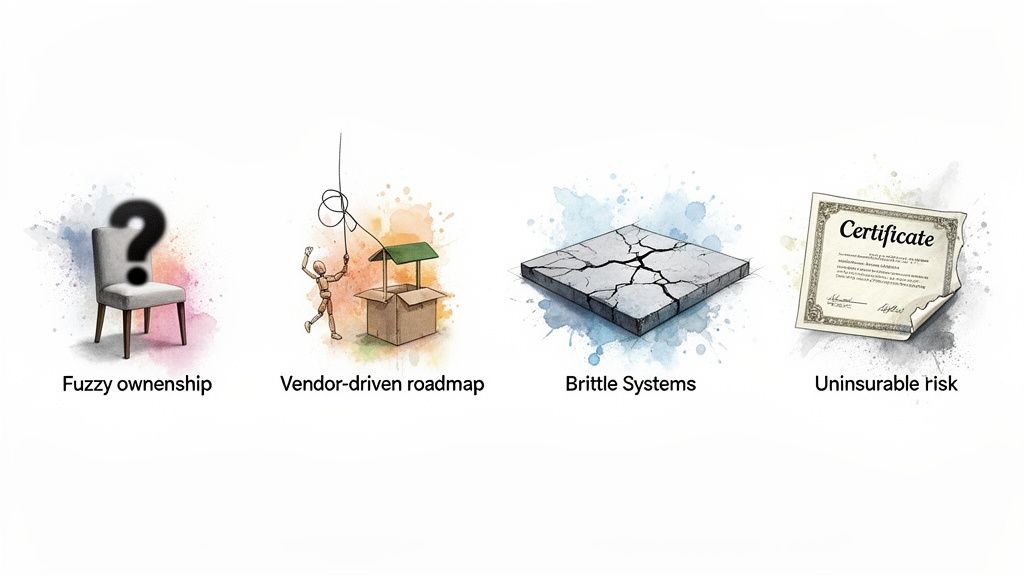
When a company is missing real technology leadership, the pain shows up as a collection of frustrating, energy-sapping problems that executives feel every day. These are business problems that happen to have technical roots.
Learning to spot these symptoms is the first step to getting back on track.
1. Fuzzy Ownership and Endless Debate
A big decision is on the table, but nobody has the clear authority to make the call. The conversation goes in circles, bogged down in meetings and competing opinions.
Without a single person accountable for the outcome, teams either create clumsy workarounds or stop moving. The result is a culture of finger-pointing and stalled projects.
For example, a mid-sized services firm needed a new project management tool. Operations, finance, and sales all wanted different systems. With no technology leader to weigh the options against a single business strategy, the decision dragged on for two quarters. In the meantime, teams were stuck using messy spreadsheets, slowing down new client onboarding by 40%.
2. Vendor-Driven Roadmaps
When you have a leadership vacuum internally, your vendors will happily step in to fill it. Before you know it, their product roadmap has become your company’s roadmap.
This is a quiet outsourcing of your most critical business decisions. Your strategy is no longer driven by your customers or your goals, but by a salesperson's need to hit their quota. This creates deep dependencies that are expensive and painful to unwind.
When your vendor's account manager has more influence on your technology direction than your own executive team, you have lost control of your business. This is a direct failure of technology leadership.
3. Brittle Systems That Break Under Pressure
A solution that works for a 20-person startup will shatter when you have 100 employees and ten times the customer volume. Without proactive planning, your technology becomes brittle.
These fragile platforms cannot handle the stress of growth. Suddenly, simple requests like pulling a report require a team of experts and a week of manual work. The first sign you’re in trouble is when your team starts saying "we can't do that" in response to reasonable business ideas. Your technology is no longer helping you grow; it’s actively holding you back.
4. Uninsurable Risk and Vague Answers
The board’s audit committee starts asking tough questions about cybersecurity. A huge potential client sends over a security questionnaire you cannot confidently fill out. Your insurance provider triples your cyber liability premium, or denies coverage outright, because you cannot prove you have basic security controls in place.
This is what uninsurable risk looks like. It is the direct consequence of not having anyone at the leadership table who is responsible for turning abstract business risks into a clear, defensible security program.
An education nonprofit I advised was up for its cyber policy renewal. The insurer’s new questionnaire demanded specific proof of multi-factor authentication, incident response drills, and vendor risk management. With no clear technology leadership to own these functions, the internal team could only offer vague promises. The renewal quote came back nearly four times higher.
Each of these signs points back to the same gap: the absence of an executive-level leader who owns the technology blueprint.
Why Smart Leaders Miss This Problem
A sharp, successful executive team gets blindsided by a technology crisis that seems to come out of nowhere. But the problem was not new. It had been festering for years, cleverly disguised as success.
The truth is, a lack of real technology leadership is easy to miss in a growing company. The early signs are almost always misleading. Most leaders are not technologists, so they naturally look for simple proxies: Is the website running? Are customers getting served? As long as the lights stay on, it is tempting to assume everything is fine. The internal mechanics of the technology stack remain a black box.
The Myth of the Heroic Developer
Who’s keeping the lights on? In many scaling companies, it is one person: the "heroic developer." This is the indispensable engineer who built the first product and can pull an all-nighter to fix any crisis.
For a while, this person feels like a superpower. Problems get solved fast. But this dependency is a ticking time bomb.
That hero is a single point of failure. As the business grows, they become a bottleneck. Their specialized knowledge, locked in their head, makes it impossible to onboard new people. And when they leave, they take the company’s institutional memory with them, plunging the business into chaos.
The Problem with Past Assumptions
Many leaders are still operating on yesterday's playbook. What worked for technology five years ago is dangerously out of date.
Consider the global balance of power in technology. In the early 2000s, the United States led in 60 out of 64 critical technologies. According to recent analysis, China now leads in 57 of those same 64 technologies. You can see the full two-decade trend in ASPI's comprehensive technology tracker.
This is a stark reminder for every executive: technology leadership is not a one-time achievement. It is a dynamic capability you have to constantly maintain. Relying on past glory is a recipe for getting blindsided.
Because the tech feels like a black box and yesterday's hero is still putting out fires, it is easy for leadership to keep their distance. But inside that box, complexity is spiraling and risks are multiplying. You only see the problem when the walls start to crumble, and by then, the fix is ten times more expensive.
The Path Forward: A Framework for Technology Leadership
Moving your technology from firefighting to a proactive force for the business is about installing a repeatable system for making decisions. The goal is not to solve every problem at once. It is to create clarity, establish a steady rhythm, and execute on the wins that matter most.
Step 1: Make Reality Legible
You cannot fix a problem you cannot see. The first order of business is to get a brutally honest picture of your current technology landscape. This is a fact-finding mission to uncover the true source of the chaos.
This initial audit should document three key areas:
- Systems: What software and platforms are actually in use? This includes officially sanctioned corporate tools and the "shadow IT" that teams have adopted to get their jobs done.
- Vendors: Who are you paying for technology services, and what are you getting for your money? You need to know contract terms, renewal dates, and costs.
- Decision-Making: Who is responsible for what? Mapping out decision rights reveals the "fuzzy ownership" that brings progress to a halt.
By making reality legible, you replace opinions with a clear, fact-based view of what is really going on. It is helpful to think in terms of a strategic alignment model to ensure every piece of your tech puzzle supports your business goals.
Step 2: Install a Calm Operating Rhythm
Once you can see the whole system, the next step is to give it a heartbeat. A calm operating rhythm is a predictable cadence of meetings and reporting that drives accountability. It replaces panic with a structured process.
An operating rhythm is not about adding more meetings. It is about making your few essential interactions so effective that they eliminate the need for dozens of follow-ups and emergency calls.
A strong operating rhythm needs three components:
- A Weekly Accountability Cadence: A short, focused meeting where owners report on progress against clear goals and blockers are flagged.
- Clear Ownership: Every key system, project, and risk has a single, named owner. This eliminates ambiguity.
- Simple, Board-Ready Reporting: A one-page dashboard that communicates progress, risks, and spending in plain business terms.
This rhythm creates predictability. The entire organization starts moving in sync.
Step 3: Execute High-Impact Wins
With a clear map and a steady heartbeat, you can focus on execution. Resist the temptation to tackle everything at once. Instead, identify a handful of high-impact wins that deliver immediate value and build momentum. For more guidance on long-range planning, check out our guide on building a technology strategy.
Prioritize actions that rapidly reduce risk or simplify daily work. These quick wins often look like this:
- Securing Critical Assets: Rolling out multi-factor authentication across your most important systems.
- Simplifying Workflows: Retiring a redundant piece of software that is creating confusion.
- Consolidating Vendors: Getting rid of an unnecessary contract to immediately reduce costs and complexity.
Executing these wins proves that change is possible. It builds your team’s confidence and earns you the political capital needed for bigger projects. This is how real technology leadership turns chaos into calm, predictable execution.
What Better Looks Like: A Calmer, Faster Organization

You can feel the difference when technology leadership clicks into place. The constant hum of panic fades away. The organization stops lurching from one crisis to the next and settles into a rhythm that feels calm, fast, and predictable.
Strategic decisions are made with confidence because they are backed by good data. Key projects finish on schedule because ownership is clear and roadblocks are tackled immediately.
The whole conversation around technology changes. It stops being a source of frustrating surprises and becomes a reliable engine for getting things done.
The New Reality of Predictable Execution
Reporting is no longer a frantic fire drill. It becomes a simple byproduct of a system that works. When the board asks a tough question, the answer is ready. This visibility builds confidence with your board, auditors, insurers, and partners.
Your teams feel the change most deeply. They are no longer burning out on brittle systems or wasting time on manual workarounds. They can pour their energy into creating real value for customers instead of fighting internal friction. That clarity is what keeps your best people from looking elsewhere.
This reflects a major trend. A recent study shows 69% of Fortune 500 companies now have their top technology officer on the executive committee. For leaders appointed since early 2024, that number jumps to 76%. You can find out more about this shift toward strategic technology leadership and why it is happening.
Better does not mean perfect. It means predictable. It means having a system you can inspect, control, and rely on.
A Business Built for Speed and Resilience
Ultimately, strong technology leadership creates an organization that can move fast without breaking things. The guardrails are solid, giving your teams the confidence to innovate and take smart risks.
What this looks like day-to-day:
- Strategic Agility: You can jump on new market opportunities because your systems are built for change.
- Reduced Risk: Your security posture becomes clear, defensible, and always improving.
- Cost Control: Vendor sprawl gets reined in, and every dollar spent on technology is tied to business value.
This is the real promise of getting technology leadership right. It is about moving from a state of constant reaction to one of intentional action. It is about building a calmer, faster, and more resilient business.
Your Next Step Toward Predictable Growth
If your business is running through mud, hoping for a different result is not a strategy. The friction you feel is a hidden tax on growth, profitability, and morale. It is the direct result of misaligned technology.
This problem does not fix itself. Without clear, executive-level technology leadership, the chaos only deepens. Projects will keep stalling, your best people will burn out, and the organization will stay vulnerable. The only way out is to install a system that creates clarity and control.
The Path to Clarity
Moving from a reactive state to a calm, predictable one starts with a single action. You have to make your current reality legible before you can improve it. That means getting an honest assessment of where the real bottlenecks and risks are hiding.
Waiting for a crisis to force your hand is the most expensive way to solve this. A proactive approach is faster, cheaper, and less disruptive. For leaders who recognize the need for experienced guidance, exploring options like interim CTO services can provide the necessary expertise without the commitment of a full-time hire.
The cost of inaction is far greater than the cost of a single, focused conversation. The longer you wait, the more deeply entrenched the problems become.
Getting clear on the next step does not have to be a complex, multi-month engagement. It can start with one conversation designed to map out the core issues and define a practical path forward. The goal is to replace vague frustrations with a concrete plan that delivers immediate results.
This is about taking back control. It is about turning technology from a source of constant surprises into a reliable engine for your business.
If you are tired of paying the hidden tax of weak technology leadership, CTO Input can help. A Clarity Call is a single conversation designed to identify your biggest technology bottlenecks and give you a clear outline for the first 30 days of improvement. Book your Clarity Call to see what is really happening and what to do next.