

The ransomware bill always comes due. You just get to choose when, and how, you pay. You can pay in advance through calm, deliberate preparation, or you can pay a much higher price later, in the chaos of a live attack, with your reputation, customer trust, and financials on the line.
You watch another breach make headlines and know it could be you. You have smart people and expensive tools, yet the feeling of fragility persists. The real problem isn't a lack of tools. It's that your readiness plan is a collection of documents, not a calm, inspectable operating system. Misaligned tech and security create delays and rework, leaving you exposed when minutes matter. Smart people fail in ambiguous systems.
The decision is this: will you make critical choices calmly today, or in a panic tomorrow? This practical ransomware readiness checklist for leadership team is not about buying more tools. It is about restoring control by making ownership explicit, defining decisions before they become crises, and creating proof of readiness you can show your board, your insurers, and your customers. This is your plan to move from hoping you are ready to knowing you are. This is how you reduce the coordination tax and risk exposure that keep you up at night.
1. Ownership is Decided: One Name, Not a Committee
In a ransomware crisis, ambiguous ownership is fatal. When everyone is responsible, no one is. Decision-making stalls, teams duplicate effort, and critical actions are missed because everyone assumes someone else is handling it. The first decision on your ransomware readiness checklist for leadership team is to name a single owner for ransomware readiness and response. This is not a committee. It is one person with the explicit, pre-delegated authority to act.
This individual, typically the CISO or a senior technology leader, becomes the "Ransomware Owner." Their job is to drive readiness before an incident and lead the response during one. Their authority must allow them to make critical decisions, like shutting down systems or engaging external responders, without seeking consensus in the heat of the moment. This single decision transforms response from a chaotic scramble into a structured, playbook-driven operation. For the board, this translates delegated authority into clear accountability.
Proof of Control
- Time to align leadership during a test incident: Reduced from hours to under 30 minutes.
- A decision rights map: A single page showing who decides what, under what conditions.
- Board-ready summary: A paragraph in your board report naming the owner and their delegated authority.
Your 30-Day Move
- Week 1: The CEO names the owner in writing.
- Week 2: The owner maps the top five critical decisions (e.g., "isolate network," "contact insurer") and proposes a decision-maker for each.
- Week 3: The executive team reviews and approves the decision rights map.
- Week 4: The owner confirms the escalation path is documented in the incident kickoff runbook.
2. The Plan is Tested and Board-Defensible
A response plan buried in a shared drive is not a plan; it is an artifact of false security. An effective plan is a living protocol that removes improvisation from your organization's worst moments. It must clearly answer: Who calls whom and when? What systems do we isolate first? How do we communicate with law enforcement, insurers, and regulators? A board-defensible plan is one you have pressure-tested in the last 90 days.

The goal is to move from chaotic reaction to playbook-driven execution. A robust plan requires not just a strategy, but also a clear record of the decisions that shaped it, ensuring accountability and continuity, similar to how documenting key choices formalizes key choices. This documented, tested plan becomes a critical part of your overall ransomware readiness checklist for leadership team, demonstrating to auditors and insurers that your governance is real.
Proof of Control
- Time to execute the first three moves in the playbook: Measured and improved quarterly via tabletop exercises.
- Number of open findings from the last tabletop exercise: A backlog tracked to zero.
- Date of the last executive tabletop exercise: Must be within the last six months to be considered current.
Your 30-Day Move
- Week 1: The Ransomware Owner schedules a 90-minute tabletop exercise with the executive team.
- Week 2: The team runs the exercise, focusing on the first 60 minutes of a simulated attack.
- Week 3: The owner documents the top three gaps found (e.g., unclear communication triggers, slow legal engagement).
- Week 4: The owner assigns owners and deadlines for each gap and adds them to the next monthly security cadence for review. For more, see our guide on incident response planning.
3. Backups are Proven, Not Assumed
Paying a ransom happens when leadership loses faith in their ability to recover. The most devastating impact of a ransomware attack is not the encryption of production data, but the discovery that your backups are unavailable, corrupted, or have been encrypted alongside everything else. A ransomware-ready organization doesn't just have backups; it has a validated recovery capability built on tested, isolated, and resilient copies of its critical data.

Your backup strategy must be actively hostile to an attacker's goals. Backups must be isolated from the primary network, making them unreachable even if an attacker gains widespread control. The ability to restore must be proven through regular, documented tests. This turns your backup system from a passive insurance policy into an active defense, providing the business with a credible alternative to paying the ransom. Without this proof, you are negotiating from a position of weakness.
Proof of Control
- Time to restore a critical system from backup: Measured in a quarterly test against the documented goal.
- Percentage of critical systems with validated, isolated backups: Tracked monthly, aiming for 100%.
- Date of last "full dark" recovery test: An annual test simulating a total site failure.
Your 30-Day Move
- Week 1: The Ransomware Owner identifies the top three most critical business systems.
- Week 2: The technology team confirms if backups for these systems are logically or physically isolated.
- Week 3: The team conducts a timed test restore of one of the three systems to a sandbox environment.
- Week 4: The owner presents the test results—including time to restore and any issues found—at the monthly security cadence.
4. Recovery Priorities are a Business Decision, Not a Technical Debate
In the chaos of a ransomware attack, every system feels critical. This is a dangerous illusion. Without a pre-defined recovery order, teams waste precious hours debating what to restore first, while the business bleeds revenue and trust. Your ransomware readiness checklist for leadership team must include a binding decision, made before an attack, on which systems are non-negotiable and which can wait. This is a business strategy decision, not a technical task.
This process involves identifying the handful of systems that, if down, cause catastrophic business failure. For each, you must define its Recovery Time Objective (RTO) and Recovery Point Objective (RPO), answering "how fast must it be back?" and "how much data can we afford to lose?". This recovery priority list becomes the single source of truth for your technical teams during an incident, eliminating paralysis and ensuring the most valuable parts of the business are revived first.
Proof of Control
- A one-page Recovery Priority Matrix: Lists the top 10 systems, their business owners, and their board-approved RTO/RPO.
- Time to produce the matrix for an audit: Should be less than five minutes.
- Percentage of new projects that include RTO/RPO in their launch requirements: Should be 100%.
Your 30-Day Move
- Week 1: The Ransomware Owner convenes a 60-minute workshop with business leaders.
- Week 2: Using a business impact analysis framework, the group tiers applications into "must have in 4 hours," "need in 24 hours," and "can wait."
- Week 3: The IT team validates if current backup capabilities can meet the "must have" tier's RTO. Any gaps are documented as leadership-level risks.
- Week 4: The final, one-page matrix is presented to the executive team for formal approval.
5. Insurance is an Operating Control, Not a Safety Net
Cyber insurance feels like a safety net, but it is often a trapdoor. Many leaders buy coverage and file it away, assuming it will pay out when a crisis hits. This assumption is a critical vulnerability. When an attack happens, you will discover your policy is a contract with strict requirements, not a blank check. The real work is not buying insurance; it is ensuring your operations meet the policy’s conditions to make a claim successful.
Readying your insurance is about translating the policy's legal language into operational reality. This means knowing the exact coverage limits, exclusions, and, most importantly, the specific security controls required to be eligible for a claim (e.g., MFA on all remote access). Without this clarity, your policy is an expensive piece of paper that provides a false sense of security.
Proof of Control
- A one-page policy summary: Documents coverage limits, the claims hotline, and required security controls.
- Time to engage the insurer's approved breach coach: Confirmed via a pre-incident introductory call.
- A compliance report: Shows current adherence to all security controls mandated by the policy.
Your 30-Day Move
- Week 1: The owner, with legal and your broker, creates the one-page policy summary.
- Week 2: The IT team uses the summary to create a checklist of required controls.
- Week 3: A gap analysis is performed to identify any areas of non-compliance with the policy.
- Week 4: The owner presents the compliance status to leadership, with a plan to close any gaps that could void the policy.
6. Foundational Controls are Monitored, Not Just Deployed
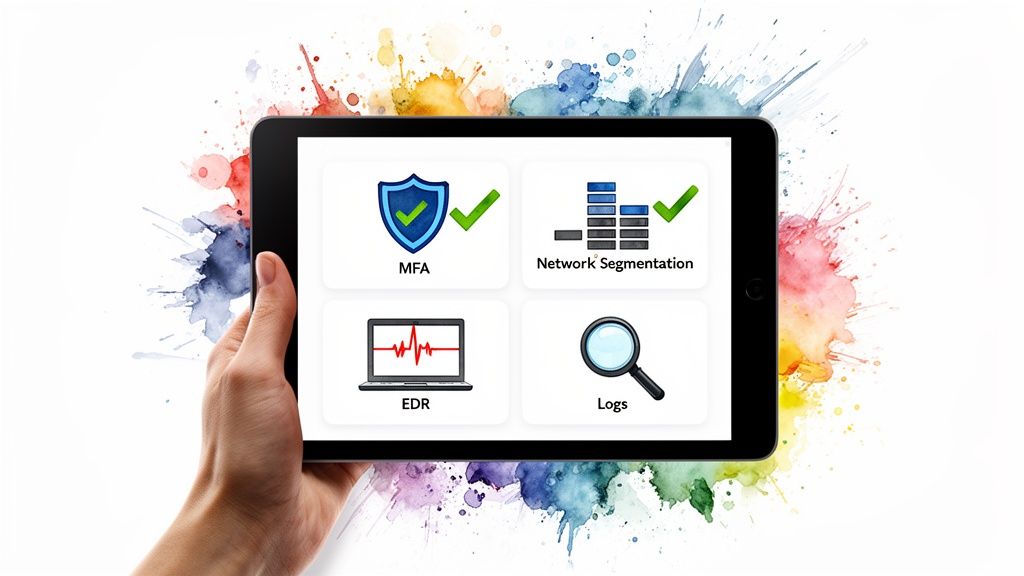
Ransomware attackers rarely use secret, advanced techniques. They exploit weak fundamentals. A complete ransomware readiness checklist for leadership team must ensure the organization masters four foundational controls that reduce blast radius: Multi-Factor Authentication (MFA), network segmentation, Endpoint Detection and Response (EDR), and centralized logging. These controls are not exciting, but they are the difference between a minor event and a catastrophic breach. Tools fail without a source of truth and clean handoffs.
These are core operating requirements, not "nice-to-haves." MFA stops attackers from using stolen passwords. Segmentation contains a breach to one part of the network. EDR provides visibility to detect an active attack, while logging creates the evidence trail needed for recovery. Leadership's job is not to configure these tools, but to demand proof they are working.
Proof of Control
- MFA enrollment rate: Percentage of employees and admins with MFA enabled, targeting 100%.
- Mean Time to Detect (MTTD): Time to identify a simulated threat, measured via regular tests.
- Number of privileged accounts: Tracked and reviewed monthly, with a goal of continuous reduction.
Your 30-Day Move
- Week 1: The owner gets a report on the current MFA enrollment rate for all employees and administrators.
- Week 2: The team identifies the top five privileged accounts with the widest access.
- Week 3: A plan is made to reduce or better control at least one of those privileged accounts.
- Week 4: The MFA enrollment rate and privileged account count are added to the monthly "Proof Snapshot" for leadership. Explore more on How to Prevent Ransomware Attacks.
7. Readiness is Proven Through Regular Exercises
A plan that is never tested is just hope. In a real incident, untested assumptions crumble, creating confusion and delays that attackers exploit. Your ransomware readiness checklist for leadership team must include a commitment to regular testing. This is the only way to transform paper plans into operational reality. This is common; smart teams fall into this trap. The fix is a firm commitment to a testing cadence.
Ready organizations conduct two types of assessments. Tabletop exercises test the human element: your playbook, decision protocols, and team coordination. Technical assessments validate the controls themselves, ensuring that backups can be restored and segmentation rules actually block attackers. The goal is not to "pass" the test; it is to find and fix problems while you still can.
Proof of Control
- Date of the last tabletop exercise involving the C-suite.
- Number of findings from the last test with an assigned owner and due date.
- A report from a recent backup recovery test showing the time taken versus the goal.
Your 30-Day Move
- Week 1: Schedule a quarterly cadence for both tabletop and technical recovery tests.
- Week 2: Run a 30-minute "mini-tabletop" on a single decision, like "When do we notify customers?"
- Week 3: Conduct a test recovery of one non-critical system to prove the process works.
- Week 4: Document the results and one key improvement to be made before the next quarterly exercise.
8. Communication is Planned, Not Improvised
Technical readiness fails without clear communication. In the vacuum of information that follows an attack, stakeholders—from the board to your customers—will fill the silence with speculation and fear, destroying trust. Your plan must translate technical preparation into language that boards, customers, and regulators understand. Without a pre-approved plan, you will waste precious hours arguing about wording while the crisis deepens.
A communication plan pre-answers critical questions: what do we say, to whom, when, and how? It separates audiences, tailors messages, and gets legal and executive pre-approval on statements before you need them. This transforms communication from a source of panic into a tool for control, demonstrating competent leadership. This is inspectable governance.
Proof of Control
- A board-ready, one-page cybersecurity summary: Updated quarterly.
- Pre-approved communication templates: For internal, customer, and regulatory notifications.
- A stakeholder notification map: Defining who communicates what, to whom, and in what order.
Your 30-Day Move
- Week 1: The owner drafts a one-page readiness summary for the board using a board-ready cybersecurity reporting template.
- Week 2: Legal and Comms review and approve a "holding statement" to be used in the first hour of an incident.
- Week 3: The holding statement is tested in a mini-tabletop: "The media is calling. Who approves this statement? How do we release it?"
- Week 4: The board summary is presented at the next board or risk committee meeting, establishing the new reporting cadence.
From Checklist to Control: Your First 30-Day Move
This ransomware readiness checklist for the leadership team is not a project to be finished. It is an operating system to be installed. The goal is not a perfect plan on paper, but a repeatable process of testing, measuring, and improving with the people who will execute it under pressure. This approach replaces ambiguity and coordination tax with a calm, predictable system of execution.
Trying to tackle everything at once guarantees failure. Instead, commit to a simple, visible 30-day move that builds momentum. This isn't about achieving perfection. It is about making progress tangible and creating a rhythm of accountability.
Here is a practical, repeatable plan:
-
Week 1: Name the Owner and Define the Outcome. The CEO assigns single-point ownership for ransomware readiness. That owner's first task is to use this checklist to produce a one-page summary of the top three most critical gaps. This creates an immediate, shared understanding.
-
Week 2: Map the Handoffs and Define Done. The owner facilitates a one-hour tabletop exercise with the executive team focused on a single, critical decision: "The threat actor is demanding a $5 million ransom. Do we consider payment? Who decides?" This drill exposes gaps in decision rights and communication protocols. "Done" is a documented decision path.
-
Week 3: Remove One Major Blocker and Ship One Visible Fix. Based on the tabletop, the owner identifies the single biggest blocker to a clean decision—perhaps lack of clarity on the legal counsel's role. They fix it by scheduling an introductory call or updating the playbook. This ships a visible fix.
-
Week 4: Start the Weekly Cadence and Publish a One-Page Proof Snapshot. The owner establishes a recurring 30-minute monthly meeting to review progress on readiness gaps. They present a "Proof Snapshot" tracking key metrics: backup test success rates, number of privileged accounts, and time-to-detection for a simulated alert. This provides the board with defensible proof of oversight.
This 30-day cycle is designed to be repeated. It gives operators the clarity they need and provides leaders with the inspectable evidence of governance they require. You are no longer just "doing security." You are building a resilient organization.
Tired of misaligned tech creating surprise risk? At CTO Input, we show up with calm experience and a practical operating system to restore control. We install the rhythms that turn checklists into proof and chaos into predictable execution.
If you need to make your ransomware readiness inspectable and your leadership team aligned, is it time to schedule a clarity call?