

Growth creates a strange kind of failure. Revenue is up. Headcount is up. Customer demand is real. But inside the business, work starts to feel heavier, slower, and less certain than it should.
You see it in the weekly meeting. The same projects stay red for weeks. Leaders ask for updates and get stories instead of answers. One manager knows how the systems fit together, so every hard decision queues up behind that person. Teams keep buying tools to solve local pain, and somehow the overall picture gets worse.
That’s why most conversations about technology priorities for growing companies miss the point. The issue usually isn’t that you picked the wrong cloud platform or haven’t rolled out enough AI tools. The issue is that growth has exposed the absence of a clear operating system for technology. No shared rules for ownership. No clean decision rights. No reliable way to connect spend, risk, and business outcomes.
If you're a CEO, COO, founder, or board-level operator, the question isn't “What new tech should we buy next?” It’s simpler and more urgent.
What deserves priority, who owns it, and how do we restore predictable execution?
When Growth Exposes Problems You Can No Longer Ignore
A lot of companies hit the same wall at roughly the same stage.
At first, technology feels scrappy but workable. The founder knows the vendors. The ops lead can patch together reports. The IT manager carries too much in their head, but the business is still small enough to survive it. Then growth arrives. More people. More systems. More customers. More pressure. The old habits stop scaling.
Suddenly, nothing is simple.
A sales change touches billing, support, reporting, and compliance. A customer asks for something reasonable, and three teams debate which system is the source of truth. A board member asks about cyber readiness, and the answer depends on who you ask. Everyone is busy. Very little is finished.
The symptoms leaders keep describing
You might recognize this pattern:
- Everything is urgent: Every request gets framed as critical, so priorities collapse into noise.
- Key people become choke points: One engineer, one admin, or one vendor contact effectively becomes the business continuity plan.
- Projects drag without obvious failure: Work doesn't explode. It just leaks time through handoffs, rework, and missed dependencies.
- Reporting gets weaker as the company grows: More data exists, but confidence in it drops.
- Tool spend rises without relief: New software gets added faster than old complexity gets removed.
Sometimes leaders respond by buying more structure through software. Sometimes that helps. If you're sorting out process sprawl in core operations, a practical resource on how to boost small business efficiency with ERP can be useful. But the software itself usually isn't the fix.
Growth didn't create the chaos. Growth exposed it.
What this means for leadership
When your company reaches this point, the problem is no longer technical housekeeping. It becomes a leadership problem.
Execution slows down. Margin gets squeezed by coordination tax. Customer experience gets less predictable. Risk becomes harder to explain. People start compensating through heroics, and heroics always expire before the business does.
The good news is that this stage is normal. The bad news is that it doesn't fix itself. If you don't install clearer ownership and a better decision system, growth keeps making the same weakness more expensive.
The Real Reason Technology Is Causing Chaos
Most leaders blame the visible thing. A weak vendor. A dated system. A bad implementation. An overwhelmed IT team.
Those things matter. But they're usually symptoms.

The deeper problem is that the business doesn't have a technology operating system. By that I mean a clear way to decide priorities, assign ownership, govern risk, and keep decisions from unraveling under pressure.
Without that operating system, your technology estate starts acting like a city built without zoning. Teams add roads wherever they need them. Vendors build neighborhoods with their own rules. Data lives wherever the nearest deadline pushed it. Eventually traffic still moves, but nobody can explain why it takes so long or where the next pileup will happen.
Why AI pressure makes this worse
This is getting sharper, not softer. 88% of companies are using AI in at least one business function as of 2026, yet that speed has outpaced organizational readiness. At the same time, 45% of organizations are adopting AI and machine learning because they believe top companies already are, not because they have clear ROI or governance models according to technology growth statistics on AI adoption and readiness.
That pattern matters because AI multiplies existing disorder. It doesn't cure it.
If your data is fragmented, AI will scale confusion faster. If ownership is fuzzy, AI decisions will become political. If your governance is weak, your risk surface expands before leadership can even define what's being used, by whom, or for what purpose.
What leaders often miss
The chaos usually comes from three failures happening together:
- Misaligned priorities: Teams optimize for local wins instead of business-wide outcomes.
- Fuzzy ownership: Important work has participants, not accountable owners.
- Vendor-driven roadmaps: External providers shape decisions by momentum, not by your actual strategy.
If nobody can answer “who decides, who owns, and what problem this solves,” the company doesn't have a technology strategy. It has motion.
A calm company doesn't need perfect systems. It needs inspectable decisions. That's the shift. Stop treating technology priorities for growing companies as a shopping list of trends. Treat them as a management system that restores control.
A Framework for Your Key Technology Priorities
You don't need twenty priorities. You need a short list that leadership can inspect every month without needing a translator.
The framework below is the one I recommend most often. It keeps the focus where it belongs. Ownership, resilience, visibility, cost control, simplification, and protection.
The six priorities that actually matter
| Priority | Why It Matters to Leadership | Board-Defensible Metric |
|---|---|---|
| Ownership and governance | Decisions stick when one accountable owner is named for each major system, risk, and roadmap item. This cuts rework and stops endless escalation. | Named owner for each critical system, vendor, and cross-functional initiative. Decision log reviewed on a set cadence. |
| Resilience | The business needs to keep operating when vendors fail, systems break, or incidents hit. Resilience protects revenue, trust, and operating continuity. | Tested incident response plan, current backup and recovery status, unresolved critical risks with owners and dates. |
| Observability and reporting | Leaders need clean visibility into delivery, risk, and spend. Without it, every board update turns into a status hunt. | One agreed operating dashboard covering project health, top risks, core system status, and major blocked decisions. |
| Architecture and cost control | Growth gets expensive when systems overlap, data is duplicated, and teams maintain too many exceptions. | Count of overlapping tools, cloud and software spend by function, and tracked retirement of redundant platforms. |
| Vendor simplification | Every extra vendor creates management overhead, security review work, integration burden, and dependency risk. | Strategic vendor list with business owner, renewal date, risk rating, and active consolidation plan. |
| Identity and data protection | Sensitive access and scattered data create avoidable trust failures. Protecting both is now a leadership issue, not just an IT task. | Access review completion, privileged account inventory, and clear list of high-risk data locations with remediation status. |
How to use this framework
Don't hand this table to your team and ask for a slide deck. Use it as a forcing function.
Ask these questions instead:
- Where is ownership implied instead of explicit
- Which priority has the biggest effect on growth or trust right now
- What can leadership review monthly without technical decoding
- Which metric would still make sense in a board room
If your roadmap is long and muddy, start with the few decisions that shape all the others. That's where strategy becomes practical. This is also where a proper IT strategy and roadmap becomes useful, not as a document for its own sake, but as a way to connect business goals to owned, inspectable execution.
The rule I use with CEOs
Practical rule: If a priority can't be assigned to one owner and tracked in one sentence, it isn't ready to be called a priority.
That's the discipline most growing companies are missing. Not ambition. Not effort. Just the discipline to define what matters, name an owner, and keep score in public.
Install Clear Ownership and Governance First
If ownership is fuzzy, everything else becomes theater.
You can buy better tools, improve security, and tighten vendor contracts. It won't hold if nobody has the authority and responsibility to make decisions stick across teams. In growing companies, this is the single biggest reason execution keeps slipping. Work gets distributed widely, but accountability stays vague.
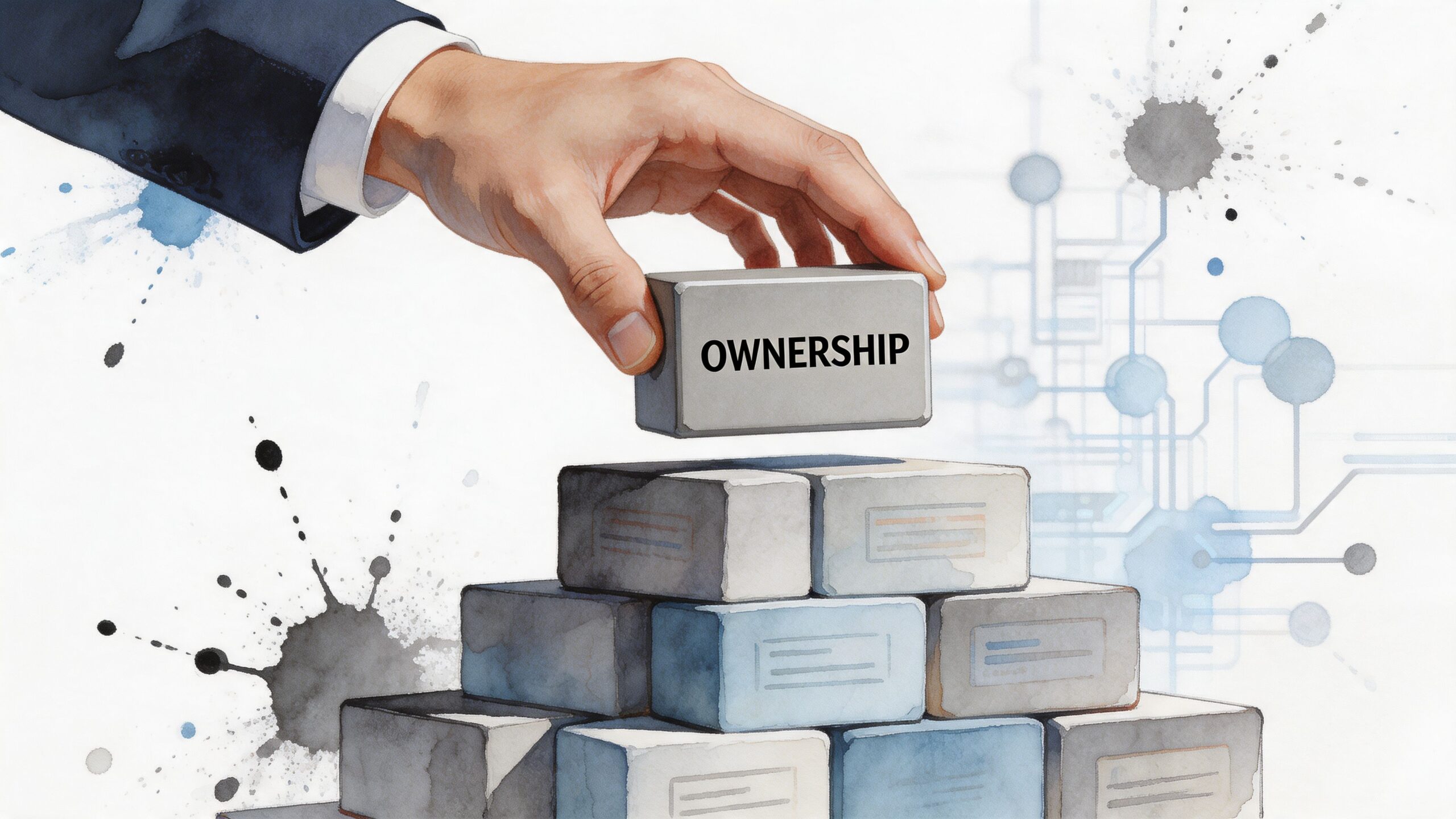
That problem is easy to hide when the business is smaller. People fill gaps informally. They know who to call. They remember why a tool was bought. As the company grows, those unwritten rules stop working.
79% of small businesses rely on digital tools to avoid falling behind, yet the bigger issue is often the execution gap created by fuzzy ownership. Fractional CTO leadership helps close that gap by adding executive-level clarity without the cost of a full-time hire, as discussed in this small business technology survey.
What implied ownership costs you
Here’s what I see when ownership hasn't been made explicit:
- Decisions get revisited: Teams treat past decisions as suggestions because nobody knows who had final authority.
- Handoffs leak: A project moves from ops to IT to vendor to finance, and each group assumes someone else is carrying the next step.
- Burnout concentrates: The most responsible person gets overloaded because the org chart doesn't match the actual work.
- Risk hides in plain sight: Access reviews, backup checks, renewal decisions, and policy exceptions all happen inconsistently.
A simple way to map decision rights
You don't need a complicated governance framework. You need a short list of critical decisions and a clear answer to four questions:
- Who decides
- Who advises
- Who executes
- Who signs off when risk crosses a business threshold
Write this down for your core systems, major vendors, security issues, and active roadmap items. If you can't fill the list quickly, that's your diagnosis.
A lot of leaders also benefit from reviewing what a CTO should own in practice. A plain-English guide to CTO responsibilities and duties helps separate executive technology leadership from day-to-day support work.
Where fractional leadership fits
This is often the point where a company isn't ready for a full-time CTO, but it is absolutely ready for stronger technology leadership. One option is CTO Input, which provides fractional and interim CTO, CIO, and CISO leadership for companies that need clearer ownership, cleaner decision-making, and a more reliable operating rhythm.
That kind of support matters when the business needs leadership structure more than another software subscription.
Governance isn't a committee problem. It's an ownership problem.
Build Board-Defensible Resilience and Security
Security becomes a board issue the moment the business needs to prove it can operate without nasty surprises.
That proof isn't a pile of policies. It isn't a vendor slide. It isn't a reassuring sentence from someone technical. Board-defensible resilience means leadership can show that critical controls exist, are assigned, are reviewed, and are tied to real operating risk.

For growing companies, this matters well before a breach. It affects diligence. It affects customer confidence. It affects whether insurers, enterprise buyers, or board members believe the business is being run with discipline.
What board-defensible actually looks like
Cybersecurity is the top technology priority for growing mid-sized businesses, with 48% of IT leaders calling it critical. Mature implementations benchmarked against NIST standards can reduce cyber insurance premiums by 20% to 30% by proving verifiable controls, according to TierPoint's modernization research on security priorities.
The practical lesson is simple. Security has to move from vague reassurance to visible evidence.
A board should be able to get crisp answers to questions like:
- What are our top unresolved security risks
- Who owns each one
- What controls are tested versus assumed
- What happens if a key vendor fails or a core system goes down
- When did we last rehearse incident response in a way leadership could understand
Security that supports growth
A lot of companies make two mistakes here.
First, they treat security like a technical silo. That guarantees weak adoption because the rest of the business sees it as someone else's concern.
Second, they overproduce compliance artifacts while underinvesting in operating controls. That looks busy. It doesn't hold up under pressure.
What you want instead is a short, inspectable resilience model:
- Critical assets are identified
- Owners are named
- Access and data exposure are reviewable
- Incidents have a tested response path
- Leadership gets regular risk reporting in business terms
Strong security should make the company easier to trust, insure, and buy from.
That's why resilience belongs near the top of the list when setting technology priorities for growing companies. Not because fear sells, but because trust does.
Simplify Architecture and Control Vendor Sprawl
Most technology estates don't become chaotic because leaders make one terrible decision. They become chaotic because nobody removes anything.
A new CRM gets added because the old one is frustrating. A new reporting tool appears because finance can't get what it needs. A niche platform gets approved for one team because the implementation looked fast. Each decision feels reasonable on its own. Together they create drag.

That drag is architectural, financial, and managerial. More tools mean more integrations, more credentials, more renewals, more training, more failure points, and more chances for vendors to shape your roadmap by default.
The business case for simplification
The case for simplification is stronger than most leaders realize. Broad data access and management is a top priority, but data silos in unconnected systems inflate processing costs by 40% and slow insights by 2-3x. Cloud-native companies also show 60% lower IT costs and 2.5x faster feature deployment in the digital transformation statistics collected by Mooncamp.
Those numbers point to a practical truth. Growing companies don't just need more cloud. They need less fragmentation.
If your customer data, operational data, and financial data live in disconnected systems with different owners and conflicting definitions, the business pays for that every week. Teams reconcile instead of deciding. Leaders debate reports instead of acting on them. AI experiments stall because the foundation is messy.
What to cut first
Don't start simplification by asking which system is technically oldest. Start by asking which ones create the most coordination tax.
Look for:
- Duplicate systems: Two tools solving roughly the same problem for different teams.
- Weakly owned platforms: Software with no clear business owner, only an admin.
- Vendor lock-in by habit: Renewals that happen because nobody has time to challenge them.
- Messy data handoffs: Reports that depend on manual exports, spreadsheets, or side-channel fixes.
A practical way to pressure-test your stack is to review how vendors have started shaping business priorities. This article on how to stop vendors from driving your roadmap gives a useful lens for deciding what stays, what gets consolidated, and what should be retired.
The standard worth adopting
You want fewer systems doing more useful work, with cleaner data flow and clearer ownership.
That doesn't mean centralizing everything into one giant platform. It means making architecture a business discipline. Every major tool should earn its place. Every integration should have an owner. Every renewal should answer a hard question: does this make the company simpler, faster, safer, or just busier?
Your 30-90-180 Day Plan to Regain Control
You don't fix this with a workshop and a prettier roadmap. You fix it by making the current state legible, installing a rhythm, and then proving the first few changes hold.
First 30 days
Start by mapping reality.
Identify your critical systems, your key vendors, your highest-trust data, and the people who really own them today. Not who should own them. Who makes decisions, carries escalations, and gets blamed when something breaks.
Then name the top three execution bottlenecks and the top three trust risks. Keep it short. If the list runs long, leadership is still avoiding prioritization.
Next 90 days
Install a weekly operating cadence.
That cadence should review active decisions, blocked work, unresolved risks, and upcoming vendor or architecture choices. The point isn't more meetings. The point is a regular place where decisions become visible and ownership becomes undeniable.
Use this period to ship a few obvious wins:
- Retire one redundant tool
- Assign one accountable owner to each critical platform
- Create one leadership dashboard for delivery, risk, and spend
- Set one board-ready security reporting format
A good operating rhythm removes drama by replacing memory and escalation with routine.
First 180 days
Here, the business starts to feel different.
You can address larger structural issues. Consolidate data flows. Reduce high-friction vendor dependence. Formalize resilience practices. Clean up identity and access. Tie roadmap choices to business outcomes instead of departmental demand.
By this stage, leadership should be able to answer a few questions quickly. What matters most. Who owns it. What has changed. What is still at risk. That's what control looks like.
From Tech Chaos to Predictable Execution
The better version of this company is quieter.
Not slower. Not bureaucratic. Just quieter in the right way.
Projects move because owners are clear. Reporting gets calmer because definitions are shared. Security feels less theatrical because leadership can inspect real controls. Vendors stop steering the business because renewal, scope, and architecture decisions now live inside a disciplined operating process.
That also makes more advanced work possible. Once the basics are stable, leaders can evaluate things like AI-driven predictive modeling solutions with better judgment, because the data, ownership, and governance questions are finally being asked in the right order.
A healthy technology function doesn't rely on heroics. It creates predictable execution.
That's the main goal behind technology priorities for growing companies. Not trend chasing. Not endless transformation language. Just a business that can grow without turning every decision into a fire drill.
If technology is slowing growth, weakening visibility, or making risk harder to explain, CTO Input can help you make the current reality legible, identify the top bottlenecks and trust risks, and define the first practical steps to restore control.